
What appears to be a clear breach may be difficult to substantiate without a reliable record. For those searching “investigating franchise agreement violations long island,” the central concern is how to document suspected conduct while preserving evidence and avoiding steps that could complicate a dispute. Contract language, business records, communications, and observed activity may all matter, but investigative findings are not legal conclusions.
It’s understandable to be unsure which records to preserve, what conduct to document, or how to respond if information could be changed or lost. A disciplined fact-finding process can help establish a timeline and provide objective material for counsel to assess alongside the franchise agreement.
This guide explains how to identify relevant evidence, document events, and consider investigative methods such as corporate investigations, surveillance, or computer forensics when circumstances justify them. It also covers what to consider when selecting an investigative firm for a Long Island matter.
Key Takeaways
- Separate suspected contract violations from established facts, and identify the specific conduct that warrants further inquiry.
- Build a clear timeline by preserving relevant records and documenting the source and context of each item.
- When investigating franchise agreement violations Long Island, compare allegations with contemporaneous records, witness accounts, and independently corroborated information.
- Assess evidence for completeness, provenance, context, and plausible alternative explanations before drawing conclusions.
- Use an initial investigator discussion to clarify scope, methods, reporting, confidentiality, and licensing. Investigative findings are not legal advice.
When to Investigate Suspected Franchise Agreement Violations on Long Island
A suspected franchise agreement violation is conduct that may conflict with an agreement but has not yet been established as a breach. An investigation is a factual inquiry that can help clarify what happened, when it happened, and which records or observations support the concern. It does not decide the parties’ legal rights. A Franchise agreement sets out the terms of the relationship, but assessing whether particular conduct violates those terms requires careful interpretation of the agreement and its context.
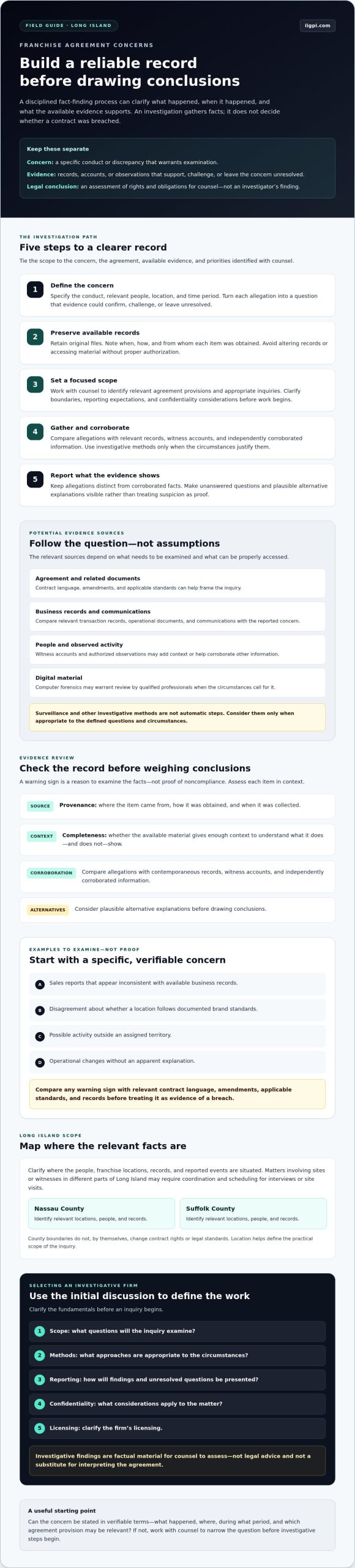
Consider fact-finding when a concern is specific enough to examine, rather than based only on a general impression. Examples might include sales reports that appear inconsistent with available business records, disagreement over whether a location follows documented brand standards, possible activity outside an assigned territory, or operational changes without an apparent explanation. None of these automatically establishes noncompliance. Compare a warning sign with the relevant contract language, amendments, applicable standards, and records before treating it as evidence of a breach. For investigating franchise agreement violations long island, the objective is to establish facts for counsel to evaluate, not to substitute an investigator’s view for legal analysis.
Which franchise concerns may warrant fact-finding?
Start by identifying the obligation that may be at issue and the conduct that raised concern. Inconsistent sales reporting, disputed interpretations of brand requirements, and possible unauthorized territory activity are examples of issues to examine, not proof of wrongdoing. Ask counsel to identify relevant provisions and explain which records or observations could help assess the concern. This keeps the inquiry focused and reduces the risk of treating an assumption as fact.
Why Nassau and Suffolk County context matters
Location can shape the practical scope of an inquiry, even though county boundaries do not, by themselves, change contract rights or legal standards. Clarify where the relevant people, franchise locations, records, and reported events are situated. If a matter involves sites or witnesses in different parts of Long Island, interviews or site visits may require coordination and scheduling. Defining locations early helps determine what can be examined and where additional information may need to be sought.
A useful threshold question is whether the concern can be described in verifiable terms: what happened, where, during what period, and which agreement provision may be relevant. If the concern remains broad, counsel can help narrow it before investigative steps begin. Once the issue is defined, a properly scoped inquiry can distinguish documented events from disputed accounts and unanswered questions.
How a Long Island Franchise Agreement Investigation Builds a Reliable Record
A reliable investigation follows a defined sequence, with its scope tied to the agreement, available evidence, and priorities identified with counsel. The New York Attorney General provides information about New York franchise regulation. That regulatory context is distinct from determining what a particular contract requires or whether a party complied. Throughout the inquiry, label client-provided allegations as allegations and keep them separate from facts corroborated through records, interviews, or observations.
- Define the concerns. Identify the conduct, relevant parties, locations, and time period. Turn each allegation into a question that evidence could confirm, challenge, or leave unresolved.
- Preserve available records. Retain original files and note when, how, and from whom each item was obtained. Avoid altering records or accessing material without proper authorization.
- Set the scope. Work with counsel to identify relevant agreement provisions and determine which inquiries are appropriate. Establish boundaries, reporting expectations, and confidentiality considerations before work begins.
- Gather and corroborate evidence. Depending on the questions, sources may include communications, transaction records, operational documents, interviews, and authorized observations. Digital material that requires forensic analysis may warrant review by qualified professionals.
- Report findings. Distinguish the methods used, sources reviewed, corroborated facts, conflicting accounts, and unresolved issues. Do not present investigative findings as a legal determination.
A timeline supported by multiple independent sources is generally more informative than an isolated allegation or record. For example, evaluate a disputed report alongside related transaction records and dated communications. Note gaps or discrepancies rather than assuming what they mean.
Set an investigation scope around the agreement
Before inquiries begin, identify the clauses, parties, dates, locations, and disputed conduct that frame the matter. Counsel can help clarify which obligations are relevant. The investigator can then translate each concern into factual questions and identify reasonable ways to examine them. A written scope helps prevent unrelated inquiries and sets expectations for collecting and reporting information.
Preserve and corroborate business records
Keep source records in their original form where possible, and record their provenance, including when they were received and who or what system supplied them. Compare communications, transaction records, and operational documents rather than relying on one account alone. If the evidence involves digital data that requires technical examination, consider whether computer forensics fits the defined scope.
For investigating franchise agreement violations long island, the appropriate method depends on the facts, not on a predetermined package. A confidential scope discussion with a firm offering corporate investigation services can help assess whether an inquiry fits the questions counsel has identified.
How to Evaluate Evidence Without Mistaking Suspicion for Proof
Evidence is most useful when assessed in relation to a specific question, not treated as proof simply because it appears to support an allegation. Compare what a person reports with contemporaneous records, other accounts, and independently corroborated findings. Consider whether each item is complete, where it came from, when it was created, and whether another explanation could account for it. In investigating franchise agreement violations long island, these distinctions help keep factual observations separate from conclusions about contractual meaning.
| Evidence type | What it may help establish | What it cannot establish on its own |
|---|---|---|
| Allegations or witness accounts | What a person recalls, observed, or believes occurred. | That the account is complete, accurate, or independently verified. |
| Contracts, amendments, and business records | Recorded terms, transactions, reporting, or operational activity. | How a disputed provision should be legally interpreted or whether conduct breached it. |
| Correspondence and digital material | Communications, dates, and information retained in a particular source. | Full context, authenticity, or completeness without appropriate examination. |
| Corroborated observations | Whether specific conduct was observed and documented under defined conditions. | That the conduct violated the agreement or resolves every disputed fact. |
What records and observations can establish
The agreement and its amendments provide a reference point for focused questions. Reports, correspondence, and business records may help show what was recorded or communicated. Their evidentiary weight depends on context and provenance, including whether a file is complete and how it was obtained. Consider surveillance only when it is lawful, relevant, and justified by the facts. Computer forensics may help assess digital material when properly authorized and technically appropriate.
Limits matter. A report should identify what was reviewed, what was independently corroborated, what remains disputed, and what could not be determined. The Federal Trade Commission’s franchise guidance on reporting concerns may help readers understand options beyond a private inquiry, but it does not replace advice about a specific dispute.
What an investigative report cannot decide
An investigative report is not a court ruling or a definitive determination that a contract was breached. An investigator also cannot promise that collected material will be admissible, decisive, or sufficient to resolve a dispute. The report presents findings and limitations; counsel assesses their legal significance. Seek prompt attorney review of questions about rights, remedies, and deadlines, especially before acting on the evidence.
How to Prepare and Choose an Investigator for a Long Island Franchise Matter
Selecting an investigator begins with defining the assignment, not choosing a method in advance. For investigating franchise agreement violations long island, look for a firm that can explain how its proposed fact-finding relates to the concerns and records you identify. The firm should distinguish investigative work from legal advice and conclusions.
Questions to ask before authorizing an investigation
Use an initial consultation to assess fit and set expectations. Ask whether the investigator has relevant corporate investigation experience, and whether the firm has experience with franchise matters rather than assuming that from general business investigations. Confirm current licensing and the firm’s capacity to handle the assignment. Discuss these points before authorizing work:
- Which investigative methods could address the specific concerns, and what facts would justify each method?
- How will findings, sources, uncertainties, and limitations be documented and reported?
- Who will receive updates, and how will changes to the assignment scope be proposed and approved?
- How will confidentiality be handled, and should counsel coordinate instructions or review proposed investigative steps?
- How will interviews, site visits, or other activity be arranged across Nassau or Suffolk County, and how will any out-of-area activity be managed?
Clear answers help you judge whether the plan is proportionate to the questions and whether the reporting process will be useful to counsel. General experience may be relevant, but it does not establish specialized franchise expertise or guarantee a particular finding.
Information to organize before the consultation
Prepare the agreement and amendments, a concise timeline, the names or roles of key contacts, and a factual summary of the concerns. Identify which records have already been preserved, where they came from, and whether access or confidentiality restrictions may apply. This gives the investigator a basis for discussing a focused scope without treating assumptions as established facts.
Preserve potentially relevant material in its current form. Don’t alter or delete records, or distribute them informally to people who may not need access. If you’re unsure how to handle particular files or communications, ask counsel before taking action. The investigator can then discuss what may be relevant and whether specialized methods, such as computer forensics or surveillance, are justified by the facts.
Once you’ve considered experience, licensing, methods, reporting, confidentiality, and Long Island logistics, a confidential scope discussion can help determine whether the proposed assignment fits. Discuss a corporate investigation to assess the scope and next steps.
What to Expect When International Investigative Group Assesses a Franchise Matter
An initial scope discussion helps determine whether investigative work fits the questions at hand. It is not a promise that evidence will establish a violation, resolve a dispute, or produce a particular outcome. For those considering investigating franchise agreement violations long island, begin with the documented concern, the information already available, and the factual questions that remain open.
Matching investigative methods to the documented concern
Corporate investigations may help clarify disputed business activity by examining relevant records and other available information within an agreed scope. The method should follow the evidence, not precede it. Consider surveillance only when relevant, proportionate, and legally appropriate. Computer forensics may be pertinent when digital evidence matters and access is properly authorized. Neither method should be a default response to a contractual disagreement.
When the issue concerns what an agreement requires or how a provision applies, counsel should guide the legal analysis. An investigator can focus on factual questions, such as whether a documented activity occurred or whether available records support a reported timeline, without reaching conclusions about legal rights or breach. Coordination with counsel can also help align investigative priorities with the client’s broader legal strategy.
From initial discussion to findings
International Investigative Group can use an initial, confidential scope discussion to consider objectives, available information, proposed methods, and reporting expectations. The discussion can also address practical questions, including whether relevant people, records, or locations are on Long Island and whether the firm’s current licensing, coverage, and capacity fit the work. The firm has more than 30 years of experience, according to its business information.
If an inquiry is appropriate, clarify its boundaries, who will receive updates, how findings and limitations will be documented, and how proposed scope changes will be handled. Findings may corroborate some facts, leave other questions unresolved, or reveal limitations in the available material. No investigative process can guarantee admissibility, a definitive breach determination, or a favorable resolution.
Before acting on investigative findings, consult counsel about their legal significance and any appropriate next steps. To discuss whether corporate investigations, surveillance, or computer forensics may fit the documented concern, contact International Investigative Group for a confidential scope discussion.
Move Forward With a Clear, Evidence-Led Plan
Suspected noncompliance is a reason to ask focused questions, not a basis for assuming that a contract has been breached. As you consider investigating franchise agreement violations long island, tie the inquiry to relevant agreement terms, preserve available records, and distinguish allegations from independently supported facts. A clear timeline and objective findings can give counsel a stronger foundation for assessing legal significance and next steps.
The investigative approach should fit the evidence. Corporate investigations may help examine disputed business activity; consider surveillance or computer forensics only when relevant and justified. International Investigative Group offers corporate investigations, surveillance, and computer forensic services, and has more than 30 years of experience.
For a confidential discussion about whether an investigation may fit your concerns, discuss a confidential corporate investigation. A defined scope, careful documentation, and counsel’s guidance can help you approach the matter with greater clarity.
Frequently Asked Questions
What evidence can help investigate a franchise agreement violation?
Useful evidence may include the franchise agreement and amendments, sales or operational reports, transaction records, correspondence, and accounts from people with direct knowledge. Preserve original files where possible, and record when and how each item was obtained. Compare sources against the specific concern, considering completeness, timing, and context. A single document or allegation may raise a question, but corroboration and alternative explanations affect how much weight it can reasonably carry.
Can a private investigator determine whether a franchise agreement was breached?
No. A private investigator can gather and report facts, identify supporting or conflicting information, and describe limitations in the inquiry, but cannot make a binding legal determination that an agreement was breached. That assessment depends on the contract and its legal interpretation. Counsel can evaluate investigative findings alongside the agreement and advise on rights, remedies, and next steps. Neither an investigative report nor an investigator’s opinion guarantees a particular legal outcome.
How do I investigate a franchise dispute on Long Island?
Begin by describing the disputed conduct, relevant time period, parties, locations, and agreement terms that may apply. Consult counsel to identify the provisions and legal questions, then preserve relevant records and consider whether a focused factual inquiry is appropriate. For investigating franchise agreement violations long island, clarify where people, sites, records, and events are located. Nassau or Suffolk County logistics may affect interviews and site visits, but do not change contract rights.
Is surveillance appropriate in a franchise agreement investigation?
Surveillance may be appropriate only if it is relevant to a defined factual question, proportionate to the concern, and legally appropriate. It is not a default method for resolving a contract disagreement, and an observation alone may not establish what an agreement requires or whether it was breached. Discuss the proposed purpose and limits with the investigator, and consult counsel when the method may affect legal strategy, privacy concerns, or evidence handling.
What should I ask before hiring a franchise investigator?
Ask about relevant corporate investigation experience, current licensing, proposed methods, and the firm’s ability to handle the locations involved. Clarify how sources, findings, and limitations will be documented; who receives updates; how confidentiality is addressed; and how scope changes require approval. Ask what facts would justify each method rather than accepting a predetermined approach. If franchise-specific experience matters, verify it directly instead of assuming it from general business investigation work.
Should I contact a lawyer or an investigator first?
If you need to understand contract language, legal rights, possible remedies, or deadlines, contact a lawyer first. Counsel can help identify the obligations and questions a factual inquiry may address, and may coordinate investigative instructions. An investigator can help assess whether fact-finding fits the concern, but does not provide legal advice. If you already have counsel, ask whether they should review the proposed scope before records are shared or investigative steps begin.
Can digital records be examined during a franchise investigation?
Yes, digital records may be examined when they relate to the defined questions and access is properly authorized. Computer forensics may help assess relevant files or other digital material, but the appropriate process depends on the source, scope, and circumstances. Preserve original material and avoid altering, deleting, or informally distributing potentially relevant records. Discuss access permissions and any restrictions with counsel and the investigator before examination begins.