
When investigating child custody violations nyc, start with the current custody order, not a confrontation. Review its specific schedule, exchange terms, communication provisions, and decision-making requirements. A missed exchange or interrupted call may be concerning, but whether it conflicts with the order depends on its wording and the circumstances.
It’s understandable to worry that informal notes won’t matter, that raising concerns could intensify conflict, or that a child’s reluctance to communicate signals parental alienation. Neutral, timely documentation can help separate observable events from interpretations without placing the child in the middle. This article explains how to organize a factual timeline, preserve messages and other available information lawfully, and distinguish recurring interference from ordinary co-parenting disputes. It also explains when to speak with a family-law attorney and how child custody investigative support can help with structured fact-gathering. The goal is practical preparation: information that can help you and your attorney assess next steps while keeping the child’s welfare at the center.
Key Takeaways
- Compare the specific event with the current written custody or visitation order before calling it a violation.
- For investigating child custody violations nyc, make timely notes that identify dates, times, locations, participants, and directly observed facts.
- Preserve complete communications and firsthand observations, and note which concern each record may help clarify.
- Prepare a concise chronology, relevant order provisions, and questions for a New York family-law attorney before taking further steps.
- A child custody investigation can support structured fact-finding, but it cannot interpret the order as legal counsel or determine custody.
What Counts as an NYC Child Custody Violation, and What May Be Parental Alienation?
Assess a suspected custody violation against the current written order, not only against what a parent expected or considers fair. In investigating child custody violations nyc, the central question is whether a specific, observable event appears inconsistent with a particular order provision. The New York Family Court has jurisdiction over custody and visitation matters, but whether conduct violates an order depends on its actual terms and the circumstances of the case.
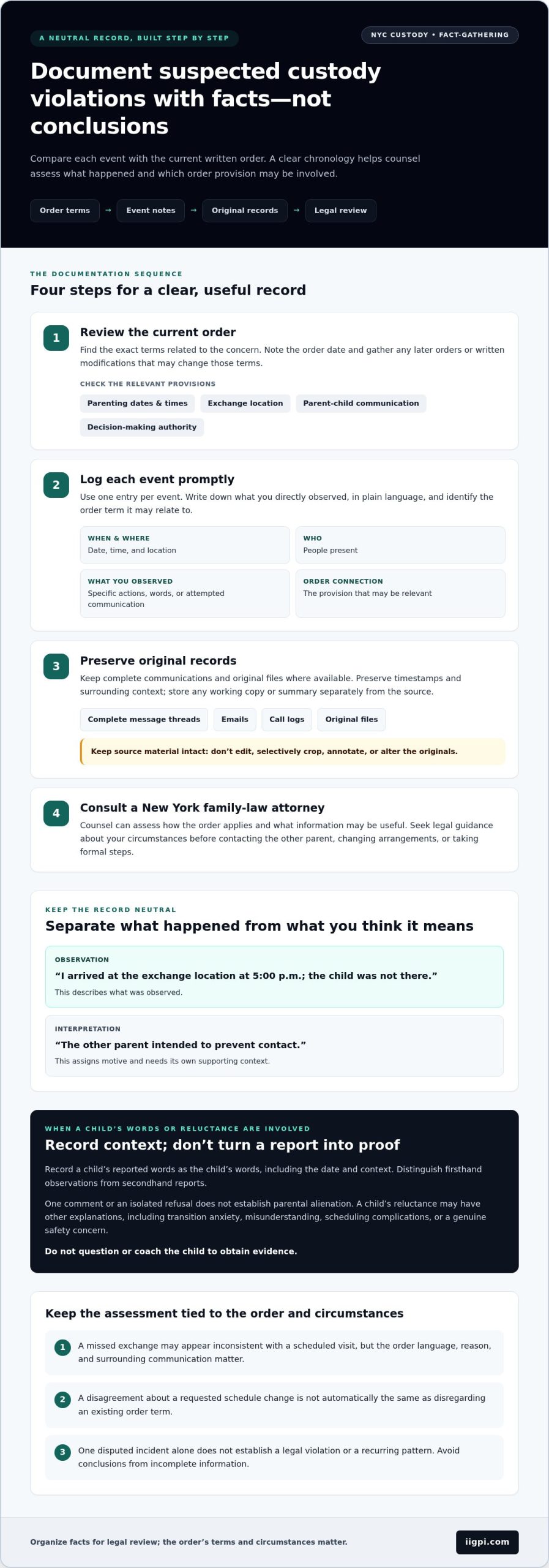
Separate what happened from what you think it means. “The exchange scheduled for 5:00 p.m. did not occur” describes an observation. “The other parent intended to prevent contact” assigns a motive. That interpretation needs its own supporting context. Keeping observations and interpretations distinct gives an attorney or court a clearer account to assess.
How to read the order before labeling an incident
Find the exact provisions for parenting dates and times, exchange locations, parent-child communication, and decision-making authority. Note the order’s date and gather any later order or written modification that may change those terms. If the order is unclear, or the parents have followed an informal arrangement that differs from it, don’t describe the informal arrangement as a court-ordered requirement without legal review.
Missed exchanges, disputes, and safety concerns
A missed exchange may appear inconsistent with a scheduled visit, but the order language, reason, and surrounding communication all matter. A disagreement about a requested schedule change is not automatically the same as disregarding an existing term. Safety concerns also call for precise documentation. Distinguish a reported risk, a parent’s response, and anything you directly observed instead of drawing conclusions from incomplete information. One disputed incident alone does not establish a legal violation or a recurring pattern.
For example, record whether a parent arrived at the specified place and time, whether the child was made available, and what each person actually said or did. Don’t turn one late pickup, changed plan, or tense exchange into a broader claim unless additional facts support it.
What parental alienation allegations can, and cannot, show
Parental alienation is an allegation about conduct that may undermine a child’s relationship with a parent. One comment or an isolated refusal to attend a visit does not establish it. Record a child’s reported words as the child’s words, along with the date and context, rather than treating them as proof of who influenced the child. Separate firsthand observations of adult conduct from secondhand reports, and don’t question or coach the child to obtain evidence.
A child’s reluctance or a parent’s actions can have other explanations, including anxiety about a transition, a misunderstanding, scheduling complications, or a genuine safety concern. These possibilities don’t resolve the dispute, but they show why it’s important not to assume motive. A neutral account of events gives counsel a sounder basis to decide whether further documentation or investigative support is appropriate.
How to Document Suspected Custody Violations in New York City
Useful documentation is an organized record, not a collection of accusations. It lets counsel compare specific events with the written custody arrangement. A clear chronology connects each concern to a date and the order provision it may involve. For parents investigating child custody violations nyc, consistent notes with enough context are more useful than dramatic descriptions or conclusions about motive.
Use this sequence to build a clear record:
- Review the order. Identify the terms relevant to the concern, such as scheduled parenting time, exchange arrangements, or communication provisions. Note the order date and gather any later orders or written modifications that may apply.
- Log each event promptly. Record the date, time, location, people present, what you observed, and the order term involved. Include specifics, such as an arrival time or attempted call, rather than a conclusion like “the other parent sabotaged the visit.”
- Preserve original records. Save complete message threads, emails, call logs, and original files where available. Keep timestamps and surrounding context. Don’t edit, selectively crop, annotate, or alter the originals. If you make a working copy or summary, keep the source material separately.
- Consult counsel. A New York family-law attorney can assess how the order applies and what information may be useful. Before contacting the other parent, changing arrangements, or taking formal steps, seek legal guidance about your circumstances.
Build a neutral incident timeline
Use one entry per event and distinguish firsthand observations from information someone else reported. For example, write, “I arrived at the exchange location at 5:00 p.m.; the child was not there,” rather than assigning intent. If the child describes an event, identify it as a reported statement and note when and how it came up. Record attempted communication and responses in plain, non-accusatory language.
Preserve records and potential witness information
Keep complete communications and original files, not just selected screenshots that may omit context. Make a separate list of potential witnesses, what each person directly observed, and how they were present. Don’t coach them or suggest what to say. Avoid secretly recording conversations or accessing another person’s accounts. Ask an attorney before considering recording or accessing information in a way that could raise legal or privacy concerns.
Keep the record focused on events and the child’s welfare, not on pressuring the child or provoking conflict. The New York City Bar Association’s overview of the child’s best interests explains why custody concerns should be presented carefully and with attention to the child’s needs. If you and your attorney identify a need for structured fact-gathering, a child custody investigation can provide investigative support alongside legal counsel, not in its place.
Which Evidence May Help Assess a Custody Violation or Alienation Concern?
Evidence is most useful when it answers a defined question: which order term may be involved, what occurred, and what reliable information supports that account? In investigating child custody violations nyc, the existence of a record doesn’t establish that it is admissible, complete, or persuasive. An attorney can assess its potential legal use, and the court determines its significance.
Documentation can support an account, but a court determines what that account means. A message may show that a schedule change was requested, for example, but not why it was requested or whether the order was violated. Assess each item in light of its source, context, limitations, and connection to the specific concern.
Match each record to an allegation
A simple evidence matrix can show what is documented and what remains uncertain. Keep relevant information that complicates or differs from your account, rather than selecting only material that seems favorable.
- Order provision: Identify the exact term at issue, such as a scheduled exchange.
- Incident date: State when the event occurred and describe it neutrally.
- Available record: Note the log entry, complete message thread, or firsthand witness observation.
- Unresolved question: Identify what the item cannot establish, such as why an exchange did not happen.
The order establishes the written terms, not whether a particular event occurred. Contemporaneous logs organize a parent’s account, but remain that person’s record. Messages may show what was communicated, but not necessarily intent. A firsthand witness can describe what they saw or heard, though their perspective and opportunity to observe matter. Don’t claim that any one source proves more than it actually shows.
Assess surveillance and digital material cautiously
Surveillance should be lawful, proportionate to the concern, and relevant to a clearly defined investigative question. It should not provoke an interaction or intrude on private spaces. Don’t use tracking devices, trespass, impersonate another person, or access accounts without authorization. These actions can create serious privacy and legal concerns and may undermine a careful assessment of the underlying issue.
Digital material also needs context. Preserve original files and complete exchanges where available, rather than relying only on cropped images or excerpts. Record how and when material was obtained, and don’t edit or annotate the original. A photo or video may show a moment without explaining what happened before or after it. A timestamp may help establish timing, but cannot answer every question about the event.
For a broader explanation of how professional observation differs from unlawful intrusion, consult this professional surveillance services guide. Investigative support can help gather relevant observations, but it doesn’t replace legal counsel or determine how a court will evaluate evidence. Present the material accurately, including uncertainty and information that may support another account.
NYC Parents: Preparing Evidence for Family Court
Before filing a petition, contacting the other parent about an allegation, or changing an existing arrangement, consult a New York family-law attorney promptly. The right next step depends on the order’s language, the history of the dispute, and any safety concerns. For parents investigating child custody violations nyc, an organized, concise presentation helps counsel identify what is documented, what remains uncertain, and what needs attention first.
Prepare a clear summary for counsel
Assemble a short chronology instead of a lengthy narrative. For each event, include the relevant order provision, date, neutral description, and available records. Separate urgent safety concerns from routine schedule or communication disputes so counsel can assess them distinctly. Bring complete versions of relevant records, and ask which materials may be appropriate to share or submit, how to preserve them, and whether further documentation is advisable.
A useful preparation file may include:
- The current order and any later orders or written modifications.
- A dated chronology linking each concern to a specific provision.
- Complete, relevant communications and records, organized by date.
- A short list of questions, including what to do next and what to avoid.
Keep the summary factual. “The scheduled exchange did not occur; I sent a message at 5:15 p.m. and received a reply at 6:02 p.m.” is more useful than a claim about the other parent’s motive. Identify sources clearly, and distinguish what you personally observed from what someone else reported.
Protect the child from the dispute
Keep the child out of evidence-gathering. Don’t repeatedly question or rehearse a child’s account to produce a preferred narrative, ask the child to carry messages, or involve them in collecting information. Likewise, don’t withhold parenting time or change arrangements based only on an allegation that hasn’t been reviewed with counsel. Those actions may intensify conflict and place additional emotional pressure on the child.
If there is immediate danger, use appropriate emergency or child-protection channels instead of relying on private investigation. An investigator from International Investigative Group can support fact-gathering, but can’t provide emergency protection, exercise law-enforcement authority, or replace legal counsel. You can learn more about professional investigative services by visiting International Investigative Group.
For court locations, forms, and current process information, consult the official New York City Family Court resources. Procedures and filing requirements may change, so verify current instructions directly with the New York State Unified Court System and discuss case-specific steps with your attorney before acting.
When counsel identifies a defined need for additional fact-gathering, explore child custody investigation support alongside legal advice and court processes, keeping the child’s welfare central.
How a NYC Child Custody Investigation Can Support Fact-Finding
When a specific concern remains unresolved after reviewing the order and available records, a child custody investigation can provide structured fact-gathering support. Start with a defined question tied to observable conduct, not a broad accusation about a parent’s character or intentions. For example, a parent and counsel might identify a recurring factual issue that needs clarification, then consider whether further lawful observation could be relevant.
International Investigative Group is a New York City firm that conducts child custody investigations. Its investigative role complements legal counsel: investigators can gather relevant observations and document information within the scope of an investigation, while an attorney assesses legal questions and the court determines custody matters. Investigators don’t interpret orders as attorneys, decide whether custody should change, or guarantee that information will affect a case outcome.
What a focused investigation can contribute
A clearly framed investigative question helps keep fact-finding relevant, proportionate, and centered on the child’s welfare. Neutral observations may clarify what occurred in a particular situation, but they don’t establish motive or replace the full context of a family dispute. Review gathered material with counsel, who can assess its relevance and appropriate use in light of the case and applicable procedures.
Before investigative work begins, the parent and attorney can identify the concern, the information already available, and what remains unknown. This helps avoid unnecessary intrusion or activity that could increase conflict. Investigation is not a way to pressure a child, provoke the other parent, or obtain a predetermined conclusion. Its value is factual clarity, not support for an unsupported interpretation.
When investigative support may complement legal guidance
Investigative support can help when a recurring factual question remains unclear after reviewing the order, communications, and other records. It should not delay urgent legal action or replace an attorney’s advice. Related personal and domestic investigation protocols provide additional context for why defined scope, discretion, and responsible fact-gathering matter in sensitive cases.
Parents investigating child custody violations nyc should discuss the proposed investigative question with counsel before proceeding, especially when the concern involves safety, privacy, or the child’s emotional well-being. A private investigator is not law enforcement, and investigative findings don’t determine what a court will accept or decide.
If you have a defined concern and want to discuss a child-centered investigative approach, contact International Investigative Group about child custody investigations. Keep the investigation focused on relevant facts and use it alongside, not instead of, legal counsel and court processes.
Choose a Child-Centered Next Step
Uncertainty can make every disagreement feel consequential, but a measured next step can keep the focus on what the child needs rather than escalating conflict. Before acting, consider what remains unclear, whether the concern is urgent, and which professional is best placed to address it. For investigating child custody violations nyc, fact-gathering is most useful when it addresses a defined question and complements legal guidance.
Proceed carefully. You don’t need to resolve every disputed detail at once, and the child shouldn’t be responsible for resolving the conflict. If you and your attorney determine that additional neutral information may help clarify a specific concern, discuss a focused, child-centered approach with a private investigator.
Discuss a child custody investigation with International Investigative Group. A thoughtful plan can support informed decisions while keeping the child’s well-being at the center of the process.
Frequently Asked Questions
Can a private investigator help document child custody violations in NYC?
Yes. A private investigator can gather relevant information through lawful investigative work, but can’t determine whether a custody order was violated or predict how a court will treat findings. For investigating child custody violations nyc, the parent and attorney can identify a specific factual question for an investigation to address. Counsel can then assess whether the resulting information is relevant and how to handle it. No investigation guarantees a particular legal outcome.
Does a missed custody visit automatically count as a violation in New York?
No. A missed visit doesn’t automatically establish a violation. The order’s wording, the circumstances, and any later agreement or court direction may affect how the event is assessed. For example, record whether a proposed schedule change was communicated and how each parent responded, without assuming the change amended the order. An attorney can review the order and context before you characterize the event or take further action.
Can text messages be used as evidence in a New York custody case?
They may be relevant, but a message’s existence doesn’t establish what a court will accept or conclude. A text can show that a parent proposed a change, for example, but may not show the full conversation or explain why the proposal was made. Preserve the original thread and avoid deleting messages that provide context. Ask your attorney how to authenticate and present communications under the rules that apply to your case.
Can I record the other parent during a custody exchange in NYC?
Don’t assume recording is lawful or helpful in your particular situation. Recording rules and privacy considerations can depend on the circumstances, including who is speaking and whether other people are captured. Before recording an exchange or conversation, ask a New York attorney about the specific facts. Don’t record to provoke a reaction or draw the child into the dispute. An attorney can suggest a safer way to document the concern.
What should I do if my child refuses a scheduled visit?
Respond calmly, and don’t treat the refusal as proof of a particular cause. A child may be tired, distressed about a transition, or reacting to circumstances you haven’t yet understood. Attend to the child’s immediate well-being, avoid repeated or leading questions, and communicate necessary logistics neutrally. If refusals recur or raise safety concerns, consult a family-law attorney about the order and an appropriate response.
Is parental alienation the same as violating a custody order?
No. A custody-order violation concerns whether a specific requirement was followed; an alienation allegation concerns broader conduct affecting a parent-child relationship. The two may overlap, but neither automatically establishes the other. If a concern arises from several interactions, note the events that support it and any relevant circumstances that complicate the picture. Don’t use a diagnostic label instead of describing conduct. Ask counsel to assess the full context.