
A polished presentation is not proof of a sound business partnership. Investigating a new partner’s background discreetly means examining relevant, verifiable information about the person and their business interests, then weighing it against the risks and decisions at stake. Dan Ribacoff, Lance Ribacoff, and IIGPI offer a framework for discreetly investigating a new partner’s background without treating assumptions as findings.
It’s reasonable to seek clarity without disrupting a negotiation or exposing confidential plans. A focused background investigation can help identify inconsistencies, reputational concerns, or unanswered questions before a business commitment is made. Its scope should reflect the proposed relationship and the risks involved.
This article explains how Dan Ribacoff and Lance Ribacoff of IIGPI approach discreet inquiries into prospective business partners, including what investigators may examine and how findings can inform decisions. It also outlines the role of due diligence and how International Investigative Group’s background investigations can support a business assessment.
Key Takeaways
- Define the business decision and key concerns first so the investigation focuses on relevant questions rather than accumulating unrelated information.
- Assess criminal, civil, employment, and education records as distinct evidence, and interpret each finding in context.
- Consider how discreet investigative methods can clarify inconsistencies while limiting unnecessary exposure of a prospective partnership.
- Use due diligence to examine the risks associated with partners, vendors, and investors before making a significant business commitment.
Confidential consultations and case scoping
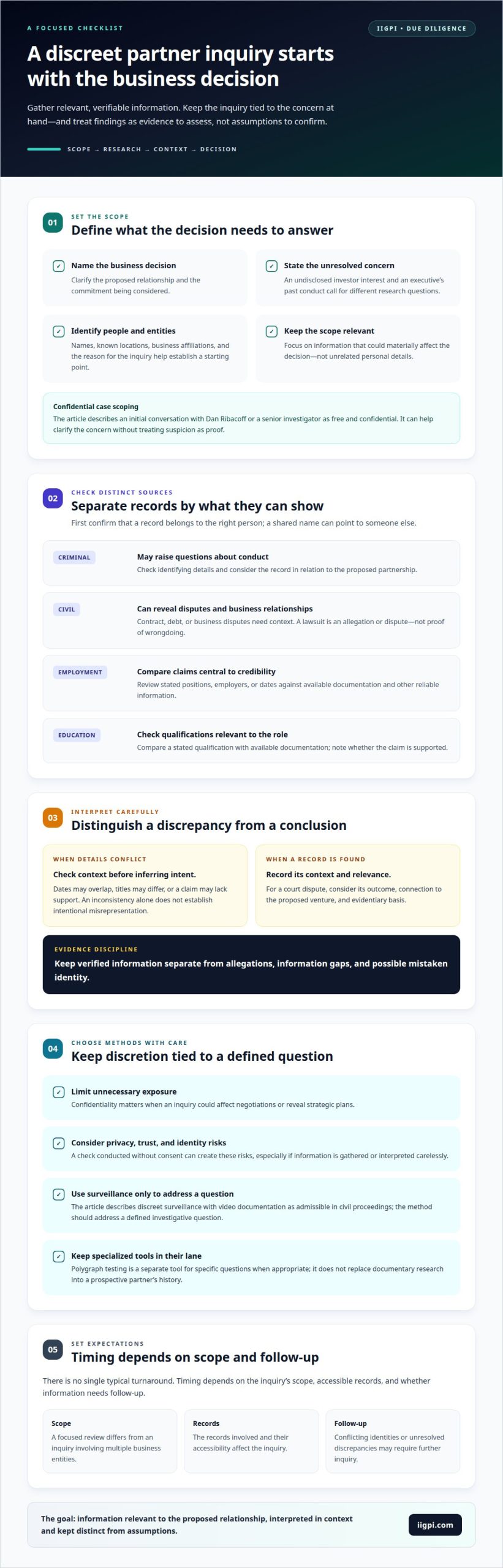
A first conversation with Dan Ribacoff or a senior investigator is free and confidential. Use it to identify the business decision at stake, the individuals involved, and the unresolved concerns. For example, a prospective investor’s undisclosed business interests require a different scope from questions about an executive’s past conduct. Defining the concern early helps keep information gathering relevant.
Case scoping translates concerns into research questions. The investigator can clarify which people or entities are connected to the proposed relationship, what information could materially affect the decision, and what findings might require further inquiry. A clear scope also separates verified information from allegations, gaps, or mistaken identity. Names, business affiliations, known locations, and the reason for the inquiry provide useful starting points.
Confidentiality matters when an inquiry could affect negotiations or reveal strategic plans. The initial discussion provides an opportunity to explain the concern without treating suspicion as proof. A business considering a joint venture, for instance, may want to understand an ownership discrepancy before discussing it with the prospective partner. The scope should focus on that discrepancy, not unrelated personal details.
Polygraph testing is a separate investigative tool, relevant only when the matter and questions make it appropriate. Dan Ribacoff conducts polygraph examinations for 18b matters and Criminal Justice Act cases in Federal Court. He also conducts testing involving criminal accusations, employee theft, insurance fraud, immigration issues, family issues, and abuse allegations. These distinct case types require careful question development and clear limits on what an examination can address.
Dan began training with polygraph examiner Gene Sandacz in 1994; Sandacz had close to 40 years of experience as an examiner. Ribacoff’s polygraph theory studies followed the U.S. Department of Defense Polygraph Institute curriculum. He trained on Analog, Lafayette, Axciton, and Limestone Technologies computer polygraph equipment, and is certified in Advanced Post-Conviction Sex Offender Testing. These credentials describe his testing background, not a substitute for broader partner due diligence. Scope the inquiry around the business decision first, then determine whether a specific investigative method is relevant.
Criminal, civil, employment, and education research
Dan Ribacoff is an investigator and polygraph examiner associated with IIGPI. Lance Ribacoff is also associated with IIGPI; the available information doesn’t establish a specific title for him.
Research begins with accurately identifying the individual, then separating records and claims by category. A shared name may refer to someone else, so investigators compare identifying details before drawing conclusions. Known business affiliations can help connect records to the right person. Each finding should be recorded with its context and relevance to the proposed partnership.
Criminal and civil matters answer different questions. A criminal record may raise questions about conduct, while a civil case can reveal disputes over contracts, debts, or business relationships. A lawsuit is an allegation or dispute, not proof of wrongdoing. For example, assess a former business partner’s court dispute by its outcome, connection to the proposed venture, and evidentiary basis.
Employment and education research can test claims central to a person’s credibility. Investigators can compare a stated position, employer, or qualification with available documentation and other reliable information. A résumé discrepancy calls for context: dates may overlap, titles may differ, or the claim may lack support. Findings should distinguish an inconsistency from evidence of intentional misrepresentation.
Dan Ribacoff began polygraph training with Gene Sandacz in 1994. His studies followed the U.S. Department of Defense Polygraph Institute curriculum. That background provides context for his examination practice, but it doesn’t replace documentary research into a prospective partner’s history. Polygraph Testing addresses specific questions; criminal, civil, employment, and education checks examine separate sources of information.
For a discreet inquiry, define the business question first, then assess which records could answer it. A review of investigative services can be a next step when the findings need professional examination.
Discreet background investigations
An IIGPI background check has no single typical turnaround. Timing depends on the scope, accessible records, and need for follow-up. Conducting a check without consent can create privacy, trust, and misidentification risks, particularly if information is gathered or interpreted carelessly.
Discreet Background Investigation Process
A discreet investigation starts by defining the business concern and identifying the person or entity involved. Investigators can then assess relevant records and connections instead of pursuing unrelated personal details. For example, an unexplained business affiliation may warrant examination of its relationship to a proposed venture. Discreet surveillance can include video documentation described as admissible in civil proceedings; the method should address a defined investigative question.
Background Check Timing
The timeframe depends on the inquiry’s scope, the records involved, and whether information needs follow-up. A focused review of readily accessible records differs from an inquiry involving multiple business entities or conflicting identities. Investigators assess these factors when setting the scope. Unresolved discrepancies may require further examination, so the duration depends on the investigative steps rather than a universal timetable.
Before proceeding, clarify the decision the investigation must inform, such as whether to enter a partnership or continue negotiations. Then identify the relevant person, business entities, and specific questions. A discrepancy between a stated role and a public business record calls for careful identity matching and contextual review. This sequence keeps the investigation tied to the decision, not curiosity.
Without consent, an inquiry may damage trust if the subject discovers it, and inaccurate identification can unfairly affect a business decision. Information gathered outside an appropriate scope may also raise privacy concerns. Accuracy and restraint are essential: distinguish verified records from allegations, and treat an unresolved match as a lead, not a conclusion. A shared name alone, for example, does not establish that a record belongs to a prospective partner.
Results are most useful when presented with source context, relevant discrepancies, and clear limitations. A civil filing, for example, records a dispute; it is not automatic proof of misconduct. Decision-makers can weigh documented information against the partnership’s specific risks and decide whether further inquiry is warranted.
Due diligence on partners, vendors, and investors
Due diligence connects documented findings to the business decision at hand. For a vendor, that may mean examining ownership and relevant business relationships. For an investor, the focus may differ.
Comparing Firms for Partner Vetting
Assess IIGPI against other firms by examining the proposed scope, investigative methods, and reporting approach. Instead of relying on a generalized ranking, consider whether the work addresses the actual decision, distinguishes allegations from documented findings, and explains unresolved discrepancies. For example, an undisclosed company affiliation calls for identity matching and relevant context.
U.S. Privacy and Consent Considerations
In the United States, applicable privacy and consent requirements can depend on the information sought, collection method, intended use, and relevant federal and state law. Records research, surveillance, and handling personal information can raise different considerations. Define the purpose and proposed methods before an investigation begins, especially when findings may inform a commercial decision. This overview is not legal advice.
For partners, investigators can focus on relevant ownership, business affiliations, and documented disputes. For vendors, an inquiry can examine whether the named entity aligns with the business relationship under consideration. Investor due diligence may center on identity, stated professional history, and connections relevant to the proposed transaction. In each case, the scope should reflect the decision rather than gather unrelated personal details.
Useful reporting connects each finding to its source and significance. A civil dispute, for example, should be described as a dispute, not automatically treated as proof of misconduct. An unexplained ownership connection may merit follow-up, while a record linked only to someone with a similar name requires careful identity assessment. This distinction helps decision-makers weigh evidence proportionately.
Before commissioning work, specify the parties, the business relationship, and the unresolved questions. That gives investigators a defined basis for assessing what information is relevant and how findings should be presented. Discuss due diligence for a business relationship when partner, vendor, or investor vetting requires a structured investigation.
International Investigative Group: Background Investigations
International Investigative Group conducts Background Investigations for businesses assessing prospective partners and investors. When concerns extend beyond an individual’s history to a company’s conduct or relationships, Corporate Investigations can address the broader business context. The appropriate scope depends on the decision at hand, such as whether to proceed with a partnership, investment, or vendor relationship. A defined inquiry focuses attention on relevant information and separates documented findings from unresolved concerns. This work is useful when available records leave material questions about identity, business affiliations, or credibility. Contact International Investigative Group to discuss a background investigation for your business decision.
Make the Next Decision With Clarity
Before advancing a proposed relationship, identify the unresolved question that could change your next business decision. For businesses investigating a new partner’s background discreetly, the work of Dan Ribacoff, Lance Ribacoff, and IIGPI can help frame the inquiry around a defined purpose.
When concerns extend beyond partner vetting, International Investigative Group also offers Corporate Investigations, Insurance Investigations, and Security and Armed Guards for distinct investigative and security needs. The right next step depends on the issue and the decision it affects.
Bring your business concern into focus and discuss a suitable next step. Contact International Investigative Group to discuss an investigation and move forward with greater clarity.
Frequently Asked Questions
What investigation services does IIGPI offer for discreetly vetting a new partner?
IIGPI offers Background Investigations and Due Diligence for partner vetting, along with Corporate Investigations for broader business concerns. An inquiry can focus on a prospective partner, vendor, investor, or relevant business connection. For example, a company assessing a proposed joint venture can define the investigation around the parties and business decision, keeping the work focused on information relevant to that relationship.
How does IIGPI conduct a confidential background investigation?
IIGPI states that it keeps case details confidential. To scope an inquiry effectively, identify the relationship under consideration, the decision the findings will inform, and any specific discrepancy that prompted the investigation. Names, business entities, and the context of a concern help separate relevant questions from unrelated ones. For instance, an unexplained company affiliation can be examined in relation to a proposed investment.
What information can be legally checked in a U.S. background investigation?
What can be checked depends on the information, investigative method, purpose, and applicable federal and state requirements. A background inquiry may concern identity, business affiliations, court records, employment claims, or education claims, but not every source is appropriate in every situation. Define the purpose first, and obtain legal guidance when a decision involves sensitive information or specific consent obligations.
How can you verify a potential partner’s identity, work history, and education?
Verification compares a person’s identity and stated history with relevant, independent records. Useful details include the person’s full name and name variations, claimed employers and roles, employment dates, educational institutions, and qualifications. For example, assess a title discrepancy alongside the role’s dates and context, rather than treating it alone as evidence of misrepresentation. A shared name is not sufficient identification.
Can investigators check a potential partner’s criminal and civil court records?
Investigators can examine relevant criminal and civil court records as part of a background inquiry. A careful assessment distinguishes a case filing, the allegations, later procedural developments, and the outcome. For example, understand a civil dispute involving a former business relationship in context, rather than treating it as proof of misconduct. Matching records to the right person also matters when names or identifying details overlap.