
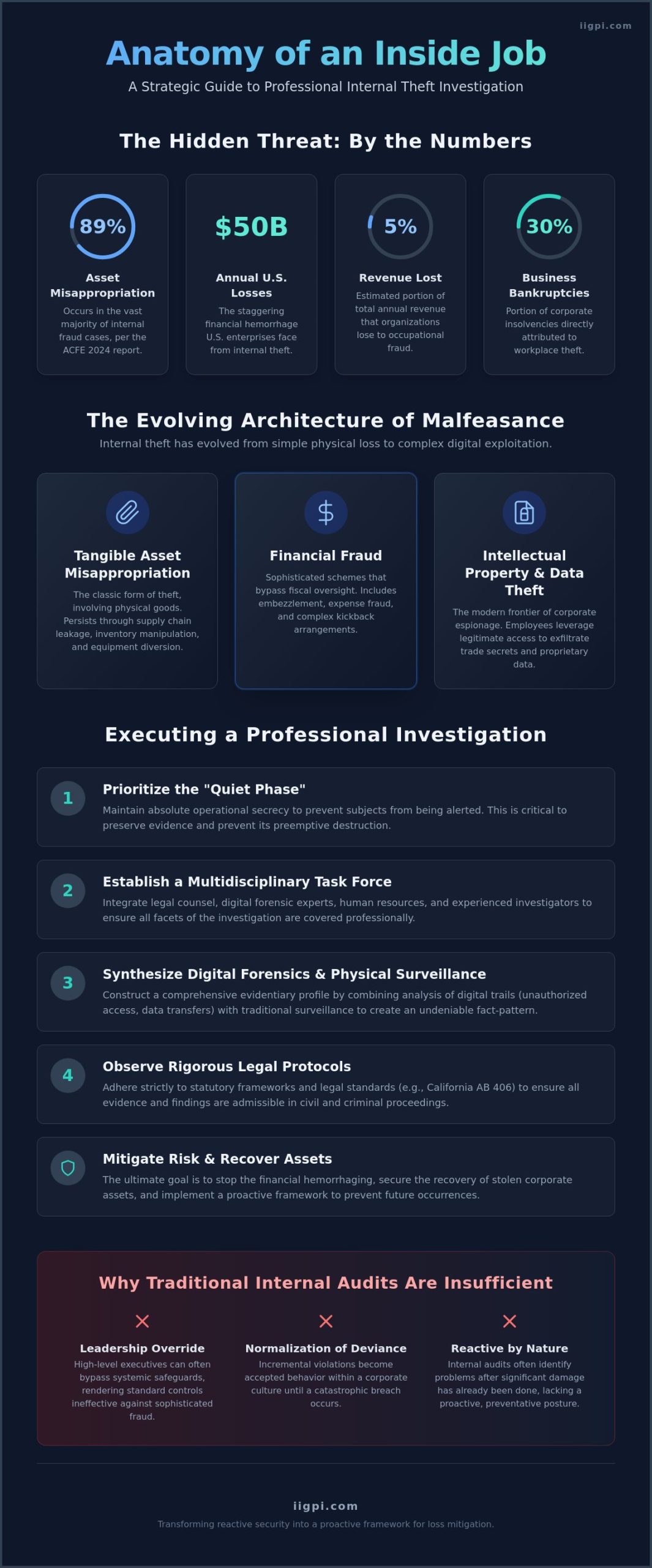
While external security threats often dominate the corporate discourse, empirical evidence from the ACFE 2024 report indicates that asset misappropriation occurs in 89% of cases, contributing to a staggering $50 billion in annual losses for U.S. enterprises. Much like a clandestine insurgency within a sovereign state, occupational fraud erodes an organization’s foundation from the inside, often remaining undetected until the financial hemorrhaging becomes critical. Organizations lose an estimated 5% of their total annual revenue to these internal actors, a reality that necessitates a sophisticated internal theft investigation to mitigate systemic risk. It’s likely you recognize that the most profound threats to your institution’s solvency and reputation originate from within the very structures designed to protect them.
This analysis offers an authoritative examination of the specialized methodologies, legal protocols, and strategic imperatives required to execute a professional internal theft investigation in the 2026 regulatory environment. We’ll explore the synthesis of digital forensics and traditional surveillance to ensure the securing of admissible evidence and the recovery of stolen assets. By understanding the intersection of California’s AB 406 and emerging forensic technologies, decision-makers can transform reactive security into a proactive framework for loss mitigation, bridging the gap between regional legal complexities and global operational standards through our 2026 Corporate Loss Mitigation Protocol.
Key Takeaways
- Comprehend the evolution of corporate malfeasance from rudimentary physical inventory loss to the sophisticated misappropriation of intellectual property and digital assets.
- Execute a professional internal theft investigation by prioritizing the “Quiet Phase” and establishing a multidisciplinary task force to maintain operational secrecy.
- Synthesize digital forensic analysis with physical surveillance to construct a comprehensive evidentiary profile that identifies hidden financial trails and unauthorized access.
- Observe rigorous legal protocols and statutory frameworks to ensure that all investigative findings remain admissible in civil and criminal judicial proceedings.
- Leverage a law enforcement-led framework with over 30 years of experience to mitigate financial hemorrhaging and secure the recovery of stolen corporate assets.
The Architecture of Internal Theft in Modern Corporations
Internal theft represents a multifaceted breach of fiduciary duty that transcends mere asset misappropriation; it’s a fundamental violation of the organizational compact and a significant threat to corporate longevity. Much like a clandestine insurgency within a sovereign state, occupational fraud erodes an organization’s foundation from the inside, often remaining undetected until the financial hemorrhaging becomes critical. The contemporary environment necessitates a rigorous internal theft investigation to address sophisticated intellectual property exfiltration and complex financial malfeasance that standard oversight mechanisms frequently overlook. Statistical data from 2026 confirms that nearly 30% of business bankruptcies are directly attributed to workplace theft, illustrating that these internal breaches are not isolated incidents but rather systemic drivers of corporate insolvency.
The psychological profile of the insider threat is characterized by a convergence of perceived pressure, opportunity, and rationalization, often manifesting in individuals who possess deep institutional knowledge. This insider status allows perpetrators to navigate security frameworks with precision, exploiting the very trust that the organization relies upon for operational efficiency. Consequently, organizations lose an estimated 5% of their total annual revenue to occupational fraud, a figure that underscores the failure of traditional internal controls to mitigate the financial damage caused by trusted actors.
Categorizing Modern Internal Theft
The Failure of Internal Auditing
Standard internal controls, although designed to ensure fiscal integrity, frequently fail to detect high-level executive fraud due to the inherent ability of leadership to override systemic safeguards. This failure is often exacerbated by a “normalization of deviance” within corporate cultures, where incremental violations of protocol become accepted standards of behavior until a catastrophic breach occurs. Effective Strategic Risk Mitigation: The International Investigative Group Framework requires an understanding that internal audits are often reactive and insufficient for uncovering deeply embedded schemes. To address these vulnerabilities, organizations must adopt a more comprehensive approach, as detailed in our analysis of Corporate Fraud Investigation: A Definitive Guide, which emphasizes the necessity of specialized external oversight to restore architectural integrity.
Methodologies for Executing a Professional Internal Theft Investigation
The execution of a professional internal theft investigation necessitates a strategic departure from standard administrative procedures. Central to this process is the “Quiet Phase,” a period of absolute operational secrecy designed to prevent the preemptive destruction of evidence or the alerting of potential suspects. By establishing a multidisciplinary task force that integrates legal counsel, forensic experts, and investigative specialists, an organization can ensure that its inquiry remains both legally sound and technically rigorous. This collaborative approach allows for the systematic identification of suspects through the synthesis of forensic accounting and behavioral analysis. Drawing upon over 30 years of investigative experience, professionals can anticipate and neutralize the sophisticated countermeasures that modern perpetrators often employ to obscure their illicit activities.
Adhering to structured Methodologies for Executing a Professional Internal Theft Investigation provides a roadmap for maintaining the integrity of the process. It’s essential to move beyond surface-level audits and engage in deep-tier intelligence gathering. Organizations facing high-value losses often find that professional theft investigations provide the necessary depth to secure admissible findings and facilitate asset recovery.
The Investigative Lifecycle
The lifecycle of an internal theft investigation is divided into three distinct phases. Phase I involves the initial assessment, where the suspected loss is quantified and the scope of the inquiry is established. Phase II transitions into clandestine intelligence gathering, prioritizing the preservation of digital and physical evidence through covert means. Finally, Phase III culminates in high-stakes interviewing, where investigators apply strategic interrogation techniques and, when legally permissible, polygraph testing to confirm culpability and identify co-conspirators.
Information Control and Discretion
Maintaining a narrow “need-to-know” circle is vital to protect the integrity of the ongoing inquiry and prevent organizational panic. Internal communications must be managed with extreme discretion to avoid tipping off suspects who may be monitoring corporate channels. For multinational entities, leveraging a global network of specialized agents ensures that investigations involving international subsidiaries maintain the same level of rigor and secrecy as domestic operations. This global reach is particularly effective in cases of complex, cross-border embezzlement where local oversight may be compromised.
The Convergence of Digital Forensics and Physical Surveillance
The efficacy of a modern internal theft investigation hinges on the seamless integration of digital forensic protocols and clandestine physical surveillance. While digital footprints often provide the initial indication of malfeasance, they frequently lack the contextual weight necessary for definitive attribution in a judicial setting. By synthesizing electronically stored information with documented physical movements, investigators construct a comprehensive evidentiary profile that bridges the gap between virtual suspicion and physical proof. Utilizing sophisticated computer forensics allows for the identification of deleted records, unauthorized network access, and the hidden financial trails that often characterize complex embezzlement schemes.
This multidisciplinary approach ensures that technical findings aren’t viewed in isolation. If a digital audit reveals unauthorized data transfers occurring at 2:00 AM, physical surveillance can confirm the perpetrator’s presence at a specific terminal or their use of an external storage device. This synthesis transforms circumstantial data into a robust narrative of culpability, providing the intellectual and evidentiary depth required by high-level decision-makers to pursue civil or criminal remedies.
Forensic Digital Analysis
Digital forensics is the preservation and analysis of electronically stored information for legal purposes. This specialized discipline involves identifying data exfiltration patterns through endpoint monitoring, which captures unauthorized file transfers or the use of peripheral storage devices. Beyond simple file recovery, experts focus on the retrieval of encrypted or obfuscated communications between conspirators, often uncovering the intent and planning behind the theft. For a deeper examination of these technical methodologies, our guide on Computer Forensics for Corporate Investigations details the rigors of maintaining a verifiable chain of custody for digital assets.
Strategic Physical Surveillance
Strategic physical surveillance serves as the essential validator for digital suspicions, transforming abstract data points into admissible visual evidence. When an internal theft investigation identifies a suspect through network anomalies, covert surveillance is deployed to document the physical disposal of stolen assets or unauthorized meetings with external entities. High-definition video evidence provides an undeniable record of unauthorized access to secure areas, such as server rooms or inventory vaults, where digital logs might have been tampered with or bypassed. Implementing Professional Surveillance Services for 2026 ensures that these physical observations are conducted within strict legal parameters, preventing the risk of evidence exclusion due to privacy violations.
Legal Protocols and the Admissibility of Investigatory Findings
The integrity of an internal theft investigation hinges on strict adherence to established statutory frameworks, most notably the Employee Polygraph Protection Act (EPPA), which mandates specific procedural requirements for private employers conducting inquiries into economic loss. Failure to observe these legal boundaries doesn’t just jeopardize the admissibility of evidentiary findings; it exposes the organization to significant liability through “wrongful termination” or “defamation” litigation. By maintaining an objective, fact-based reporting structure that avoids speculative conclusions, investigative entities provide the necessary insulation against such retaliatory legal actions, transforming raw intelligence into a defensible corporate asset that can withstand the rigors of judicial scrutiny. It’s essential that these protocols are established at the onset of the inquiry to ensure that every gathered fact remains a viable tool for asset recovery.
It’s vital to recognize the critical distinction between private investigative findings and the procedural requirements of law enforcement. While private actors possess greater flexibility in certain administrative contexts, the transition of evidence from a corporate environment to a criminal courtroom requires a standard of care that mirrors, and often exceeds, public sector protocols. Securing the services of specialized corporate investigators ensures that every phase of the inquiry remains compliant with jurisdictional privacy laws and evidentiary standards, bridging the gap between internal suspicion and public prosecution. This alignment with legal standards is what ultimately allows for the recovery of stolen assets or successful insurance indemnification.
Chain of Custody and Evidence Integrity
Establishing a rigorous chain of custody involves documenting every touchpoint of physical and digital evidence to preemptively neutralize claims of tampering or contamination. This procedural discipline ensures that the professional investigator can serve as a credible expert witness in subsequent litigation, providing the intellectual and technical foundation for the organization’s legal strategy. Every surveillance activity, whether physical or digital, must be meticulously mapped against the legal boundaries of privacy laws to ensure that the resulting footage or data isn’t excluded during judicial review. This meticulous documentation serves as a safeguard, ensuring that the transition from private internal theft investigation to public prosecution is seamless and legally unassailable.
Interviewing and Self-Incrimination
Formal protocols for employee interviews must be designed to maximize information yield while strictly avoiding any appearance of coercion or custodial interrogation, which could trigger labor law violations or civil liability. The strategic application of Efficacy and Legal Standing of Polygraph Testing serves as a voluntary mechanism for clearing the innocent and narrowing the scope of the inquiry within the specific exemptions provided by the EPPA for ongoing investigations. These interviews aren’t merely interrogations but are structured intellectual exercises aimed at establishing a clear record that can withstand the scrutiny of opposing counsel and judicial oversight. Ensuring that participants are fully informed of their rights and the voluntary nature of certain tests is paramount to maintaining the legal integrity of the entire investigative lifecycle.
Strategic Risk Mitigation: The International Investigative Group Framework
The International Investigative Group functions as a premier institutional arbiter in the field of corporate loss mitigation, leveraging a 30-year legacy and the successful resolution of over 10,000 complex cases to provide an authoritative framework for the modern enterprise. The efficacy of an internal theft investigation within this framework is derived from a unique synthesis of law enforcement-led expertise and advanced digital forensic capabilities, ensuring that every inquiry meets the highest evidentiary thresholds required for judicial or insurance-related outcomes. By deploying customized security and surveillance solutions, the organization addresses the specific vulnerabilities of high-stakes corporate environments, bridging the gap between initial suspicion and the successful restoration of assets. This comprehensive end-to-end strategy transforms the investigative process from a reactive necessity into a sophisticated instrument of corporate governance and strategic risk management.
The IIG advantage is characterized by a global-minded perspective that treats every corporate breach with the seriousness of a geopolitical security concern. While competitors may offer fragmented services, the IIG methodology integrates computer forensics with clandestine physical intelligence to create a unified front against internal malfeasance. This elite positioning ensures that high-level decision-makers receive not only data but actionable intelligence that facilitates the recovery of stolen assets and the mitigation of long-term reputational damage. It’s this commitment to intellectual rigor and operational excellence that defines the organization’s role as a leader in global investigative discourse.
Case Study: High-Value Fraud Resolution
Analyzing the methodologies employed in the resolution of a $120 million bank fraud case reveals the critical importance of a multidisciplinary approach in uncovering deeply embedded financial schemes. The investigation utilized specialized specie loss protocols to address unique challenges, such as those found in Fine Arts Loss Investigations and Jewelers Loss Investigations, where asset valuation and tracking require hyper-specialized expertise. These protocols ensure that even the most abstract losses are quantified with precision, providing the objective proof necessary for insurance claim indemnification. Professional intervention at this level provides the intellectual depth required to navigate the complexities of high-value asset misappropriation, ensuring that the evidentiary record is unassailable during subsequent litigation or settlement negotiations.
Initiating a Formal Consultation
Engaging the services of a professional investigative entity requires a protocol rooted in maximum discretion and legal protection to prevent the further dissipation of stolen assets. The importance of immediate action cannot be overstated, as the “Quiet Phase” of an internal theft investigation is most effective when initiated before the perpetrator can implement sophisticated countermeasures or obfuscate financial trails. Organizations seeking to restore institutional integrity must follow a structured path toward consultation, ensuring that all communications remain privileged and strategically sound. To secure your organization’s future and initiate a rigorous analysis of suspected malfeasance, Consult with our elite corporate investigation team at International Investigative Group.
Securing Institutional Integrity Through Advanced Investigative Frameworks
The modern corporate landscape necessitates a synthesis of technical precision and legal rigor to mitigate the sophisticated exfiltration of organizational assets. Successfully executing an internal theft investigation requires the establishment of an unassailable evidentiary record through the convergence of digital endpoint monitoring and clandestine physical surveillance. By strictly adhering to statutory frameworks and maintaining a meticulous chain of custody, organizations transform raw intelligence into actionable instruments for asset recovery and judicial resolution. It’s this commitment to procedural discipline that differentiates a professional inquiry from a standard administrative review.
International Investigative Group stands as a premier authority in this domain, led by former law enforcement professionals who bring an elite level of expertise to every engagement. With a 30-year legacy of NYC-based investigative excellence and a global portfolio of over 10,000 cases solved, the firm provides the intellectual depth and technical sophistication required to mitigate systemic financial risks. Proactive engagement with these specialized methodologies ensures the preservation of organizational solvency and the restoration of fiduciary trust. Secure your corporate assets with a formal consultation at International Investigative Group.
Frequently Asked Questions
How do you legally start an internal theft investigation without alerting the suspect?
Initiating an inquiry with maximum discretion requires the establishment of a “Quiet Phase” where clandestine intelligence gathering and remote digital monitoring are prioritized over visible administrative actions. By utilizing specialized endpoint monitoring and forensic data collection, an organization can secure critical evidence of malfeasance before the perpetrator can implement countermeasures or destroy electronically stored information. This approach relies on a narrow “need-to-know” circle of high-level decision-makers and external experts to maintain absolute operational secrecy during the preliminary assessment.
What are the legal risks to a company if an internal investigation is handled improperly?
Improperly executed inquiries expose an organization to significant civil liability, including lawsuits for wrongful termination, defamation, and intentional infliction of emotional distress. Violations of statutory frameworks such as the Employee Polygraph Protection Act (EPPA) or California’s AB 406 can result in substantial financial penalties and the judicial exclusion of critical evidence. A flawed internal theft investigation doesn’t just jeopardize asset recovery; it potentially transforms the perpetrator into a plaintiff, shifting the legal burden back onto the institution.
Can private investigator findings be used as evidence in a criminal court case?
Findings from a professional private inquiry are fully admissible in criminal proceedings provided they are gathered through lawful means and supported by a rigorous chain of custody. Courts increasingly demand that investigators not only present the evidence but also provide a verified account of its preservation and trustworthiness from the moment of discovery. When private experts serve as expert witnesses, their ability to authenticate digital footprints and physical surveillance records is essential for meeting the high evidentiary standards of the criminal justice system.
How long does a typical corporate internal theft investigation take to resolve?
The duration of an inquiry is dictated by the complexity of the financial malfeasance and the volume of forensic data that requires analysis. While an initial assessment might quantify a suspected loss within several days, a comprehensive investigation involving multinational subsidiaries or sophisticated embezzlement schemes often requires several weeks of intensive labor. This timeframe ensures that every lead is exhausted and all evidence is legally secured to facilitate either successful prosecution or insurance indemnification.
What is the cost structure for a professional internal theft investigation firm?
Professional investigative fees are generally structured around the scope of the inquiry, the level of technical expertise required for computer forensics, and the geographic reach of the surveillance operations. These structures reflect the specialized nature of the labor and the high-stakes environment in which these elite teams operate, focusing on the strategic objective of mitigating multi-million dollar losses. Most organizations view these costs as a necessary investment in asset restoration and the long-term protection of institutional reputation.
What happens if the internal investigation reveals executive-level involvement?
If culpability extends to the executive level, the investigation must be managed by an external multidisciplinary task force to ensure that internal reporting hierarchies don’t compromise the inquiry’s integrity. This external oversight provides the board of directors with an impartial and intellectually rigorous analysis of the breach of fiduciary duty, allowing for objective decision-making regarding termination or legal action. Maintaining this distance is vital for preserving the organization’s credibility with shareholders and regulatory bodies during a high-level crisis.
Does a company need to notify the police before starting a private investigation?
There is no legal requirement to engage law enforcement prior to initiating a private internal theft investigation, and many organizations prefer to establish an evidentiary foundation before making a formal criminal referral. By conducting an independent inquiry first, a company can present the police with a structured and authenticated record of the crime, which significantly increases the likelihood of a successful prosecution. This private-sector groundwork often fills the resource gaps that public law enforcement agencies face when dealing with complex corporate fraud.
How does digital forensics play a role in proving employee embezzlement?
Digital forensics is the primary mechanism for uncovering the hidden financial trails and unauthorized access patterns that define modern embezzlement. Specialized investigators use endpoint monitoring to identify data exfiltration and recover encrypted communications that reveal the intent and coordination behind the theft. This technical discipline transforms abstract network anomalies into concrete evidence, providing the definitive proof required to link a specific individual to the misappropriation of corporate funds.