
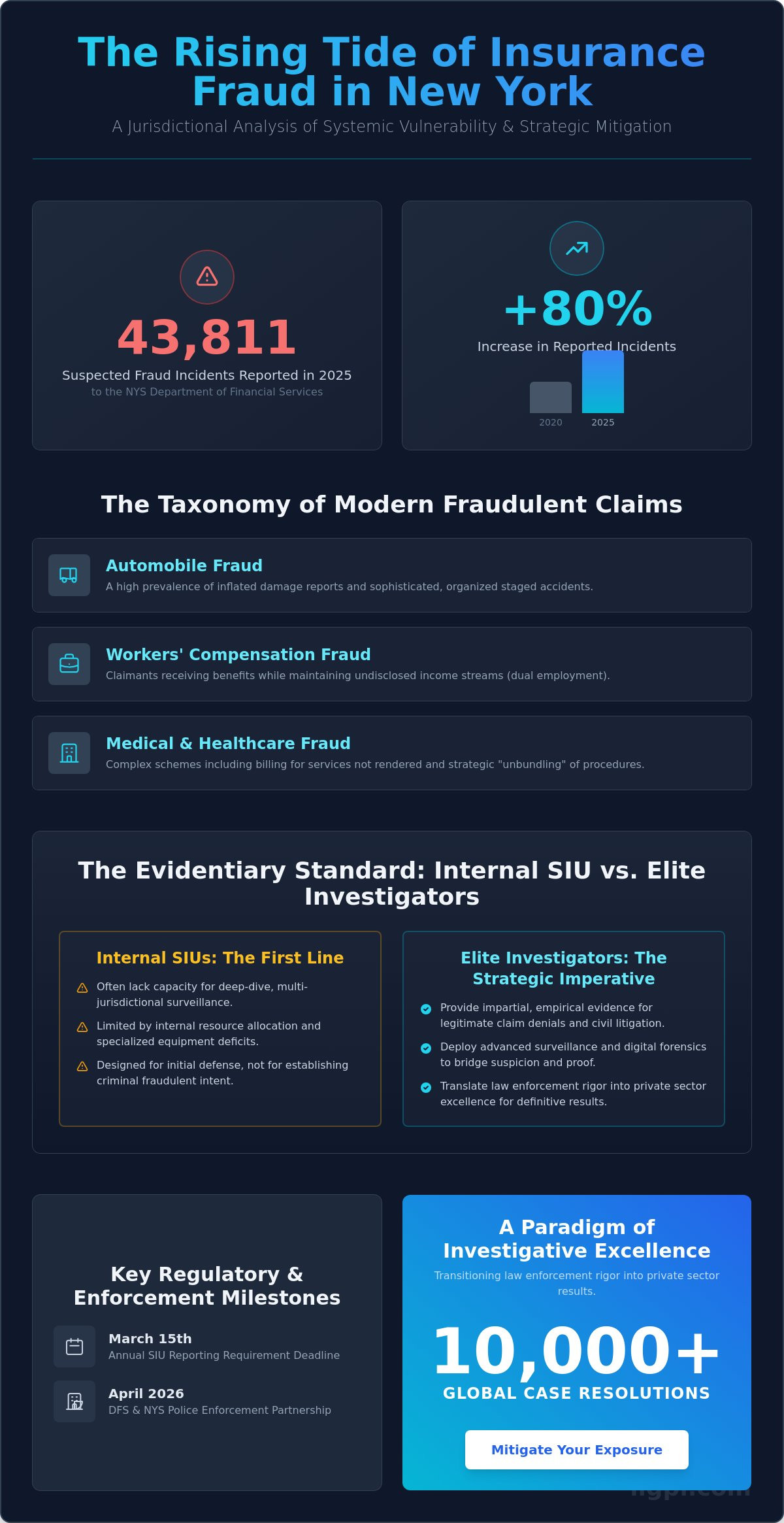
With 43,811 incidents of suspected motor vehicle insurance fraud reported to the New York State Department of Financial Services in 2025, representing an 80 percent increase since 2020, the jurisdictional landscape has shifted toward a state of systemic vulnerability. It’s evident that the escalating costs of fraudulent claims, coupled with the rigorous March 15th annual SIU reporting requirements, demand a level of evidentiary precision that standard protocols cannot provide. Engaging an elite insurance fraud investigator new york is a critical strategic imperative for organizations aiming to mitigate multi-million dollar exposures and maintain regulatory compliance.
This analysis provides an authoritative framework for deploying sophisticated detection methodologies and selecting investigative counsel capable of securing the empirical evidence necessary for successful claim denials. You’ll explore the integration of advanced digital forensics and field surveillance within the context of the April 2026 DFS and New York State Police enforcement partnership to ensure your claims mitigation strategy remains definitive and robust. By synthesizing law enforcement rigor with private sector expertise, institutions can effectively navigate the complexities of the New York insurance market and protect their financial integrity against increasingly sophisticated fraudulent actors.
Key Takeaways
- Gain an advanced understanding of how integrating surveillance intelligence with empirical data analysis facilitates precise determinations in AOE/COE investigations.
- Identify the rigorous criteria required to select a premier insurance fraud investigator new york capable of managing high-stakes, multi-million dollar claims mitigation strategies.
- Examine the complex relationship between private investigative initiatives and the New York Department of Financial Services (DFS) regulatory reporting framework.
- Appreciate the strategic value of an investigative firm’s institutional pedigree, specifically the transition of law enforcement rigor into private sector excellence.
- Explore the elite methodologies that have defined a paradigm of investigative achievement across more than 10,000 global case resolutions.
The Socioeconomic Landscape of Insurance Fraud in the New York Jurisdiction
Within the statutory framework of the New York Penal Law, specifically Article 176, insurance fraud is defined as a criminal act characterized by the intentional submission of written statements containing false information to obtain wrongful payments. This legal definition encompasses a spectrum of activities ranging from fifth-degree misdemeanors to first-degree felonies, categorized primarily by the monetary value of the fraudulent transaction. A comprehensive Insurance fraud overview helps contextualize these offenses as systemic threats that extend beyond individual losses to destabilize the regional economic structure. Engaging a qualified insurance fraud investigator new york is a critical strategic move for institutions aiming to protect their fiduciary health against these predatory practices.
The systemic impact of fraudulent claims manifests as an invisible, regressive tax on the New York economy, driving up premiums for legitimate policyholders and eroding the capital reserves of insurance carriers. While reported figures provide a baseline for analysis, the hidden costs of undetected fraud in the 2026 market remain a profound concern for risk managers. These costs include increased administrative overhead, the dilution of internal investigative resources, and the distortion of actuarial models. It’s essential to distinguish between opportunistic consumer fraud, which often involves isolated incidents of padding claims, and organized corporate malfeasance, where sophisticated syndicates orchestrate large-scale deceptive operations for substantial profit.
The Taxonomy of Modern Fraudulent Claims
The current environment displays a high prevalence of inflated automobile damage reports and staged accidents, which accounted for a significant portion of the 43,811 suspected incidents reported in 2025. Workers’ compensation fraud presents another significant challenge, particularly regarding dual employment detection where claimants receive benefits while maintaining undisclosed income streams. In the New York metropolitan area, medical and healthcare billing irregularities often involve complex schemes, such as billing for services never rendered or the strategic unbundling of procedures to maximize reimbursement rates. A professional insurance fraud investigator new york utilizes advanced surveillance and data analysis to bridge the gap between suspicion and empirical proof in these complex cases.
The Legal Imperative for Professional Intervention
Establishing criminal fraudulent intent requires a much higher evidentiary standard than resolving simple consumer disputes. While internal Special Investigation Units (SIUs) serve as the first line of defense, they often lack the capacity for deep-dive surveillance or the specialized equipment required for multi-jurisdictional inquiries. External expertise from a firm like The International Investigative Group provides the impartial, empirical evidence needed for civil litigation and the legitimate denial of claims. These findings serve as the cornerstone for legal teams to demonstrate that a claim isn’t merely a disagreement over value but a deliberate attempt to defraud the system. It’s the difference between a successful defense and a costly settlement.
Methodologies of Modern Fraud Detection: An Elite Investigative Framework
The mitigation of high-stakes insurance exposure requires a multifaceted synthesis of traditional field intelligence and advanced computational analysis. While basic investigative agencies rely on static observation, a sophisticated insurance fraud investigator new york must employ a more rigorous framework to address the complexities of the 2026 risk environment. This methodology aligns with the strategic objectives outlined by the National Insurance Crime Bureau (NICB), emphasizing the necessity of a data-driven approach to dismantle organized fraud syndicates. By integrating real-time surveillance data with historical claim patterns, investigators can identify systemic anomalies that indicate premeditated deception rather than isolated opportunistic behavior.
Precision in Arising Out of Employment and Course of Employment (AOE/COE) investigations is paramount for determining the legitimate scope of liability in workers’ compensation claims. These inquiries demand exhaustive verification. A professional insurance fraud investigator new york ensures that alleged injuries are consistent with documented professional functions through both physical surveillance and digital footprint analysis. Cases involving specie loss, such as high-value fine arts and jewelry, require specialized protocols to authenticate provenance and verify the circumstances of the reported disappearance. These elite investigations demand a deep understanding of global asset markets to recover stolen property or expose fraudulent claims of loss.
Advanced Surveillance and Intelligence Gathering
Covert operations in the hyper-dense urban corridors of New York City necessitate a transition from conventional physical observation to multi-platform digital tracking. Maintaining the chain of custody for surveillance evidence is a foundational requirement. It ensures that all visual and electronic data remains admissible in high-stakes civil litigation. Modern intelligence gathering now incorporates geolocation data and social media sentiment analysis to provide a comprehensive view of a subject’s physical capabilities and lifestyle consistency.
Digital Forensics and Financial Analysis
Uncovering digital paper trails requires the expertise of forensic technicians who can identify subtle anomalies in electronic claim submissions and financial records. Tracing hidden assets and financial motives provides the necessary context to establish intent in complex fraud cases involving corporate entities. It’s a process that doesn’t allow for oversight. For a more exhaustive examination of these technical protocols, industry leaders should consult this guide on Computer Forensics to understand the depth of digital scrutiny required in the modern era.
Navigating Regulatory Compliance and the DFS Framework in New York
The intersection of private sector investigative functions and the New York Department of Financial Services (DFS) regulatory architecture is defined by a shared objective of systemic integrity. Licensed carriers must adhere to stringent reporting standards. Under Insurance Law Section 405(a), suspected fraud must be electronically submitted through the Frauds Case Management System. An elite insurance fraud investigator new york serves as a vital conduit in this process. They transform raw suspicion into the structured data required by the NY State Insurance Frauds Bureau. This partnership ensures that institutional reporting isn’t merely a compliance exercise but a rigorous defense mechanism. By providing the empirical basis for the Annual SIU Report due every March 15th, professional investigators enable insurers to meet their statutory obligations with precision.
Legal boundaries in 2026 require a nuanced understanding of privacy statutes and judicial precedents. Private surveillance operations must operate within the strictures of New York law to avoid civil liability or the suppression of evidence. While investigators often uncover information that transitions from civil disputes to criminal matters, the handover to law enforcement must be handled with procedural precision. This ensures that the work of a private entity doesn’t compromise a subsequent state prosecution. It’s a delicate balance that requires deep expertise in jurisdictional mandates. When the scope of an investigation expands beyond civil mitigation, the investigator’s role shifts toward preserving the integrity of a potential criminal referral.
Evidentiary Standards for New York Courts
Admissibility in New York courts hinges on the credentials and methodological rigor of the investigator. Professionals must maintain active licensing under the New York Secretary of State to ensure their testimony carries the necessary weight. Ethical protocols and a transparent chain of custody are not optional. They’re the foundations of institutional credibility. Reports must be exhaustive, objective, and capable of withstanding the scrutiny of aggressive cross-examination in high-stakes litigation. Failure to adhere to these standards can result in the exclusion of critical evidence, leaving an insurer vulnerable to fraudulent payouts.
Strategic Risk Mitigation for Insurers
Beyond immediate claim denial, the deployment of Insurance Fraud Investigation Services acts as a potent deterrent against future malfeasance. The return on investment for professional inquiry is particularly evident in high-value settlements where empirical findings can reduce exposure by millions. Developing an anti-fraud culture requires more than just policy. It requires a strategic partnership with a firm that understands the macro-economic stakes. This proactive stance signals to potential bad actors that the organization possesses the intellectual and operational resources to identify and challenge deceptive claims. It’s an essential component of a robust fiduciary strategy.
Strategic Criteria for Engaging an Insurance Fraud Investigator in New York
The selection of an insurance fraud investigator new york requires a rigorous analytical assessment of institutional capability rather than a mere review of superficial service offerings. For high-stakes, multi-million dollar claims, the depth of a firm’s investigative infrastructure directly determines the viability of the eventual legal defense. Decision-makers should prioritize agencies that demonstrate a synthesis of technological sophistication and historical success within the specific legal constraints of the New York jurisdiction. The pedigree of leadership remains a primary indicator of operational excellence. Firms led by individuals with extensive backgrounds in federal or state law enforcement bring a level of procedural rigor that’s essential for complex claims mitigation.
Engaging an insurance fraud investigator new york with a global reach is a mandatory attribute in an era characterized by transnational fraud syndicates and sophisticated cross-jurisdictional asset concealment. A firm’s ability to execute seamless inquiries across international borders, while maintaining strict adherence to local regulatory mandates, is vital for modern risk management. This capability is particularly relevant when investigating specie loss or complex corporate malfeasance where the trail of evidence frequently extends beyond the New York metropolitan area. Reviewing a firm’s legacy of over 10,000 solved cases provides the empirical validation necessary to justify a strategic partnership. To secure an authoritative assessment of your current exposure, consider a professional consultation with our senior investigative counsel.
Essential Firm Credentials and Expertise
The necessity of over 30 years of localized New York experience can’t be overstated, as the nuances of the regional legal environment dictate the ultimate success of evidence collection. Specialization in niche sectors, such as Fine Arts Loss Investigations or Jewelers Loss Investigations, requires a level of domain expertise that generalist firms simply can’t replicate. A robust global network for tracing international fraud ensures that investigations remain comprehensive and that recovery efforts aren’t limited by geographic boundaries. Forensic capabilities must include advanced data recovery and the ability to synthesize disparate digital footprints into a coherent evidentiary narrative.
The Consultation and Engagement Process
Defining the scope of work and establishing clear investigative objectives are the first steps in a successful engagement. Transparency in reporting and the maintenance of rigorous communication protocols ensure that all findings are delivered with the clarity required for executive decision-making. For a more detailed analytical framework on selection, business leaders should review this Hiring a Corporate Private Investigator checklist. Establishing these parameters early in the process mitigates risk so that stakeholders don’t face unexpected procedural hurdles and aligns the investigative effort with the organization’s broader financial and legal goals.
The International Investigative Group: A Paradigm of Investigative Excellence
The International Investigative Group functions as a premier institutional entity, established upon a foundational synthesis of public sector evidentiary rigor and private sector operational agility. By leveraging the expertise of former law enforcement professionals, the organization maintains a standard of inquiry that transcends conventional private sector methodologies. This institutional pedigree ensures that every engagement is conducted with a precision that mirrors the highest levels of state and federal investigation. With a documented legacy of over 10,000 successfully resolved cases across the global spectrum, the firm provides a level of empirical validation that’s indispensable for high-level decision-makers. As a leading insurance fraud investigator new york, the group specializes in transforming disparate, raw data points into a cohesive framework of actionable intelligence. This process allows elite institutions to mitigate risk through informed, strategic interventions rather than reactive measures.
Customized security and surveillance solutions for the New York City market are engineered to address the unique density and jurisdictional complexities of the region. The organization’s methodology bridges the gap between sophisticated data collection and the strategic requirements of corporate counsel. By integrating the field expertise of a seasoned insurance fraud investigator new york with advanced forensic technologies, the firm delivers a comprehensive defense against multifaceted fraudulent schemes. This approach doesn’t merely identify anomalies but constructs a definitive evidentiary narrative suitable for the highest levels of judicial scrutiny. The firm’s ability to navigate the intersection of regional dynamics and global financial systems positions it as an essential partner for organizations operating within high-stakes environments.
Case Study Highlights: Success in the New York Market
The efficacy of this elite framework is best demonstrated through its historical performance in high-stakes jurisdictional disputes. One significant resolution involved the comprehensive investigation of a 12 million dollar fraudulent burglary claim, where the deployment of advanced forensic analysis and field surveillance successfully exposed the fabricated nature of the loss. Similar rigor has been applied to resolving complex bank fraud and sophisticated financial crimes that threaten the economic stability of regional markets. By protecting the assets of elite New York institutions, the firm has established itself as a critical component of the city’s financial defense infrastructure. These successes illustrate the necessity of a sophisticated investigative partner when facing organized and highly motivated fraudulent actors.
Engagement and Next Steps
Securing the integrity of an organization’s capital reserves requires a proactive and confidential approach to fraud detection. Institutions facing potential exposure or currently navigating suspicious claims should prioritize a strategic consultation to define the scope of investigative requirements. By customizing a fraud detection strategy tailored to specific institutional vulnerabilities, the firm ensures that every resource is deployed with maximum efficiency. For organizations requiring immediate intervention or a comprehensive audit of their current mitigation protocols, it’s recommended to contact the International Investigative Group to initiate a partnership with senior investigative counsel. This engagement represents a commitment to evidentiary excellence and the long-term preservation of institutional assets.
Securing Institutional Integrity through Strategic Investigative Partnerships
The evolution of fraudulent methodologies within the New York jurisdiction necessitates a transition from reactive claims management toward a proactive, elite framework of mitigation. Organizations must synthesize the rigorous evidentiary standards required by the Department of Financial Services with sophisticated digital forensics to protect their capital reserves against systemic exploitation. Precision is paramount. Engaging a premier insurance fraud investigator new york provides the intellectual and operational depth required to navigate these complexities with authority. By leveraging a legacy of over 30 years of investigative experience and more than 10,000 successfully resolved cases, institutions can establish a definitive defense against organized malfeasance. This strategic alignment, led by former law enforcement professionals, ensures that every inquiry remains compliant with jurisdictional mandates while securing the empirical proof necessary for successful claim denials. We invite you to consult with our elite New York insurance fraud investigators today to fortify your organization’s fiduciary health. Establishing a robust anti-fraud culture isn’t merely a regulatory requirement; it’s a foundational pillar of institutional longevity and economic stability.
Frequently Asked Questions
What is the primary role of an insurance fraud investigator in New York?
The primary role of an insurance fraud investigator new york is to establish a definitive evidentiary record that determines the legitimacy of a claim through objective observation and technical analysis. This process involves the synthesis of field surveillance, digital forensics, and comprehensive background inquiries to identify inconsistencies between reported incidents and physical reality. By providing institutional leaders with actionable intelligence, these professionals facilitate the mitigation of financial exposure and ensure that claims settlements are based on verified facts.
Can private investigator evidence be used in New York civil courts?
Evidence procured by a licensed private investigator is fully admissible in New York civil courts, provided it adheres to established judicial protocols and privacy statutes. Admissibility depends on the investigator’s ability to maintain a rigorous chain of custody and demonstrate that data collection methods didn’t violate the subject’s reasonable expectation of privacy. Expert testimony from the investigator often serves as the cornerstone of defense strategies, allowing legal teams to present visual and digital proof of malfeasance.
How does an AOE/COE investigation differ from standard surveillance?
An AOE/COE investigation focuses specifically on determining if an injury occurred arising out of employment or in the course of employment, whereas standard surveillance generally observes physical activity without a specific nexus to workplace duties. This specialized inquiry involves verifying the claimant’s professional functions and identifying undisclosed secondary employment or pre-existing conditions. While standard surveillance might capture general mobility, AOE/COE protocols are designed to address the specific statutory requirements of the New York workers’ compensation system.
Is it mandatory to report suspected insurance fraud to the NY DFS?
Reporting suspected insurance fraud is a statutory requirement for licensed insurers under New York Insurance Law Section 405(a). Carriers must electronically submit these reports through the Department of Financial Services (DFS) Frauds Case Management System within the mandated timeframes. Failure to adhere to these reporting standards can result in regulatory penalties and jeopardize the organization’s compliance standing. Professional investigators assist in this process by structuring the necessary empirical data for submission.
What are the indicators of a sophisticated high-value insurance fraud scheme?
Sophisticated high-value fraud schemes are often characterized by the involvement of organized syndicates, professional enablers, and meticulously staged incidents designed to maximize payout potential. Indicators include anomalous patterns in medical billing, the rapid involvement of specific legal counsel, and claims that occur shortly after a policy’s inception. These schemes frequently utilize multiple claimants and complex digital deceptive practices to mask the premeditated nature of the loss, requiring an elite insurance fraud investigator new york to unravel.
How long does a typical insurance fraud investigation take to complete?
The duration of an insurance fraud investigation is dictated by the complexity of the claim and the geographic scope of the required inquiries. While a preliminary surveillance operation might conclude within several days, more intricate cases involving global asset tracing or digital forensics can extend over several weeks or months. Each engagement is structured around specific investigative milestones to ensure that intelligence gathering remains efficient without compromising the depth of the empirical record required for litigation.
What qualifications should I look for in a New York private investigation firm?
Strategic engagement should prioritize firms that possess active New York state licensing, extensive institutional longevity, and leadership with high-level law enforcement backgrounds. It’s essential to verify the firm’s experience in managing multi-million dollar claims and its capacity for specialized inquiries like fine arts or jewelry loss. A robust technological infrastructure and a documented track record of case resolutions within the New York jurisdiction are critical indicators of a firm’s ability to deliver authoritative results.
Can an investigator help recover assets after a fraudulent claim has been paid?
Investigators play a vital role in asset recovery by executing comprehensive due diligence and financial searches to identify property or funds concealed after a fraudulent payout. This process involves tracing digital paper trails and identifying physical assets that can be leveraged during civil recovery actions or restitution proceedings. While the investigative firm doesn’t provide legal advice, the empirical data it secures provides the necessary foundation for legal teams to pursue the return of misappropriated institutional capital.