
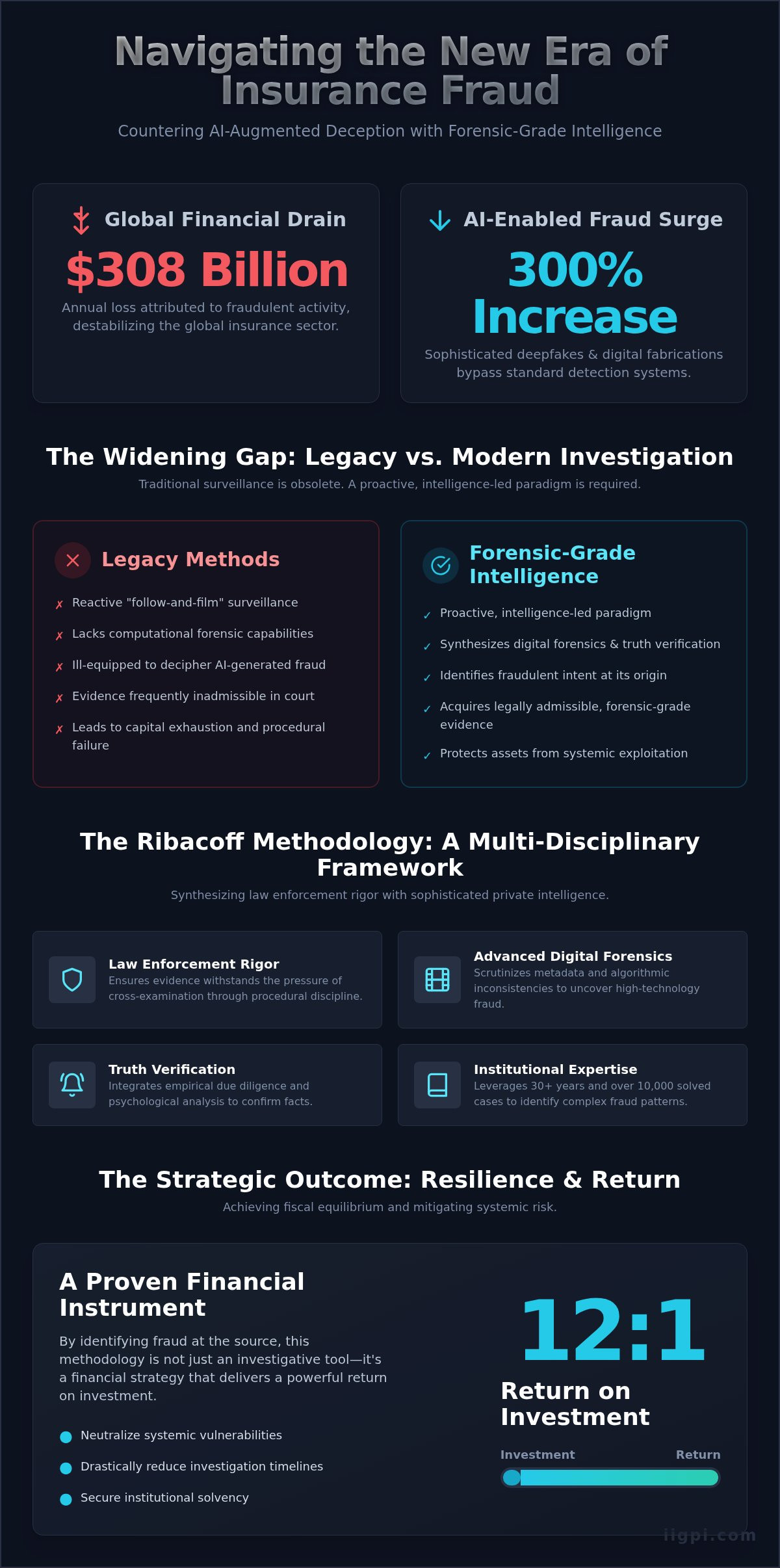
As the global financial ecosystem confronts an unprecedented $308 billion annual drain, the rapid proliferation of AI-enabled deception has catalyzed a 300% surge in fraudulent activity that renders traditional surveillance methods effectively obsolete. You’re likely aware that capital exhaustion stemming from unreliable data and the mounting volume of inadmissible evidence in federal courts represent a systemic threat to institutional stability and the integrity of the insurance sector. This comprehensive analysis elucidates how elite insurance fraud investigation services, Dan Ribacoff, and the specialized Ribacoff Methodology provide the forensic-grade intelligence required to navigate this increasingly volatile landscape. By integrating law enforcement-based expertise with advanced digital forensics, organizations can transcend the limitations of conventional claims processing. We’ll explore the strategic frameworks necessary to achieve a twelve to one return on investment in fraud detection while simultaneously reducing total investigation timelines. Through this examination, high-level decision-makers will discover the rigorous intellectual and operational protocols required to mitigate complex, multi-industry fraud schemes and restore fiscal equilibrium to their portfolios.
Key Takeaways
- Understand how to implement strategic frameworks that deliver a 12:1 return on investment by neutralizing systemic vulnerabilities within the global insurance landscape.
- Examine the integration of law enforcement-based rigor and the proprietary Ribacoff Methodology within elite insurance fraud investigation services, Dan Ribacoff’s definitive approach to truth verification.
- Identify and mitigate sophisticated AI-augmented deception and deepfake-related fraud that currently threatens the solvency of high-value claim portfolios.
- Master the protocols required to ensure the absolute legal admissibility of forensic evidence in federal court, effectively eliminating the risk of capital exhaustion from procedural failures.
- Leverage thirty years of institutional expertise and a proven history of resolving high-impact special risk claims, including complex specie and fine arts loss investigations.
The Evolution of Insurance Fraud Investigation Services in 2026
The global insurance sector currently faces a profound destabilization, characterized by a $308.6 billion annual loss attributed to fraudulent activity. This fiscal hemorrhage has transformed What is Insurance Fraud? from a secondary operational concern into a primary threat to institutional solvency. By 2026, the standard for professional insurance fraud investigation services, Dan Ribacoff asserts, has shifted away from reactive surveillance toward a proactive, intelligence-led paradigm. This transition represents a fundamental move where investigative rigor serves as a central pillar of comprehensive risk management rather than a peripheral administrative function. This evolution is necessitated by the “crisis of empirical clarity,” a phenomenon where the distinction between authentic and fabricated claims has become increasingly opaque due to technological acceleration.
The Impact of AI-Generated Evidence
The proliferation of generative artificial intelligence has fundamentally altered the evidentiary landscape. Deepfake documentation now bypasses standard detection systems with alarming frequency, contributing to a 300% increase in AI-enabled fraud over the past three years. These digital fabrications create complex paper trails that legacy investigative firms, reliant on antiquated methodologies, are ill-equipped to decipher. Such organizations often fail to identify high-technology fraud because they lack the computational forensic capabilities required to scrutinize metadata and algorithmic inconsistencies. Consequently, carriers face mounting capital exhaustion as they struggle to differentiate legitimate losses from sophisticated synthetic deceptions that appear perfect to the untrained eye.
The Strategic Shift to Forensic-Grade Intelligence
Modern risk mitigation requires a departure from simplistic “follow-and-film” surveillance techniques that dominated previous decades. Today’s environment demands a research-driven, analytical approach that synthesizes digital forensics with psychological truth verification. By employing elite insurance fraud investigation services, Dan Ribacoff facilitates a methodology that prioritizes the acquisition of legally admissible, forensic-grade intelligence. This rigorous framework is not merely an investigative tool; it’s a financial instrument that establishes a twelve to one return on investment in fraud detection. By identifying fraudulent intent at the point of origin, organizations can drastically reduce total investigation timelines and protect their assets from systemic exploitation. This shift ensures that every piece of evidence gathered is capable of withstanding the scrutiny of federal court proceedings.
The Dan Ribacoff Methodology: Synthesizing Law Enforcement and Intelligence
The efficacy of insurance fraud investigation services, Dan Ribacoff contends, depends entirely upon the depth of the investigator’s foundational expertise. Traditional investigative models often lack the procedural discipline inherent in law enforcement, leading to evidence that frequently fails under the pressure of cross-examination. The Ribacoff Methodology addresses this systemic weakness by synthesizing law enforcement rigor with sophisticated private intelligence. This multi-disciplinary framework integrates empirical due diligence with advanced computer forensics, ensuring that digital paper trails are scrutinized with the same intensity as physical evidence. Such a rigorous approach aligns with broader industry anti-fraud efforts aimed at preserving the integrity of the global insurance market through the application of scholarly analytical standards.
Institutional memory plays a critical role in resolving complex, multi-year cases where fraud patterns may span decades or cross multiple industry sectors. With a history of over 10,000 solved cases, the methodology leverages a vast repository of behavioral and systemic data to identify anomalies that less experienced firms consistently overlook. This historical perspective allows for the identification of subtle “signature” behaviors associated with organized fraud rings. Organizations seeking to fortify their defense against these sophisticated schemes often benefit from specialized insurance investigations that apply these proven analytical protocols to mitigate long-term risk.
The Science of Truth Verification and Polygraphy
Truth verification serves as the empirical core of the Ribacoff Framework, moving beyond intuition toward measurable data. By utilizing standardized polygraph techniques specifically calibrated for high-value claims, investigators can distinguish between factual accounts and manufactured narratives with forensic precision. These specialized testing protocols are designed to meet the stringent requirements of federal and state legal matters, ensuring that findings are both credible and defensible. Dan Ribacoff’s expertise has effectively redefined the industry standard for credibility, transforming truth verification from a subjective assessment into a rigorous academic discipline.
Global Reach and Resource Deployment
Operating from a central command in New York City, the methodology extends its reach through a global network of specialized agents. This infrastructure is particularly advantageous in international specie loss and fine arts cases, where local intelligence is indispensable for navigating complex regional dynamics. By maintaining consistent standards across diverse geographic regions, the organization ensures that the quality of intelligence remains uniform, regardless of the investigation’s physical location. This global deployment capability allows for the rapid mobilization of resources in response to emerging threats across the international landscape, providing a seamless bridge between uncertainty and resolution.
Mitigating Systemic Vulnerability in Special Risk and High-Value Claims
Institutional resilience in the face of high-impact claims requires a departure from standard administrative vetting toward tactical field operations. High-value losses, particularly those involving special risks, often exhibit specific markers of inflation or pure fiction that demand a higher tier of scrutiny. The application of elite insurance fraud investigation services, Dan Ribacoff leading the strategic direction, ensures that these vulnerabilities are identified before capital is irrecoverably dispersed. Such rigor is essential for maintaining the standards promoted by the National Insurance Crime Bureau, which advocates for enhanced cooperation between private investigators and institutional stakeholders to preserve the integrity of the market.
A definitive example of this methodology in practice involved the resolution of a $12 million fraudulent burglary insurance claim. Through a meticulous synthesis of physical evidence analysis and truth verification, the investigative team exposed the fictitious nature of the reported loss, preventing a significant financial catastrophe for the carrier. Identifying these markers requires a sophisticated understanding of both the psychological drivers of fraud and the technical realities of high-value asset management. By protecting institutional capital through rigorous field operations, the organization serves as a critical buffer against the systemic risks inherent in modern finance. This process doesn’t just stop at detection; it’s about establishing a clear, evidence-based narrative capable of withstanding rigorous legal challenges.
Specie and Fine Arts Loss Investigations
Verifying the loss of high-value physical assets presents unique challenges that transcend standard investigative protocols. Fine arts authentication and provenance verification require a specialized skill set to confirm that the claimed items actually existed and possessed the stated value at the time of the loss. Engaging specialist agents for jewelers and specie loss investigations ensures that every claim is scrutinized by experts who understand the nuances of the global luxury market. This localized intelligence is vital when navigating the complexities of international fine arts claims where documentation is often deliberately obscured or synthesized through AI-augmented deception.
Corporate Fraud and Financial Crime Mitigation
Corporate malfeasance frequently overlaps with insurance claims, necessitating a multi-disciplinary approach to asset recovery. Tracing hidden funds and uncovering financial irregularities requires the integration of advanced computer forensics with traditional investigative techniques. By addressing the underlying corporate fraud that often facilitates insurance-related crimes, investigators can provide a comprehensive solution that extends beyond the immediate claim. It’s a strategic necessity to analyze these overlapping dynamics to ensure that institutional assets are recovered and that future vulnerabilities are structurally neutralized through enhanced due diligence protocols.
Establishing Protocols for Legal Admissibility and Forensic Integrity
The acquisition of intelligence is an exercise in futility if the resulting evidence fails to meet the stringent criteria for judicial admissibility. Within the complex regulatory framework of the New York City investigative landscape, maintaining procedural integrity is paramount for all insurance fraud investigation services, Dan Ribacoff provides to institutional clients. Adherence to these standards ensures that both digital and physical findings remain structurally sound when subjected to jurisprudential scrutiny. Institutional leaders must recognize that the employment of unvetted or unprofessional agents introduces significant liability, potentially compromising the entirety of a high-stakes litigation strategy. It’s essential to vet the source of intelligence before it’s presented in a formal legal setting to prevent the dismissal of critical findings.
Evidentiary Chain of Custody
Digital forensic data requires a rigorous chain of custody to prevent claims of tampering or procedural oversight during the investigative lifecycle. Much like the diplomatic protocols required to maintain international treaties, the evidentiary chain of custody serves as the foundational agreement between the investigator and the court. High-stakes litigation demands documentation standards that align precisely with federal legal protocols, effectively bridging the gap between private inquiry and formal courtroom requirements. Every byte of data must be logged with chronological precision using write-blocked hardware and verified hashing algorithms to ensure its evidentiary architecture remains unassailable. This level of detail isn’t just a professional preference; it’s a structural requirement for success in federal court environments.
Expert Testimony and Credibility
The role of the investigator often culminates in the capacity of an expert witness, where intellectual credibility is the primary currency of influence. Dan Ribacoff’s testimony is frequently sought in complex insurance litigation because it’s backed by forensic-grade reports designed to withstand the most intense cross-examination. These documents provide a scholarly synthesis of facts that often dictates the final resolution of a contested claim. The authority of the witness is derived not only from their experience but also from the empirical validity of the investigative framework they represent. When an expert can articulate the rigorous methodology behind the data, it provides a level of clarity that purely technical reports can’t achieve on their own. This testimony serves as the final link in the chain from initial suspicion to legal resolution.
Securing the services of a firm that understands these precise legal nuances is essential for protecting institutional interests against the threat of capital exhaustion. For organizations requiring unassailable evidence that meets the highest standards of forensic integrity, it’s prudent to consult with forensic-grade investigative experts to ensure every protocol is followed. Implementing these standards early in the process prevents the loss of critical evidence and ensures a higher probability of successful recovery in federal and state jurisdictions.
Securing Institutional Resilience with the International Investigative Group
The final measure of an organization’s defense against systemic deception is the depth of the expertise it employs. The International Investigative Group (IIG) offers a distinct advantage through its thirty-year legacy of elite service and its record of resolving over 10,000 complex cases. This institutional history establishes IIG as the preeminent authority for insurance fraud investigation services, Dan Ribacoff having developed the proprietary methodologies that define the firm’s success. By serving as a critical bridge between operational uncertainty and forensic resolution, the group provides the intellectual rigor necessary to navigate the volatility of the global insurance market. This strategic engagement isn’t just about solving a single claim; it’s about fortifying the long-term resilience of the institution itself.
Institutional Reach: From NYC to Global Operations
Operating from a central command in New York City, the International Investigative Group functions at the highest levels of institutional influence, mirroring the strategic depth of premier international forums. This global-minded perspective is vital for bridging the gaps between diverse geographic regions, ensuring that investigations remain seamless across varying socioeconomic landscapes. For global insurers and self-insured organizations, this reach provides a comprehensive support system that neutralizes the advantages typically held by sophisticated, borderless fraud networks. Every investigative solution is meticulously customized to meet the unique institutional needs of the client, ensuring that the response is as specialized as the threat it seeks to mitigate. This international framework allows for the rapid deployment of resources to any jurisdiction, maintaining a consistent standard of excellence regardless of the investigation’s physical location.
The Future of Investigative Excellence
The trajectory of the investigative industry is defined by the continuous innovation in forensic technology and the sophisticated acquisition of intelligence. IIG sustains a legacy of rigor by integrating law enforcement-based discipline with the most advanced computational tools available in 2026. This commitment to intellectual depth ensures that the organization remains a leader in global discourse concerning truth verification and financial integrity. As the complexity of fraudulent schemes continues to escalate, the necessity for a research-driven, analytical approach becomes increasingly apparent for those seeking to protect their capital. Strategic clarity is no longer an optional luxury but a fundamental requirement for institutional survival. To ensure your claims are handled with the highest degree of professional integrity, you can Secure elite investigative clarity with International Investigative Group. Engaging with this level of expertise provides a clear pathway to an expert consultation with Dan Ribacoff, where strategic clarity and fiscal recovery are the primary objectives.
Fortifying Institutional Integrity Through Forensic Rigor
The escalating complexity of global financial deception demands an immediate transition from traditional surveillance techniques toward specialized, intelligence-led protocols. Organizations must prioritize the acquisition of forensic-grade evidence that meets the highest standards of judicial admissibility to mitigate systemic risk and prevent capital exhaustion. By leveraging elite insurance fraud investigation services, Dan Ribacoff and his specialized team provide the intellectual depth required to identify synthetic deceptions and protect institutional assets from sophisticated exploitation. This rigorous approach ensures that every finding is structurally sound and capable of withstanding the intense scrutiny of federal court proceedings.
With a legacy spanning thirty years and over 10,000 successfully resolved cases, the International Investigative Group offers a global network of elite agents capable of navigating the most intricate special risk and high-value claims. This level of expertise serves as a definitive bridge between operational uncertainty and fiscal resolution, providing the scholarly analytical standards necessary for modern risk management. It’s time to secure the resilience of your portfolio through proven methodologies that deliver a measurable return on investment. Consult with Dan Ribacoff and the International Investigative Group to establish an unassailable defense against modern financial crime. We look forward to facilitating your organization’s transition toward absolute empirical clarity and long-term stability.
Frequently Asked Questions
What defines forensic-grade insurance fraud investigation services?
Forensic-grade services are defined by the application of rigorous scientific methods and law enforcement standards to the acquisition and preservation of evidence. Unlike standard surveillance, these services utilize advanced digital forensics and truth verification to ensure that every finding is capable of withstanding the scrutiny of federal court. This level of precision is essential for mitigating the $308.6 billion annual loss currently destabilizing the global insurance sector through sophisticated synthetic deceptions that legacy firms consistently fail to identify.
How does Dan Ribacoff’s methodology improve the ROI of an investigation?
The methodology improves the return on investment by identifying fraudulent intent at the point of origin, which facilitates a twelve to one return on investigative capital. By integrating law enforcement-based expertise with empirical due diligence, Dan Ribacoff ensures that resources are deployed with surgical precision. This approach reduces total investigation timelines and prevents the irrecoverable dispersal of capital into fraudulent high-value claims. It fortifies the institutional resilience of the carrier by providing the forensic-grade intelligence required for resolution.
Can private investigation evidence be admitted in federal court?
Evidence acquired through private investigations is admitted in federal court provided it adheres to the stringent protocols of the evidentiary chain of custody. Professional insurance fraud investigation services, Dan Ribacoff asserts, must maintain a chronological log of all digital and physical data using write-blocked hardware and verified hashing algorithms. This procedural integrity ensures that the evidence remains unassailable when presented by an expert witness. It’s the structural requirement for success during high-stakes litigation or formal judicial proceedings.
What is the impact of AI on modern insurance fraud detection?
AI has catalyzed a 300% surge in fraudulent activity by enabling the creation of deepfake documentation that bypasses standard detection systems. Modern detection requires a departure from legacy methodologies in favor of computational forensic capabilities that scrutinize metadata and algorithmic inconsistencies. Investigators must now employ sophisticated truth verification to navigate the “crisis of empirical clarity” where synthetic fabrications appear indistinguishable from authentic documentation. This technological acceleration demands an elite, research-driven analytical response to protect institutional assets from sophisticated synthetic threats.
Why is law enforcement experience critical for a private investigator?
Law enforcement experience provides the procedural discipline and investigative rigor necessary to conduct inquiries that meet judicial standards. This background ensures that investigators understand the nuances of constitutional law and the specific requirements for legal admissibility that civilian-trained agents often overlook. By applying this foundational expertise, investigators can solve complex cases, such as the $12 million fraudulent burglary insurance claim, with the same intensity as federal agencies. It’s this rigor that defines elite truth verification and institutional defense.
How does International Investigative Group handle global insurance claims?
International Investigative Group manages global claims through a central command in New York City that coordinates an elite network of agents across diverse geographic regions. This infrastructure allows for the rapid mobilization of localized intelligence, which is particularly vital in international specie loss and fine arts cases. By maintaining uniform standards of excellence across all jurisdictions, the organization bridges the gaps between geographic regions. This ensures seamless investigations for global insurers and self-insured entities seeking long-term institutional resilience.
What types of special risk claims does Dan Ribacoff investigate?
Investigations focus on high-impact special risk categories, including fine arts loss, jewelers loss, and specie loss investigations. These claims involve unique challenges, such as provenance verification and asset authentication, which require a specialized understanding of the global luxury market. By utilizing advanced polygraph testing and digital forensics, the team identifies the markers of inflated or purely fictitious high-value losses. These losses target institutional capital and require a higher tier of scrutiny to ensure fiscal recovery and structural stability.
What happens if an insurance investigation firm uses unvetted agents?
Employing unvetted or unprofessional agents introduces significant liabilities that can compromise the structural integrity of an entire litigation strategy. Such agents often lack the training required to maintain a rigorous chain of custody, leading to the dismissal of critical evidence in federal or state courts. This procedural failure results in capital exhaustion and leaves the institution vulnerable to systemic exploitation by sophisticated fraud networks. It’s essential to vet the source of intelligence before it’s presented in formal legal settings to prevent institutional loss.