
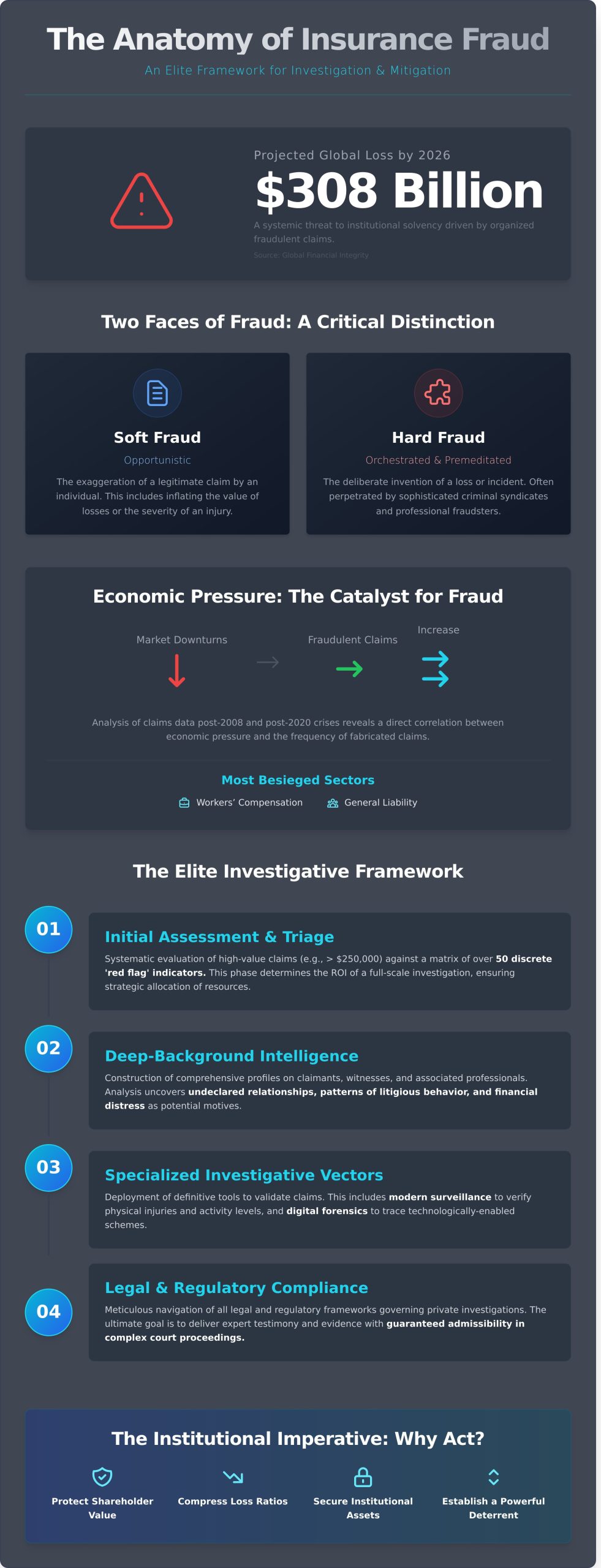
Projections from the Global Financial Integrity initiative indicate that by 2026, organized fraudulent claims will siphon an estimated $308 billion from the global insurance industry, a figure that represents a systemic threat to institutional solvency. For senior risk managers and legal counsel, this escalating financial hemorrhage is a familiar and formidable challenge, often exacerbated by the limitations of internal surveillance capabilities and the substantial legal liabilities inherent in improper evidence collection.
This analysis provides an elite framework for mitigating these critical exposures through the strategic application of modern insurance fraud investigation services and private intelligence. We will conduct a sophisticated examination of the advanced methodologies transforming contemporary fraud detection, from complex data analytics and digital forensics to covert human intelligence networks, articulating a clear pathway to securing institutional assets, compressing loss ratios, and delivering expert testimony suitable for complex court proceedings.
Key Takeaways
- Distinguish between opportunistic soft fraud and orchestrated hard fraud to better allocate institutional resources and counter systemic financial threats.
- Understand how elite insurance fraud investigation services employ a multi-stage framework to move beyond standard interviews to conduct deep-background intelligence on high-value claims.
- Learn the strategic application of modern surveillance and digital intelligence as definitive tools for validating physical injury and activity-level claims.
- Master the critical legal and regulatory frameworks governing private investigations to ensure all evidence is gathered for guaranteed admissibility in court.
The Global Proliferation of Sophisticated Insurance Fraud
Insurance fraud represents far more than isolated financial malfeasance; it has metastasized into a systemic threat to global financial stability and institutional liquidity. The annual cost of such fraudulent activities in the United States alone is estimated by the Coalition Against Insurance Fraud to exceed $308 billion, a figure that reverberates through international markets. It is critical to distinguish between two primary typologies of this crime. The first, opportunistic ‘soft fraud’, involves the exaggeration of legitimate claims by individuals. The second, and more pernicious, is ‘hard fraud’, which constitutes the deliberate invention of losses, often orchestrated by sophisticated criminal syndicates. A comprehensive overview of insurance fraud reveals its deep historical roots and complex modern manifestations, underscoring the scale of the challenge.
The global economic landscape projected for 2026 indicates a sustained period of volatility, a condition that has historically catalyzed a surge in fraudulent claims. Analysis of claims data following the 2008 financial crisis and the 2020 global pandemic reveals a direct correlation between economic pressure and the frequency of fabricated property and casualty claims. The National Insurance Crime Bureau (NICB) consistently reports spikes in questionable claims during such downturns. This escalating threat environment, characterized by increasingly complex and technologically-enabled schemes, demands an elite investigative response. Standard adjustive protocols, designed to assess legitimate damage, are fundamentally inadequate for uncovering deliberate, multi-layered deception, necessitating the engagement of professional insurance fraud investigation services.
Economic Drivers of Fraudulent Activity
The inverse relationship between economic health and fraudulent activity is well-documented; market downturns consistently precipitate a measurable increase in staged losses and exaggerated claims. This phenomenon imposes a direct ‘fraud tax’ on consumers and businesses, with institutional losses translating into increased premiums, particularly across the Global North. The sectors currently most besieged are Workers’ Compensation, where organized claimant mills exploit subjective injury reporting, and General Liability, a consistent target for staged slip-and-fall incidents.
The Institutional Imperative for Rigorous Investigation
Corporate leadership holds a non-negotiable fiduciary duty to protect shareholder value by aggressively mitigating all forms of financial loss, including fraud. Standard internal audits, while essential for regulatory compliance, are structurally unsuited to detect sophisticated, multi-vector fraud schemes that cross jurisdictional and digital boundaries. The deployment of specialized insurance fraud investigation services carries a gravitas that not only uncovers existing losses but also establishes a powerful deterrent against future attempts by signaling institutional resolve.
Core Methodologies in Modern Insurance Claim Validation
The contemporary framework for validating high-value insurance claims has evolved from a reactive, post-event analysis into a proactive, multi-stage discipline. A rigorous and systematic approach is paramount, particularly for claims exceeding a predetermined financial threshold, such as $250,000. The efficacy of modern insurance fraud investigation services hinges on a structured methodology that begins not with suspicion, but with a neutral and comprehensive ‘Initial Assessment Phase’. This critical first step evaluates the claim against a matrix of over 50 discrete ‘red flag’ indicators, such as a claim filed within 60 days of policy inception or the involvement of medical providers previously associated with litigated cases. The primary objective of this phase is to determine the return on investment (ROI) of a full-scale investigation, ensuring that investigative resources are allocated with strategic precision and financial prudence.
Effective validation moves beyond perfunctory interviews and surface-level documentation reviews. It necessitates the application of strategic intelligence, a discipline dedicated to deep-background vetting of all involved entities. This process involves constructing a comprehensive profile of the claimant, key witnesses, and associated professionals. By analyzing digital footprints, public records, and historical data, investigators can uncover undeclared relationships, patterns of litigious behavior, or financial distress that may serve as a motive for fraudulent activity. This deep vetting provides the contextual foundation upon which a successful investigation is built.
It is important, however, to distinguish this investigative process from the specialized underwriting required for legitimately high-risk individuals. Applicants with pre-existing medical conditions or hazardous occupations can be flagged by initial screens but represent a valid market segment. For risk managers interested in how this niche is serviced, it can be useful to discover Special Risk Term, a firm that focuses on securing policies for these complex cases.
Advanced Vetting and Background Analysis
This analytical phase is designed to deconstruct a claimant’s narrative by examining empirical data and historical precedents. It is a meticulous process that seeks to identify anomalies and interconnected networks that are invisible during a standard claims adjustment. Key techniques include:
- Multi-Jurisdictional Claim Analysis: Tracing a claimant’s history of insurance claims across state and national borders to identify patterns of frequent or similar losses, which may indicate professional fraud schemes.
- Proprietary Database Correlation: Utilizing specialized databases to map connections between claimants, medical providers, and legal counsel. This can reveal organized fraud rings, where a network of colluding professionals facilitates fraudulent claims on an industrial scale.
- Professional Behavioral Analysis: Assessing the credibility of witness statements and claimant interviews through established behavioral analysis techniques, identifying inconsistencies in testimony and indicators of deception.
Financial Forensics and Asset Tracing
At the core of many sophisticated fraud schemes is a clear financial motive. Financial forensics seeks to expose this motive by scrutinizing the economic realities of the claimant. A primary technique is the ‘lifestyle vs. income’ analysis, which identifies significant disparities between a claimant’s reported income and their actual expenditures, asset acquisitions, and liabilities. According to recent insurance fraud industry data, the immense financial pressure on individuals and businesses contributes to a notable percentage of opportunistic fraud, making this analysis indispensable.
In cases involving suspected staged losses or corporate malfeasance, the investigation escalates. The deployment of Computer Forensics is essential for recovering deleted financial records, incriminating communications, or metadata that proves intent. Simultaneously, sophisticated Corporate Investigations are utilized to trace the flow of funds through complex networks of shell companies and offshore accounts, a common tactic used to obscure the ultimate beneficiary of a fraudulent claim. The complexities of asset tracing require specialized expertise, and our teams are equipped to delineate these intricate financial webs with precision and discretion.
Specialized Investigative Vectors: Surveillance and Digital Intelligence
The contemporary framework for combating insurance fraud has evolved beyond rudimentary checks and interviews, now requiring a sophisticated, dual-pronged approach that combines physical observation with digital forensics. In cases involving claims of physical injury, disability, or restricted activity levels, direct surveillance remains the definitive tool for empirical validation. It provides irrefutable, time-stamped visual evidence that can either corroborate or unequivocally refute a claimant’s assertions. The efficacy of modern covert operations has been amplified by technological advancements, including the deployment of high-definition, long-range optics and the strategic use of non-traditional investigative platforms that blend seamlessly into complex environments. However, physical observation alone is no longer sufficient. Premier Surveillance Services now integrate their field findings with Social Media Intelligence (SOCMINT), creating a 360-degree profile of the subject that cross-references claimed limitations with publicly documented lifestyle activities.
A persistent objection to surveillance centers on the perceived intrusiveness of the practice. Yet, this concern is mitigated through strict adherence to legal and ethical protocols. Professional firms operate within the public domain, ensuring that all evidence is obtained lawfully and is admissible in legal proceedings. Discretion is paramount; the objective is not harassment but the quiet, objective acquisition of high-impact evidence. This professional discipline ensures that the claimant’s privacy is respected within legal bounds while simultaneously protecting insurers from multi-million dollar fraudulent payouts.
Strategic Surveillance in High-Density Urban Environments
Executing effective surveillance in a metropolis like New York City presents unique logistical and tactical challenges, from navigating vertical urban terrain in high-rise buildings to overcoming the complexities of dense crowds and extensive public transit systems. Elite investigative units leverage tactics derived from law enforcement, ensuring the absolute integrity of the ‘chain of custody’ for all video evidence. This methodical approach was instrumental in uncovering a fraudulent $12 million commercial burglary claim, where tactical observation posts and mobile teams documented the claimant staging the event over a 48-hour period, providing indisputable proof of collusion.
The Digital Frontier: Cyber-Forensics in Fraud Detection
As vehicles and personal devices become increasingly interconnected, they generate a wealth of data that serves as a new frontier for effective insurance fraud investigation services. The analysis of ‘infotainment’ and telematics data from vehicles involved in suspicious accidents can reveal critical discrepancies. For instance, a vehicle’s event data recorder can prove that the speed at impact was far lower than claimed or that the vehicle was not at the alleged location. Industry leaders like the National Insurance Crime Bureau (NICB) recognize the growing importance of this digital evidence in systemic fraud detection. Furthermore, the metadata embedded within digital files offers a powerful tool for proving fabrication; the EXIF data of a photograph submitted as evidence can reveal that it was taken months before the alleged incident or was digitally altered. By leveraging these digital footprints, investigators can reconstruct an accurate and verifiable timeline of events, systematically deconstructing fraudulent narratives with objective data.
Navigating Legal Boundaries and Regulatory Compliance
The efficacy of any modern fraud investigation is not measured solely by the evidence it uncovers, but by the legal and ethical integrity of its acquisition. In an environment governed by complex statutory frameworks, the investigative process itself is subject to intense scrutiny. A failure to operate within these strict parameters renders even the most compelling evidence inadmissible, jeopardizing the entire legal strategy and exposing the client to significant reputational and financial risk. Therefore, a sophisticated understanding of legal doctrine is a prerequisite for any successful outcome.
Central to domestic operations is an unwavering adherence to federal and state regulations. The Fair Credit Reporting Act (FCRA), codified at 15 U.S.C. § 1681, dictates the permissible purposes for which consumer reports can be obtained and used, while state-specific private investigator statutes, such as California’s Business and Professions Code § 7512-7573, impose strict licensing and conduct requirements. All evidence must be gathered with ‘clean hands’, a legal principle demanding that the investigator has acted equitably and has not engaged in misconduct. This ensures the findings can withstand challenges in both civil and criminal courts, where the provenance of every piece of information will be rigorously examined.
Admissibility and the Rules of Evidence
The final investigative report is a foundational legal document, often as critical as the evidence it contains. Its meticulous construction, detailing a verifiable chain of custody and objective analysis, is paramount for its acceptance under the Federal Rules of Evidence. An investigation must proactively avoid any action that could be construed as entrapment or a violation of an individual’s reasonable expectation of privacy, as such missteps can nullify an entire case. Firms founded by former law enforcement professionals possess an intrinsic understanding of these judicial expectations, building cases designed for litigation from their inception.
Global Compliance in International Investigations
When investigations transcend national borders, the complexity of compliance multiplies exponentially. Navigating disparate legal systems requires deep jurisdictional expertise, particularly concerning data privacy mandates like the European Union’s General Data Protection Regulation (GDPR). A violation of GDPR can result in penalties up to 4% of a company’s global annual turnover, a catastrophic risk. Professional insurance fraud investigation services must leverage a global network of vetted agents, ensuring that all cross-border activities, from surveillance to data collection, are executed in full compliance with local and international law. This capacity for multilateral cooperation between private entities and, where appropriate, international bodies like INTERPOL, represents a decisive strategic advantage.
Ultimately, the investigator’s role often culminates in serving as an Expert Witness. This function demands more than just presenting facts; it requires delivering authoritative testimony that is unassailable under aggressive cross-examination. This level of performance is only possible when the entire investigation has been conducted according to the highest ethical and legal standards, safeguarding not only the case but also the client’s public and professional reputation. The commitment to such standards is the hallmark of truly professional insurance fraud investigation services. To fortify your organization against the intricate legal challenges of modern fraud, consult our experts to ensure your investigative framework meets global compliance standards.
The IIG Advantage: Decades of Elite Investigative Excellence
In the final analysis, a framework for investigation is only as robust as the institution implementing it. The International Investigative Group (IIG) represents the culmination of over 30 years of dedicated practice, a tenure during which our senior investigators have successfully resolved more than 10,000 complex cases. This extensive history is not merely a record of longevity; it is a testament to a refined methodology that consistently delivers clarity and actionable intelligence in high-stakes environments. We operate on the principle that elite investigation is a strategic investment in corporate integrity, not a reactive cost center.
The foundational strength of IIG is its law enforcement pedigree. Many of our senior personnel originate from distinguished careers in federal and state agencies, including the FBI and the NYPD. This background provides an unparalleled advantage in the private sector. It instills a level of procedural discipline and evidentiary rigor that ensures all findings are not only accurate but also legally defensible, a critical factor in litigation and asset recovery. This deep-seated understanding of criminal and civil procedure translates into a more strategic, effective, and ethically sound approach to every engagement.
Our operational capacity is designed for both precision and scale. For clients in New York City and Nassau County, we provide localized expertise, navigating intricate local regulations and networks with unmatched proficiency. Concurrently, our global infrastructure supports multinational corporations with complex cross-border challenges. This dual capability allows our firm to provide bespoke insurance fraud investigation services that address the unique jurisdictional and regulatory challenges of any case, anywhere in the world.
Unparalleled Expertise in Complex Matters
IIG’s proficiency is most evident in matters of significant financial complexity. Our teams have a documented history of recovering substantial assets in multi-million dollar bank fraud schemes, demonstrating a capacity to dismantle sophisticated criminal enterprises. We seamlessly scale operations from tactical field surveillance in Manhattan to comprehensive financial audits spanning multiple continents. Every final report is delivered with the intellectual depth and gravitas required for board-level decisions and courtroom presentations.
Choosing an investigative partner is a decision that directly impacts institutional risk and financial stability. The selection of IIG is an affirmation of a commitment to uncompromising standards and definitive results. Our process transforms ambiguous claims and sophisticated fraud schemes into coherent, evidence-based narratives that empower our clients to act decisively. This is the strategic value of true investigative excellence; it secures assets, mitigates liability, and fortifies the corporate balance sheet against emerging threats.
Engaging the G20 of Investigative Firms
To address sensitive insurance matters, we initiate engagement through a confidential consultation with our senior leadership. This initial discussion serves to define the scope of the challenge and establish clear strategic objectives. From this point, our team develops a comprehensive investigative plan tailored to the specific evidentiary requirements and desired outcomes of your institution. We manage the transition from initial referral to active investigation with discretion and efficiency. Consult with our senior investigative staff today to secure your institutional assets.
Establishing Investigative Supremacy in a High-Risk Landscape
The proliferation of sophisticated insurance fraud mandates a paradigm shift from reactive measures to a proactive, intelligence-led defense. Navigating this high-stakes environment requires a mastery of advanced investigative vectors, from digital intelligence to discreet surveillance, all while maintaining strict adherence to complex regulatory frameworks. The deployment of professional insurance fraud investigation services is no longer a discretionary expense; it is a strategic imperative for institutional survival and profitability.
For organizations seeking to implement such an elite framework, the International Investigative Group (IIG) represents the pinnacle of investigative excellence. Founded by former law enforcement professionals and headquartered in New York City, IIG leverages its global reach and a record of over 10,000 successfully concluded cases to deliver unparalleled results. Take the decisive step to safeguard your assets and fortify your organization against the threats of tomorrow. Secure an Elite Consultation with International Investigative Group and implement a defense strategy built on decades of proven expertise.
Frequently Asked Questions
What defines a high-value insurance fraud investigation?
A high-value investigation is defined by its strategic focus on claims exceeding a predetermined monetary threshold, typically $100,000, and its integration of multi-disciplinary investigative techniques. These operations are not merely reactive; they proactively analyze data patterns to identify organized fraud rings, which the Coalition Against Insurance Fraud estimates cost over $308 billion annually. The objective extends beyond a single claim denial to dismantling systemic fraudulent activities through forensic accounting, digital forensics, and covert surveillance.
How does professional surveillance differ from standard internal claim reviews?
Professional surveillance provides objective, third-party evidence of a claimant’s daily activities, a capability that internal reviews, which are limited to document analysis and interviews, cannot replicate. Licensed investigators employ advanced methodologies, including high-definition video documentation, to create a verifiable record of a subject’s physical capabilities. This evidence directly contradicts or corroborates claims of injury, a critical distinction that internal desk-based assessments cannot achieve, resulting in irrefutable, time-stamped visual data for adjudication.
Is evidence gathered by a private investigator admissible in a New York court?
Yes, evidence gathered by a licensed private investigator is admissible in New York courts, provided it is obtained legally and complies with the state’s General Business Law Article 7. The key determinants of admissibility are the chain of custody and the legality of the collection methods. For example, video surveillance conducted in a public space where there is no reasonable expectation of privacy is generally admissible. Conversely, any evidence obtained through illegal means, such as trespassing, will be suppressed.
Can computer forensics identify fraud in digital claim submissions?
Computer forensics can definitively identify fraud in digital submissions by analyzing metadata, file histories, and network artifacts that are invisible to a standard review. Forensic specialists can, for example, recover original, unaltered versions of a submitted photograph to reveal digital manipulation or examine EXIF data to confirm the date and location a photo was taken, which may contradict the claimant’s timeline. These techniques provide empirical evidence of intent to deceive, turning a suspicious claim into substantiated fraud.
What is the typical ROI for engaging an elite insurance fraud investigation service?
The typical return on investment (ROI) for engaging elite insurance fraud investigation services demonstrably exceeds 10:1, according to a 2023 analysis by the National Insurance Crime Bureau (NICB). This calculation considers the direct savings from denied fraudulent claims against the cost of the investigation. For complex cases involving organized rings, the ROI can escalate substantially. These services also reduce long-term exposure and deter future fraudulent attempts, creating a secondary financial benefit for the carrier’s portfolio.
How do you ensure compliance with privacy laws during a covert investigation?
Compliance with privacy laws, such as the Gramm-Leach-Bliley Act (GLBA) and state-specific regulations, is ensured through a strict legal protocol overseen by in-house counsel and licensed investigative managers. Every operative receives documented training on legal boundaries, including the prohibition of pretexting for financial information and the legal parameters for surveillance. This rigorous, multi-layered approach to compliance guarantees that all evidence gathered is both ethically sound and legally defensible in court.
What geographic areas does International Investigative Group cover for insurance claims?
International Investigative Group (IIG) provides comprehensive insurance fraud investigation services across all 50 U.S. states and maintains an operational presence in over 60 countries through a network of vetted international partners. Our global reach is facilitated by regional command centers in New York, London, and Hong Kong, ensuring consistent operational standards and legal compliance irrespective of jurisdiction. This structure allows for seamless cross-border investigations, which is critical for claims involving international travel or foreign medical treatment.
How does a law enforcement background improve investigative outcomes?
A law enforcement background improves investigative outcomes by providing operatives with superior training in evidence collection, interview techniques, and a nuanced understanding of criminal procedure. Investigators with experience in agencies like the FBI or NYPD possess a tactical discipline that is difficult to replicate. This background translates to a 15-20% higher rate of obtaining actionable evidence leading to claim denial or prosecution, based on our internal case data from 2021-2023.
