
The escalating sophistication of fraudulent activities presents a formidable challenge to the global insurance sector, where conventional systems are increasingly bypassed and internal teams are burdened by the operational drag of false positives. This systemic vulnerability, exacerbated by the difficulty of converting suspicious activity into legally admissible evidence, results in significant financial erosion that directly impacts the bottom line. As institutions look toward 2026, it is clear that legacy approaches are no longer sufficient to counteract these evolving threats, demanding a more robust and integrated strategic response.
This definitive guide provides a comprehensive framework for insurance claim fraud detection, meticulously designed to fortify your defenses against complex fraudulent schemes. We will articulate a forward-thinking methodology that synergizes the power of advanced technology with the indispensable expertise of human investigation. The purpose of this analysis is to equip your organization with a reliable, systematic process to identify and investigate high-risk claims, enhance the efficiency of your SIU, and substantially reduce the rate of fraudulent payouts, thereby protecting your most critical assets.
Key Takeaways
- Understand the evolving typologies of insurance fraud and their significant financial impact, which necessitates a forward-looking strategic response.
- This analysis presents a strategic workflow for an effective insurance claim fraud detection program, integrating automated risk scoring with decisive human action.
- Grasp the fundamental distinction between technology’s role in flagging anomalies and the indispensable function of human expertise in building a legally sound investigative case.
- Determine the critical junctures at which engaging elite, third-party investigative services becomes a strategic imperative for complex case resolution.
The Evolving Landscape and Financial Impact of Insurance Fraud
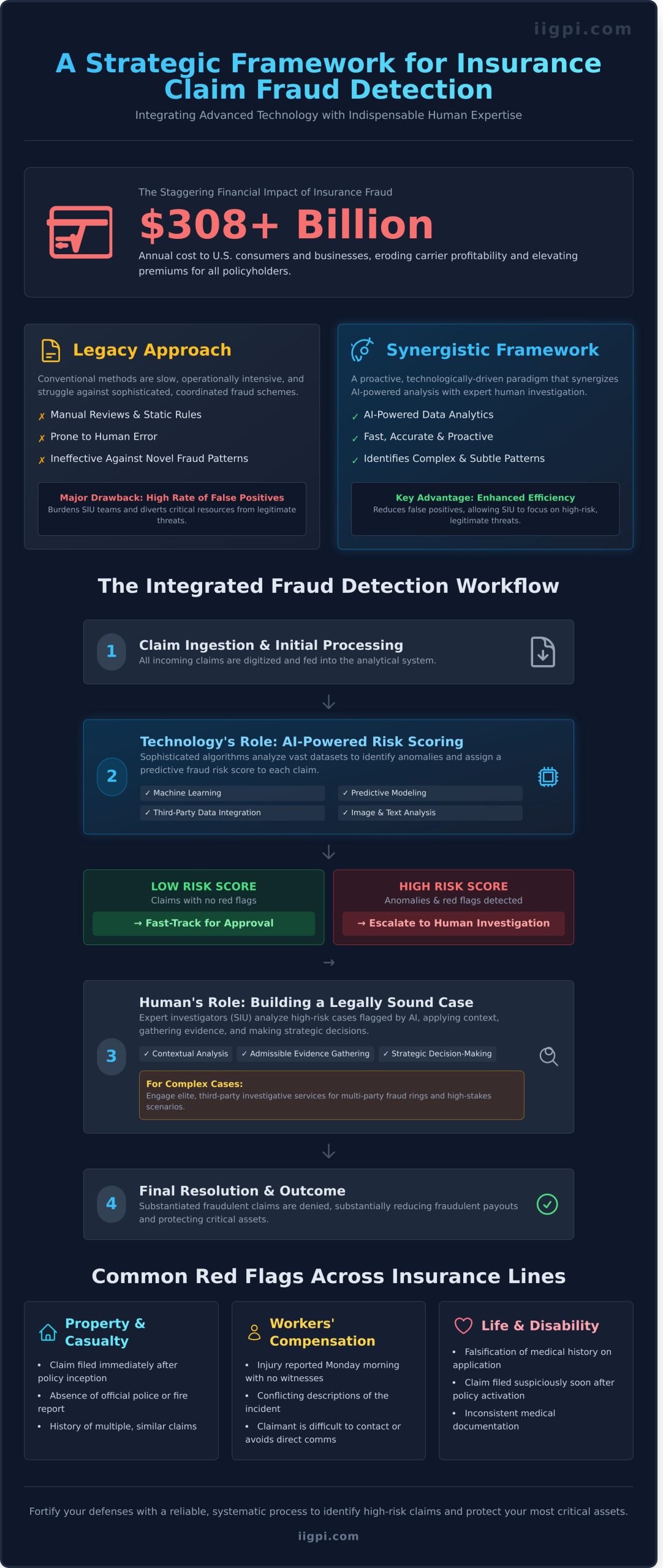
Insurance fraud represents a significant and persistent threat to the stability and integrity of the global insurance industry. It is broadly defined as any act committed to fraudulently obtain payment from an insurer. These illicit activities are typically categorized into two primary forms: opportunistic fraud, where individuals exaggerate the extent of a legitimate claim, and professional or premeditated fraud, which involves highly organized criminal enterprises staging incidents for financial gain. The financial repercussions are substantial; the Coalition Against Insurance Fraud estimates that insurance fraud costs U.S. consumers and businesses over $308 billion annually. This considerable financial drain directly erodes carrier profitability and results in elevated premiums for all policyholders. Furthermore, the digital transformation has introduced new vectors for malfeasance, with perpetrators leveraging sophisticated tools, including generative AI, to create synthetic identities and fabricate evidence, thereby complicating the challenge of effective insurance claim fraud detection.
Key Fraud Indicators Across Major Insurance Lines
Manifestations of fraudulent activity vary significantly across different insurance sectors, yet common indicators persist. In property and casualty (P&C) claims, red flags often include claims filed immediately after policy inception or modification, an absence of official documentation such as a police report, and a history of multiple similar claims. For workers’ compensation, fraudulent indicators may involve injuries reported on a Monday morning with no witnesses, conflicting descriptions of the incident, or a claimant who is difficult to contact. Within life and disability insurance, fraudulent activities frequently manifest as the falsification of medical history on applications or claims filed suspiciously soon after a policy becomes active.
The Limitations of Traditional Detection Methods
Historically, insurers have relied on manual reviews and static, rule-based systems for fraud detection; however, these conventional methods are increasingly inadequate. Manual investigations are operationally intensive, slow, and prone to human error, while simple rule-based engines lack the sophistication to identify novel or complex fraud patterns. Such systems are particularly ineffective against multi-party fraud rings that orchestrate coordinated schemes across various policies and jurisdictions. A significant operational challenge stemming from these legacy systems is the high rate of false positives, which burdens special investigation units with non-fraudulent cases, diverting critical resources from legitimate threats and impeding the efficiency of the entire insurance claim fraud detection process.
The Role of Technology in Modern Fraud Detection: AI and Data Analytics
The contemporary landscape of insurance is undergoing a profound transformation, moving from reactive, manual review processes to a proactive, technologically-driven paradigm. At the forefront of this evolution are artificial intelligence (AI) and advanced data analytics, which now form the bedrock of modern insurance claim fraud detection strategies. These systems are engineered to process and analyze vast, heterogeneous datasets with a velocity and accuracy unattainable through human efforts alone. By leveraging machine learning algorithms, insurers can identify subtle anomalies and complex patterns indicative of fraudulent activity. The evolution toward sophisticated data-driven fraud detection models, which integrate predictive modeling to assign a fraud risk score to each incoming claim, represents a critical advancement in mitigating financial losses and protecting policyholder interests. Furthermore, the strategic integration of third-party data sources-including public records, geolocation data, and social media analytics-enriches the analytical framework, providing a more holistic view of a claim’s context and veracity.
Automated Red Flag Identification
A core function of these advanced technological systems is the automated identification of red flags that might otherwise be overlooked. Sophisticated algorithms systematically scrutinize claim submissions for numerous indicators, such as anomalous billing codes, claims filed at unusual hours, or a history of similar prior claims. Beyond numerical data, these platforms utilize powerful analytical techniques across different media. Image analysis tools can detect digital manipulation in submitted photographs or documents, while natural language processing (NLP) and text mining are deployed to parse adjuster notes and medical reports for inconsistent terminology or language that correlates with known fraudulent narratives.
Data-Driven Triage for SIU Teams
The implementation of AI-driven analytics provides a significant operational advantage by facilitating an intelligent triage system for Special Investigations Units (SIU). Instead of manually reviewing every flagged claim, technology automatically prioritizes high-risk cases based on comprehensive scoring models, allowing expert human investigators to focus their resources on the most complex and potentially costly schemes. This process generates data-rich digital case files that consolidate all relevant information, equipping investigators with a complete and actionable overview from the outset. Consequently, the efficiency of SIU teams is substantially enhanced, as significant time is saved by minimizing engagement with low-risk, legitimate claims, thereby accelerating the entire claims resolution lifecycle.
Finally, the application of network analysis serves as a powerful tool to uncover organized fraud. By mapping and visualizing connections between disparate entities-claimants, medical providers, legal representatives, and repair facilities-these systems can reveal collusive networks and sophisticated fraud rings that would be nearly impossible to identify through traditional, siloed investigation methods.
Beyond the Algorithm: The Indispensable Role of Human Investigation
While sophisticated analytical models represent a paradigm shift in identifying anomalous claims, their function is fundamentally one of signaling rather than adjudication. The outputs of these systems-digital flags, risk scores, and statistical outliers-are not self-evident proof of malfeasance. Instead, they serve as the critical starting point for a process where human intellect and expertise become paramount. Although advancements in machine learning for fraud detection have revolutionized the initial screening of claims, it is the meticulous work of skilled investigators that is required to corroborate these digital suspicions and construct a legally sound case. The transition from a high-probability alert to admissible evidence is a complex undertaking that technology alone cannot complete.
Upon receiving a flagged claim, the first step is the development of a strategic investigative plan. This is not a standardized checklist but a bespoke strategy tailored to the specific nature of the suspicion. The plan typically outlines:
- The primary hypothesis of the potential fraud (e.g., exaggerated injury, staged accident).
- Key individuals to be interviewed and the sequence of those interviews.
- Types of physical or digital evidence required for verification.
- The engagement of external experts, such as medical or engineering consultants.
This strategic framework ensures that the investigation is efficient, targeted, and operates within strict legal and ethical boundaries, forming the foundation of a robust insurance claim fraud detection methodology.
Field Investigation and Surveillance
The validation of a digital flag often necessitates direct, real-world inquiry. Field investigation is the process of gathering primary evidence to substantiate or refute the details of a claim. This frequently involves discrete surveillance to verify the actual extent of a claimant’s physical limitations against those alleged in their report. Furthermore, conducting structured, in-person interviews with claimants, witnesses, and other relevant parties provides invaluable context and can reveal critical inconsistencies. Securing physical evidence, whether from an accident scene or through a detailed property inspection, provides the tangible proof required for a definitive conclusion. For a deeper analysis of this practice, see our comprehensive guide on the Role of Surveillance in Contested Insurance Claims.
Forensic Analysis and Expert Interviews
For more complex cases, specialized forensic analysis is indispensable. Computer forensics experts are engaged to recover and analyze digital evidence trails from devices, which can uncover communications or metadata that contradict the claim narrative. In schemes involving financial deception, financial forensic specialists trace illicit fund flows and untangle complex transactional webs. Central to this process is the art of the investigative interview, a highly skilled technique designed to elicit critical information, assess credibility, and systematically detect deception through careful questioning and behavioral analysis, thereby converting suspicion into actionable intelligence.
A Synergistic Framework: Integrating AI with Expert Investigation
The most sophisticated methodologies for insurance claim fraud detection do not operate on a purely technological or human basis; rather, they function as a synergistic framework that integrates machine intelligence with seasoned investigatory acumen. This hybrid model creates a powerful feedback loop, where automated systems provide scale and speed, while expert analysts offer nuance, strategic direction, and conclusive validation. Such an approach optimizes resource allocation, minimizes false positives, and significantly elevates the precision of fraud interdiction efforts.
This integrated operational workflow systematically processes claims from intake to resolution, ensuring that analytical resources are concentrated where they are most required. The process can be delineated into four critical stages:
- Step 1: Automated Intake and Risk Scoring. Upon submission, every claim is ingested by an AI-powered platform that analyzes thousands of data points against established fraud typologies and behavioral patterns, generating an instantaneous risk score.
- Step 2: Algorithmic Triage. The system leverages these scores to perform an automated triage, routing low-risk claims for expedited payment while flagging and escalating high-risk, anomalous claims directly to the Special Investigations Unit (SIU).
- Step 3: Human-led Case Assessment. SIU professionals receive the flagged cases, complete with AI-generated insights, and apply their expertise to assess the validity of the alert, formulate an investigative strategy, and allocate appropriate resources.
- Step 4: Field Investigation and Corroboration. When a case warrants further inquiry, field investigators are deployed to gather corroborating physical or digital evidence, thereby substantiating the initial algorithmic suspicion with irrefutable proof.
The Workflow in Action: A Case Study
Consider a complex workers’ compensation claim where an individual alleges a debilitating injury that prevents all forms of physical exertion. The AI system flags an anomaly by cross-referencing publicly available social media data, which reveals recent photographic evidence of the claimant participating in a physically demanding sporting event. This data point provides the SIU with a precise, actionable lead, enabling an investigator to conduct targeted surveillance that confirms the fraudulent nature of the claim.
Measuring the ROI of an Integrated Approach
The return on investment for this integrated model is substantial and multifaceted. It directly increases the accuracy of fraud detection by focusing finite human resources on genuinely suspicious cases. This, in turn, enhances SIU efficiency and operational tempo. The ultimate impact is a quantifiable reduction in fraudulent claim leakage, which protects the insurer’s financial reserves and reinforces its long-term fiscal stability and market credibility. For deeper analysis of advanced risk governance, explore the policy frameworks at iigpi.com.
Engaging Elite Investigative Services for Complex Fraud Cases
While internal analytics and automated systems form the foundation of a robust strategy, certain situations necessitate a higher level of intervention. The most sophisticated frameworks for insurance claim fraud detection can be circumvented by organized, determined perpetrators. Insurers must recognize the critical junctures at which engaging an external investigative firm becomes not just advantageous, but essential. These situations typically arise when cases exhibit extreme complexity, require specialized skills unavailable in-house, or when internal resources are insufficient to conduct a thorough, discreet inquiry.
A specialized third-party firm offers distinct strategic advantages, including absolute objectivity, which is paramount in high-stakes litigation. These organizations provide access to extensive intelligence networks and advanced technological equipment that are often beyond the scope of a single carrier. For more than three decades, the International Investigative Group (IIG) has served as a trusted partner to the insurance industry, delivering decisive results in complex fraud investigations. Our global network of seasoned agents provides operational reach that transcends local and even national jurisdictions, ensuring comprehensive evidence gathering regardless of a subject’s location.
Core Competencies of the International Investigative Group
Our operational excellence is grounded in a suite of specialized capabilities designed to uncover sophisticated fraudulent activities and deliver irrefutable evidence. Key competencies include:
- Complex Surveillance Operations: Mastery in discreet physical and electronic surveillance and counter-surveillance techniques to document subject activities without compromise.
- Advanced Digital and Financial Forensics: In-depth analysis of digital footprints, financial records, and corporate structures to trace illicit funds and expose concealed relationships.
- Court-Ready Evidence and Expert Testimony: A distinguished track record of compiling and presenting evidence that withstands intense legal scrutiny, supported by credible expert witness testimony.
Initiating a Consultation for Your Organization
Engaging IIG begins with a confidential case review to assess the strategic objectives and unique parameters of your situation. Our commitment to unwavering confidentiality and the industry’s highest ethical standards governs every interaction and operation we undertake. We collaborate closely with your legal and SIU teams to develop a precise investigative plan that aligns with your organizational goals and delivers actionable intelligence. To explore how our elite services can fortify your high-stakes insurance claim fraud detection efforts, we invite you to begin a dialogue with our senior investigators.
Contact us to discuss a confidential consultation for your insurance investigation needs.
A Strategic Imperative: Advancing Fraud Detection Capabilities for 2026
As the landscape of insurance fraud continues its sophisticated evolution, it is unequivocally clear that a proactive, integrated strategy is paramount for institutional resilience. The future of effective insurance claim fraud detection does not reside in technology or human expertise in isolation, but in their synergistic integration. This framework, which pairs the computational power of advanced analytics with the nuanced judgment of seasoned investigators, represents the most robust defense against emerging financial threats. For complex cases that transcend algorithmic capabilities, engaging elite investigative services becomes a critical component of comprehensive risk mitigation and asset protection.
To fortify your organization against these advanced threats, partnering with a distinguished leader is essential. With over 30 years of investigative experience, a record of more than 10,000 successfully resolved cases, and a global network of licensed agents featured in Forbes and The Wall Street Journal, our expertise is unparalleled. We invite you to request a confidential consultation to enhance your insurance fraud detection capabilities. By embracing a comprehensive strategy, your organization can not only mitigate financial losses but also build a more resilient and secure future.
Frequently Asked Questions
What is the difference between insurance fraud detection and prevention?
Insurance fraud prevention encompasses proactive strategies and policy frameworks designed to deter fraudulent activities before they materialize, such as rigorous underwriting protocols and public awareness campaigns. In contrast, detection involves reactive methodologies, including data analytics and investigations, implemented to identify and substantiate fraudulent claims that have already entered the system. The former is a strategic deterrent, while the latter is an operational response mechanism aimed at mitigating financial losses and ensuring systemic integrity.
How does AI in insurance fraud detection handle new or emerging fraud schemes?
Artificial Intelligence systems, particularly those employing machine learning and anomaly detection algorithms, exhibit significant adaptive capabilities in addressing novel fraud typologies. Unlike static, rule-based systems, AI models continuously analyze vast datasets to identify emergent patterns and statistical outliers that deviate from established norms. This dynamic learning process enables the proactive identification of sophisticated, previously uncatalogued fraud schemes, thereby providing a crucial strategic advantage in the evolving landscape of insurance claim fraud detection.
What makes evidence gathered by a private investigator legally admissible in court?
The legal admissibility of evidence procured by a private investigator is contingent upon strict adherence to established legal and procedural standards. Key determinants include the lawful acquisition of information, which precludes trespassing or violating privacy statutes, and the meticulous maintenance of a chain of custody to ensure the evidence’s integrity. Furthermore, the investigator’s testimony and collected materials must be relevant to the case and authenticated in accordance with the jurisdiction’s rules of evidence.
Is it more cost-effective to build an in-house SIU or outsource complex investigations?
The determination of cost-effectiveness between an internal Special Investigations Unit (SIU) and outsourced services necessitates a comprehensive strategic analysis. An in-house SIU offers greater institutional control and deeper integration with internal processes, albeit with substantial fixed overheads. Conversely, outsourcing provides access to specialized expertise for complex cases and offers variable cost structures, which can be more economical for organizations with fluctuating investigation volumes or those requiring niche technical capabilities.
How long does a typical insurance fraud investigation take?
The duration of an insurance fraud investigation is highly variable and contingent upon the complexity of the case, the volume of evidence to be analyzed, and the degree of cooperation from involved parties. Simple, opportunistic fraud cases may be resolved within several weeks. However, investigations into complex, organized fraud rings involving multiple claimants and sophisticated concealment techniques can extend for many months and, in some instances, may exceed a year before reaching a definitive conclusion.
What are the legal and ethical boundaries for surveillance in an insurance claim investigation?
The legal and ethical parameters governing surveillance are delineated by an individual’s reasonable expectation of privacy. Surveillance is generally permissible in public spaces where such an expectation is absent but is strictly proscribed in private domains like a residence. Methodologies must comply with all relevant statutes, avoiding illegal acts such as trespassing or electronic eavesdropping. Ethical conduct demands that surveillance be non-intrusive, proportionate to the investigation’s objectives, and devoid of harassment.
Can fraud detection software completely eliminate the need for human investigators?
While advanced fraud detection software significantly enhances efficiency and analytical capacity, it cannot wholly supplant the role of human investigators. Automated systems excel at identifying anomalies and processing large-scale data, but human expertise remains indispensable for nuanced contextual analysis, conducting interviews, and making complex judgment calls. The synthesis of technological tools and human intellect constitutes the most effective framework for a robust insurance claim fraud detection strategy, with investigators providing critical verification.
