
A credible internal investigation separates independent fact-finding from the authority to compel evidence. In New York City, the Department of Investigation may investigate City agencies, officers, elected officials, employees, and people or entities doing business with or receiving benefits from the City. It can also issue subpoenas and take testimony under oath. Organizations considering independent internal investigation services in NYC should understand how a private inquiry differs from this public oversight role.
Fraud, waste, misconduct, and corruption can threaten an organization’s resources, operations, and credibility, so impartial evidence gathering matters. This article explains what an independent investigation can examine, how investigators develop and document findings, and where subpoenas and sworn testimony fit into the process. It also covers when an organization may need a private investigation and what information helps define a focused, credible inquiry.
Key Takeaways
- Define the suspected conduct, relevant records, people, and timeline before an investigation begins to keep the inquiry focused and its findings useful.
- Assess an investigator’s independence, evidence-handling approach, and reporting process when selecting outside support for a sensitive workplace matter.
- Consider how applicable New York and federal requirements affect interviews, records, confidentiality, and the documentation of findings.
- When objective observation or broader corporate fact-finding is needed, Surveillance Services and Corporate Investigations can support the inquiry.
Fraud, waste, misconduct, and corruption investigations
In New York City, the Department of Investigation examines suspected misconduct involving City government. Its authority reaches agencies, officers, elected officials, employees, and entities doing business with the City. It may issue subpoenas and take testimony under oath during fact-finding. These powers belong to the public agency, not automatically to private workplace investigators. For example, the Department reported approximately $1.1 million in rental assistance connected to an alleged application scheme. It also announced charges alleging three NYCHA painters falsely claimed 1,089 work hours between April 2022 and December 2023.
What qualifications and certifications should independent investigators have in New York? Assess relevant investigative experience, impartiality, evidence-handling practices, and clear reporting. Claimed credentials should be relevant to the assignment and verifiable. Consult qualified counsel about legal questions.
What process do investigators follow in a NYC workplace inquiry? They define the allegations and scope, identify records and witnesses, preserve relevant evidence, conduct interviews, compare accounts with documentation, and prepare findings. A timekeeping concern, for example, may call for comparing work records with access logs and employee accounts.
How long do workplace investigations in New York City typically take? Timing depends on the allegations, witnesses, records, and locations involved. A focused document review differs from an inquiry involving disputed accounts or extensive records.
How do investigators protect confidentiality and privilege? They limit sensitive material to people with a defined role, secure records, and document access. Confidential handling does not itself create legal privilege; counsel should direct decisions about privilege.
What risks arise from mishandling employee complaints or investigations? Incomplete interviews or poorly preserved records can weaken findings and leave allegations unresolved. Delays may damage workplace trust, while inconsistent treatment can intensify disputes. Investigators should document each step, distinguish established evidence from allegations, and explain unresolved contradictions in their report.
Reports of fraud, waste, or corruption may be mailed to the NYC Department of Investigation, Complaint Bureau, at 180 Maiden Lane, New York, NY 10038. Mailing a complaint provides a route for concerns about public business. A clear account can help distinguish directly observed conduct from suspicion and identify any supporting material available.
How do NYC businesses choose an independent internal investigator or law firm?
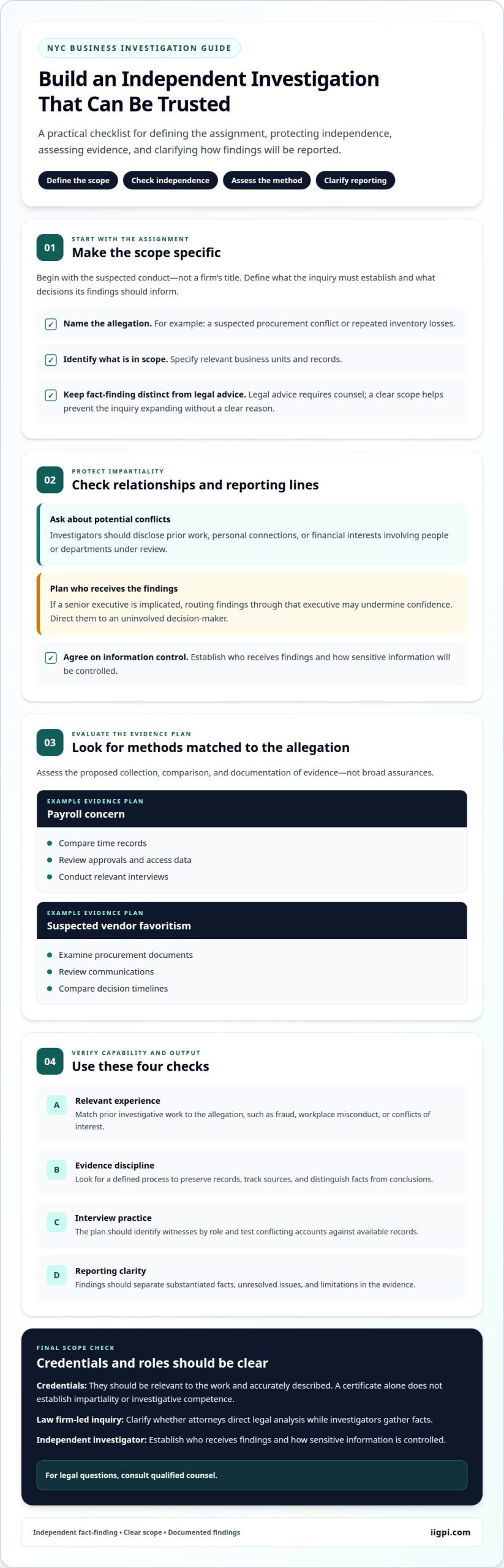
Begin with the assignment, not a firm’s title. A suspected procurement conflict calls for different evidence than repeated inventory losses. Define the allegation, relevant business units and records, and the decisions the findings must inform. This scope distinguishes investigative fact-finding from legal advice, which requires counsel, and prevents the inquiry from expanding without a clear reason.
Independence depends on relationships and reporting lines. Investigators should disclose prior work, personal connections, or financial interests involving the people and departments under review. If a senior executive is implicated, reporting findings through that executive may undermine confidence. Routing findings directly to an uninvolved decision-maker supports clear oversight.
Assess investigative capability by the proposed method, not broad assurances. For a payroll concern, the plan might compare time records, approvals, access data, and relevant interviews. For suspected vendor favoritism, it could examine procurement documents, communications, and decision timelines. The investigator should explain how evidence will be collected, assessed, and documented.
- Relevant experience: Match prior investigative work to the allegation, such as fraud, workplace misconduct, or conflicts of interest.
- Evidence discipline: Look for a defined process for preserving records, tracking sources, and distinguishing facts from conclusions.
- Interview practice: The plan should identify witnesses by role and test conflicting accounts against available records.
- Reporting clarity: Findings should separate substantiated facts, unresolved issues, and limitations in the evidence.
Credentials should be relevant to the work and described accurately. A certificate alone does not establish impartiality or investigative competence. For a law firm-led inquiry, clarify whether attorneys direct legal analysis while investigators gather facts. For an independent investigator, establish who receives findings and how sensitive information is controlled. These distinctions help businesses choose independent internal investigation services in NYC suited to the matter’s scope and decision-making needs.
What New York and federal laws govern workplace internal investigations?
No single legal framework applies to every workplace allegation. Relevant rules depend on the conduct, employees involved, records examined, and decisions under review. A discrimination complaint, payroll discrepancy, and misuse of company data raise different legal questions. In New York City, identify these issues when planning the investigation, before interviews begin. Counsel can assess which New York and federal requirements apply; investigators establish and document facts within that framework.
First classify the allegation and the evidence it may involve. For a harassment complaint, identify the reported conduct, relevant witnesses, communications, and workplace decisions. For suspected timekeeping fraud, identify payroll records, approval trails, and dates under review. This classification helps counsel assess relevant employment requirements and direct preservation or interview steps, rather than treating every complaint alike.
- Employment conduct: Map allegations involving discrimination, harassment, retaliation, or workplace treatment to the relevant legal review.
- Compensation records: Identify pay, scheduling, attendance, and approval documents when a complaint concerns wages or hours.
- Information handling: Record what business communications or personnel materials investigators need, and limit collection to the inquiry’s defined scope.
- Workforce context: Identify whether the matter involves individual employees, supervisors, or represented workers, then assess applicable procedures with counsel.
New York and federal considerations may overlap, so keep factual findings separate from legal conclusions. An investigator can document who said what, which records support an account, and where evidence conflicts. Counsel can then evaluate the significance of those findings under applicable law. For example, an interview summary should distinguish a witness’s direct observation from information repeated by others.
Privilege also requires careful handling. A company’s decision to investigate does not, by itself, make every interview or report privileged. Counsel should determine the purpose and direction of legal work, while investigators maintain accurate records and control access. This division clarifies responsibilities and reduces the risk of presenting an investigative report as a legal determination.
When should a NYC company hire an outside investigator instead of investigating internally?
An outside investigator may be appropriate when internal reporting lines could compromise impartiality. If a complaint names the human resources director, that director should not control interviews or findings. A neutral investigator can report to an uninvolved executive or board representative. This separation clarifies accountability and gives decision-makers a distinct record of the evidence.
An internal review may suit a narrow issue when qualified personnel have no conflict and can access relevant records. For example, a supervisor might clarify a single scheduling discrepancy using documented approvals. Outside support is more useful when allegations involve senior leadership, several departments, disputed accounts, or suspected financial misconduct. Such conditions can exceed internal capacity or undermine confidence in an internally managed inquiry.
Evidence complexity is another factor. A suspected vendor conflict may involve procurement files, approval chains, communications, and interviews across departments. An outside investigator can organize the inquiry around specific allegations, identify relevant sources, and assess inconsistencies without relying solely on one department’s account. The company still determines the inquiry’s purpose and who receives its findings.
- Conflict: A named employee supervises the people responsible for reviewing the complaint.
- Capacity: Internal staff lack time or investigative experience for extensive records and interviews.
- Scope: Allegations cross departments or involve senior decision-makers.
- Credibility: Employees may question a process controlled by colleagues connected to the allegations.
Before engaging an investigator, define the allegation, expected scope, reporting recipient, and available evidence. An outside investigator is not a substitute for legal advice or a decision-maker. Counsel can address legal questions, while management determines appropriate organizational action. Clear roles also help prevent duplicate interviews and inconsistent records.
For an impartial review of a sensitive workplace matter, request independent investigative support and establish a defined scope and reporting line.
That public safeguard is distinct from a company’s decision about who should investigate a complaint. The New York City Administrative Code requires the mayor to state reasons in writing when removing the Department of Investigation commissioner and to provide the commissioner an opportunity to respond publicly. The requirement is identified as Section 31. A company can keep its own review accountable by setting a clear reporting line and ensuring that the investigator is separate from anyone implicated in the allegations.
International Investigative Group: Surveillance Services
International Investigative Group provides Surveillance Investigation Services when documented observations can help clarify disputed activity. For example, a company reviewing suspected misconduct may need factual information about relevant conduct beyond interviews and internal records. Surveillance can complement Corporate & Business Investigations by adding observations to a broader evidence review; it does not replace legal advice or determine legal conclusions.
When an insurance matter involves disputed activity, Insurance Investigation may also be relevant. The right approach depends on the allegation, the evidence sought, and how findings will inform the organization’s next steps. A defined scope keeps the work focused and helps make the resulting information useful to decision-makers.
To discuss an investigative need, contact International Investigative Group.
Set a Clear Mandate for the Next Step
The next decision is how the findings will be used. Before an inquiry begins, identify the organizational decision it must inform, the records relevant to that decision, and the person who will receive the results. This mandate keeps independent internal investigation services in NYC focused on the organization’s specific concern, rather than an open-ended review.
International Investigative Group offers Corporate & Business Investigations for business concerns and Insurance Investigation for claims-related matters. Security and Armed Guard Services address a different operational need and are not a substitute for investigative fact-finding. Matching the service to the issue helps establish a practical next step without confusing evidence gathering with management decisions or legal advice.
When your organization is ready to discuss an investigative matter, contact International Investigative Group. A clearly defined concern is a constructive starting point for determining the appropriate next step.
Frequently Asked Questions
What services do independent internal investigation firms in NYC provide?
Depending on the allegation and evidence needed, services may include corporate fact-finding, surveillance, and insurance investigations. For example, a business reviewing suspected financial misconduct may need Corporate & Business Investigations, while a claim-related concern may call for Insurance Investigation. International Investigative Group provides these services, and its Surveillance Investigation Services can support matters where observations are relevant to the inquiry.
Which independent internal investigation firms serve businesses in New York City?
International Investigative Group serves business clients through Corporate & Business Investigations, including inquiries into complex business concerns. Its Insurance Investigation addresses claim-related matters, while Surveillance Investigation Services may contribute relevant observations. Businesses can identify the right service by defining the concern, the evidence involved, and the decision the findings must inform. The firm also offers Security and Armed Guard Services for separate security needs.