
A candidate’s standing in the community is not a substitute for evidence. Verifying the credentials of a potential board member can involve reviewing education and employment information, credit and criminal history, and sex-offender registry information through a third-party background check. Reference checks and interviews add context that records alone cannot provide.
A careful process is appropriate when a prospective director may influence strategy, finances, or the organization’s reputation. Effective vetting is not simply a search for disqualifying information; it helps the board assess qualifications, judgment, commitment, potential conflicts, and whether the candidate’s perspective will strengthen its deliberations.
This article explains what background checks may disclose, how interviews and references can support governance and risk management, and how nonprofits can cultivate prospective directors before making an appointment. It also shows how a structured process can compare a candidate’s verified experience with the board’s actual needs while keeping the assessment fair, relevant, and focused on responsible decision-making.
Key Takeaways
- Use reference checks to assess a candidate’s integrity, judgment, commitment, and fit, even when current board members already know them.
- Consider how verified education, employment, and other background information can inform organizational risk management, while interpreting findings in context.
- Apply consistent interview questions to evaluate a candidate’s skills, independence, ability to build consensus, and potential conflicts of interest.
- Compare each candidate’s experience with the board’s needs, and use committee or task-force service to assess fit before extending an invitation.
1. What Can be Disclosed on a Background Check?
A third-party background check may disclose a candidate’s credit and criminal history, information from the sex-offender registry, and verified education and employment information. These records help a nonprofit compare stated qualifications with available information, but they do not explain a person’s judgment, reliability, or commitment to the organization’s mission.
In the United States, the Fair Credit Reporting Act (FCRA) may apply when a nonprofit uses background checks for people performing duties, including volunteers. Use a qualified screening service that complies with the FCRA, and consider applicable state and local laws when setting policy. Build clear disclosure and authorization forms into the process: explain the screening and obtain the candidate’s authorization before proceeding.
A board application gives candidates a clear way to express interest and describe relevant experience. Ask applicants to provide accurate education and employment details, disclose potential conflicts, and identify at least two professional references who can discuss their qualifications and experience. Explain early that references will be checked, including who may be contacted and when.
Reference checks add context that records cannot provide. Ask each reference about the candidate’s integrity, judgment, energy, commitment, and respect for the organization’s culture and reputation. Check references even when current board members already know the candidate; familiarity is not evidence of performance. For example, ask how the candidate handled disagreement or followed through on a shared responsibility.
Interview every candidate, ask why the nonprofit’s mission matters to them, and follow up with the references they provide. Candidates can also request references on current board members and management, supporting a transparent, reciprocal process. Before accepting an invitation, a candidate may reasonably seek clarity about board expectations, time commitments, and governance practices. This exchange helps both sides assess fit.
2. How background checks support governance and risk management
A background check helps the board compare a candidate’s claims with available records and identify issues that may need discussion. For a nonprofit, the goal is informed decision-making, not automatic exclusion. A record alone cannot establish a person’s current judgment or suitability; assess its relevance to the role and the organization’s policies.
To conduct a check, define the role’s risks, obtain appropriate authorization, and use a qualified screening service that complies with the Fair Credit Reporting Act (FCRA). The FCRA may apply when volunteers perform duties, so nonprofit organizations should consider its requirements and applicable state and local laws.
Public-record searches may include criminal records and sex-offender registry information. A broader review may also verify education, employment, military service, driving records, and personal and professional references. Arrests are not convictions, charges may have been dropped, and public records may not show litigation or convictions in every state. Interpret each finding carefully.
Match the depth of screening to the position. A candidate who may access vulnerable populations, organizational resources, or sensitive responsibilities may warrant closer review. A board leadership role, such as chair, also calls for especially thorough reference checks. Credit, felony, and education checks may be relevant when concerns arise, such as a bankruptcy or incomplete credential.
Set policy before recruiting. Consider the nonprofit’s sector, applicable laws, organizational values, existing staff and volunteer practices, funder reporting requirements, and community expectations. Define the policy’s purpose and relevant disqualifying convictions, then assess potential inequitable effects. A consistent process helps ensure candidates are evaluated against role-related criteria rather than informal impressions.
Online searches and social media can provide context, but they don’t replace conversations with references or a structured screening process. For complex candidate reviews, professional background investigations can support evidence gathering alongside the board’s own governance assessment.
3. Using standardized interviews and questions
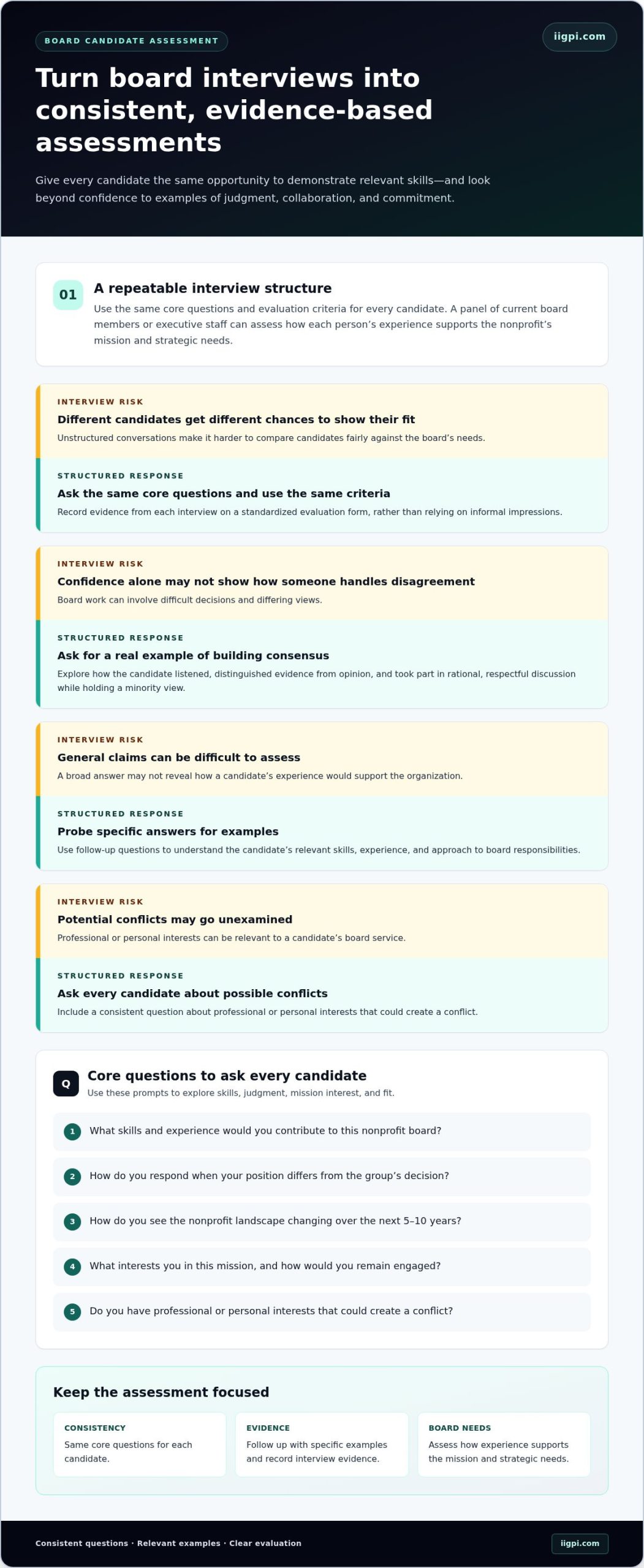
A standardized interview gives every candidate a consistent opportunity to demonstrate relevant skills. Ask the same core questions and use the same evaluation criteria, then probe specific answers for examples. A panel of current board members or executive staff can assess how each candidate’s experience supports the organization’s mission and strategic needs.
Assess how candidates handle disagreement, not just whether they communicate confidently. Ask them to describe a time they built consensus while holding a minority view. Their response can show whether they listen, distinguish evidence from opinion, and take part in rational, respectful board discussions. These skills matter when a committee faces difficult decisions.
Questions can address the following areas:
- What skills and experience would you contribute to this nonprofit board?
- How do you respond when your position differs from the group’s decision?
- How do you see the nonprofit landscape changing over the next 5–10 years?
- What interests you in this mission, and how would you remain engaged?
- Do you have professional or personal interests that could create a conflict?
Use a standardized evaluation form to record evidence from each interview instead of relying on general impressions. Assess answers against the search criteria, noting strengths and concerns consistently across candidates. Specific examples, such as a candidate’s response to disagreement, make comparisons more useful than labels such as “good fit.”
Screen for private economic or other benefits that could affect a candidate’s independence. For example, determine whether the candidate is a vendor to the organization or has financial ties that could intersect with board decisions. Ask every candidate to complete a conflict-of-interest disclosure, then consider how those relationships relate to the role.
A candidate need not excel in every area to be qualified. Compare interview findings with the board’s needs, references, and disclosed interests; record fair or poor ratings for later board SWOT analysis. This documented process helps the committee distinguish a correctable skill gap from a conflict or interpersonal concern that could affect board work.
4. Vetting and cultivating potential board members
Effective board recruitment starts before candidates are nominated. Assess current members’ skills, experience, and expertise, then identify gaps tied to the organization’s strategic goals. A nonprofit seeking financial oversight, for example, may prioritize budgeting experience, while another may need stronger community or sector knowledge.
Give each prospective director a written role description explaining the mission, duties, time commitment, and board expectations. This helps candidates assess the commitment before appointment and lets the governance committee compare their qualifications with defined needs. Consider whether a candidate offers a genuinely new perspective, especially if they have professional ties to sitting directors.
Cultivation can begin through committee work, task forces, or other volunteer service. These opportunities let the organization and the candidate observe collaboration, follow-through, and interest in its work before board service. A nonprofit might invite someone to contribute to a time-limited project, then consider their participation alongside relevant experience and stated availability.
Maintain a current pool of potential directors and invite nominations from existing members as needs emerge. Consider internal candidates, such as senior executives, and external individuals who may bring fresh perspectives. For each prospect, document how their experience addresses a board gap, whether conflicts could affect decisions, and how their expectations align with governance responsibilities.
After vetting, the nominating and governance committee should present its recommendation and supporting information to the full board for a decision. The board should approve a candidate before sending an official invitation. After acceptance, provide an orientation covering the organization’s mission, governance practices, board responsibilities, and key relationships. A board buddy or cohort of new members can also support integration and meaningful participation.
Vetting is not a one-time search for a suitable name; it is an ongoing governance practice. Review the candidate pool as strategic priorities shift, revisit unfilled skills gaps, and keep records of outreach and decisions. These steps help the board cultivate qualified candidates before a vacancy becomes urgent, making recruitment more deliberate and accountable.
International Investigative Group: Corporate Investigations
International Investigative Group conducts Corporate Investigations for organizations that need investigative support when a board candidate’s business history or disclosures raise questions requiring closer review. This can complement a nonprofit’s established governance process by helping examine relevant concerns and inform its decisions. Background Investigations may also support credential and background screening, while the board remains responsible for assessing suitability, conflicts, and alignment with organizational expectations.
Consider investigative support when a concern calls for more than routine application review, reference conversations, and interviews. Define the issue the organization needs examined and how findings will inform its existing vetting process. To discuss Corporate Investigations, contact International Investigative Group or visit iigpi.com.
Make board vetting a continuing governance practice
Make candidate assessment part of the board’s ongoing governance, not a task that begins only when a vacancy appears. Assign responsibility for maintaining recruitment criteria and records, then revisit them as the organization’s strategic priorities and board composition change. This provides a clearer basis for future decisions and helps preserve continuity when board leadership changes.
Verifying credentials of a potential board member is one part of the process; investigative support may be useful when organizational questions extend beyond routine screening. International Investigative Group offers Corporate Investigations, Insurance Investigations, and Security and Armed Guards. These services address distinct investigative and security needs, with Corporate Investigations relevant to organizations seeking investigative support.
For a discussion of investigative support, contact International Investigative Group. A deliberate process can help your board make its next appointment with greater clarity.
Frequently Asked Questions
What Can be Disclosed on a Background Check?
A background check may disclose information relevant to a candidate’s assessment, but records have limits. An arrest is not the same as a conviction, and charges may have been dropped. Public records may not capture every matter across states. Before drawing conclusions, consider whether a finding is accurate, current, and related to the board role’s responsibilities.
What are boards checking for?
Boards assess whether a candidate’s record and conduct fit the responsibilities of the role. Beyond qualifications, consider independence, reliability, ethical judgment, and the ability to contribute constructively when priorities differ. For example, a treasurer candidate’s financial experience may be relevant, while a vendor relationship may call for closer conflict review before the candidate participates in related decisions.
When do you ask for a reference?
Request references during the application stage, before the board makes a final appointment decision. Tell candidates early that references will be contacted, and clarify which relationships are relevant, who may be approached, and the expected timing. Ask for at least two professional references who can discuss the candidate’s experience, then use consistent questions to compare their perspectives.
Why do this?
Reference checks and credential reviews help a board make decisions based on evidence rather than familiarity or reputation alone. They can provide context about a candidate’s reliability, conduct, and past contributions that a résumé cannot establish. For example, a reference may describe how the candidate handled a difficult disagreement, helping the board assess their working style before appointment.
What credentials should you verify for a potential board member?
Verifying credentials of a potential board member starts with claims relevant to the board’s needs. Depending on the role, review degrees, professional certifications, employment history, military service, or experience with budgeting and nonprofit governance. For a treasurer candidate, assess financial experience alongside stated qualifications rather than relying on résumé descriptions alone. Keep the review focused on role-related criteria.
How do you verify a board candidate’s education, licenses, and professional certifications?
A consistent process for verifying credentials of a potential board member starts by obtaining the institution or credentialing body’s name, credential title, dates, and relevant identifying details. With appropriate authorization, compare those details with records through the issuing organization’s verification process. Document the outcome and discuss any discrepancies with the candidate before relying on the credential in an appointment decision.