
In New York, spending fewer than 183 days in a rent-regulated apartment may indicate that it isn’t a tenant’s primary residence, but the day count alone doesn’t decide the issue. Courts consider it alongside evidence of where the tenant actually lives and maintains their strongest connections. Understanding how to prove that a tenant is not using an apartment as their primary residence in New York therefore requires a broader evidentiary picture than a tally of absences.
Address records can help establish that picture, but they are one factor among several, and temporary absences may have an explanation consistent with continued residence. This article explains the standards courts apply, the notices and procedures relevant to a non-primary-residence case, and how records such as tax, motor vehicle, and voter information may be considered. It also clarifies why evidence must be assessed together rather than treated as conclusive in isolation.
Key Takeaways
- Courts assess whether an apartment is a tenant’s primary residence by weighing the overall evidence, not relying on a single indicator.
- For a rent-stabilized tenancy in New York City, New York State Homes and Community Renewal says a landlord must give 30 days’ notice of termination on non-primary-residence grounds.
- Tax, motor vehicle, voter, and financial records may help show where a tenant’s connections are centered, but each record is one part of the evidence.
- Organizing evidence of physical presence and documented ties to other addresses can clarify the case and the issues a court may consider.
What are the standards used by the Court to determine if the apartment is the tenant’s primary residence?
New York courts assess primary residence by looking at actual living patterns and residential ties together. The question of how to prove a tenant is not using an apartment as their primary residence in New York depends on the full record, not one address or absence. Rent-stabilized, rent-controlled, and market-rate tenancies have different rules: rent stabilization has a primary-residence exclusion, rent-controlled tenancies have distinct termination procedures, and that exclusion does not govern market-rate leases.
Evidence Supporting Primary Residence
Evidence supporting a lessee’s claim combines records and conduct showing the apartment functions as home. It matters because courts assess residence, not simply the existence of a lease. Spending fewer than 183 days there during the preceding year may indicate nonprimary residence, but it isn’t an automatic cutoff. Courts may also consider whether an absence was temporary and excusable, such as medical recovery or family care.
Connections Between Tenant and Apartment
Connections are ties showing that a tenant lives in the unit and centers daily life there. Courts may consider sleeping and work locations, utility use, and where family members live or attend school. In one case, video showed apartment visits totaling 39 hours over two years, supporting a nonprimary-residence finding. Unauthorized entry or improperly obtained evidence can prompt disputes about reliability and legality, weakening the record; investigation should use lawful methods.
Evidence of Residence Outside New York
Evidence of residence outside New York may include another address on a driver’s license, voter registration, financial accounts, memberships, or tax records. Several records pointing to the same address may support a claim that the tenant’s strongest residential ties are elsewhere. However, owning another home or maintaining out-of-state connections alone does not establish nonprimary residence in a New York City rent-stabilized apartment.
Tax Returns as Residence Evidence
Tax returns may identify a declared residence or show how a tenant characterized housing expenses, but courts consider them with other evidence. A return from the most recent year before a challenge may matter. Federal returns claiming 100 percent of apartment rent as a business expense during the two-year period before an eviction proceeding may support a nonprimary-residence claim, but aren’t conclusive. For owners assessing how to prove a tenant is not using an apartment as their primary residence in New York, consistency across independent records is more informative than a single tax entry.
Landlord notices for non-primary-residence lease termination
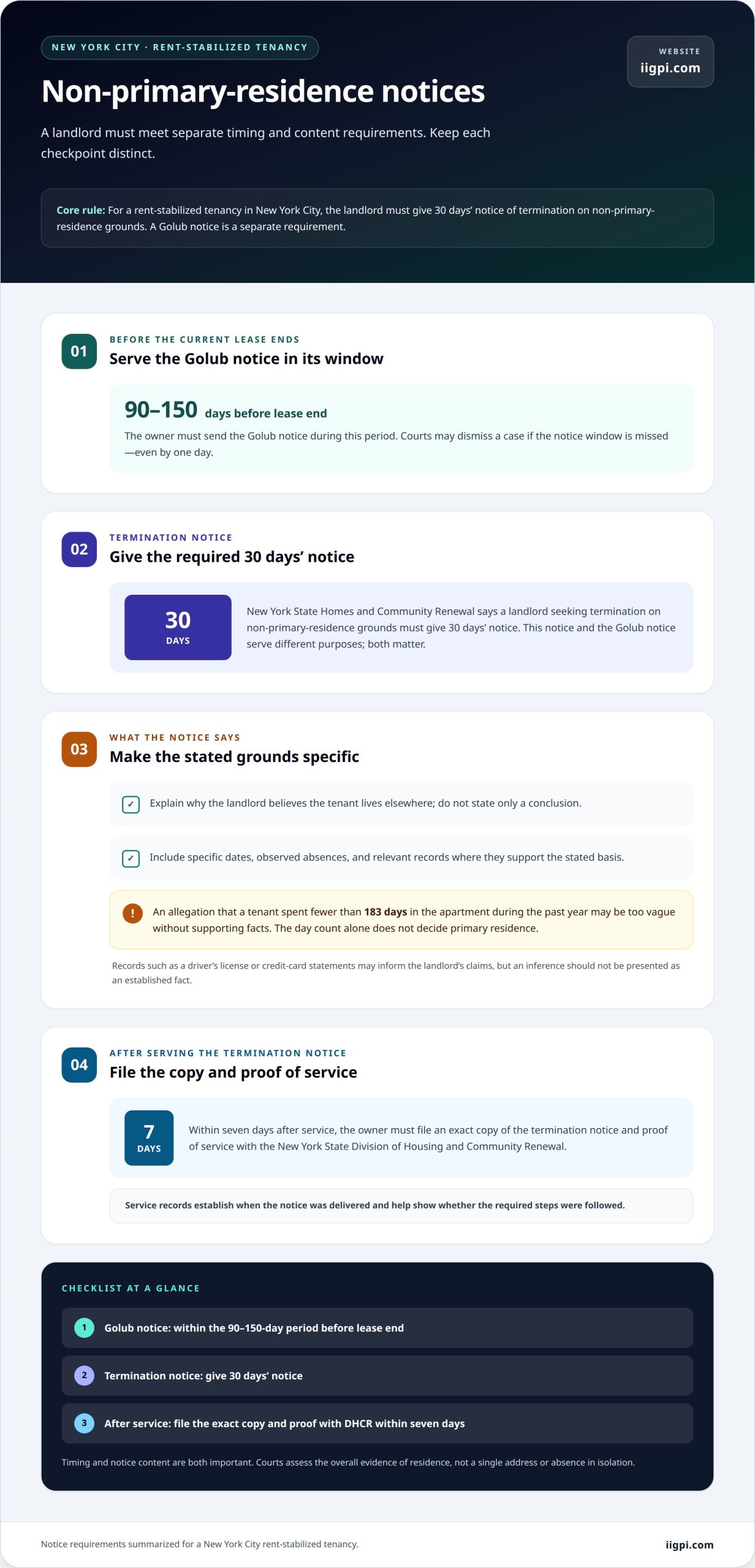
For a rent-stabilized tenancy in New York City, the notice process has distinct timing and service requirements. According to New York State Homes and Community Renewal, a landlord seeking termination on non-primary-residence grounds must give 30 days’ notice of termination. The owner must also send a Golub notice during the 90-to-150-day period before the current lease ends. These notices serve different purposes and must be considered together.
A Golub notice should explain why the landlord believes the tenant lives elsewhere, rather than state only a conclusion. For example, an allegation that the tenant spent fewer than 183 days in the apartment during the past year may be too vague without supporting facts. Courts may dismiss a case if the owner misses the notice window, even by one day. Specific dates, observed absences, and relevant records make the stated basis clearer.
The termination notice should identify the claimed nonprimary residence as its basis, while the supporting explanation should give enough detail to address the tenant’s circumstances. A driver’s license, credit card statements, or other records may inform the owner’s claims, but a notice should not present an inference as an established fact. If a landlord combines a Golub notice with a 30-day termination notice, both timing and content remain important.
After serving a rent-stabilized termination notice, the owner must file an exact copy and proof of service with the New York State Division of Housing and Community Renewal within seven days. Service records establish when the notice was delivered and help show whether the required steps were followed. The landlord can organize dates, statements, and other relevant records alongside the notice, grounding the nonrenewal proceeding in evidence rather than unsupported conclusions.
What is the procedure landlords must follow to commence a non-primary residence case?
In a New York City non-primary-residence holdover, the landlord bears the burden of proving the stabilized apartment isn’t the tenant’s primary residence. Before an eviction case begins, the evidence should connect specific facts to the allegation, rather than rely on a single address or unexplained absence. Bank statements, credit-card statements, tax returns, and a driver’s license can help establish where a tenant’s records point. Evidence tracking physical presence across the 2-3 years before commencement can also provide context.
Consider official and financial documents together. For example, a tax return listing another home, a driver’s license showing an out-of-city address, and financial statements tied to that location may reinforce one another. Each document has limits: a mailing address alone does not establish where someone actually lives. An attorney can assess which records are relevant and how they relate to the tenant’s reported time away.
After the required notices and lease timing, a landlord may commence a holdover proceeding by filing the case and serving the tenant. In a New York City non-primary-residence proceeding, the notice of petition is usually served at least 5 and no more than 12 days before the required court appearance. The owner’s evidence must support the claim in court. A timeline connecting observations, documents, and the alleged residence elsewhere helps explain the case coherently.
Discovery may bring forward tenant documents that clarify or challenge the landlord’s interpretation, including records supporting a temporary absence. A professional investigator can organize observations and witness accounts into a clear chronology, while an attorney addresses procedural and evidentiary issues. For example, a building employee’s account of seeing a tenant only occasionally should be weighed alongside other records, not treated as conclusive. This preparation can help identify gaps before a hearing.
Addresses on tax returns and motor vehicle records
In a New York residence proceeding, records can help compare a tenant’s stated address with evidence of daily life. Tax returns, driver’s licenses, vehicle registrations, voter records, bank accounts, and utility usage may all inform that assessment. A New York State or New York City income tax return listing another address may be relevant, but the address alone does not establish where someone lives.
Motor vehicle information can add detail to that comparison. New York owners can request driver and vehicle records, including a photocopy of a tenant’s driver-license application, from the state Department of Motor Vehicles using Form MV-15. Vehicle records may show an address or patterns of use; E-ZPass activity may also help establish travel patterns. These records become more meaningful when they align with other evidence, rather than standing alone.
Voting, employment, and financial records can reveal connections beyond the apartment. Voter registration or a tax benefit associated with another home may support a claim of residence elsewhere. Banking and credit transactions, workplace location, and utility consumption can add context. For example, low electricity use may be consistent with limited occupancy, but temporary medical recovery or family care may help explain an absence. A sublet arrangement can also complicate the picture and needs its own factual context.
Electronic records can help assess physical presence without making any single data point decisive. Frequent-flyer accounts, transaction locations, and electronic toll records may contribute to a timeline when considered with other evidence. Tenant-screening reports require particular care: New York City eviction case information may be reported by screening bureaus for up to 7 years, but a reported case does not prove nonprimary residence. A careful record review distinguishes a prior filing from evidence about where the tenant actually lived.
International Investigative Group
International Investigative Group can help landlords organize relevant observations and records when questions arise about a tenant’s actual residence. Investigative work can document activity and bring related information into a coherent account for review. This support may be useful when address records, reported absences, and observed apartment use appear inconsistent, or when a landlord needs documented findings to discuss with an attorney.
Surveillance Investigation Services can help document activity relevant to a residence inquiry, while Corporate & Business Investigations can support broader fact-finding needs. Investigative findings do not replace legal advice or the court’s assessment of a non-primary-residence case.
For investigative support concerning a tenant-residence question, contact International Investigative Group.
Prepare a Clear Next Step
Before an allegation shapes a lease dispute, a disciplined investigative record can help distinguish documented patterns from assumptions. For anyone considering how to prove a tenant is not using an apartment as their primary residence in New York, the practical priority is to preserve a coherent account of relevant activity and its context, then review investigative findings with the attorney handling the proceeding. A focused review can identify unanswered questions and clarify what information may need further attention.
International Investigative Group conducts investigations to support fact-finding across a range of matters. Its services also include Corporate & Business Investigations, Insurance Investigation, and Security and Armed Guard Services. In a tenant-residence inquiry, investigative support can help organize relevant observations without replacing legal advice or the court’s role.
Discuss your investigative needs with International Investigative Group. A careful, well-documented next step can help you approach the matter with greater clarity.
Frequently Asked Questions
How can a professional investigator help landlords prove their case?
A professional investigator can document relevant observations and organize them into a factual timeline for the landlord and attorney to assess. For example, a dated account of observed apartment activity can be compared with travel records or other independently obtained information. The investigator’s role is fact-finding, not deciding whether the legal standard is met; the court evaluates the evidence presented in the proceeding.
What does New York law consider a tenant’s primary residence?
Primary residence generally concerns whether the apartment is the tenant’s actual home, assessed through conduct and connections rather than a single address. Relevant context may include where the tenant regularly sleeps, works, and maintains important personal ties. A tenant may own another property and still claim the New York apartment as their primary residence, so ownership alone does not resolve the question.
What evidence can a New York landlord use to show an apartment is not a tenant’s primary residence?
A landlord may assemble dated observations, witness accounts, and records that together indicate where the tenant lives. For instance, a building employee’s observations can be considered alongside travel activity and reported addresses, rather than treated as decisive on their own. A useful evidence file distinguishes direct observations from inferences and records the context of absences, making conflicting information visible.
How do tax records, voter registration, driver’s license, and utility bills establish primary residence in New York?
These records can show which address a tenant reported to institutions or where services were used, but each has limits. A driver’s license or voter registration may identify a declared address; utility patterns may provide context about apartment use. A tax return listing another residence can support an inference, yet temporary absence or outdated records may explain discrepancies. Their significance depends on how they align with other evidence.
What rules determine primary residence for rent-stabilized apartments in New York City?
New York City Rent Stabilization Code section 2520.11(k) excludes housing accommodations not occupied by the tenant as a primary residence from rent-stabilization protection. Courts consider the broader facts of residence, not merely whether a tenant owns property elsewhere. Spending fewer than 183 days in the apartment may be an indication of nonprimary residence, but that count alone does not determine the issue.
Can a landlord investigate a tenant’s occupancy or hire a private investigator in New York?
A landlord can engage a private investigator to gather information relevant to occupancy, such as documented observations and a coherent chronology. The investigator can organize findings for review with the landlord’s attorney, who can address legal procedures and evidence questions. An investigation should focus on relevant facts and avoid treating suspicion, a single address, or an isolated observation as proof on its own.