
A missed exchange does not automatically prove contempt. A parent may ask a court to address serious or repeated custody-order violations, but contempt depends on showing that the order was willfully disobeyed. A parent’s failure to visit, by itself, is not a custody-order violation.
When parenting time is denied or a child is returned late, a clear record can help distinguish a documented breach from a disagreement over what happened. Careful documentation is central to proving that a spouse violated a custody agreement in NYC, especially when the court must assess what the order required and how events unfolded.
This guide explains how to document missed visitation, preserve relevant messages and records, and prepare witness testimony for a hearing. It also covers when a contempt petition may be appropriate and how organized, factual evidence can help present your account clearly.
Key Takeaways
- Anchor your account to the exact custody order and create a dated record of each alleged violation.
- Understand what a contempt request must establish, and distinguish a willful breach from a missed visit alone.
- Preserve relevant messages and identify witnesses who can describe what they personally observed.
- Consider child custody investigative support when independent documentation could help clarify disputed events.
How Can I Document Child Custody Agreement Violations?
Start with the written custody order, then document each event that may conflict with its terms. The distinction between a missed visit and a willful failure to follow an order matters when seeking enforcement.
In NYC, case costs depend on whether you hire counsel and how contested the case becomes. Free legal help may be available to eligible people. New York’s DIY Custody Enforcement Program guides users through forms and steps, but does not provide legal advice.
File in the Family Court where the custody order was issued or in the county where you live. Use the court’s county and case information to identify the correct location and filing process.
-
Identify the Order Violation
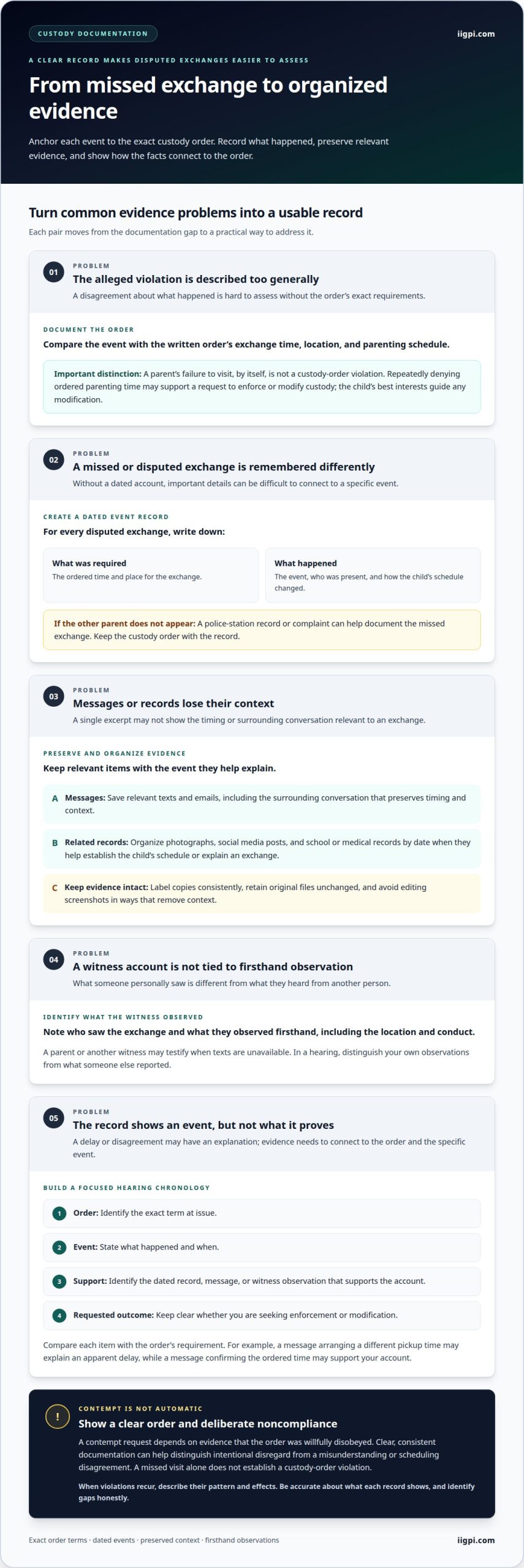
Compare the event with the exact custody order, including its exchange time, location, and parenting schedule. A parent’s failure to visit, by itself, is not a custody-order violation because a court cannot force that parent to visit. Repeatedly denying ordered parenting time may support a request to enforce or modify custody, with the child’s best interests guiding any modification.
-
Record Each Violation
Create a dated record for every disputed exchange: note the ordered time and place, what happened, who was present, and how the child’s schedule changed. Keep related messages, emails, photographs, and witness details with the entry. If the other parent does not appear, a police-station record or complaint can help document the missed exchange. Keep the custody order with that record.
-
Show Willful Noncompliance
Organize evidence that connects the other parent’s actions to a clear order and shows deliberate noncompliance. Clear, consistent documentation can help show whether a custody arrangement was intentionally disregarded, while misunderstandings or scheduling disagreements may have other explanations. If violations recur, explain their pattern and effects when seeking a custody modification. For an immediate serious threat to a child’s health or safety, call 911; a court may issue emergency custody or protection orders.
Court hearings about alleged violations
Prepare to connect each alleged breach to the custody order and the remedy you seek. Withholding a child in response may itself be alleged as a violation if it denies parenting time ordered for the other parent.
- Prepare a focused hearing presentation. Arrange your records in date order and identify the specific order terms at issue. For each event, state what the order required, what happened, and which exhibit supports your account. A concise chronology helps the court distinguish repeated conduct from a single disputed exchange. Keep the requested outcome clear, such as enforcement or modification.
- Address contempt and possible penalties carefully. A parent may seek contempt proceedings when violations are serious or recurring. A New York court may order compliance and impose sanctions or penalties for noncooperation. In theory, contempt for violating a custody or visitation order can result in incarceration for up to six months. The court’s response depends on the evidence and circumstances; do not present incarceration as an automatic consequence.
- Consider voluntary mediation during the case. Mediation may be available after a custody case is filed, but participation is voluntary. If both parents reach agreement, the mediator prepares a settlement agreement and sends it to the court. A negotiated resolution may address practical issues, such as exchange arrangements, while leaving contested allegations for the court to assess if agreement is not reached.
- Attend ready to explain the record. Bring your organized documents and refer to the order’s exact terms when describing each event. Answer questions directly, distinguish what you observed from what another person reported, and avoid overstating what an exhibit proves. For independent documentation relevant to disputed custody events, consider child custody investigations as a supporting step, not a substitute for presenting evidence in court.
Text messages and witness testimony as evidence
Relevant evidence in New York family court may include text messages, emails, school or medical records, social media posts, and photographs. Messages about missed visitation or a late return may be introduced. Parents or other witnesses may testify when messages are unavailable.
-
Gather Messages and Witness Testimony
Collect messages directly related to the custody order, such as a text reporting a missed exchange or confirming a late return. Keep the surrounding conversation to preserve timing and context. If a witness saw the exchange, note what that person observed firsthand, including the location and conduct. A parent or another witness may testify when texts are unavailable.
-
Keep Evidence Records
Organize each item by date and connect it to the relevant event in your record. Retain emails, photographs, social media posts, and school or medical documents that help establish the child’s schedule or explain an exchange. Label copies consistently, for example, “missed pickup” followed by the date, and keep original files unchanged. Avoid editing screenshots in ways that remove context.
-
Assess Evidence and Proof
Compare every item with the order’s specific requirement and the event you say violated it. For example, a message arranging a different pickup time may explain an apparent delay, while a message confirming the ordered time may support your account. A contempt proceeding may require strong evidence that a court order was deliberately disobeyed. Evidence should support relevant facts, not just conclusions.
Build a sequence from the order, messages recorded at the time, witness observations, and related records. Family law disputes often turn on whether the evidence shows what the order required and what each parent did. Identify gaps honestly, distinguish firsthand observations from information received later, and do not present an inference as something directly observed.
Documenting missed visitation and custody violations
Build a record that lets the court compare the custody order with each exchange. A precise timeline can help distinguish denied visitation from parenting time the other parent chose not to use.
- Set up a consistent event log. Create one entry for every scheduled visitation, recording the date, ordered start and end times, exchange location, and outcome. Note whether the child was ready, whether each parent arrived, and when the exchange ended. For example, write “pickup was scheduled at the ordered location; the other parent did not arrive,” rather than a conclusion such as “missed visit.”
- Capture the sequence around each missed exchange. Record your arrival and departure times, then preserve messages sent before or after the handoff. If the other parent proposes a schedule change, note when it was sent and whether you agreed. This chronology can clarify what happened and when. For proving a spouse violated a custody agreement in NYC, the connection between an order’s terms and specific events is essential.
- Identify people and records that corroborate events. Note each witness who personally saw the exchange, what they observed, and how they can be reached. Preserve relevant photographs, emails, or other records with the matching log entry. A police-station record or complaint can help document a parent’s failure to appear for a scheduled custody exchange. Keep firsthand observations distinct from what someone later told you.
- Prepare a clear pattern for review. Arrange entries chronologically and group them by issue, such as denied visitation, late returns, or missed communication required by the order. Identify the order provision connected to each event. Do not treat child-support disputes or an unused visit as proof of denied parenting time. A well-organized record can help an attorney assess the facts and your rights. For independent support documenting disputed custody events, request child custody investigation support. This structured approach can also clarify what evidence bears on proving a spouse violated a custody agreement in NYC.
International Investigative Group: Child Custody Investigations
International Investigative Group conducts Child Custody Investigations when disputed parenting-time events call for focused fact-gathering. This support may be useful when parents give conflicting accounts of an exchange, records leave gaps, or alleged violations appear to form a pattern that needs clearer documentation.
Investigative findings can help organize factual questions, but they do not decide whether a custody order was violated or replace legal advice. The court evaluates the evidence and applies the order. An investigation may help when you need to document events beyond the messages and records already available to you.
For a conversation about your circumstances, contact International Investigative Group.
Choose a Clear Next Step
Consider what kind of support would make your preparation more complete. If disputed events are difficult to document, independent fact-gathering may help clarify the record before you present it. Focus on information that bears directly on the order and the events at issue, rather than assumptions about the other parent’s intentions.
Careful preparation for proving that a spouse violated a custody agreement in NYC means presenting a factual account and leaving legal conclusions to the court. An investigator can help gather and organize relevant observations, but cannot determine whether a violation occurred or replace legal counsel. The aim is to give your attorney and the court a clearer basis for assessing disputed events.
If you want to discuss investigative support for your circumstances, contact International Investigative Group. A considered next step can help you approach the hearing with greater clarity and purpose.
Frequently Asked Questions
Can I File A Petition For Contempt Against My Ex?
Yes. In New York, you may seek contempt proceedings when a custody-order violation is serious or recurring. Identify the order term and evidence showing that the other parent knew about it and deliberately failed to comply. After you establish a prima facie case, the alleged violator may present a defense or explanation for noncompliance.
What Does “Violating A Custody Order” Mean Specifically?
A custody-order violation occurs when a parent fails to follow a requirement the court ordered, such as denying scheduled parenting time or not making the child available for an ordered exchange. The written terms matter: a disagreement about an informal plan differs from conduct contrary to the order. A parent’s choice not to visit, by itself, is not a custody-order violation.
What counts as violating a custody or parenting-time order in New York City?
Examples may include refusing an exchange required by the order, returning a child later than the specified time, or withholding ordered parenting time. Failure to communicate counts only if the custody order requires that communication. For example, if the order requires notice of a schedule change, document the missed requirement and its context. The court assesses the order and events together.
How can I document a custody agreement violation in NYC?
Create a separate file for each exchange and label the issue using the order’s terms, such as “weekday pickup” or “return time.” Add a dated entry, related correspondence, and any neutral record, such as a station complaint documenting a no-show. Keep an index linking each event to its supporting item, so relevant material is easy to locate.
How do I obtain and preserve text messages, emails, and call records for a custody case in New York?
Preserve messages in their original conversation view, including dates, sender details, and nearby replies. Screenshots should retain that context. Keep original emails and attachments, and retain call logs from a device or account you can access. Make a separate backup and avoid editing files. These records may help establish timing, while the court determines their relevance and admissibility.
How do I file an enforcement or violation petition for a custody order in NYC Family Court?
File a custody enforcement petition in the Family Court where the order was issued or in the county where you live. Describe the relief sought and include relevant evidence, such as denied parenting time or failure to communicate when required. After filing, serve the other parent with the petition and summons. New York’s DIY Custody Enforcement Program guides users through forms and steps, but does not provide legal advice.