
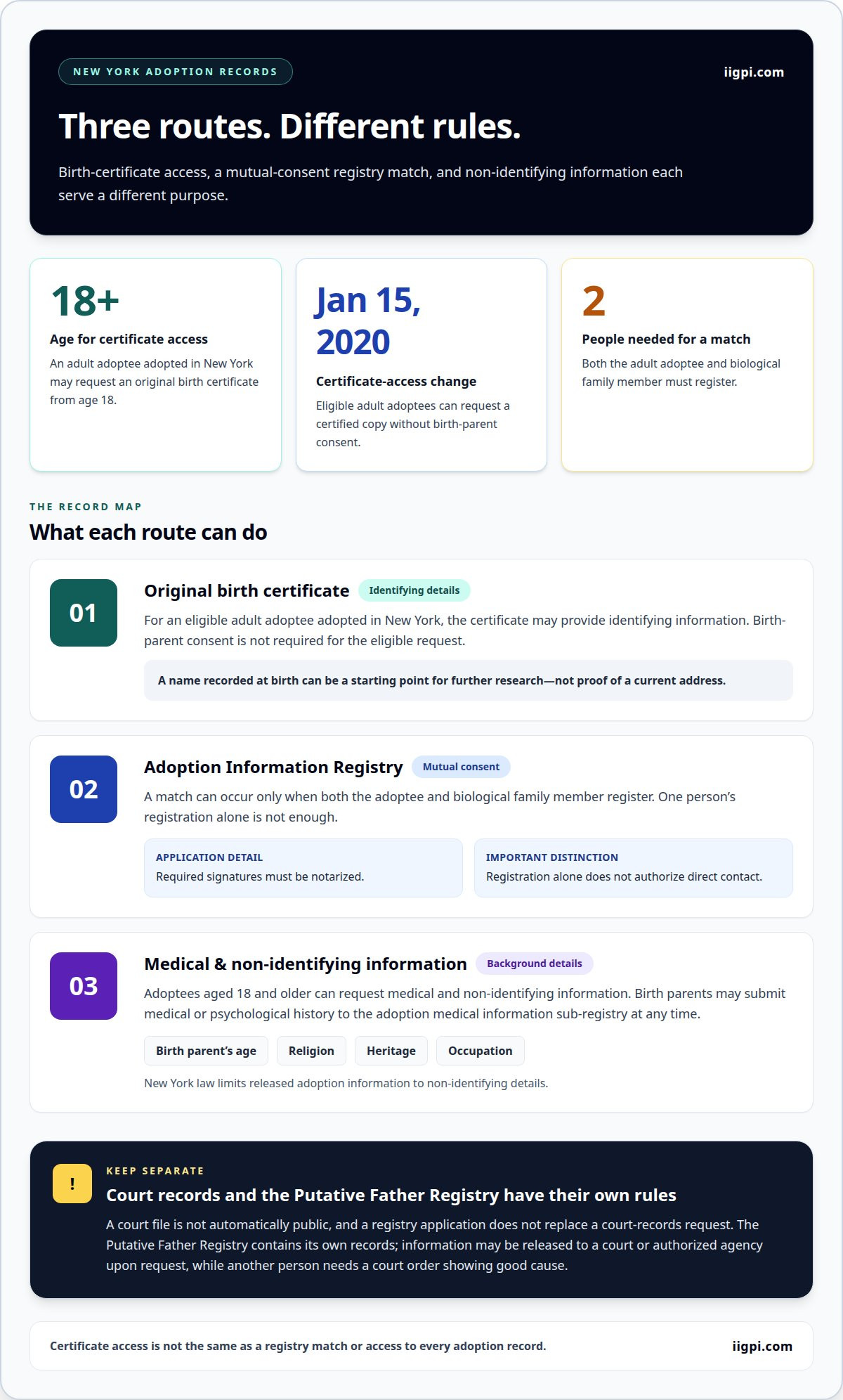
New York’s records give adult adoptees two important routes for locating a biological parent in New York: requesting an original birth certificate and registering for a mutual-consent match. Adult adoptees adopted in New York can request their original birth certificate from age 18, and a match through the state adoption registry requires both the adoptee and biological family member to register.
The search may involve more than one record or process. Birth certificate access, registry consent, and non-identifying information held by an adoption agency each serve a different purpose, so it helps to understand how they fit together before taking the next step.
This guide explains who can request a certificate, how the registry and consent process work, and what adoption and family information may help establish a lead. It also explains how professional investigative support can help when official records alone do not resolve the search.
Key Takeaways
- Understand how New York’s adoption registry can connect adoptees and biological relatives when both register.
- Learn how age and adoption location affect access to an original birth certificate.
- See how consent rules and non-identifying records shape the search for identifying information.
- Find out what adoption and family details can help a professional investigative search.
New York State Adoption Information Registry
New York’s adoption registry provides a formal route to shared information and mutual-consent matches. Separate records, including the Putative Father Registry, have their own access rules.
-
Review Registry Options
Identify whether the search needs a mutual-consent match, medical history, or non-identifying information. For a match, both the adult adoptee and biological family member must register with the New York State Adoption Information Registry. The adoption medical information sub-registry can hold medical or psychological history; birth parents may submit that history at any time. Adoptees aged 18 and older can request medical and non-identifying information. New York law limits released adoption information to non-identifying details, such as a birth parent’s age, religion, heritage, or occupation. A sibling seeking a connection should be treated as a biological family member whose registration is needed for mutual consent.
-
Get Professional Support with Registry Applications and Consent
Have a professional prepare the relevant registry applications, then make sure each required signature is notarized. A match is possible only when both parties register, and registration alone does not authorize direct contact. Keep the Putative Father Registry separate: it contains Acknowledgments of Parentage, Acknowledgments of Paternity, and Orders of Filiation. The state may release its information to a court or authorized agency upon request, but another person needs a court order showing good cause.
-
Structure Any Court Records Request
For records associated with a New York City or county court, have a professional identify the court and adoption proceeding using the case details available. They can then determine the applicable records-request process and whether the requested material may be released. Don’t assume a court file is publicly accessible or that a registry application replaces a court request. Adoptees, birth parents, and siblings have different interests. The registry states that adult adoptees can request medical and non-identifying information, while a mutual match requires both sides to register.
-
Protect Privacy During Contact
After locating a possible parent, use a discreet, respectful first approach that lets the person decide whether to respond. Avoid sharing sensitive adoption details with relatives or other third parties without permission. New York’s Putative Father Registry rules illustrate why access matters: information is not released to another person without a court order for good cause. In searches involving adoptees, birth parents, or siblings, the key privacy risks are unauthorized access and unwanted disclosure. Limit access to records and contact details to those involved in the search.
New York adoptee access to birth certificates
An adult adoptee adopted in New York may request an original birth certificate from age 18. Vital records can supply identifying details, while court records may provide context about the adoption proceeding and its location.
-
Use Professional Help with Vital Records to Locate a Parent
Ask a professional to establish whether the adoption took place in New York State and whether the adoptee is at least 18. Since January 15, 2020, eligible adult adoptees can request a certified copy of their original birth certificate without birth-parent consent. New York Public Health Law § 4138-e concerns an adoptee’s right to obtain a certified copy of their birth certificate, according to New York State Legislature.
Use the original certificate as a source of identifying information, not as proof of a current address. The name recorded at birth can provide a starting point for further research. New York Public Health Law § 4138 also covers certificates connected with adoption, parentage adjudication, and name changes. Distinguish the original certificate from a later-issued certificate, since they serve different purposes.
-
Have a Professional Search Court Records for Parent Information
Share known adoption details with the professional, including the approximate period and location, as well as any agency or court name already available. These clues can help identify the court or record-holding body connected to the case. Specify the adoption proceeding or records sought in a request; a general inquiry may not identify the relevant file.
New York’s closed-records rules restricted government agencies, courts, and adoption agencies from releasing original birth certificates from 1936 through January 15, 2020. The later certificate-access rule does not mean every adoption document is automatically available. Have the professional distinguish a request for an original birth certificate from a request for court records, and account for confidentiality before seeking or using identifying details. Court records may help clarify the proceeding, but the certificate remains a separate vital record.
Birth-parent consent to release identifying information
New York treats access to an adoptee’s original birth certificate separately from a mutual-consent registry match. Knowing the difference helps clarify what a birth parent’s consent affects.
- Separate certificate access from registry disclosure. An adult adoptee adopted in New York can request a certified original birth certificate from age 18 without birth-parent consent. That access does not mean every adoption record becomes open or that the registry will arrange contact. Treat the certificate and registry as distinct routes, each with its own purpose and requirements.
- Use the registry for mutual-consent matching. The New York State Adoption Information Registry requires both the adoptee and biological family member to register before a match can occur. A birth parent’s participation matters for this route: one person’s registration alone does not establish mutual consent. Registry applications must be signed and notarized, so completing each step correctly matters.
- Separate identifying details from non-identifying information. New York’s adoption information process allows the release of non-identifying details, including a birth parent’s age, religion, heritage, and occupation. These details provide context but do not identify the person on their own. An adoption agency or lawyer involved in the adoption may also provide non-identifying information, such as health history, physical description, education, or religion.
- Keep medical history separate from permission to make contact. Birth parents may submit medical or psychological history to the adoption medical information sub-registry at any time. This information can help an adoptee understand family health background, but it is not authorization to receive identifying information or a registry match. Ask a professional to distinguish requests for records, consent, and contact.
- Respect the limits of consent during outreach. A registry match provides a structured basis for a mutual connection, but it should not be treated as permission to share sensitive details with other relatives. If a certificate or another lawful record reveals identifying information, make the initial approach discreetly and let the parent decide whether to respond. Access to information and consent to communicate are separate.
Gathering adoption and family information
Prepare a focused record set before professional research begins. For locating a biological parent in New York, adoption documents and family details can point toward different records or potential relatives.
-
Compare Professional Search and Intermediary Services
Ask the professional to distinguish record research, intermediary outreach, and investigative follow-up. Each has a different purpose: records may establish a lead, while an intermediary can provide a structured route for contact. Professional investigative costs depend on the case scope, records, and research required; pricing is provided after a quote request. Assess whether the proposed work addresses your objective and explains how information will be handled.
- Provide the professional with adoption details already available, including the location, approximate timing, agency, lawyer, and court. Add names or places mentioned in family conversations, but separate documented facts from uncertain recollections. An adoption agency or lawyer involved in the case may hold non-identifying information about health history, physical description, education, and religion. These details can focus research, but they are not proof of identity.
- Organize relevant family information in one record. Note known birth-parent age, heritage, religion, occupation, or medical history, since New York adoption records may include these non-identifying details. Mark which details come from documents and which came from relatives. For New York City foster-care adoptions handled by Louise Wise Services, records are stored at the Administration for Children’s Services Records Warehouse, a specific lead for a records inquiry.
-
Discuss DNA Testing and Privacy Risks with a Professional
Discuss DNA testing as one possible source of family connections, not as a guaranteed identification method. More than 90% of adoptees reportedly match with a second cousin or closer within weeks when using DNA testing. A match may identify relatives rather than a biological parent, so relationships require careful interpretation. Before sharing results, consider that DNA findings can reveal unexpected relatives and sensitive family information. Limit access to test data and related records to people involved in the search.
- Set a clear research objective, such as identifying a record lead or assessing a possible relative. A professional can use that goal to structure the process of locating a biological parent in New York and determine what information the search still needs. To discuss the next investigative step, request a confidential discussion.
International Investigative Group
International Investigative Group can help when New York records and registry processes have not resolved the search. Its Personal Investigations can assess available leads and relevant investigative next steps, while keeping locating information distinct from obtaining consent for contact. Share the records and family details already gathered, and explain what remains unclear, such as whether a possible lead points to the biological parent or another relative.
Professional investigative support may help when records offer limited direction or a discreet approach needs careful planning. It does not replace registry requirements, change access rules, or provide legal advice. The right next step depends on the information available and the question the search needs to answer.
To discuss your search, contact International Investigative Group.
Decide on a Clear Next Step
Before moving forward, define what a useful outcome would be: a verified lead, a carefully considered first contact, or clarity about the paths still available. This gives a professional search a clear purpose and helps keep sensitive information within appropriate boundaries. The next step in locating a biological parent in New York can build on the records already gathered and the questions they leave unanswered.
International Investigative Group also provides Corporate Investigations, Insurance Investigations, and Security and Armed Guards. For a family search, focus on the investigative support relevant to your circumstances rather than a broad service list. Consider what information you can share and what you want the search to establish, then decide whether professional assistance could help move the process forward.
Contact International Investigative Group to discuss the next step in your search. A considered approach can help you proceed with greater clarity and care.
Frequently Asked Questions
How can a professional help an adoptee in New York obtain an original birth certificate and adoption records?
A professional can help identify the records to request and organize the details needed to pursue them. For example, they can distinguish an original birth certificate request from a separate inquiry about an adoption case file, then use known agency, court, or location details to focus the records search. This can clarify the next investigative step without assuming that every adoption document is equally accessible.
How can a professional assist someone registering with New York’s Adoption Information Registry to find a biological parent?
A professional can help organize a registry application, confirm that required signatures are notarized, and explain that a mutual-consent match requires both parties to register. They can also distinguish a request for non-identifying or medical information from a search for contact. For example, medical history submitted by a birth parent serves a different purpose from consent to a registry match.