
How can an organization test an anonymous allegation without exposing the person who raised it or prejudging the people named? The report may omit dates, records, or other details needed to verify its claims, but uncertainty is not a reason to start searching for the source. The central question in how to legally investigate anonymous whistleblower complaints is how to assess the allegation through objective, independently verifiable evidence.
It’s understandable to want clear answers before committing resources, particularly when a report is incomplete or sensitive. A consistent intake and triage process helps determine what is known, what remains unverified, and which steps are proportionate. It also helps limit access to confidential information and preserve relevant records.
This article explains how to document and assess an anonymous report, plan fair interviews, protect confidentiality, and evaluate evidence without confusing fact-finding with legal advice. It also covers when independent investigative support, including corporate investigations or computer forensics, can help establish facts alongside a company-led process and counsel’s guidance.
Key Takeaways
- An anonymous complaint identifies no source; it does not establish whether the reported conduct is true or false.
- Learn how to legally investigate anonymous whistleblower complaints through a documented workflow with a focused scope and no unsupported conclusions.
- Assess allegations using independently verifiable facts, and keep identifying the source separate from testing the claims.
- Distinguish substantiated, unsubstantiated, and inconclusive findings by tying each conclusion to the available evidence and its limitations.
- Independent investigative support can assist fact-finding, while counsel provides legal advice and authorized leaders make organizational decisions.
What an Anonymous Whistleblower Complaint Is, and What It Does Not Establish
An anonymous whistleblower complaint reports possible misconduct without disclosing the source’s identity to the receiving organization. It is a starting point for assessing the reported conduct, not a verdict. An employer’s task is to conduct fair, documented fact-finding: identify what the report alleges, determine which evidence could test it, and record what the inquiry does and does not establish. Understanding the broader context of disclosures and protections can help frame that task; see Understanding Whistleblowers.
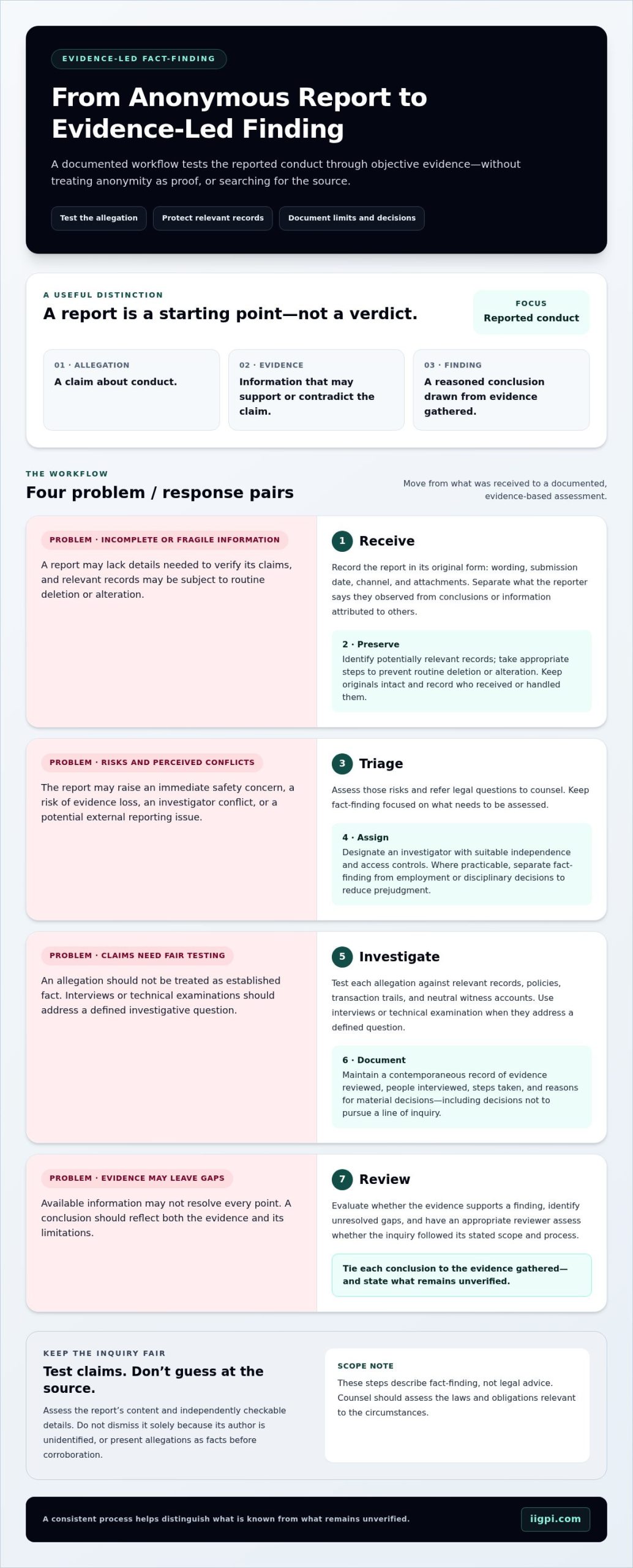
Keep three concepts distinct: an allegation is a claim about conduct, evidence is information that may support or contradict it, and a finding is a reasoned conclusion drawn from the evidence gathered. A report can be specific but uncorroborated, or brief yet point to records that can be examined. Neither circumstance alone determines the outcome.
An internal employer inquiry is also distinct from submitting information to a government agency or making a complaint under a particular legal protection. Those routes may involve different procedures, deadlines, confidentiality rules, and eligibility questions. The practical objective here is narrower: establish what happened within the organization’s process without assuming that an internal review resolves an external reporting or legal issue.
Anonymous report, confidential report, and agency tip are not interchangeable
An anonymous report generally means the recipient does not know the reporter’s identity. A confidential report generally means the identity is known but access to it is restricted. Usage and protections depend on the reporting channel and context, so the label alone does not determine a person’s legal status. An internal submission is not automatically the same as an official agency filing.
For example, OSHA provides channels for whistleblower retaliation complaints, while the CFTC operates a separate whistleblower program for tips and related submissions. These examples illustrate that agencies have distinct processes; they do not establish that an internal report has been filed with either agency. Refer questions about a report’s legal status, applicable protections, or filing obligations to qualified counsel.
Why anonymity does not determine credibility
Assess the report’s content rather than guessing who submitted it. Consider whether it identifies conduct, locations, transactions, or time periods that can be checked; whether its details are internally consistent; and whether records or other witnesses could independently confirm or contradict its claims. A missing name may limit follow-up, but it does not make the underlying evidence impossible to test.
Apply the same discipline in both directions: don’t dismiss a report solely because its author is unidentified, and don’t present its allegations as established facts before corroboration. If a secure reporting channel allows anonymous follow-up, neutral questions about missing dates or documents can clarify the claim without seeking the source’s identity. That distinction anchors how to legally investigate anonymous whistleblower complaints: examine reported conduct through evidence, not assumptions about the reporter.
How to Legally Investigate an Anonymous Whistleblower Complaint
A consistent workflow helps an organization move from an uncertain report to a documented, evidence-led inquiry. A defensible approach to how to legally investigate anonymous whistleblower complaints starts by preserving what was received, then limits the inquiry to allegations and evidence that can be meaningfully tested. Counsel should assess the laws and obligations relevant to the circumstances; the steps below describe fact-finding, not legal advice.
- Receive. Record the report in its original form, including its wording, submission date, channel, and attachments. Where possible, distinguish what the reporter says they observed from conclusions or information attributed to someone else.
- Preserve. Identify potentially relevant records and take appropriate steps to prevent routine deletion or alteration. Keep original materials intact and record who received or handled them.
- Triage. Assess whether the report suggests an immediate safety concern, evidence that may be lost, an investigator conflict, or a potential external reporting issue. Refer legal questions to counsel.
- Assign. Designate an investigator with suitable independence and access controls. Where practicable, keep fact-finding separate from employment or disciplinary decisions to reduce prejudgment.
- Investigate. Test each allegation against relevant records, policies, transaction trails, and neutral witness accounts. Use interviews or technical examination when they address a defined investigative question.
- Document. Maintain a contemporaneous record of evidence reviewed, people interviewed, steps taken, and reasons for material decisions, including decisions not to pursue a line of inquiry.
- Review. Evaluate whether the evidence supports a finding, identify unresolved gaps, and have an appropriate reviewer assess whether the inquiry followed its stated scope and process.
Intake, preservation, and initial risk assessment
At intake, restrict access to people with a defined role in assessing or investigating the report. Avoid circulating identifying details that are not necessary for the work. Preserve attachments and relevant records in a way that retains their original context. Initial triage should identify possible safety issues, evidence-loss risks, conflicts of interest, and questions about reporting obligations for counsel’s review.
Set a proportionate scope and record investigative decisions
Translate each allegation into a question that evidence could answer. If a report alleges that a particular transaction was altered, for example, identify which transaction records or system history could test that claim. Don’t broaden the inquiry into unrelated conduct without a reason tied to evidence. Record why each interview, record request, or technical examination is relevant, and revise the scope only when new facts justify doing so.
The scope should follow the reported conduct and the available, testable evidence. Link each investigative step to a defined question rather than conducting an open-ended search for possible wrongdoing. This discipline helps reviewers understand what the investigation examined and what it did not.
For complex matters, independent corporate investigative support from International Investigative Group can assist with objective fact-finding alongside the organization’s process and counsel’s guidance. Corporate investigation support can help structure an inquiry into reported business conduct.
Testing Allegations Without Unmasking the Whistleblower
The investigative objective is to determine whether evidence supports the reported conduct, not to infer who submitted the report. Start with the specific actions, transactions, or decisions described, then identify records and witnesses that can independently confirm or challenge those claims. For example, an allegation that an expense was improperly approved can be tested against approval records, invoices, applicable policies, and relevant communications without asking who raised the concern.
This evidence-first approach also limits unnecessary disclosure. Share only the information needed for each investigative task, and avoid repeating distinctive details that could reveal the source indirectly. Record where each item came from, who accessed it, and how it was handled. These practices support a transparent account of the inquiry; they do not determine whether evidence is admissible, which counsel must assess in context.
Documentary and digital evidence
Match evidence collection to the allegation. Relevant material may include business records, communications, transaction histories, policies, or information held in organizational systems. Preserve original files where possible, and document how records were located, collected, transferred, and stored, including any changes made for review. Technical questions about digital evidence may warrant specialist examination; see this computer forensics guide for additional context.
Interpret records carefully. A missing document, unusual transaction, or gap in a system log may justify further inquiry, but should not be treated as proof of misconduct without context. Compare relevant materials with ordinary business processes and seek corroborating or contradictory evidence. If an allegation concerns suspected business fraud, a focused corporate fraud investigation guide offers related investigative context.
Interviews, corroboration, and confidentiality
Use neutral, open questions that invite witnesses to describe what they observed, when it occurred, and which records may relate to it. Distinguish firsthand knowledge from information a person heard from someone else, and document responses accurately, including uncertainty or disagreement. Apply a consistent approach across interviews so questions test the allegation rather than signal a preferred conclusion.
Where practicable, describe the subject of an interview in enough detail to allow a meaningful response without disclosing unnecessary information from the report. Seek corroboration from separate records or witnesses rather than asking employees to identify the anonymous reporter. Avoid retaliatory or coercive conduct, deceptive access, or intrusive methods. Refer questions about permissible investigative boundaries to counsel.
In practice, how to legally investigate anonymous whistleblower complaints depends on keeping the evidence trail distinct from speculation about the source. A reviewer should be able to see what was collected, why it was relevant, who handled it, and how it supports or limits each conclusion. That record can also show when a claim remains unresolved because essential evidence was unavailable, rather than because the reporter was unidentified.
How to Evaluate Findings, Protect Fairness, and Decide What Happens Next
Closing an inquiry requires more than choosing a label. Each conclusion should follow from the evidence gathered, the scope examined, and any material gaps that remain. The reporter’s anonymity, a subject’s seniority, or the seriousness of an allegation should not substitute for evidence. A disciplined approach to how to legally investigate anonymous whistleblower complaints separates the investigator’s factual assessment from decisions about employment, regulatory reporting, or legal exposure. Those decisions belong to authorized decision-makers, with counsel’s guidance.
Use finding categories consistently, and explain what each means in the context of the inquiry. The terms should describe the strength and limits of the evidence, not imply certainty beyond what the investigation can establish.
| Finding | Meaning | How to describe it |
|---|---|---|
| Substantiated | The evidence gathered supports the reported conduct within the defined scope. | Identify the supporting evidence and explain how it relates to the allegation. |
| Unsubstantiated | The available evidence does not support the allegation based on the inquiry conducted. | Clarify that this does not necessarily establish that the report was knowingly false. |
| Inconclusive | The evidence is insufficient, unavailable, or conflicting, so the inquiry cannot reach a supported conclusion. | Specify what remains unresolved and which evidentiary limits prevented a firmer finding. |
Write a clear, evidence-based investigative record
The close-out record should summarize the allegation, scope, methods, records reviewed, interviews conducted, and material limitations. Distinguish corroborated facts from conflicting accounts and unresolved questions. For example, note that a transaction record confirms an approval occurred while witness accounts differ about the reason for it. Avoid conclusory labels such as “fraud” or “dishonesty” unless the documented evidence supports that characterization and its use has been appropriately reviewed.
Make the reasoning traceable. A reader should be able to see which evidence supports each finding, what evidence points in another direction, and why any gaps matter. If a record was unavailable or a witness could not be interviewed, state that limitation rather than implying the issue was resolved. Preserve the record in accordance with the organization’s procedures and counsel’s guidance.
Consider remediation and follow-up with counsel
Factual findings inform, but do not themselves determine, employment actions, external reporting, or legal conclusions. Refer potential reporting duties, legal exposure, and employment decisions to qualified counsel and authorized organizational leaders. If the investigation identifies a control weakness, the organization can assess corrective steps through its established governance channels and document follow-up responsibility without promising a particular outcome.
Continue to protect confidentiality after the inquiry closes. Limit disclosure of findings to people with a legitimate role, communicate outcomes carefully, and monitor follow-up actions for possible retaliation. Independent fact-finding can strengthen a sensitive review by helping assess evidence, while legal advice and organizational decisions remain with the appropriate parties.
When Independent Corporate Investigative Support Can Help
An organization may benefit from independent fact-finding when an allegation involves complex records, sensitive internal relationships, potential conflicts, or activity across jurisdictions. An external investigator can perform a defined investigative role alongside the company’s own process, helping gather and assess information without taking over decisions reserved for organizational leaders. Independence can be particularly useful when internal staff may be witnesses, an inquiry involves multiple business units, or an objective review is important to maintaining confidence in the process.
Structure the work around a clear scope, authorized access, and documented investigative questions. Counsel remains responsible for legal advice, including assessment of applicable laws, reporting duties, and legal exposure. Organizational leaders retain responsibility for decisions within their authority, including employment, governance, and remediation matters. An investigator gathers and evaluates facts; that role does not make the investigator law enforcement or legal counsel.
For organizations considering how to legally investigate anonymous whistleblower complaints, this division of responsibility keeps fact-finding distinct from legal interpretation and internal decision-making. Before work begins, define the allegations to be examined, the available evidence, reporting lines, confidentiality expectations, and how findings will be communicated to authorized stakeholders.
Relevant investigative capabilities
Corporate & Business Investigations and Financial Fraud Investigation address allegations involving business conduct, financial transactions, or possible misuse of company resources. Computer Forensic Services support examination of relevant digital evidence, such as files or system information, when the scope and authorized access make that work appropriate. International Investigative Group also provides Surveillance Investigation Services, including local and international human surveillance and the collection of photographic and video evidence. The investigative method should fit the reported conduct and be reviewed against relevant legal boundaries.
What an engagement with IIGPI can contribute
International Investigative Group, Ltd. is a private investigation firm that is Licensed, Bonded, Insured, with former law-enforcement experience across its team. Its global agent network supports local and international investigations. Each engagement is shaped by its defined scope and circumstances. Independent investigators can help organize fact-finding and report evidence and limitations, but they do not determine legal obligations or guarantee a particular conclusion.
IIGPI provides customized investigative packages tailored to the organization’s investigative needs. An engagement should complement, not replace, counsel’s advice and authorized leadership decisions. Clear instructions also help maintain appropriate boundaries around access to sensitive information, investigative methods, and reporting of findings.
Organizations seeking independent support for a sensitive or complex inquiry can discuss a corporate investigation and the scope of a customized investigative package. The purpose is to support disciplined fact-finding, not to promise a particular finding or outcome.
Move Forward With a Clear Fact-Finding Plan
Translate the concern into a defined investigative mandate: identify the decisions that must be informed, the evidence that can address them, and the boundaries that will preserve fairness and confidentiality. A deliberate plan helps an organization respond proportionately while keeping fact-finding distinct from legal interpretation and employment or regulatory decisions.
Understanding how to legally investigate anonymous whistleblower complaints is ultimately about establishing a reliable basis for responsible action, even when the available information is incomplete. When a matter is sensitive, complex, or difficult to assess internally, independent investigative support can contribute objective fact-finding within a scope shaped alongside the organization and its counsel. Keep findings tied to the evidence, and acknowledge uncertainty and limitations clearly.
For an inquiry that would benefit from structured investigative support, explore a customized corporate investigation. A careful, evidence-led process gives decision-makers a sounder foundation for what comes next.
Frequently Asked Questions
Can an employer investigate an anonymous whistleblower complaint?
Yes. An employer can assess a report through an impartial inquiry, with the scope shaped by the allegation and context. If a report concerns procurement decisions, for example, an initial review might examine the relevant approval process and transactions rather than the reporter’s identity. How to legally investigate anonymous whistleblower complaints depends on the facts and jurisdiction, so counsel should assess applicable duties, privacy issues, and reporting obligations.
Does an anonymous whistleblower complaint have to include evidence?
No. A report can raise a concern without attaching supporting documents. Specific details can make it easier to identify useful lines of inquiry: a vendor name, approximate transaction period, or department may help investigators locate records even if the reporter has no copies. Treat these details as leads to test, not proof. If key information is missing, document what cannot yet be checked rather than treating that gap as evidence against the allegation.
Can a company legally try to identify an anonymous whistleblower?
There isn’t a universal answer, because the legal and confidentiality implications depend on the reporting channel, subject matter, and applicable protections. As a practical safeguard, avoid making identity discovery the purpose of the inquiry; it can undermine trust and raise retaliation concerns. If someone proposes identifying the source for a specific reason, pause and have qualified counsel assess whether that step is necessary and consistent with the relevant rules and protections.
What should a company do first after receiving an anonymous complaint?
Secure the original submission and attachments, then create a restricted intake record noting when and how it arrived, who received it, and any immediate concerns. Avoid forwarding it broadly or asking colleagues to speculate about the author. A short, confidential triage discussion can identify whether records may be lost or a person may face immediate harm, while counsel helps determine appropriate next steps.
Are anonymous whistleblower complaints protected by law?
Some protections and reporting channels apply to particular types of conduct, workers, and recipients, so an internal anonymous report is not automatically equivalent to a protected agency filing. Certain federal whistleblower programs permit anonymous submissions under program-specific conditions, which may include representation by an attorney. Because protections and procedures differ, use current official agency information and qualified counsel to assess a specific report rather than assuming anonymity alone confers legal protection.
When should a company use an independent investigator for a whistleblower complaint?
Consider independent support when the inquiry involves a senior decision-maker, internal investigators may have a conflict, or records span multiple departments or locations. For example, an external investigator may help assess a complicated transaction trail when the employees responsible for gathering records also report to someone named in the complaint. Define the investigator’s role and reporting line in advance; legal advice and organizational decisions remain with counsel and authorized leaders.
What happens if an anonymous complaint cannot be substantiated?
An unresolved allegation does not, by itself, establish that the report was knowingly false or that no issue occurred. Record which evidence was unavailable or conflicting, and identify what new information could justify reopening the inquiry. If the review surfaced a process weakness despite insufficient evidence to confirm misconduct, leaders can consider addressing that weakness separately. Keep follow-up proportionate and avoid treating uncertainty as a basis for retaliation.