
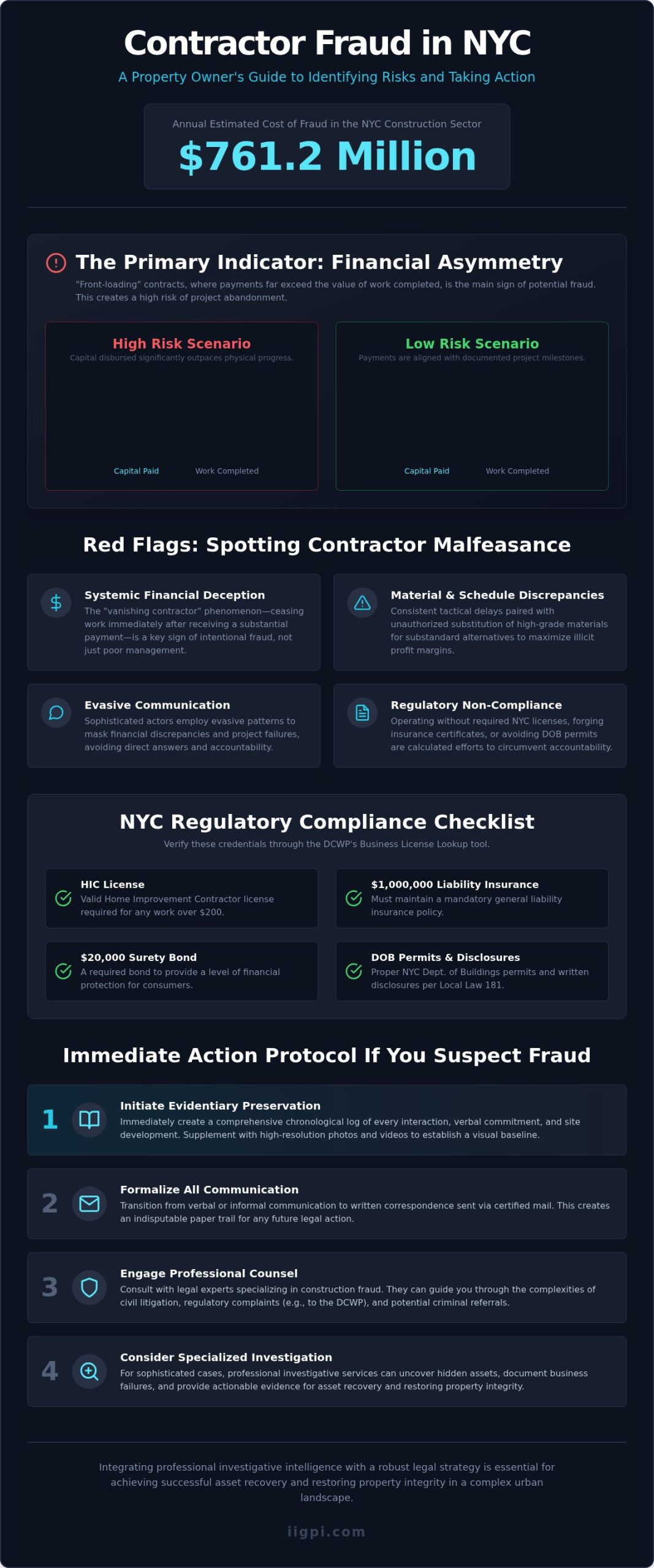
With the annual cost of fraud in the New York City construction sector estimated at a staggering $761.2 million, the financial peril facing property owners is not merely a theoretical risk but a systemic reality. High-level stakeholders often recognize that the inherent complexity of metropolitan development creates fertile ground for professional malfeasance. If you find yourself questioning the integrity of your project’s trajectory, understanding exactly what to do if you suspect a contractor is scamming you nyc is the critical first step toward institutional preservation. It’s common to feel a sense of operational paralysis when front-loaded contracts result in depleted capital without corresponding physical progress.
This article provides a rigorous framework for identifying sophisticated contractor fraud, securing forensic evidence, and navigating the intricate investigative landscape unique to the five boroughs. We examine the transition from mere suspicion to definitive proof, detailing the methodologies for asset recovery and the restoration of property integrity through professional intelligence. Readers will gain a comprehensive understanding of the mechanisms required to transform a stalled project into a successful legal judgment and recover essential assets.
Key Takeaways
- Property owners must prioritize the identification of systemic risks, such as front-loaded contracts, which represent the primary indicator of sophisticated contractor malfeasance in the New York City market.
- Establishing a definitive protocol for what to do if you suspect a contractor is scamming you nyc involves the immediate creation of chronological logs and high-resolution visual evidence to secure the integrity of future litigation.
- Navigating the inherent limitations of regulatory bodies like the Department of Consumer and Worker Protection requires a strategic understanding of when to escalate disputes to formal civil actions or specialized investigative interventions.
- The application of professional surveillance and principal background investigations provides the necessary intellectual rigor to uncover hidden business failures and provide actionable evidence of project abandonment.
- The integration of professional investigative intelligence with legal strategy is essential for achieving successful asset recovery and the restoration of property integrity within the complex urban landscape.
Identifying Indicators of Contractor Malfeasance in the New York City Market
Contractor malfeasance in the New York City construction sector often manifests as a deliberate exploitation of capital structures rather than simple project mismanagement. A primary indicator of this behavior is “front-loading,” where the payment schedule is aggressively weighted toward the project’s inception. This strategy creates a significant financial asymmetry, as the contractor’s liquid assets far exceed the tangible value of the work performed. When the capital disbursed outpaces the physical progress of the site, the risk of project abandonment increases exponentially. Determining what to do if you suspect a contractor is scamming you nyc requires an immediate and rigorous audit of all financial disbursements against documented site milestones.
Sophisticated actors often employ evasive communication patterns to mask these discrepancies. Tactical delays, characterized by a consistent failure to meet established deadlines, are frequently paired with the unauthorized substitution of high-grade materials for substandard or non-compliant alternatives. This practice maximizes the contractor’s profit margins at the expense of the property’s structural integrity and safety. In some instances, these schemes involve a violation of the intangible right of honest services, particularly if the contractor engages in kickback arrangements with suppliers or attempts to bribe regulatory inspectors to overlook code violations.
Sophisticated Fraud vs. Standard Breach of Contract
Distinguishing between a standard breach of contract and criminal fraud requires an analytical focus on intent and systemic patterns. While logistical delays are common in high-density NYC boroughs, systemic financial deception is often signaled by the “vanishing contractor” phenomenon. This involves an intentional cessation of work immediately following the receipt of a substantial payment. Identifying the threshold where poor performance transitions into malfeasance is essential for property owners. It’s the difference between a contractor struggling with supply chain interruptions and one who has systematically diverted project funds for personal gain or to service debts on unrelated projects.
NYC-Specific Regulatory Red Flags
Regulatory non-compliance serves as a definitive precursor to institutional fraud. Under current NYC Department of Consumer and Worker Protection (DCWP) regulations, any contractor performing home improvement work exceeding $200 must possess a valid Home Improvement Contractor (HIC) license. Operating without this credential, or failing to provide the written permit disclosures required by Local Law 181 of 2025, constitutes a significant red flag. Property owners must verify that the contractor maintains the mandatory $1,000,000 general liability insurance policy and the required $20,000 surety bond. The presence of forged insurance certificates or the strategic avoidance of NYC Department of Buildings (DOB) permits suggests a calculated effort to circumvent accountability. Knowing what to do if you suspect a contractor is scamming you nyc starts with a formal verification of these credentials through the DCWP’s Business License Lookup tool.
Immediate Protocols for Documenting Discrepancies and Securing Evidence
Once the initial indicators of fraud are identified, property owners must transition from passive observation to active evidentiary preservation. This phase is critical in establishing what to do if you suspect a contractor is scamming you nyc, as the burden of proof in civil litigation remains substantial. A comprehensive chronological log must be established immediately, detailing every interaction, verbal commitment, and site development with forensic precision. This record should be supplemented by high-resolution photographic and videographic documentation that serves as a visual baseline of the project’s current state. Securing all digital correspondence, including fragmented text messages and project management software logs, ensures that the contractor’s internal contradictions remain accessible for future scrutiny.
A rigorous financial audit is equally indispensable. Comparing invoices against verified material deliveries and labor hours often reveals the mechanisms of capital diversion. While the New York State Department of State provides general tips for avoiding home improvement scams, the recovery of lost assets in a high-stakes NYC environment requires a more granular approach to documentation. It’s not enough to simply note that work is incomplete; you must document the specific delta between the capital disbursed and the value realized.
The Evidentiary Value of Professional Site Assessments
Engaging independent third-party inspectors provides an objective quantification of the “percentage of completion,” which is often significantly lower than the contractor’s billing claims. These professionals can also identify latent safety violations that might trigger NYC Department of Buildings (DOB) stop-work orders, providing additional leverage in negotiations. When coupled with forensic accounting, these assessments trace the precise misappropriation of project funds, transforming suspicion into admissible evidence. Property owners often find that specialized investigative support is necessary to bridge the gap between regulatory complaints and successful litigation.
Preserving Digital Footprints and Communication
The role of computer forensics is paramount when contractors attempt to obscure their tracks by deleting communications or modifying digital logs. Meta-data analysis of project photos can verify precise timestamps and GPS coordinates, effectively debunking false claims regarding the timing or location of work performed. Standardizing this digital evidence is essential for its eventual introduction into the New York State Supreme Court, where the technical integrity of the data determines its weight. By ensuring that all electronic footprints are preserved, property owners create a robust foundation for asset recovery efforts.
Navigating Regulatory Recourse and Legal Avenues in New York
The pursuit of institutional restitution in the New York City construction market necessitates a strategic evaluation of both regulatory and judicial mechanisms. While governmental bodies offer a baseline for consumer protection, high-stakes fraud often requires a more assertive legal posture. The NYC Department of Consumer and Worker Protection (DCWP) serves as a primary mediator, yet its efficacy is often constrained by the contractor’s willingness to participate in non-binding resolution. For disputes where the financial delta is below the $10,000 threshold, NYC Small Claims Court provides a streamlined but limited venue for recovery. However, when the capital depletion is substantial, property owners must analyze the statutory leverage provided by Article 3-A of the New York Lien Law.
This specific provision establishes that any funds received by a contractor for a home improvement project constitute a trust for the benefit of the owners, laborers, and material suppliers. Any diversion of these assets for purposes unrelated to the specific project’s completion is not merely a breach of contract; it’s a statutory violation that can carry significant civil and criminal consequences. Understanding what to do if you suspect a contractor is scamming you nyc involves recognizing that these trust fund provisions provide a legal avenue to pierce the corporate veil and potentially hold principals personally liable for the misappropriated capital.
The Role of the District Attorney’s Office
Escalation to the District Attorney’s Office, specifically the NYC Rackets Bureau, is an appropriate response when a dispute meets the criteria for a criminal larceny investigation. Proving “larcenous intent” in a construction context is a complex evidentiary challenge, as it requires demonstrating that the contractor entered into the agreement with the specific intent to deprive the owner of property. Working with specialized bureaus is essential when the fraud is part of a systemic pattern of deception across multiple jurisdictions, rather than an isolated instance of project mismanagement.
Civil Litigation and the Importance of Asset Tracing
In cases of high-value corporate construction fraud, initiating civil litigation is often the only viable path to restoration, yet a successful judgment is functionally worthless if the defendant’s assets remain obscured. Fraudulent actors frequently utilize complex networks of shell companies and offshore accounts to insulate their gains from judicial reach. Therefore, a comprehensive corporate fraud investigation must precede and inform the litigation strategy. This investigative rigor identifies the flow of capital and locates tangible assets, ensuring that the eventual legal judgment translates into actual financial recovery rather than remaining a symbolic victory on paper.
Strategic Investigative Methodologies for Contractor Disputes
When administrative remedies and regulatory mediation reach an impasse, property owners must adopt an intelligence-driven approach to secure their interests. Determining what to do if you suspect a contractor is scamming you nyc requires moving beyond the sphere of reactive complaints into active, empirical data collection. This methodological shift focuses on the contractor’s external operational reality, uncovering the discrepancies between their stated progress and their actual deployment of resources. High-stakes disputes necessitate a granular analysis of the contractor’s principal actors, as historical patterns of business failure often predict future malfeasance. By executing a sophisticated investigative strategy, stakeholders can transform anecdotal suspicion into actionable intelligence suitable for high-level litigation.
The transition from suspicion to restitution depends on the ability to identify hidden capital and document the intentional diversion of project-specific assets. While local regulatory bodies focus on licensing compliance, professional investigators examine the systemic exploitation of the New York construction market. This involves deep-background research into the principals’ prior corporate entities, identifying “phoenix companies” that rise from the ashes of previous fraudulent collapses. It’s essential to recognize that a contractor’s claim of insolvency is often a tactical facade designed to discourage legal pursuit. Breaking this facade requires a rigorous examination of the contractor’s current activities and financial health.
The Power of Professional Surveillance
Professional surveillance serves as a definitive tool for confirming site abandonment and the strategic misallocation of labor. It’s common for fraudulent contractors to claim personal illness or systemic material delays while simultaneously deploying their crews to more profitable job sites. Utilizing specialized surveillance services allows property owners to document these activities in real-time, providing irrefutable visual evidence of the contractor’s presence at competing projects. This intelligence is particularly effective when surveillance captures the unauthorized removal of materials from the victim’s property for use on another site, establishing a clear record of theft. Documenting these operational lies creates a powerful evidentiary baseline that undermines the contractor’s credibility in any future judicial proceeding.
Asset Recovery and Financial Intelligence
Successful litigation is predicated on the ability to satisfy a judgment, making asset tracing a fundamental component of the investigative process. Comprehensive asset searches identify real estate holdings, undisclosed bank accounts, and high-value equipment that can be targeted for seizure. By tracing the flow of funds from the project account to the contractor’s personal expenditures, investigators can prove the misappropriation of trust funds under New York law. This financial intelligence is synthesized into a detailed “Asset Profile,” which provides the necessary leverage to force a favorable settlement or ensure that a court-ordered judgment results in actual financial recovery. For those facing substantial losses, engaging an experienced NYC investigative firm is the most direct path to identifying and securing the contractor’s hidden capital before it’s further dissipated.
Engaging Professional Investigative Services to Mitigate Loss
The decision to transition from internal documentation to specialized external intervention marks a critical juncture in the restoration process. Determining the optimal timing for this escalation is essential, as the window for effective asset recovery often closes as the contractor realizes their malfeasance has been detected. If the initial protocols established in earlier sections confirm systemic discrepancies, engaging a private investigator provides the intellectual and technical resources necessary to confront sophisticated fraud. This professional engagement creates a powerful synergy between investigative intelligence and legal counsel, ensuring that litigation is supported by empirical data rather than mere allegations. When considering what to do if you suspect a contractor is scamming you nyc, recognize that a professionally prepared investigative report acts as a catalyst, significantly increasing the likelihood of engagement from both government regulators and law enforcement agencies. These entities are more inclined to prioritize cases where the evidentiary groundwork has been rigorously established by experts.
Why International Investigative Group is the NYC Standard
International Investigative Group (IIGPI) occupies a preeminent position within the New York City investigative landscape, leveraging over 30 years of specialized experience in construction-related fraud. The organization’s foundational leadership by former law enforcement professionals ensures a disciplined, methodological approach to every inquiry, maintaining the highest standards of evidence handling and forensic integrity. This institutional expertise is augmented by access to sophisticated surveillance technology and a global intelligence network designed specifically for tracing hidden assets across multiple jurisdictions. By positioning IIGPI as a central component of the recovery strategy, property owners gain access to the same level of investigative rigor utilized by major financial institutions and global corporations.
The Path to Resolution and Recovery
Achieving a successful resolution requires a rapid transition from a state of victimization to a position of strategic dominance. It’s imperative to act with celerity before a fraudulent contractor can dissolve their existing business entity or further dissipate misappropriated capital. A comprehensive recovery plan must integrate both legal and investigative components, ensuring that every judicial motion is backed by verifiable intelligence. Beyond the immediate recovery of lost assets, the implementation of rigorous due diligence protocols serves as a permanent safeguard against future malfeasance. The ultimate objective is the complete restoration of property integrity and the total mitigation of financial loss through a structured, authoritative response to contractor fraud.
Institutional Restitution and Strategic Risk Mitigation
The restoration of institutional capital and property integrity requires a rapid transition from passive observation to a state of strategic dominance. By implementing rigorous documentation protocols and leveraging the statutory power of Article 3-A, property owners can effectively challenge the systemic malfeasance prevalent in the New York City construction market. Understanding exactly what to do if you suspect a contractor is scamming you nyc is the first step in a process that must culminate in professional investigative intervention. Successful asset recovery is rarely the result of administrative complaints alone; it’s the product of deep-background intelligence and forensic evidence that leaves no room for contractor evasion.
International Investigative Group offers the elite resources required to transform stalled projects into successful legal judgments. With over 30 years of NYC investigative experience and leadership by former law enforcement professionals, we’ve established a definitive track record in high-value fraud recovery. Don’t allow your project’s trajectory to be dictated by fraudulent actors when an authoritative response is within reach. Consult with the Elite Investigators at International Investigative Group to secure the expertise necessary for total financial and operational recovery. It’s time to reclaim control over your property’s future.
Frequently Asked Questions
What is the very first thing I should do if I suspect my NYC contractor is scamming me?
Property owners must immediately cease all further financial disbursements to prevent additional capital depletion. Establishing a comprehensive evidentiary record is the next priority, which involves documenting the current state of the project through high-resolution photography and securing all digital and physical correspondence. Determining what to do if you suspect a contractor is scamming you nyc begins with this immediate cessation of funds and the creation of a chronological log to quantify the delta between capital disbursed and work performed.
Can I fire a contractor in NYC if they haven’t finished the work?
Termination is a contractual right, but it must be executed within the specific parameters defined in your agreement to avoid claims of wrongful termination. Property owners should issue a formal notice of default, providing a specific cure period as required by New York law. It’s critical to document the contractor’s failure to meet milestones before finalizing the dismissal. Consulting investigative professionals can provide the site assessment data necessary to support the termination and defend against retaliatory legal actions.
How do I check if a contractor is licensed and insured in New York City?
Verification is performed through the NYC Department of Consumer and Worker Protection (DCWP) Business License Lookup tool. Any contractor performing work over $200 on residential dwellings must possess a valid Home Improvement Contractor license. Additionally, you should request a Certificate of Insurance directly from the contractor’s provider to verify a minimum of $1,000,000 in general liability coverage. Forged certificates are a common indicator of sophisticated malfeasance in the city and require professional verification.
Will the NYC 311 or DCWP actually get my money back?
The DCWP offers mediation services, yet they lack the judicial authority to compel financial restitution if the contractor refuses to cooperate. While the department can impose fines or revoke licenses, actual recovery often requires a civil judgment or an investigative settlement. Regulatory complaints provide a baseline for consumer protection, but they are frequently insufficient for high-value fraud cases where the contractor has already dissipated the project funds or hidden assets through complex corporate structures.
Is it worth hiring a private investigator for a contractor dispute?
Specialized investigative services are essential when the financial loss justifies the pursuit of asset recovery through civil litigation. Professional investigators provide the surveillance and digital forensics needed to prove intentional fraud, which is often beyond the scope of local law enforcement. When assessing what to do if you suspect a contractor is scamming you nyc, recognize that investigative intelligence provides the leverage required to identify hidden assets and secure a meaningful financial judgment against the principals involved.
What are the signs of ‘front-loading’ in a construction contract?
Front-loading is characterized by a payment schedule that demands significant capital disbursements before corresponding physical milestones are achieved. This creates a financial asymmetry where the contractor’s liquid gains vastly exceed the value of the materials and labor provided. Indicators include requests for substantial deposits for materials that never arrive or labor costs billed in advance of site mobilization. This practice is a primary precursor to intentional project abandonment and systemic capital diversion in the NYC market.
How can I prove that a contractor intentionally defrauded me?
Proving intent requires demonstrating a systemic pattern of deception, such as the diversion of project funds to unrelated accounts or the use of shell companies. Evidence of larcenous intent might include surveillance documenting the removal of materials from your site for use elsewhere or forensic accounting that traces misappropriated trust funds. Establishing this pattern is complex and typically requires professional intelligence to transform suspicion into admissible evidence suitable for the New York State Supreme Court.
What happens if a contractor files a mechanic’s lien against my property after I stop payment?
A mechanic’s lien is a statutory claim that must be challenged through a formal lien discharge proceeding if the underlying work was not performed. If the contractor is unlicensed, they generally lose the legal standing to enforce a lien in New York City. Property owners can move to vacate the lien by proving the contractor’s malfeasance or breach of contract. Strategic investigative reports are vital in providing the empirical evidence needed to invalidate these retaliatory filings and protect property titles.