
A new message, an unexpected appearance, or contact through someone else can raise an urgent question: does it violate the order, and what should you do next? If you’re asking how to get evidence of a restraining order violation nyc, put your safety first. Don’t confront the restrained person or try to gather proof at personal risk. What counts as a violation depends on the specific order and the circumstances, so uncertainty about its terms is understandable.
Useful documentation is timely, contextual, and preserved in its original form. This article explains how to create a clear incident record, retain messages, photos, and other potential evidence, and note witnesses without altering material or putting yourself in danger. It also outlines general options for reporting a suspected violation, including when immediate danger calls for 911 and when a police report or court process may be relevant. A private investigator can help document observable conduct lawfully and objectively, but investigative work doesn’t replace emergency assistance or legal counsel. The order itself and the facts of each incident remain central to deciding what steps are appropriate.
Key Takeaways
- Learn how to get evidence of a restraining order violation nyc by documenting observable details and preserving original records without putting yourself at risk.
- Use a consistent incident chronology to connect each event with the relevant order term, location, witnesses, and supporting files.
- Choose a reporting path based on the circumstances, and contact 911 if there is immediate danger rather than delaying to gather evidence.
- Understand why the signed order and any amendments matter when assessing whether reported conduct may violate its terms.
- Consider lawful, objective investigative documentation when repeated observable conduct is difficult to organize in a personal incident log.
Suspect a Restraining Order Violation in NYC? Start with Safety and the Order
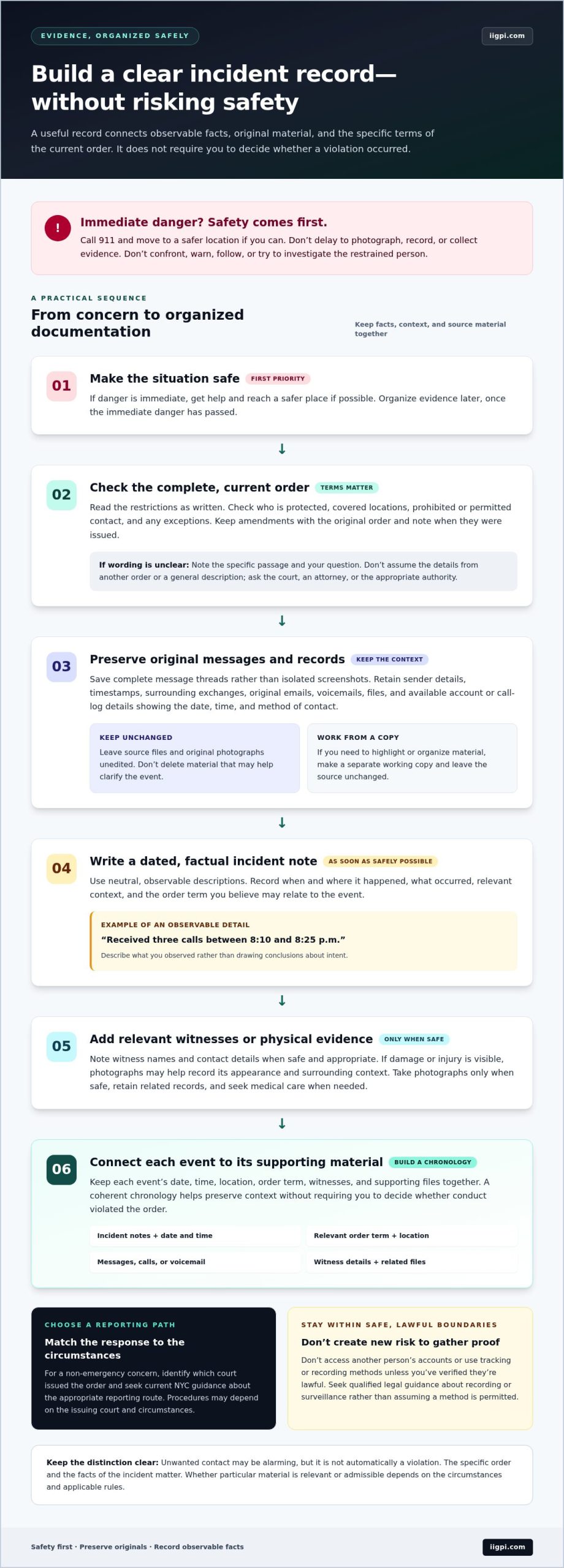
If you’re in immediate danger, call 911 and move to a safer location if you can. Don’t delay to photograph, record, or collect other evidence. Your safety comes first. You can organize documentation later, once you’re out of immediate danger.
An order of protection, often referred to as a restraining order, is a court order that sets restrictions for a particular case. Its purpose and terms vary. The general Order of protection overview provides background, but it can’t explain the terms of your specific NYC order. Unwanted contact may be alarming, but it isn’t automatically a violation. Whether conduct conflicts with an order depends on its precise provisions and the facts.
What the order says matters
Obtain the complete, current copy of the order and read its restrictions as written. Check who is protected, which locations are covered, what contact is prohibited or permitted, and whether exceptions apply. For example, an order may address contact with particular people or places, or allow specific forms of communication. Don’t assume the details based on someone else’s order or a general description.
Keep any amendments with the original order, and note when they were issued so you can distinguish older terms from current ones. If the wording is unclear, record the specific passage and your question rather than deciding for yourself what it means. The court, an attorney, or the appropriate authority can address questions about interpretation.
When to treat the situation as urgent
If you believe you or someone else faces immediate danger, call 911 and get to a safer place if possible. Don’t confront, warn, follow, or attempt to investigate the restrained person. Doing so may increase risk and distract from getting help. Evidence gathering should never take priority over emergency action.
Act for safety now; organize evidence after the immediate danger has passed.
For a non-emergency concern, identify which court issued the order and seek current NYC guidance about the appropriate reporting route. Procedures may depend on the issuing court and the circumstances, so use current official local information rather than relying on an outdated instruction. If you’re unsure whether conduct falls within the order, preserve the relevant facts and ask a qualified legal professional or the appropriate authority how to proceed.
These steps establish the foundation for how to get evidence of a restraining order violation nyc: understand the actual restrictions, address immediate safety, and seek guidance without treating suspicion as a legal determination.
What Evidence Can Help Document an Alleged Order Violation?
Useful documentation helps establish what happened, when and where it occurred, and how the event relates to a specific restriction in the order. A single screenshot or photograph may not tell the whole story. A complete, timely record can give authorities or legal counsel clearer context, but whether particular material is relevant or admissible depends on the circumstances and applicable rules.
If you’re considering how to get evidence of a restraining order violation nyc, focus on preserving what already exists and recording observations accurately. Messages, call logs, voicemails, photographs, incident notes, and witness details may each provide a different part of the context.
Digital messages, calls, and online contact
Save complete message threads rather than isolated screenshots. Keep sender details, timestamps, and surrounding exchanges that help explain the communication. Retain original emails, voicemails, and files in their original form. If you need to highlight or organize material, make a separate working copy and leave the source unchanged. Keep available account or call-log information that identifies the date, time, and method of contact.
Don’t access another person’s accounts or use tracking or recording methods unless you’ve verified that they’re lawful. Rules can depend on the circumstances, so seek qualified legal guidance about recording or surveillance rather than assuming a method is permitted.
Incident notes, physical evidence, and witnesses
Write a dated account as soon as you safely can. Use neutral, observable descriptions, such as “received three calls between 8:10 and 8:25 p.m.,” rather than conclusions about intent. Record the location, what occurred, relevant context, and the order term you believe may relate to the event. Note witness names and contact details only when doing so is safe and appropriate.
If there’s visible damage or an injury, photographs may help record its appearance and surrounding context. Take them only when it’s safe, and seek medical care when needed. Retain related records. Avoid editing or annotating original photographs and files, and don’t delete material that may help clarify the event.
Preserve original material, keep its context, and create a dated account of events. This can make your record more coherent without requiring you to decide whether a violation occurred or whether particular evidence will be accepted.
When repeated, observable conduct is difficult to document safely or consistently on your own, professional investigative documentation may supplement your personal records. International Investigative Group provides surveillance investigation services to document observable conduct lawfully and objectively. Investigative work doesn’t replace emergency reporting, legal counsel, or a court’s assessment. Learn about investigative services that may support organized documentation.
How to Preserve and Organize Evidence Without Losing Context
Once you’ve gathered records, organize them so each item can be understood alongside the event it relates to. A consistent chronology helps a lawyer or investigator review the sequence and reduces the risk of confusing dates, sources, or circumstances. Keep the record factual: describe the conduct and identify a potentially relevant order term without drawing a legal conclusion.
For each incident, create one dated entry and include:
- Date, time, and location: Record when and where the event occurred, and separately note when you wrote the entry.
- Conduct: Describe what you directly observed or experienced in neutral terms.
- Order term: Identify the provision that may relate to the event, without deciding what it legally means.
- Witnesses: Note names and safe, appropriate contact details, if available.
- Evidence reference: Record the exact filename or item identifier for related messages, images, or other material.
Build a dated incident log
Use a separate entry for each event, even if several occur on the same day. Distinguish what you personally saw or received from information another person told you, and identify that person as the source. If you add a note later, record the date you created it rather than making it appear contemporaneous with the incident. Cross-reference files by filename so a reviewer can locate them without relying on memory.
A simple index can connect each log entry to its supporting material. For example, an entry might reference a message thread and a call-log image by their stored filenames. The index should help locate the items, not replace or alter them.
Keep files authentic and secure
Retain original messages, images, and recordings separately from any copies you use for review. Make secure backups where feasible, choosing a location the restrained person cannot access. Avoid editing source files if doing so could alter metadata, and don’t crop, annotate, or otherwise change originals. If you need a marked-up version for your own reference, work from a copy and keep it clearly separate.
Protect sensitive records. Avoid posting evidence publicly, adding speculative captions, or sharing files broadly. Public disclosure can expose private information and remove material from its original context. If another person may access your device or accounts, consider a safer storage method and seek support to protect your privacy.
Careful organization is a practical part of how to get evidence of a restraining order violation nyc, but it doesn’t establish that a violation occurred or guarantee that material will be considered in court. Preserve the originals, maintain a clear index, and let qualified professionals assess the records in context.
How to Report a Suspected Restraining Order Violation in NYC
If you or someone else is in immediate danger, call 911. Don’t delay to collect files, arrange them, or finish an incident log before seeking emergency help. For a non-emergency concern, reporting options may include contacting the police or the court connected with the order. The appropriate route depends on the order, case type, and current NYC procedures.
Reporting a concern is not the same as deciding whether a violation occurred. Police, court staff, and legal professionals have different roles. The order’s terms and the facts of the incident determine what further steps may be appropriate.
What to prepare when making a report
If it’s safe to do so, organize the current order, a concise incident chronology, and the original supporting material. Be ready to identify dates, times, locations, what happened, and whether the conduct is continuing or creating an immediate safety concern. Describe what you observed rather than presenting assumptions about the other person’s intent.
You can ask the receiving authority how it accepts and preserves supporting material, and whether there is a report or case number for your records. If police respond to a domestic incident, ask about obtaining a copy of the Domestic Incident Report. For a non-emergency police report, contact the appropriate precinct and follow its current instructions. A suspected violation involving a Family Court order may also be addressed through a Family Court violation petition. Confirm the current filing process with the relevant court. These routes are not interchangeable in every case.
Where legal guidance fits
An attorney can advise you about the order’s meaning, available legal options, and strategy specific to your case. For procedural information, consult current New York court resources or contact the court that issued the order. Procedures may differ depending on whether it came from Family Court, Criminal Court, or Supreme Court. Don’t rely on a general description to interpret a restriction or determine which filing applies.
A private investigator has a distinct, limited role: lawful investigative work may help document observable conduct, but an investigator isn’t law enforcement, can’t determine whether a court order was legally violated, and doesn’t replace emergency help or legal counsel. Learn more about private investigator roles and responsibilities. If objective documentation of repeated conduct may supplement your records, explore investigative support.
When Lawful Investigative Documentation May Help in a NYC Case
A personal incident log may be enough to track isolated events. When conduct appears to recur, documenting patterns over time can become difficult, particularly if observing it would require you to change routines or put yourself at risk. In those circumstances, a private investigator may provide lawful, objective documentation of observable activity to supplement your records.
Professional investigative documentation is not emergency response, legal advice, or a substitute for reporting a safety concern to authorities. An investigator cannot decide whether someone’s conduct legally violates an order, establish that a court will accept particular evidence, or guarantee enforcement or a specific outcome. Those decisions belong to the appropriate authorities and court, with legal questions addressed by an attorney.
What professional surveillance can and cannot do
Depending on the circumstances, surveillance may document activity that can be observed lawfully and safely, helping create a more organized record of repeated conduct. The work must respect applicable law, privacy, personal safety, and the order’s terms. It doesn’t authorize access to another person’s private accounts or make otherwise unlawful recording or tracking methods acceptable.
To understand the scope and limitations of this work, see professional surveillance services. Treat any documentation as factual material for review, not as a legal conclusion about what the order prohibits.
Choosing a safe next step
Consider investigative assistance only when there is no immediate emergency and the need is to document a pattern that can be observed without putting you in danger. If you face immediate danger, contact emergency services. If you need advice about interpreting the order, filing options, or case strategy, consult an attorney. A private investigator serves a separate, supplementary role.
Before pursuing additional documentation, consider whether it addresses a genuine gap in your personal records and whether the approach can be conducted lawfully without confrontation. The question of how to get evidence of a restraining order violation nyc should be guided by safety, the specific order, and the limits of each source of support, not by pressure to collect proof at any cost.
If objective documentation of repeated, observable conduct may be useful in your circumstances, International Investigative Group provides surveillance investigation services. This assistance can supplement personal documentation and reporting, but it does not replace emergency response or legal counsel.
Take the Next Step With Safety and Clear Documentation
When considering how to get evidence of a restraining order violation nyc, keep three priorities in view: protect your immediate safety, follow the exact terms of the current order, and preserve a clear, dated record with original evidence and context. Report urgent danger promptly, and seek legal guidance when you need help understanding the order or your options. Documentation can support a report, but it cannot determine whether a violation occurred or guarantee a court outcome.
If repeated, observable conduct is difficult to document safely on your own, professional investigative work may provide an objective supplement to your records. International Investigative Group offers surveillance and personal investigations. This work does not replace emergency response or legal counsel.
Discuss investigative documentation with International Investigative Group if additional documentation may be appropriate. Keep safety and reliable records at the center of your next step.
Frequently Asked Questions
What counts as a violation of an order of protection in New York?
A violation may occur when conduct conflicts with a restriction in the specific order, but the order’s exact language and the circumstances matter. Check the complete, current order, including amendments, for who is protected, prohibited contact, locations, and any exceptions. Unwanted or upsetting conduct isn’t automatically a violation. If the terms are unclear, document what happened and seek guidance from an attorney or the appropriate authority rather than deciding the legal meaning yourself.
Can screenshots or text messages be used as evidence of a restraining order violation?
Screenshots and text messages may help document contact, but preserve the complete conversation and original material where possible. Keep sender details, timestamps, and surrounding messages, since an isolated image may omit important context. Don’t edit or annotate the source file. Make a separate copy if you need to organize it. Whether a particular message is relevant or admissible depends on the case and applicable rules, so no evidence format guarantees a legal outcome.
What should I do if someone violates an order of protection in NYC?
If you or someone else is in immediate danger, call 911 and move to a safer place if possible. Don’t delay to gather evidence. For a non-emergency concern, contact the appropriate police precinct or the court connected with the order to ask about current procedures. Keep the current order and a concise record of incidents available if safe. The correct reporting route can depend on the issuing court and case circumstances.
Do I need proof before reporting a suspected violation?
You don’t need to complete an evidence file before reporting a concern, and gathering material should never delay help in an emergency. Report what you personally observed or experienced as accurately as you can, distinguishing direct knowledge from information someone else shared. Preserve relevant messages, call records, or notes if available, but don’t guess or embellish. The authority receiving the report can explain its process for documenting the concern and submitting supporting material.
Can I record someone who may be violating an order in New York?
Recording rules can depend on the circumstances and the type of recording, so don’t assume a method is lawful or appropriate. Avoid confronting or following the person, accessing private accounts, or using tracking methods. If you’re considering recording, get qualified legal guidance about the specific situation first. You can still preserve existing messages, call logs, and other records without creating a new recording, and prioritize safety over collecting evidence.
What happens after I report an alleged order-of-protection violation in NYC?
Next steps depend on the facts, the order, and the reporting channel. Authorities may document your account, ask follow-up questions, or explain how to provide supporting records. A court process may differ by case type. If police respond to a domestic incident, ask how to obtain the Domestic Incident Report. Keep any report details and continue recording relevant events safely. Reporting does not itself determine whether a violation occurred or what a court will decide.
Can a private investigator help document a suspected restraining order violation?
A private investigator may help document repeated, observable conduct through lawful, objective methods, supplementing a personal incident log. This may be useful when a pattern is difficult to record consistently or safely yourself. An investigator isn’t law enforcement, can’t determine whether conduct legally violates an order, and can’t guarantee evidence will be admitted or affect a court outcome. Investigative documentation doesn’t replace emergency assistance or an attorney’s advice about your rights and legal options.