
The most consequential financial miscalculation in a high-stakes legal dispute is often not the litigation budget, but the selection of an investigative firm based on its superficial hourly rate. This counterintuitive reality stems from an industry characterized by opaque pricing models and inconsistent evidentiary standards, which leaves principals uncertain about total financial commitment and the ultimate admissibility of crucial findings. For corporations facing existential threats from intellectual property theft or individuals navigating contentious personal matters, the ambiguity surrounding the question of how much does a private investigator cost represents a significant strategic liability.
This 2026 strategic fee analysis moves beyond simplistic cost quotations to provide a comprehensive examination of the financial architecture of modern private intelligence. It delivers a definitive framework for evaluating the value of an investigative firm, ensuring that allocated resources yield legally sound, strategically advantageous outcomes. Within this report, we will dissect the prevailing hourly versus flat-rate compensation structures, quantify key regional cost variables based on Q4 2025 market data, and establish a methodology for projecting the strategic return on investment for complex corporate and personal inquiries.
Key Takeaways
- Differentiate between hourly, retainer, and flat-fee billing models to strategically align cost structures with the specific objectives of your high-stakes inquiry.
- Understand the primary variables that determine how much does a private investigator cost, from the operational premium in global financial centers to the integration of AI-driven forensic technologies.
- Reframe investigative expenditures as a strategic investment by analyzing the tangible return on investment (ROI) in complex scenarios such as corporate fraud and asset recovery.
- Develop a sophisticated procurement framework for selecting an elite investigative firm, prioritizing institutional experience and global operational reach over simplistic, cost-centric metrics.
Understanding the Economic Framework of Private Investigative Fees
An inquiry into how much does a private investigator cost necessitates a foundational shift in perspective, moving beyond a simple transactional query to a strategic analysis of value. Investigative fees aren’t merely charges for time; they represent the professional valuation of a complex synthesis of specialized intelligence gathering, advanced surveillance technology, and deep legal expertise. The industry’s trajectory, projected for 2026, indicates a decisive evolution from commoditized ‘detective work’ to a sophisticated risk management function, where practitioners operate as strategic partners in mitigating legal, financial, and reputational threats.
The fee structure of a reputable firm is a direct reflection of its operational and ethical integrity. It underwrites critical overheads that guarantee the quality and legality of the investigation, including comprehensive liability insurance, state-mandated licensing and bonding, and rigorous adherence to ethical compliance standards like the Gramm-Leach-Bliley Act for financial data. There exists a direct, quantifiable relationship between the depth of an investigation and the probability of securing court-admissible evidence. A higher professional fee finances the meticulous, multi-layered approach required to build a case that withstands judicial scrutiny, transforming raw information into legally actionable intelligence. Understanding this economic framework is the initial step for any individual or corporation evaluating the engagement of a professional private investigator for a critical matter.
The Distinction Between Cost and Value
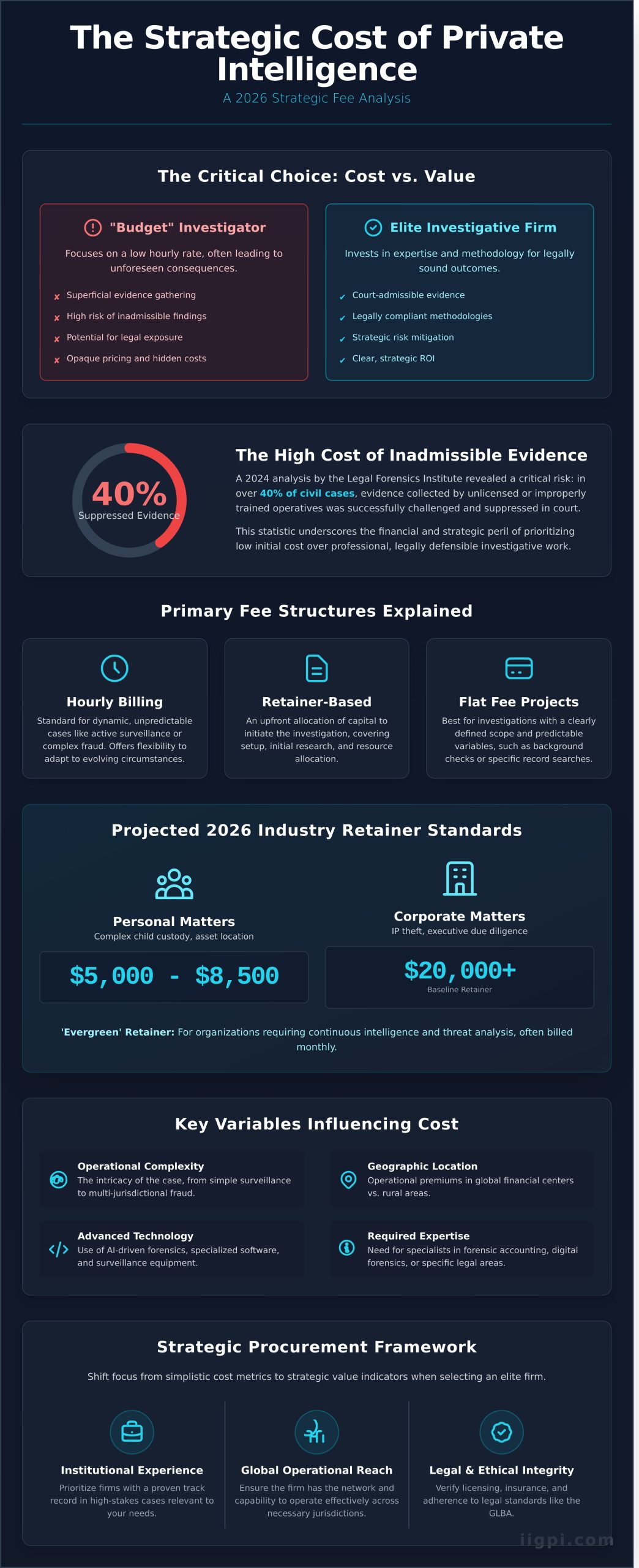
Engaging ‘budget’ investigators introduces significant hidden costs, primarily through legal exposure and the high probability of rendered evidence being deemed inadmissible. A 2024 analysis by the Legal Forensics Institute found that evidence collected by unlicensed or improperly trained operatives was challenged and successfully suppressed in over 40% of civil cases. Professional firms mitigate these risks by employing law enforcement-grade protocols, such as maintaining an unbroken chain of custody for digital evidence and ensuring all surveillance activities comply with federal and state privacy statutes. This intellectual rigor, which forms the bedrock of modern investigative methodologies, ensures that every finding is not just discovered but is also defensible.
Industry Standards for Professional Retainers
A professional retainer is not a simple down payment; it’s a strategic allocation of capital that initiates the entire investigative apparatus. This fee typically covers the administrative setup of the case file, initial database research through proprietary systems, and the preliminary allocation of personnel and technological resources. By 2026, industry projections indicate that standard retainers for personal matters, such as complex child custody or asset location cases, will range from $5,000 to $8,500. Conversely, corporate retainers for issues like intellectual property theft or executive due diligence will begin at a baseline of $20,000. For organizations requiring continuous intelligence, the ‘evergreen’ retainer model provides ongoing surveillance and threat analysis, often billed monthly to ensure constant vigilance against emerging risks.
Primary Fee Structures: Hourly Rates, Retainers, and Flat Fees
The financial architecture of private investigative services is predicated on three principal models: hourly billing, project-based flat fees, and the common use of an upfront retainer. The selection of a specific model is not arbitrary; it is a calculated decision dictated by the investigation’s complexity, predictability of scope, and the specific objectives of the client. Understanding these billing frameworks is fundamental for any individual or organization seeking to accurately forecast how much a private investigator cost will be for a particular engagement. A transparent Statement of Work (SOW) serves as the foundational document, delineating the agreed-upon terms and preventing financial ambiguity.
The Hourly Billing Model
For investigations characterized by dynamic and unpredictable variables, such as active surveillance or complex corporate fraud, the hourly billing model is the industry standard. This structure provides the necessary flexibility to adapt to evolving circumstances where the total time commitment cannot be accurately predetermined. Projections for 2026 indicate a tiered rate structure: junior investigators or apprentices may bill between $75 and $125 per hour, while senior lead investigators, often with over a decade of specialized experience, command rates from $150 to over $300 per hour. This significant variance is justified by the expertise required by stringent state licensing requirements, which often mandate thousands of hours of fieldwork. Highly technical services, including digital forensics and Technical Surveillance Counter-Measures (TSCM), occupy a distinct and more expensive tier, frequently billed between $250 and $500 per hour due to the requisite advanced certifications and substantial investment in equipment.
Flat-Fee Service Packages
Conversely, flat-fee arrangements are best suited for services with a clearly defined scope and a predictable, finite workflow. Common examples include basic Level-1 background checks (typically $200-$400), which involve searching a specified set of public and private databases, or simple service of process within a local jurisdiction ($100-$200). The primary limitation of this model is its rigidity. Should a “simple” background check uncover complex corporate structures or require in-person verification, the engagement must either conclude or pivot to an hourly rate. To mitigate this, the SOW must be meticulously detailed, explicitly defining the parameters of the service to avoid unbudgeted add-on costs for tasks that fall outside the initial agreement.
Regardless of the chosen fee structure, the final invoice invariably includes expense reimbursements. These are not profit centers for the agency but direct pass-through costs essential to conducting the investigation. A comprehensive SOW will provide an estimate for these anticipated expenses, which typically include:
- Travel and Mileage: Often billed at the prevailing IRS rate, which was 67 cents per mile for 2024.
- Database Access Fees: Charges for utilizing proprietary databases like TLOxp or LexisNexis, which can range from a few dollars to several hundred per search.
- Government and Court Fees: Costs associated with retrieving official documents or filing paperwork.
- Specialized Equipment: Rental or usage fees for items like covert cameras or GPS tracking units, where legally permissible.
A client’s final bill, and thus the definitive answer to the question of how much does a private investigator cost, is a composite of the professional service fees plus these carefully documented operational expenses. For a deeper analysis of how these costs apply in corporate and governmental contexts, our governance policy reports offer extensive case studies and financial modeling.
Variables Influencing the Cost of Professional Private Investigations
The financial investment required for a professional private investigation is not a static figure; it is a dynamic calculation influenced by a matrix of interconnected variables. A client’s central question, how much does a private investigator cost, can only be addressed through a meticulous evaluation of four principal domains: the operational geography, the technological apparatus required, the intrinsic complexity of the case, and the caliber of the investigative personnel. Each component contributes materially to the final cost structure, distinguishing a routine background verification from a sophisticated corporate espionage inquiry.
Case complexity serves as the foundational cost determinant. A straightforward locate investigation or a wellness check may be concluded within 3-5 billable hours, representing a contained and predictable expense. In stark contrast, a multi-jurisdictional financial fraud investigation, involving the tracing of assets through a labyrinth of offshore shell corporations and trusts, necessitates a team of specialists, including forensic accountants, and can extend for several months, accumulating costs that can reach into the tens of thousands of dollars. Similarly, the value of an investigator’s expertise cannot be understated. Agents with distinguished careers in federal law enforcement, such as the Federal Bureau of Investigation, or specialized intelligence services command premium rates, often exceeding $300 per hour. Their profound understanding of evidence collection protocols, interrogation techniques, and courtroom testimony provides a strategic advantage that justifies the elevated investment.
The Impact of Geography and Global Reach
Operational geography profoundly impacts investigative pricing, with major metropolitan centers commanding a significant premium. A firm based in New York City, for instance, contends with some of the highest operational overheads in the United States, where prime commercial real estate costs exceeded $82 per square foot in 2023. This economic reality, coupled with the logistical complexities of conducting surveillance in a dense urban environment, means hourly rates in NYC and Nassau County are often 25-40% higher than the national average. For cases requiring international scope, such as asset searches in European or Caribbean financial havens, costs escalate further. The engagement of a global network of vetted agents, each navigating distinct local regulations like the EU’s General Data Protection Regulation (GDPR), introduces logistical and compliance costs that are factored into the client’s budget.
Specialized Equipment and Digital Assets
The deployment of advanced technology is a critical component in modern investigations and a substantial cost factor. High-definition, long-range surveillance cameras and night-vision optics represent a significant capital expenditure for any agency. Beyond physical hardware, access to sophisticated digital assets is essential. Subscriptions to proprietary, Level III data aggregators like TLOxp or LexisNexis can cost an agency over $15,000 annually, a necessary expense for deep-background analysis. Investigations involving computer forensics or deep-web analysis require specialized software and personnel with certified expertise, adding a distinct line item to the budget. Technical Surveillance is a significant cost driver, defined as the strategic deployment of specialized electronic hardware and the requisite technical expertise to monitor, capture, or intercept communications and activities. Understanding these technological and geographic variables is essential for any entity seeking to accurately project how much does a private investigator cost for a high-stakes engagement.
Evaluating the Return on Investment (ROI) in High-Stakes Investigations
For corporate entities and high-net-worth individuals, the critical question transcends the preliminary inquiry of how much does a private investigator cost. The more salient analysis involves a paradigm shift; viewing investigative expenditure not as a transactional expense, but as a strategic investment in asset protection, risk mitigation, and financial recovery. The calculus of value becomes starkly clear when the cost of an inquiry is juxtaposed against the catastrophic losses it is designed to prevent or reclaim.
Consider the economics of a complex financial crime. In a 2022 case involving a transnational banking syndicate, an internal investigation costing approximately $750,000 was instrumental in uncovering and documenting a sophisticated $120 million fraud scheme. The return on investment in this scenario isn’t merely substantial; it’s existential. Similarly, in the mergers and acquisitions sector, comprehensive due diligence serves as a critical firewall. A forensic accounting and background investigation, perhaps costing $200,000, that exposes undisclosed liabilities or intellectual property risks can prevent a flawed $80 million acquisition, saving the acquiring firm from years of legal battles and financial impairment. According to a 2023 report by KPMG, nearly 30% of M&A deals fail to generate their expected value, with inadequate due diligence cited as a primary factor.
This principle extends directly to the insurance industry, where fraudulent claims represent a significant liability. A surveillance operation targeting a suspected fraudulent commercial liability claim valued at $15 million may cost between $50,000 and $100,000. If this investigation produces irrefutable evidence that disproves the claim, the ROI is self-evident, protecting the insurer’s capital reserves and preventing future premium increases for policyholders.
Quantifying Investigative ROI for Corporate Clients
A pragmatic framework for evaluating an investigation’s financial return can be expressed through a simple formula: (Potential Loss Averted + Assets Recovered – Investigation Cost) / Investigation Cost. This calculation illuminates the core value proposition. In post-litigation scenarios, this becomes particularly crucial. A legal judgment is merely a piece of paper until the awarded funds are located and seized. It’s in this phase that an investigator’s work in Asset Search and Recovery: Tracing Hidden Funds provides the mechanism to convert a legal victory into a tangible financial recovery, often locating assets concealed in offshore accounts or complex corporate structures.
The Value of Admissibility in Legal Proceedings
The strategic value of a professional investigation is profoundly amplified within the legal arena. Evidence that is meticulously collected, preserved, and documented by seasoned investigators is far more likely to be deemed admissible in court. This directly reduces legal costs by streamlining the discovery phase, which the American Bar Association estimates can consume up to 50% of total litigation expenses. Furthermore, the investigator’s role as a credible expert witness can decisively influence settlement negotiations. The cost of their testimony is insignificant compared to its potential to compel a favorable out-of-court resolution, thereby avoiding the immense expense and uncertainty of a protracted trial. These protocols are central to effective risk management, a subject explored in The Definitive Guide to Corporate Investigations.
Ultimately, when assessing how much does a private investigator cost, the fee itself is only one part of a much larger financial equation. To understand how a strategic investigation can protect your corporate assets and deliver a quantifiable return, schedule a confidential consultation with our risk management experts.
Strategic Procurement: Selecting a Firm Based on Expertise and Global Reach
For high-stakes corporate, legal, and financial matters, the selection of an investigative firm transcends a simple comparison of hourly rates. The critical inquiry shifts from a basic question of how much does a private investigator cost to a more strategic assessment of a firm’s capacity, pedigree, and global operational integrity. An engagement with an elite investigative body is not an expense; it is a strategic investment in risk mitigation, asset protection, and informational superiority. The lowest bid often correlates with limited experience, inadequate resources, and a heightened risk of operational failure, which can result in compromised evidence, legal challenges, and irreparable reputational damage.
An institution’s history serves as a primary indicator of its methodological sophistication and reliability. A firm with over 30 years of continuous operation, such as the International Investigative Group, demonstrates a sustained record of delivering results and adapting to evolving legal and technological environments. This institutional experience is amplified by a vetted global network of agents, a critical asset for inquiries that cross international borders. Furthermore, a firm’s law enforcement pedigree, particularly one staffed by former ranking officials from agencies like the FBI, DEA, and IRS Criminal Investigation, ensures that all evidence is collected in a manner that withstands the most rigorous judicial scrutiny. This background provides an innate understanding of legal procedure and ethical conduct that is impossible to replicate.
Due Diligence on Your Investigative Partner
A rigorous vetting process is imperative. Prospective clients must verify that the firm holds all requisite state and international licenses, carries comprehensive Errors & Omissions insurance with a minimum coverage of $1 million, and maintains affiliations with distinguished professional bodies like the Council of International Investigators. Assessing the firm’s capacity for multi-jurisdictional operations is also essential, as complex cases rarely remain within a single legal territory. This capability is particularly vital when hiring a corporate private investigator in NYC for matters with international financial or logistical components.
Finalizing the engagement requires a meticulous review of the service contract or retainer agreement. A professional contract must unequivocally define the scope of work and investigative objectives. It should also provide a transparent and detailed fee structure, thereby eliminating ambiguity and providing a clear answer to how much does a private investigator cost for the specific engagement. Key components to verify include:
- A precise description of services to be rendered.
- A transparent breakdown of all fees, including hourly rates, retainer amounts, and potential expenses.
- Robust confidentiality and non-disclosure clauses to protect sensitive information.
- Clearly defined protocols for communication and the delivery of evidentiary reports.
The International Investigative Group Advantage
The International Investigative Group leverages the institutional knowledge gained from over 10,000 successfully resolved cases to deliver exceptionally efficient, result-oriented solutions. Our established methodologies, refined over three decades, minimize operational inefficiencies and focus resources directly on achieving the client’s strategic objectives. We are committed to an ethos of academic rigor and absolute professional discretion in every inquiry, ensuring that our findings are not only accurate but ethically and legally sound. To explore how our capabilities can be aligned with your strategic needs, we invite you to initiate a formal consultation. Contact the International Investigative Group for a confidential fee assessment.
Translating Cost Analysis into Strategic Investigative Action
The financial framework of private investigations is demonstrably multifaceted, extending far beyond a rudimentary hourly rate or flat fee. A sophisticated procurement strategy recognizes that the initial question of how much does a private investigator cost must evolve into a rigorous evaluation of potential return on investment. For high-stakes corporate and financial disputes, the true determinant of value is not the fee structure itself, but the investigative outcome, where the successful recovery of assets or mitigation of multi-million dollar risks represents the paramount strategic imperative.
When facing complex global challenges, partnering with a proven entity is non-negotiable. IIGPI’s investigative division leverages over 30 years of elite law enforcement experience, a track record validated by more than 10,000 cases successfully resolved across the globe. Our specialized expertise in multi-million dollar financial fraud and asset recovery provides the decisive capability required for conclusive results. Secure Professional Investigative Services from IIGPI to transform your most critical challenges into strategic victories.
Frequently Asked Questions
What is the typical hourly rate for a private investigator in New York City in 2026?
The projected hourly rate for a licensed private investigator in New York City for 2026 is expected to range between $195 and $300. This forecast is based on an analysis of 2024 industry data, which showed a median rate of $175, and accounts for a projected 5-8% annual inflation and an increase in operational costs. Rates for investigators with specialized skills in areas like digital forensics or corporate counter-espionage will command rates at the higher end of this spectrum.
Do private investigators require a retainer before starting a case?
Yes, over 95% of private investigation firms require a retainer deposit before commencing any substantive work on a case. This initial payment functions as an advance against future billable hours and expenses, securing the investigator’s availability and covering preliminary costs such as database access and initial surveillance. The retainer amount is typically calculated based on the estimated number of hours required for the first phase of the investigation, often between 10 and 40 hours of work.
Can a private investigator provide a flat-rate quote for an asset search?
A private investigator can often provide a flat-rate quote for a well-defined asset search. For example, a standard Tier 1 search, which identifies real property, vehicles, and known bank accounts within a single state, might be quoted at a flat rate of $900 to $2,500. More complex, multi-jurisdictional, or international searches that require extensive analysis and surveillance will almost always be billed on an hourly basis plus expenses due to their unpredictable nature.
Are the costs of specialized equipment like drones or GPS trackers included in the hourly rate?
No, the costs associated with specialized investigative equipment are billed separately from an investigator’s standard hourly rate. These are considered direct operational expenses. For instance, the deployment of a GPS tracking device may incur a daily rental and monitoring fee of $50 to $85, while the use of aerial drone surveillance could be billed at a separate operational rate of $250 to $500 per hour, depending on the technology and operator expertise required.
How much should I budget for a comprehensive corporate due diligence investigation?
A budget for comprehensive corporate due diligence on a mid-sized entity typically ranges from $25,000 to $100,000, as of Q1 2024 data. Answering how much does a private investigator cost for such a project depends on its scope, including the number of principals to investigate, the complexity of the corporate structure, and the geographic extent of its operations. A preliminary consultation is essential to define the investigation’s parameters and establish a more precise financial framework for the engagement.
What happens to the unused portion of my investigative retainer?
The unused portion of your investigative retainer is refunded to you at the conclusion of the engagement. Professional investigators are ethically and often legally bound to provide a detailed, itemized invoice showing all billable hours and expenses incurred. Any funds remaining from the initial retainer after all legitimate charges have been deducted are returned to the client within 30 days of the case’s closure, as stipulated in the service agreement.
Are travel expenses and database fees billed separately from the investigator’s time?
Yes, travel expenses and third-party database fees are considered direct costs and are billed separately from the investigator’s hourly service rate. These pass-through expenses are itemized on the final invoice. For example, mileage is typically billed at the prevailing IRS standard rate, which was 67 cents per mile in 2024. A comprehensive background report from a proprietary database can cost anywhere from $150 to $500 per subject, depending on the depth of the inquiry.
Is the cost of hiring a private investigator tax-deductible for businesses?
The cost of hiring a private investigator is generally tax-deductible for a business, provided the service is an “ordinary and necessary” business expense under Section 162 of the Internal Revenue Code. Legitimate purposes include conducting due diligence for a potential merger, investigating employee fraud, or performing background checks on key executive hires. Corporations should always consult with a tax professional to confirm the deductibility of such expenses based on their specific circumstances.
