
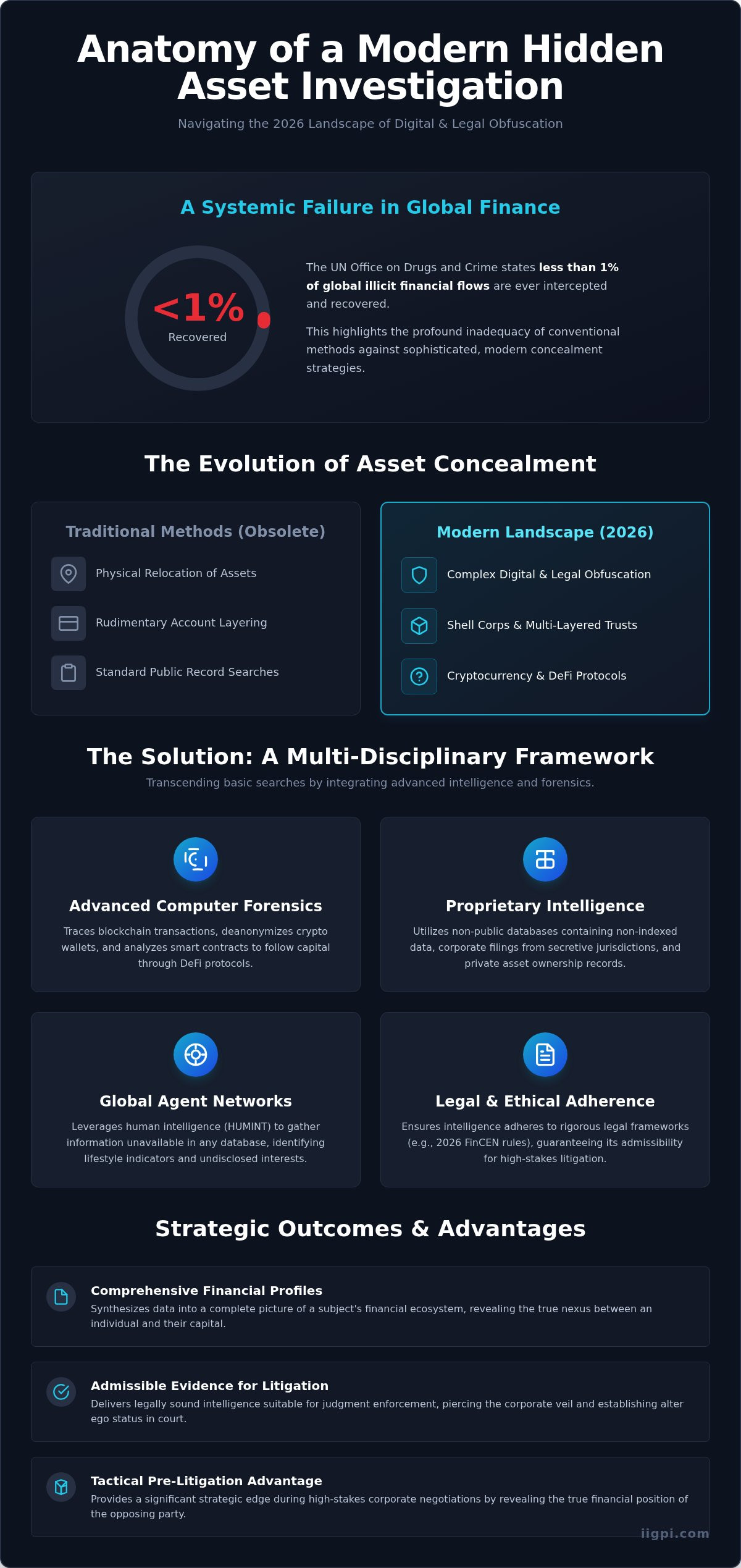
The United Nations Office on Drugs and Crime observes that less than 1% of global illicit financial flows are intercepted and recovered, a figure that highlights the profound inadequacy of conventional investigative paradigms. This systemic failure often stems from the sophisticated architecture of modern financial concealment, where layered shell entities and cross-border banking networks render standard database inquiries obsolete. For high-level decision-makers, the frustration of ineffective searches is compounded by the risk of legal repercussions and the substantial financial loss inherent in judgment evasion. A hidden asset investigation must therefore employ a multi-jurisdictional framework that utilizes advanced computer forensics to pierce these opaque structures. This article presents an authoritative analysis of the methodologies required to identify, trace, and recover concealed interests within the 2026 regulatory environment. We examine how the integration of forensic intelligence and global agent networks facilitates the construction of comprehensive financial profiles suitable for high-stakes litigation. By addressing the nuances of the 2026 FinCEN AML/CFT program modernization rules, this discourse provides a strategic roadmap for mitigating risk and securing admissible evidence in the pursuit of global asset recovery.
Key Takeaways
- A modern hidden asset investigation requires a multi-disciplinary framework that transcends basic database searches by integrating computer forensics and proprietary intelligence.
- Understanding the transition from rudimentary physical concealment to complex digital and legal obfuscation is essential for identifying sophisticated financial structures in 2026.
- Adherence to rigorous legal frameworks and ethical standards ensures that gathered intelligence remains admissible for litigation and judgment enforcement across global jurisdictions.
- Strategic implementation of asset tracing in the pre-litigation phase provides a significant tactical advantage during high-stakes corporate negotiations and settlements.
- Leveraging elite institutional experience and global agent networks facilitates the synthesis of comprehensive financial profiles for high-value recovery operations.
The Evolution of Asset Concealment in the Global Financial Landscape
A modern hidden asset investigation functions as a rigorous forensic discipline rather than a mere administrative inquiry. It requires the systematic deconstruction of layered financial arrangements designed to obscure the nexus between a subject and their capital. Historically, concealment relied on physical relocation or rudimentary account layering; however, the 2026 landscape is defined by digital and legal obfuscation. Standard public record searches, which rely on localized and indexed databases, consistently fail in high-value cases. These tools aren’t capable of penetrating structures where legal ownership is distinct from beneficial control. Asset recovery demands precision. Consequently, reliance on such superficial methods during high-stakes litigation often results in significant financial loss and the failure of judgment enforcement.
The integration of private intelligence into a hidden asset investigation during corporate and matrimonial litigation’s become essential for achieving equitable outcomes. Unlike standard database providers, elite investigative firms utilize global agent networks and proprietary datasets to identify assets that aren’t reflected in public filings. This process involves the identification of lifestyle indicators, undisclosed business interests, and the movement of funds across borders. By providing a comprehensive view of a subject’s financial ecosystem, these investigations mitigate the risks associated with sophisticated fraud or strategic insolvency. It’s a necessary evolution in a world of borderless capital.
Strategic Diversification and Offshore Legal Structures
The utilization of shell corporations and multi-layered trusts remains a cornerstone of institutionalized asset concealment. These structures often span multiple jurisdictions, creating a labyrinthine path that frustrates traditional recovery efforts. As evidenced by the Pandora Papers, the complexity of these networks allows individuals to maintain control over vast wealth while remaining legally invisible. Piercing the corporate veil in these investigative contexts demands a forensic analysis of corporate governance documents, nominee agreements, and capital flow patterns to establish the requisite evidence of alter ego status. Identification of beneficial ownership in secretive jurisdictions requires more than just legal requests. It necessitates the synthesis of human intelligence and financial data to reveal the true architects of these offshore entities.
The Digital Frontier: Cryptocurrency and Virtual Assets
The digital era’s introduced unprecedented challenges through the proliferation of cryptocurrency and decentralized finance (DeFi) protocols. Tracing blockchain transactions requires a specialized intersection of computer forensics and financial intelligence to deanonymize wallets and identify undisclosed wealth. While blockchains provide a public ledger, the use of privacy coins and mixing services necessitates advanced investigative methodologies to reconstruct transaction histories. Identifying the off-ramps where virtual assets are converted into fiat or tangible property is critical for achieving a comprehensive financial profile of the subject. The rise of DeFi allows for the automated movement of capital without traditional intermediaries; this requires investigators to possess a deep understanding of smart contracts and liquidity pools to trace the ultimate destination of hidden funds.
Advanced Investigative Methodologies for Asset Identification
The identification of obscured financial interests in 2026 necessitates a multi-disciplinary paradigm that transcends the limitations of automated data aggregation. A rigorous hidden asset investigation utilizes proprietary databases that are structurally inaccessible to the general public, providing a foundational layer of intelligence. These specialized repositories contain non-indexed historical data, corporate registry filings from restrictive jurisdictions, and private aircraft or vessel ownership records. However, digital leads alone are insufficient; the role of human intelligence (HUMINT) remains paramount in verifying the empirical reality of these virtual signatures. By integrating physical surveillance with financial data analysis, investigators can construct a 360-degree profile that bridges the gap between a subject’s reported financial status and their observable lifestyle. This synthesis of technical and traditional intelligence ensures that the findings aren’t just theoretically sound but are practically actionable.
Forensic Accounting and Complex Financial Data Analysis
The deconstruction of bank statements and tax filings serves as a critical mechanism for identifying anomalies that indicate fund diversion. Forensic accountants scrutinize capital flow patterns to detect “lifestyle vs. reported income” discrepancies, which often provide the first empirical evidence of concealment. When financial records have been intentionally purged, investigators employ advanced computer forensics to reconstruct deleted ledgers and communication logs. This process requires a sophisticated understanding of how digital footprints persist within enterprise resource planning (ERP) systems and private cloud environments. Identifying these subtle inconsistencies is often the catalyst for a successful hidden asset investigation, as it provides the necessary leverage for subsequent legal discovery.
Multi-Jurisdictional Intelligence and Global Agency Networks
Modern asset recovery operations are rarely confined to a single territory, requiring the seamless coordination of on-the-ground agents in international financial centers. The principles of International asset recovery dictate that investigators must navigate a complex web of US, European, and offshore legal requirements simultaneously. This global reach is essential for identifying assets held in jurisdictions where beneficial ownership transparency is traditionally low. Effective investigators must also manage the constraints of international data privacy laws, such as the GDPR, to ensure that all evidence remains admissible in court. When the complexity of a case demands this level of sophisticated synthesis, engaging a specialized investigative partner becomes a critical strategic decision for legal counsel and corporate leadership. Coordinating these disparate intelligence streams requires a central authority capable of translating localized findings into a cohesive global strategy.
Legal Frameworks and Regulatory Compliance in Private Intelligence
The legitimacy of a hidden asset investigation is predicated upon its strict adherence to the complex tapestry of federal and state statutes. In the 2026 regulatory environment, the ethical imperatives of private intelligence have transitioned from discretionary guidelines to mandatory operational protocols. Critics often question the legality of tracing obscured wealth; however, when conducted by elite firms with law enforcement backgrounds, these inquiries are rooted in established legal discovery and transparency mandates. Non-compliant searches, such as those involving unauthorized digital intrusions or deceptive pretexting, don’t just risk ethical censure. They jeopardize the entire litigation strategy by rendering critical evidence inadmissible under the “fruit of the poisonous tree” doctrine. Maintaining institutional integrity requires a meticulous approach to every inquiry.
The landscape of financial intelligence has been further refined by the Financial Crimes Enforcement Network (FinCEN) through its April 7, 2026, proposed rule. This reform emphasizes the necessity of documented risk assessments within AML/CFT programs, a standard that sophisticated investigative entities have already integrated into their internal compliance frameworks. For high-level decision-makers, the risk of engaging with an unvetted investigative partner is significant. A single procedural lapse can lead to severe legal repercussions or the total collapse of a recovery effort. High-stakes litigation demands a partner that views compliance as a strategic asset rather than a bureaucratic hurdle.
Adhering to the Gramm-Leach-Bliley Act (GLBA) and FCRA
Defining the boundaries of permissible financial inquiries is central to the operational philosophy of International Investigative Group. The Gramm-Leach-Bliley Act (GLBA) strictly governs the acquisition of non-public personal information, necessitating that investigators possess a permissible purpose for every search. Similarly, the Fair Credit Reporting Act (FCRA) dictates the parameters of corporate due diligence and background checks to ensure consumer protections aren’t bypassed. Maintaining a strict chain of custody for all gathered intelligence is vital. This ensures that the provenance of every data point can be verified, protecting the client from allegations of procedural impropriety during the discovery phase of a trial.
Admissibility of Evidence in Civil and Criminal Litigation
The ultimate utility of any hidden asset investigation lies in its ability to withstand the scrutiny of the courtroom. Preparing investigative reports requires a foresight that anticipates the demands of expert witness testimony. Digital evidence, particularly that involving complex blockchain or ERP reconstructions, must meet the Daubert standard for admissibility; this requires that the methodologies used are both scientifically valid and peer-accepted. Investigators must collaborate closely with legal counsel to ensure that all evidentiary filings are robust and strategically aligned with the broader case theory. This synergy between private intelligence and legal jurisprudence is what transforms raw data into a decisive tactical advantage during judgment enforcement or high-value settlements.
Strategic Implementation: From Pre-Litigation to Judgment Enforcement
Successful asset recovery is a function of strategic timing and the precise alignment of investigative goals with broader legal objectives. A hidden asset investigation shouldn’t be viewed as a reactive measure but as a foundational component of the litigation lifecycle. By establishing a clear nexus between the subject and their obscured wealth during the initial phases of a dispute, legal counsel gains a significant tactical advantage during settlement negotiations. The construction of a comprehensive financial profile allows counsel to determine whether the potential recovery justifies the significant expenditures associated with high-stakes litigation. Without this preliminary intelligence, organizations risk pursuing “paper judgments” that are practically unenforceable due to the subject’s strategic insolvency.
The efficacy of this approach is underscored by the rigorous standards of Conducting Due Diligence: A Corporate Imperative. In the current global economy, where capital can be relocated across jurisdictions in seconds, the window for effective intervention is narrow. Utilizing forensic intelligence to identify the location and nature of assets before a formal complaint is filed prevents the defendant from liquidating or transferring interests in anticipation of a freeze order. This proactive stance is essential for maintaining the integrity of the recovery process and ensuring that the final judgment carries substantive weight.
Pre-Litigation Feasibility and Risk Assessment
Determining the “collectability” of a potential judgment is a critical prerequisite for any high-value lawsuit. Investigators analyze the subject’s liquidity, real property holdings, and equitable interests to provide an objective assessment of financial viability. This data informs settlement strategies by revealing the subject’s actual capacity to satisfy a claim, often exposing discrepancies between their public poverty and private wealth. As evidenced by Europol’s Project A.S.S.E.T. in May 2026, which successfully traced 884 bank accounts and 74 vehicles, the scale of modern identification requires a macro-level perspective. Early identification ensures that assets remain within the reach of the court’s jurisdiction throughout the proceedings.
Post-Judgment Recovery and Asset Seizure Support
Once a judgment is secured, the focus shifts to the identification of specific assets to satisfy outstanding court orders. Investigators assist in the execution of writs of attachment and garnishment by providing precise location data for bank accounts, brokerage portfolios, and tangible property. This phase often requires monitoring subjects over extended periods for the emergence of new assets or the movement of previously obscured funds. When the complexity of enforcement spans multiple international territories, the 30 years of experience offered by International Investigative Group provides the necessary institutional depth to navigate diverse legal environments. Continuous surveillance of a debtor’s financial activities ensures that no recovery opportunity is overlooked, effectively closing the gap between a legal victory and financial restitution.
The Institutional Approach of International Investigative Group
The International Investigative Group (IIG) represents a premier institutional entity in the field of global intelligence, where the synthesis of 30 years of elite law enforcement experience and sophisticated private sector methodologies creates a definitive framework for recovery. High-net-worth individuals and multinational corporations prioritize IIG for sensitive matters due to the firm’s adherence to the highest evidentiary standards and its ability to operate within the most restrictive global jurisdictions. This institutional approach’s rooted in the understanding that a hidden asset investigation isn’t merely a technical exercise but a strategic operation requiring the coordination of disparate intelligence streams. By drawing parallels to the protocols found in The Modern Personal Detective: Protocols for Private and Domestic Intelligence, the firm ensures that every inquiry’s conducted with the gravity and precision expected by global leaders.
Operating as a prestigious research-driven entity, IIG functions as a critical partner for complex corporate litigation and high-value recovery. The organization’s NYC roots provide a foundational perspective on the world’s most dense financial markets, while its global reach ensures that no asset remains obscured by geographical distance. This duality of localized expertise and international perspective allows for the construction of comprehensive financial profiles that transcend the limitations of conventional database inquiries. In an era where capital’s increasingly abstract, the firm’s commitment to intellectual rigor and objective analysis provides the certainty required for decisive legal action.
Leveraging a Legacy of Law Enforcement Expertise
Applying rigorous investigative standards derived from decades of public service, IIG’s leadership’s institutionalized a culture of intellectual rigor and operational excellence. The value of this legacy’s manifest in an elite global network of vetted investigative agents who possess the localized knowledge necessary to navigate international financial centers. This network allows the firm to solve complex cases, ranging from intricate bank fraud schemes to multi-jurisdictional asset tracing, with a success rate that’s earned the trust of the global legal community. Over 10,000 cases have been resolved through this disciplined approach, demonstrating a consistent ability to bridge the gap between regional dynamics and global recovery objectives.
Integration of Computer Forensics and Field Intelligence
The unique synergy between computer forensics and traditional field intelligence allows IIG to construct a multi-dimensional view of a subject’s financial interests. By combining digital “deep dives” into encrypted communications and blockchain ledgers with the empirical data gathered through surveillance, the firm pierces the most sophisticated layers of obfuscation. For example, in a recent multi-million dollar fraud inquiry, this integrated methodology successfully identified a network of undisclosed real estate holdings that had been obscured through nominee owners and offshore trusts. This capacity to synthesize technical findings with human intelligence provides the definitive evidence required for high-stakes litigation. Those facing complex financial challenges are encouraged to engage with International Investigative Group for a confidential consultation to discuss the strategic implementation of these advanced recovery protocols.
Securing Financial Integrity in a Borderless Economy
The landscape of global asset recovery has reached a point of unprecedented complexity, where the distinction between legal ownership and beneficial control’s intentionally blurred through sophisticated digital and jurisdictional layering. Successfully executing a hidden asset investigation in this environment requires more than rudimentary data access; it necessitates a synthesis of forensic accounting, computer forensics, and elite human intelligence. By prioritizing early identification and maintaining rigorous compliance with federal statutes, organizations can transform abstract claims into tangible recoveries. International Investigative Group brings over 30 years of investigative excellence and former law enforcement leadership to every engagement, ensuring that our global reach’s always balanced by precise local expertise. This institutional depth’s critical for navigating the nuanced socioeconomic dynamics of emerging markets and established financial centers alike. We invite you to consult with our elite investigative team to initiate a comprehensive asset search and secure the financial restitution your case demands. Achieving transparency in the face of deliberate obfuscation’s possible with the right strategic partner.
Frequently Asked Questions
Is a hidden asset investigation legal in the United States?
A hidden asset investigation’s entirely legal within the United States when conducted in strict adherence to federal and state statutes, specifically the Gramm-Leach-Bliley Act and the Fair Credit Reporting Act. These laws mandate that investigators possess a permissible purpose and utilize non-deceptive methods to acquire information. Non-compliant inquiries, such as those involving pretexting or unauthorized digital access, are illegal and render any findings inadmissible in a court of law.
Can a private investigator find offshore bank accounts?
Private investigators with a global network can identify the existence of offshore bank accounts by tracing capital flows and analyzing beneficial ownership structures in secretive jurisdictions. While direct access to foreign account balances without a court order’s often restricted, investigators utilize human intelligence and on-the-ground agents to verify the nexus between a subject and specific international financial institutions. This methodology provides the empirical evidence necessary for legal counsel to initiate formal discovery or freeze orders.
How long does a comprehensive hidden asset search typically take?
The duration of a comprehensive inquiry depends on the complexity of the subject’s financial architecture and the number of jurisdictions involved in the search. A standard domestic investigation might conclude within several weeks; however, cases involving multi-layered shell companies or decentralized digital assets often require several months of rigorous forensic analysis. This deliberate pace ensures that all gathered intelligence’s verified and that the final financial profile’s robust enough to withstand judicial scrutiny.
What types of assets can be uncovered during a professional investigation?
Professional investigations identify a broad spectrum of tangible and intangible interests, ranging from real property and luxury vehicles to equitable shares in private corporations. Advanced methodologies also reveal sophisticated financial instruments, such as offshore trusts, life insurance policies with cash value, and intellectual property rights. By synthesizing data from non-indexed registries and physical surveillance, investigators uncover assets that aren’t reflected in standard public records, ensuring a 360-degree view of the subject’s true net worth.
Can cryptocurrency be traced if it has been moved through multiple wallets?
Cryptocurrency remains traceable despite the use of multiple wallets or mixing services, as the immutable nature of the blockchain provides a permanent record of all transactions. Expert technicians utilize specialized computer forensics to deanonymize wallet addresses and map the movement of funds to centralized exchanges or fiat off-ramps. While decentralized finance protocols introduce additional layers of complexity, persistent forensic analysis often reveals the ultimate destination of hidden virtual wealth, facilitating eventual recovery.
Will the subject of the investigation know they are being searched?
A professionally executed investigation’s designed to remain entirely covert, ensuring the subject’s unaware of the scrutiny until the intelligence’s utilized in a legal context. Investigators prioritize discretion to prevent the subject from liquidating or transferring assets in anticipation of a recovery effort. By utilizing non-intrusive methodologies and secure communication protocols, elite firms protect the integrity of the operation and maintain the tactical advantage for their corporate or high-net-worth clients.
What is the difference between a database search and a forensic asset investigation?
A standard database search relies on aggregated public records that are often outdated or incomplete, providing only a superficial view of a subject’s financial status. In contrast, a forensic hidden asset investigation involves the active deconstruction of complex legal structures and the verification of leads through human intelligence and computer forensics. This institutional approach’s necessary to pierce the veil of shell companies and identify interests that have been intentionally obscured from public view.
How is the evidence gathered by a private investigator used in court?
Evidence gathered during an investigation’s typically presented through detailed forensic reports and expert witness testimony to support motions for discovery or writs of attachment. All intelligence must meet the Daubert standard for scientific validity to ensure its admissibility in civil or criminal litigation. By collaborating closely with legal counsel, investigators provide the evidentiary foundation required to prove the existence of concealed wealth and justify the seizure of assets to satisfy a judgment.