
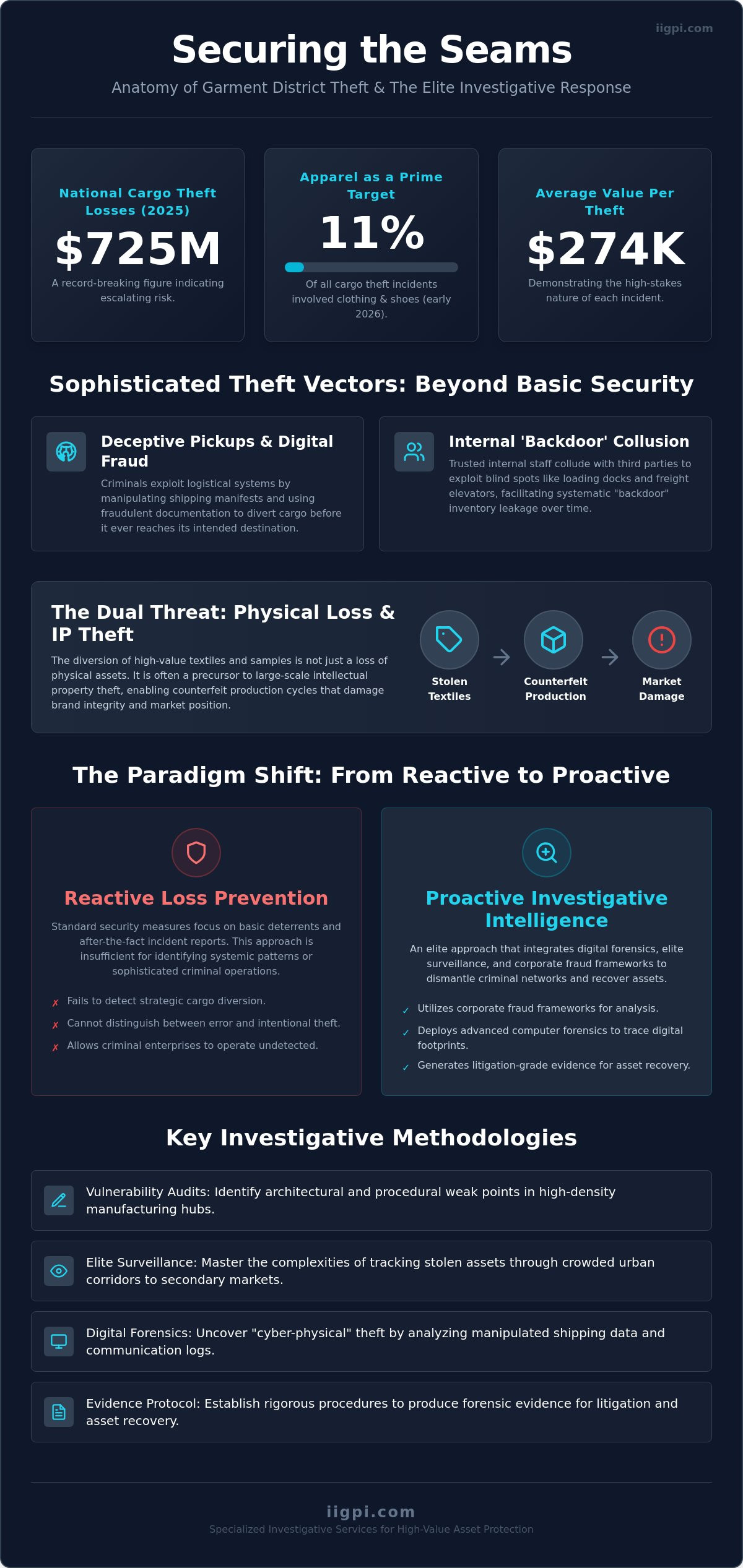
With national cargo theft losses escalating to a record $725 million in 2025 and apparel remaining one of the most frequently targeted commodities in 2026, the strategic preservation of inventory within Manhattan’s commercial corridors has transcended the capabilities of basic loss prevention. You likely recognize that standard security measures are increasingly insufficient against the sophisticated “deceptive pickup” schemes and internal “backdoor” operations currently plaguing the region’s high-value textile trade. This analysis provides an authoritative examination of the specialized garment district theft investigation services required to dismantle organized retail crime networks and restore systemic supply chain integrity. We will explore the rigorous integration of digital forensics, undercover surveillance, and law-enforcement-grade protocols designed to secure high-value assets and generate the actionable evidence necessary for litigation or executive termination. By addressing these vulnerabilities through an elite investigative lens, stakeholders can transition from reactive loss acknowledgment to a proactive posture of total asset recovery and long-term risk mitigation.
Key Takeaways
- Identify the architectural vulnerabilities of Midtown Manhattan’s high-density manufacturing hubs that facilitate both physical inventory loss and intellectual property theft.
- Implement garment district theft investigation services that utilize corporate fraud frameworks to transition from reactive security to proactive, intelligence-driven asset preservation.
- Master the complexities of conducting elite surveillance within crowded urban corridors to track stolen high-value textiles from the point of origin to secondary markets.
- Utilize advanced computer forensics to uncover the digital footprints of “cyber-physical” theft, specifically addressing manipulated shipping manifests and deceptive pickup schemes.
- Establish rigorous investigative protocols that produce the forensic evidence required for successful litigation, executive termination, and the comprehensive recovery of stolen corporate assets.
The Architecture of Risk: Understanding Garment District Theft
The Garment District represents a unique topological challenge for asset protection, where the convergence of high-density manufacturing and rapid logistics creates a fertile environment for systemic inventory leakage. Theft in this sector isn’t merely a series of isolated incidents. Instead, it’s a multi-layered phenomenon encompassing physical inventory diversion, intellectual property infringement, and logistical manipulation. The Garment District’s history and economic significance underscore its role as a critical hub, yet this very prominence invites sophisticated criminal actors who exploit the area’s aging infrastructure and labyrinthine shipping corridors. For fashion houses operating within these Midtown blocks, the deployment of professional garment district theft investigation services is essential to navigate a landscape where standard loss prevention protocols often fail to detect elite-level “backdoor” diversions.
Shrinkage currently exerts an unprecedented pressure on fashion house margins, particularly as cargo theft losses in the U.S. reached approximately $725 million in 2025. With clothing and shoes accounting for 11% of these incidents in early 2026, the economic impact of strategic theft is profound. Standard security personnel, while effective for basic deterrents, aren’t equipped to identify the forensic signatures of strategic cargo diversion or the subtle manipulation of shipping manifests. The inability to distinguish between administrative error and intentional diversion often allows criminal enterprises to operate with impunity for extended periods.
The Nuances of High-Value Textile Diversion
High-value textiles, often treated as “specie” due to their immense value per yard, are increasingly targeted for illicit resale in secondary markets. This diversion doesn’t just result in physical loss; it frequently serves as the precursor to design piracy. When stolen samples or proprietary fabrics are diverted, they’re often used to facilitate counterfeit production cycles that can precede a collection’s official market launch. This intersection of physical theft and intellectual property loss requires an investigative approach that treats fabric as a high-stakes asset rather than mere raw material.
Internal Collusion and the Supply Chain Gap
The “Fraud Triangle”—comprising motive, opportunity, and rationalization—finds ample expression within the district’s complex supply chains. Loading docks and freight elevators represent significant blind spots where third-party contractors and internal staff may collude to facilitate inventory leakages. These gaps in oversight allow for the systematic removal of goods, including items designated for destruction or sample archives. Identifying these vulnerabilities requires more than a cursory audit. It demands a rigorous analysis of the “blind load” practices and third-party interactions that often mask the true extent of internal collusion.
To mitigate these physical risks, many firms are adopting industrial-grade security measures; for example, utilizing specialized, high-durability transit containers from Packaging For Industry (PFI) can help ensure that high-value textiles are shielded from tampering during the most vulnerable stages of the logistics cycle.
Specialized Investigative Methodologies for Apparel Loss
The methodological shift from reactive security to proactive investigative intelligence is a fundamental requirement for fashion houses operating within Midtown Manhattan. While traditional deterrents focus on immediate physical breaches, elite garment district theft investigation services employ comprehensive corporate fraud investigation frameworks to identify systemic patterns of loss that often evade standard retail audits. This transition involves a rigorous synthesis of forensic accounting and physical evidence collection. It’s particularly critical when dealing with luxury goods where “specie loss” expertise is paramount. Given that the average value of a single cargo theft in 2025 reached approximately $273,990, the financial stakes demand a level of sophistication far beyond basic surveillance. Precision is paramount.
The efficacy of these methodologies is enhanced by broader legislative shifts. New York’s crackdown on retail theft has introduced more stringent legal frameworks, yet private entities must still provide high-fidelity evidence to trigger state intervention. Utilizing sophisticated garment district theft investigation services allows organizations to establish an empirical chain of custody that withstands the most rigorous legal scrutiny. For fashion houses facing unexplained inventory discrepancies, seeking professional investigative assistance ensures that the corporate response is both precise and legally robust.
Forensic Inventory Reconstruction
Forensic inventory reconstruction is the mathematical verification of physical assets against procurement records. This process requires a meticulous SKU-level analysis to identify “ghost” inventory, which refers to items that appear on paper but have been systematically diverted through manipulated manifests. By reconstructing paper trails, investigators can pinpoint the exact temporal and geographical points of failure within the supply chain. This quantitative approach transforms vague suspicions into actionable data.
Undercover Operations and Internal Intelligence
Human intelligence (HUMINT) remains the cornerstone of uncovering organized theft rings that operate within manufacturing or distribution centers. The strategic placement of undercover operatives allows for the observation of clandestine activities that cameras and sensors often miss. They observe everything. These operatives gather critical intelligence on internal collusion while maintaining the delicate balance required to preserve workplace morale. Maintaining supply chain integrity requires a multifaceted approach that addresses both digital and physical vulnerabilities. This strategy identifies the specific individuals and methods behind internal diversions, providing the intelligence needed to dismantle established criminal networks from within.
Elite Surveillance in High-Density Urban Environments
The operational landscape of Midtown Manhattan necessitates a surveillance paradigm that is both technologically advanced and tactically agile. Conducting surveillance within the high-density corridors of the Garment District involves navigating an environment with a crime index of 121, which sits 21% above the national average, and a robbery concern indexed at 185 as of July 2026. These metrics underscore the volatility of the district’s commercial corridors. Unlike stationary security personnel who are restricted by property boundaries, elite garment district theft investigation services leverage former law enforcement expertise to maintain discrete coverage across complex urban terrain. They navigate the subway systems, service elevators, and multi-tenant lobbies that define the district’s manufacturing hubs. This expertise is vital when tracking the escalation of Organized Retail Crime (ORC), where stolen assets are rapidly moved from production sites to decentralized liquidation points.
Technological integration is no longer optional. While physical tails provide essential context, they’re now augmented by professional surveillance services utilizing GPS tracking and miniaturized hidden cameras to ensure continuous monitoring of high-value shipments. This hybrid approach allows investigators to document the exact moment of diversion, providing a definitive record of the “cyber-physical” breach. It’s the only way to counteract the strategic theft methods currently dominating the apparel sector.
Tracking the Secondary Market
Liquidating stolen designer goods requires a network of “fences” and illicit boutiques that operate on the periphery of the legitimate market. Surveillance of delivery routes often reveals unauthorized stops at these secondary locations, where premium textiles and finished garments are offloaded for rapid monetization. By establishing a continuous chain of custody through high-fidelity surveillance, investigators can identify the entire hierarchy of a theft ring. This includes the low-level “boosters” and the high-level financiers who orchestrate the distribution of stolen luxury inventory across the tri-state area.
Legal Compliance and Evidence Admissibility
The transition from intelligence gathering to legal action depends entirely on the admissibility of evidence. All surveillance activities must strictly adhere to New York State privacy laws to ensure that captured footage serves as a viable foundation for prosecution or termination. High-definition video evidence is particularly critical when resolving insurance fraud investigation claims, where insurers require empirical proof of loss and culpability. Expertly prepared surveillance logs and forensic testimony transform raw visual data into a powerful tool for litigation. Deploying specialized garment district theft investigation services ensures that the architecture of the theft is fully exposed within a judicial framework, facilitating the total recovery of assets.
Digital Forensics and Supply Chain Integrity
The contemporary landscape of asset protection within Manhattan’s apparel hub has shifted from purely physical deterrents to a sophisticated reliance on digital evidence. Strategic theft, characterized by deceptive pickups and identity fraud, increased by 31% in the first quarter of 2026, illustrating a profound transition toward “cyber-physical” criminality. Elite garment district theft investigation services must now operate at the intersection of logistics and technology, utilizing computer forensics to dismantle the digital architecture that facilitates large-scale inventory diversion. This process involves the meticulous examination of manipulated shipping manifests and the auditing of encrypted communication channels used by organized crime networks to coordinate the movement of stolen goods. By identifying the digital footprints left during the fraudulent redirection of cargo, investigators can expose the systemic vulnerabilities that traditional security measures inevitably overlook.
The role of digital forensics extends beyond the warehouse floor to the tracking of stolen apparel across the global e-commerce ecosystem. Sophisticated investigative protocols utilize web-crawling tools and forensic data analysis to trace the online liquidation of stolen designer inventory, correlating digital sales patterns with known physical losses. This comprehensive approach ensures that the investigation follows the assets from the point of diversion to the final point of sale. For organizations seeking to fortify their internal systems, engaging professional digital forensic services is a critical step in establishing a resilient defense against the increasingly technological nature of corporate theft.
Auditing the Digital Paper Trail
Effective forensic auditing requires identifying anomalies within Warehouse Management Systems (WMS) that suggest intentional data manipulation. Investigators focus on correlating digital “voids”—instances where inventory records are deleted or altered—with physical shifts in stock levels. Extracting metadata from internal communications and access logs provides the empirical evidence needed to prove intent, transforming a suspicious inventory discrepancy into a documented case of internal collusion. This rigorous digital reconstruction is essential for establishing the culpability of actors who exploit administrative access to facilitate theft.
Protecting Intellectual Property and Design Data
The threat to the fashion industry isn’t limited to finished garments; it encompasses the digital theft of proprietary design data and “tech packs” before production even begins. Digital breaches often serve as the precursor to physical theft or the rapid production of counterfeit collections that undermine a brand’s market exclusivity. Implementing long-term digital safeguards, including forensic monitoring of design servers and secure communication protocols, prevents the leakage of high-value intellectual property. By securing the digital blueprints of a collection, garment district theft investigation services protect the entire lifecycle of a garment, from the initial design phase to its final delivery at retail.
The IIG Advantage: Securing the Fashion Industry’s Future
The resolution of systemic inventory diversion within Manhattan’s apparel hub demands an investigative paradigm that transcends the limitations of conventional security. International Investigative Group (IIG) is positioned as the definitive authority in this specialized sector, providing elite garment district theft investigation services that address the multi-layered risks inherent in high-value textile manufacturing. As the premier private investigator NYC for high-stakes corporate matters, the firm leverages a 30-year legacy of investigative excellence. Having successfully resolved over 10,000 cases, IIG provides a level of empirical rigor and strategic depth that’s essential for fashion houses facing the sophisticated “cyber-physical” theft trends dominating 2026. This extensive track record serves as the ultimate trust signal for decision-makers who require more than just a deterrent; they require total asset recovery and the dismantling of organized criminal networks.
Why Experience in NYC Law Enforcement Matters
The firm’s foundation, established by former law enforcement professionals, provides an unparalleled understanding of the specific street-level dynamics that define Manhattan’s commercial districts. This localized expertise is critical for navigating the labyrinthine corridors and complex logistics of the Garment District. When investigations cross international borders, IIG leverages its global network of agents to ensure that the chain of evidence remains intact across diverse jurisdictions. The unique capability of a private investigator with this pedigree lies in their ability to operate effectively within both the corporate boardroom and the logistical loading dock. This dual perspective allows for the identification of vulnerabilities at every stage of the supply chain, from the digital tech pack to the physical shipment.
Confidentiality and Brand Preservation
In the fashion industry, brand reputation is a primary asset that must be protected with absolute discretion. IIG executes every investigation with a commitment to confidentiality, ensuring that internal inquiries don’t disrupt the public-facing image of the fashion house. The deployment of specialized garment district theft investigation services transforms a reactive response into a proactive strategic advantage. The investigator functions as a strategic partner in risk management, moving beyond simple evidence collection to provide long-term systemic safeguards. The return on investment for professional theft investigation services is quantifiable. It’s measured not only in the recovery of stolen assets but in the preservation of market exclusivity and the fortification of future operations against emerging threats. Securing a confidential consultation is the essential first step toward mitigating current losses and establishing a resilient posture of supply chain integrity.
Fortifying Supply Chain Integrity in an Evolving Risk Landscape
The transition from traditional loss prevention to elite asset preservation is essential for fashion houses operating within the district’s complex manufacturing corridors. Effective risk mitigation necessitates a rigorous synthesis of forensic inventory reconstruction and high-fidelity surveillance to identify specific points of supply chain failure. By deploying specialized garment district theft investigation services, organizations can transform unexplained inventory shrinkage into actionable evidence for litigation and total recovery. This approach ensures that both physical diversions and digital manifest manipulations are addressed with empirical precision, providing a definitive defense against organized retail crime.
International Investigative Group provides the intellectual and operational depth required to secure your collection’s future. Our leadership, comprised of former law enforcement professionals, has successfully resolved over 10,000 cases through a global investigative network that maintains deep Manhattan roots. We’re prepared to dismantle internal theft rings and restore your operational integrity. Secure Your Assets with a Confidential Consultation from IIG’s Elite NYC Investigators. Taking these proactive steps ensures that your brand’s exclusivity and financial margins remain uncompromised in an increasingly volatile market.
Frequently Asked Questions
What are the most common types of theft in the NYC Garment District?
The prevailing modalities of asset loss within this high-density hub involve a sophisticated convergence of strategic cargo theft, deceptive logistics pickups, and internal collusion. These activities frequently extend beyond the physical removal of finished garments to encompass the misappropriation of proprietary design data and high-value textile samples. Organized retail crime networks often exploit the district’s complex shipping corridors to facilitate the rapid diversion of goods into illicit secondary markets.
How do I know if I need a private investigator or just better security guards?
Security guards function as primary physical deterrents and are effective for immediate site access control, whereas private investigators are required when systemic discrepancies suggest organized criminal activity or internal fraud. For those looking to establish a visible deterrent, you may explore Contract-based security staffing and patrol fees to understand the requirements for professional site monitoring. Professional garment district theft investigation services provide the forensic and surveillance capabilities necessary to identify the root cause of inventory leakage and establish the evidentiary foundation required for legal action that standard guard services cannot provide.
Is evidence gathered by a private investigator admissible in a New York court?
Evidence obtained by licensed private investigators is generally admissible in New York judicial proceedings provided it’s collected in strict accordance with state privacy statutes and established chain-of-custody protocols. This includes high-definition surveillance footage, forensic digital logs, and sworn expert testimony. These elements are essential for securing favorable outcomes in civil litigation or criminal prosecution, as they provide an empirical record that withstands the most rigorous legal scrutiny.
How long does a typical garment district theft investigation take to yield results?
The temporal requirements for a comprehensive investigation vary based on the complexity of the criminal network and the depth of the systemic breach. While initial intelligence gathering and digital auditing may yield preliminary findings within several days, the full dismantling of an organized theft ring often requires several weeks of sustained surveillance. This duration ensures the total identification of all complicit actors and the successful recovery of diverted corporate assets.
Can an investigation help with an insurance claim for stolen inventory?
Professional investigations serve as a critical component in validating insurance claims for high-value inventory loss by providing empirical proof of theft. By delivering a detailed forensic reconstruction of the event and identifying the specific methodology of diversion, investigators enable fashion houses to meet the rigorous evidentiary standards required by insurers. This documentation is vital for the successful resolution of complex specie loss or high-stakes corporate insurance claims.
What is the difference between a forensic audit and a theft investigation?
A forensic audit focuses primarily on the quantitative reconciliation of financial records and inventory manifests to identify paper-based anomalies or “ghost” inventory. In contrast, a theft investigation incorporates these analytical findings with physical surveillance, undercover operations, and digital forensics. This multifaceted approach identifies the specific individuals and physical methodologies responsible for the actual diversion of assets, moving beyond mere data identification to active resolution.
How does the International Investigative Group maintain discretion in high-profile fashion houses?
International Investigative Group employs rigorous operational security protocols to ensure that all inquiries are conducted with absolute discretion. By utilizing former law enforcement personnel who understand the sensitivities of elite corporate environments, the firm executes its mandates without disrupting the brand’s public reputation. This professional approach protects the fashion house’s prestige while simultaneously dismantling internal threats, ensuring that the investigation remains entirely confidential from unauthorized personnel.
What should I do if I suspect an employee is stealing designer samples or textiles?
Immediate confrontation should be avoided to prevent the destruction of evidence or the alerting of potential co-conspirators. The most effective course of action is to document all observed anomalies and engage professional garment district theft investigation services to initiate a discrete inquiry. This allows for the establishment of a definitive evidentiary record and the identification of any broader collusion before any formal administrative or legal steps are taken.