
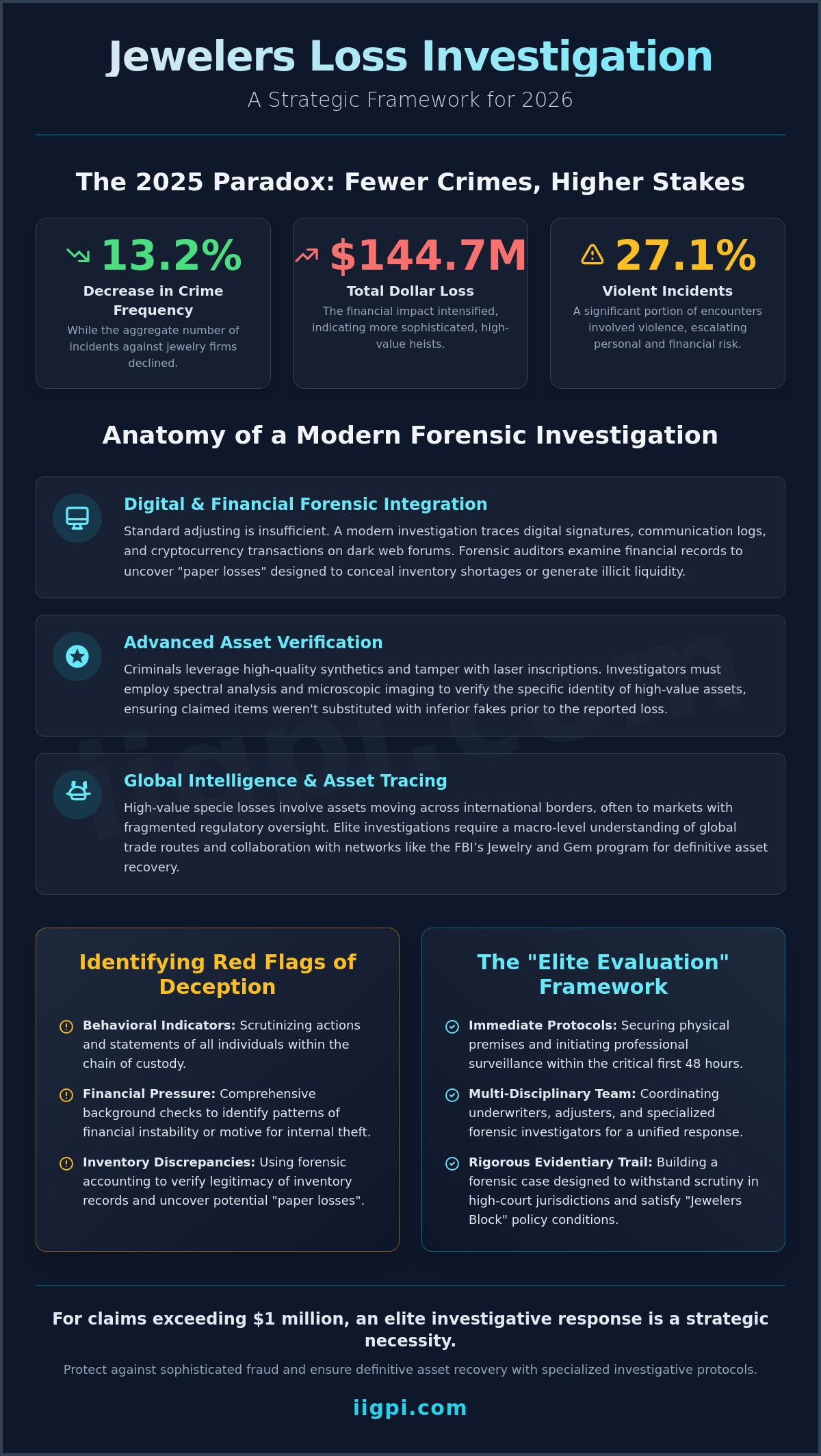
While the aggregate frequency of criminal activity against jewelry firms experienced a decline in 2025, the economic impact intensified to $144.7 million, with violent encounters rising to characterize 27.1% of these incidents. This paradox suggests that contemporary threats are becoming more targeted and sophisticated, rendering the standard jewelers loss investigation insufficient if it lacks specialized forensic depth.
You likely recognize that the failure of conventional adjusting methods to trace high-value assets across international borders leaves your firm vulnerable to profound financial exposure. It’s evident that standard protocols don’t adequately address the nuances of internal theft or organized global syndicates. This article promises an authoritative examination of the rigorous investigative protocols essential for resolving complex jewelry and specie losses with intellectual and technical precision. We will provide a comprehensive overview of the strategic framework for 2026, focusing on the integration of digital forensics, global intelligence networks like the FBI’s Jewelry and Gem program, and the methodologies required for definitive asset recovery.
Key Takeaways
- Grasp the systemic challenges inherent in tracing high-value assets across global borders within the complex 2026 economic landscape.
- Learn how a specialized jewelers loss investigation employs computer forensics to reveal digital trails that standard adjusters often miss.
- Identify the behavioral indicators and financial pressures that differentiate legitimate claims from sophisticated internal theft or corporate fraud.
- Implement rigorous protocols for the initial 48-hour window to secure physical premises and initiate professional surveillance services.
- Understand the “Elite Evaluation” framework required for the strategic recovery of stolen jewelry and specie.
The Complexity of Jewelers Loss Investigation in the Global Market
A rigorous jewelers loss investigation serves as a specialized vertical within the broader architecture of insurance fraud investigation services. It’s not merely an administrative review; it’s a forensic discipline designed to withstand the scrutiny of global underwriters and high-court jurisdictions. In 2026, the systemic challenges of high-value asset tracing have reached a critical juncture. While the Jewelers’ Security Alliance (JSA) reported a 13.2% decrease in the total number of jewelry crimes in 2025, the total dollar loss actually rose to $144.7 million. This data indicates that while volume has dropped, the sophistication and financial impact of each incident have escalated. For claims exceeding the $1 million threshold, an elite investigative response is no longer optional. It’s a strategic necessity to prevent significant financial exposure from organized theft rings that operate with paramilitary precision.
The Evolution of High-Value Specie Loss
Distinguishing between standard retail loss and high-value specie or wholesale theft is fundamental to a successful recovery strategy. Retail incidents are often localized, but specie losses involve the movement of bulk gemstones and precious metals across international borders. The 2026 landscape is further complicated by the proliferation of high-quality synthetic diamonds and the sophisticated tampering of laser inscriptions. These technological advancements allow criminals to mask the identity of stolen stones, making traditional identification methods obsolete. Geopolitical volatility also plays a decisive role. Stolen assets often migrate toward emerging markets where regulatory oversight is fragmented, requiring investigators to possess a macro-level understanding of global trade routes and regional dynamics.
The Stakeholders of an Investigative Mandate
The resolution of a high-stakes claim requires a coordinated effort between underwriters, adjusters, and specialized forensic investigators. Within the context of a “Jewelers Block” insurance policy, the burden of proof is substantial. In jurisdictions such as NYC, the legal necessity for a rigorous evidentiary trail is paramount to satisfy both policy conditions and local regulatory requirements. Investigators must employ Forensic accounting techniques to verify the legitimacy of the inventory records and the financial health of the claimant. This multi-layered approach ensures that every stakeholder has a definitive, data-driven analysis of the loss circumstances. Without this level of academic rigor, the risk of facilitating fraudulent claims or failing to recover stolen specie remains unacceptably high.
Technical Protocols: The Anatomy of a Modern Forensic Investigation
The execution of a high-stakes jewelers loss investigation necessitates a multi-disciplinary framework that transcends traditional inquiry, integrating advanced scientific methodologies with strategic intelligence. This rigorous approach is essential because modern theft scenarios often involve internal actors or sophisticated external syndicates that understand the limitations of standard adjusting. A comprehensive jewelers loss investigation protocol begins with exhaustive background checks on all individuals within the chain of custody, seeking to identify vulnerabilities or previous patterns of financial instability. By employing spectral analysis and microscopic imaging, investigators can verify the specific identity of assets, ensuring that the claimed items haven’t been substituted with inferior synthetics prior to the reported incident.
Digital and Financial Forensic Integration
The contemporary liquidation of stolen jewelry frequently occurs within clandestine marketplaces and dark web forums where anonymity is prioritized. The integration of computer forensics allows for the systematic tracing of digital signatures, communication logs, and cryptocurrency transactions that facilitate these black-market sales. Forensic auditors examine financial records to uncover “paper losses,” which are often manufactured to conceal existing inventory shortages or to generate illicit liquidity. Data from the Jewelers’ Security Alliance underscores the necessity of this digital oversight, as criminals increasingly use encrypted platforms to coordinate high-value specie thefts. Identifying these digital breadcrumbs is often the only viable path toward asset recovery in a globalized economy.
Physical Evidence and Site Analysis
Physical scene reconstruction is a critical component of verifying the legitimacy of a loss event. Investigators conduct detailed evaluations of security systems to determine if professionals used bypass techniques, such as cellphone Wi-Fi jammers or GPS trackers, which are increasingly common in high-value burglaries. Strategic surveillance services are deployed to monitor persons of interest, providing visual documentation of associations or activities that contradict the reported circumstances of the loss. “Time and Motion” studies are utilized to verify theft timelines, ensuring that the reported sequence of events is physically possible within the documented window. This level of site analysis often reveals inconsistencies that simple interviews fail to capture. To achieve definitive resolution in these complex scenarios, it’s vital to employ professional theft investigations that provide the evidentiary depth required for high-court scrutiny.
Identifying Red Flags: The Distinction Between Loss and Deception
The transition from technical site analysis to the evaluation of human intelligence (HUMINT) represents a critical phase in any comprehensive jewelers loss investigation. While physical evidence provides a skeletal framework of the event, the psychological and behavioral indicators displayed by claimants often reveal the underlying veracity of the narrative. Sophisticated theft rings and internal actors frequently attempt to “stage” losses to mirror legitimate burglaries, yet these fabrications often fail to account for the nuanced linguistic and behavioral baselines that elite investigators identify. A rigorous jewelers loss investigation must move beyond the superficial review of security footage to examine the cognitive dissonance inherent in fraudulent claims. Identifying these anomalies requires a synthesis of behavioral science and strategic inquiry to ensure that insurance settlements aren’t diverted to facilitate illicit gain.
Financial distress serves as a primary catalyst for the orchestration of staged losses, necessitating a thorough corporate fraud investigation when inventory anomalies arise. When a firm’s liabilities begin to eclipse its liquidity, the temptation to liquidate high-value specie through a reported theft becomes a systemic risk. Investigators analyze debt-to-equity ratios and recent credit inquiries to establish a motive for deception. This financial scrutiny is paired with advanced linguistic analysis during claimant interviews to detect verbal markers of evasion. In high-value personal or domestic scenarios, the strategic application of polygraph testing remains a definitive tool for establishing truthfulness regarding the chain of custody. These methodologies are particularly effective in resolving the “mysterious disappearance” of individual assets that lack a clear digital or physical trail.
Behavioral and Circumstantial Indicators
Inconsistencies between reported inventory and historical sales records often serve as the first material red flag in complex jewelry cases. The “mysterious disappearance” clause in many Jewelers Block policies presents a significant investigative challenge, as it lacks the clear forensic markers of a forced entry. While specific percentages vary by regional dynamic, a significant proportion of high-value losses involve some degree of internal compromise or “inside job” facilitation. Investigators scrutinize the timing of insurance coverage increases and the specific selection of stolen items, as the selective theft of high-margin stones while leaving lower-value inventory untouched often suggests a pre-meditated liquidation rather than a random external robbery.
Advanced Interviewing and Interrogation Techniques
The IIGPI approach prioritizes non-confrontational but high-yield interviewing techniques designed to elicit information through strategic disclosure rather than intimidation. Establishing a baseline for truthfulness is essential in specie loss cases, where the absence of physical evidence places a greater premium on the claimant’s testimony. Within the New York jurisdiction, investigators must navigate specific legal boundaries regarding the questioning of claimants to ensure that all gathered evidence remains admissible in future litigation. It’s not enough to identify a lie; one must document the contradiction with the intellectual rigor required to withstand the scrutiny of global underwriters and legal scholars alike.
Actionable Guidance: Immediate Protocols Following a Reported Loss
The immediate aftermath of a high-value theft is characterized by a state of operational volatility that requires a disciplined, hierarchical response. Securing the physical premises and digital records is the primary objective to ensure that evidence isn’t inadvertently compromised during the initial chaos. A professional jewelers loss investigation establishes a communication hierarchy that prioritizes the flow of information between legal counsel, the insurer, and the lead investigator. This structure prevents the fragmentation of the evidentiary trail; it ensures that all stakeholders are operating from a unified data set. Preparing a comprehensive dossier of documentation, including purchase invoices, tax records, and vault access logs, is essential for the investigative team to begin their analysis with precision. Failure to act decisively during this period often results in the permanent dilution of the recovery potential.
The First 48 Hours: Critical Response Phase
The first 48 hours following a reported incident constitute a high-risk period where the probability of asset liquidation and cross-border movement is at its apex. In global jewelry hubs, stolen specie can be transitioned through illicit channels with remarkable speed, necessitating the immediate implementation of “stop-loss” measures. This phase requires the strategic deployment of surveillance services to monitor local fences and known clandestine marketplaces. Simultaneously, the protocol for notifying international gemstone registries and law enforcement agencies, such as the FBI’s Jewelry and Gem program, must be executed to flag stolen certifications globally. Rapid intervention during this window often determines the feasibility of asset recovery before the items are dismantled or recut.
Evidence Preservation and Documentation
Preserving the integrity of the crime scene and associated digital data is a prerequisite for any successful forensic inquiry. High-resolution inventory photography and detailed GIA certification records must be compiled immediately to facilitate the global tracking of specific stones. The role of the private investigator is central to maintaining the chain of custody for all physical evidence, ensuring that every piece of data is documented with the rigor required for judicial scrutiny. This includes the following essential items:
- Complete GIA or AGS laboratory reports for all high-value stones.
- Unedited surveillance footage from the 72 hours preceding the incident.
- Comprehensive biometric and digital access logs for all secure areas.
- Detailed personnel schedules and visitor logs for the period in question.
The preservation of encrypted communication records is equally vital, as these may contain digital breadcrumbs left by the perpetrators. If you’re currently facing a high-value asset deficit, initiating a jewelers loss investigation with IIGPI ensures that these critical protocols are managed with elite precision and intellectual depth.
The IIGPI Advantage: Elite Intelligence and Global Recovery
The strategic efficacy of a jewelers loss investigation is fundamentally predicated on the intellectual caliber and operational experience of the lead investigative entity. At the vanguard of this discipline, the International Investigative Group operates under the strategic leadership of Lance Ribacoff, whose tenure in high-stakes investigative operations has defined the firm’s “Elite Evaluation” philosophy. This framework isn’t a mere checklist; it’s a sophisticated analytical model designed to dissect the systemic vulnerabilities within the jewelry and specie sectors. By maintaining a global network of specialized agents in primary diamond and gold trading centers, the firm ensures that the reach of an inquiry isn’t constrained by geographic borders. This international perspective allows for the real-time monitoring of asset movement across the most opaque markets, positioning the organization as a premier authority in resolving complex financial and physical losses that exceed the capabilities of standard adjusters.
Bridging Law Enforcement Expertise with Corporate Strategy
The integration of a law enforcement background significantly enhances the evidentiary standards applied to every jewelers loss investigation conducted by the firm. This professional lineage ensures that all gathered intelligence is processed with the forensic rigor required to withstand the most demanding judicial scrutiny. The International Investigative Group possesses the ability to navigate the intricate socioeconomic dynamics of the NYC Diamond District and international bourses, providing a unique operational advantage. Unlike generalist firms, this organization utilizes the specialized lexicon and industry-specific intelligence necessary to penetrate the insular networks that often facilitate high-value theft. The firm’s track record in multi-million dollar asset recovery serves as a testament to its capacity for managing the intersection of corporate risk and criminal enterprise with academic precision.
Concluding the Strategic Mandate for Specie Security
In an era where the sophistication of global theft syndicates continues to escalate, the necessity of proactive investigative partnerships becomes a strategic mandate for specie security. The 2026 framework established in this analysis underscores that asset recovery and fraud mitigation require more than technical skill; they demand a macro-level understanding of global systems. We invite high-level decision-makers and stakeholders to engage with the International Investigative Group for a confidential loss assessment to address their most significant financial exposures. The commitment to providing definitive solutions for the most difficult investigative challenges remains absolute. By prioritizing intellectual depth and forensic precision, the organization continues to bridge the gap between systemic risk and strategic resolution in the global jewelry market.
Strengthening the Global Architecture of Specie Security
The resolution of high-value jewelry claims in the 2026 landscape requires a fundamental transition from passive observation to proactive forensic engagement. It’s established that the integration of digital forensics and behavioral analysis is essential to navigate the complexities of organized theft and internal fraud. A successful jewelers loss investigation depends on maintaining a rigorous evidentiary trail that satisfies both global underwriters and high-court legal standards. IIGPI provides over 30 years of elite investigative experience in NYC and international bourses to resolve these systemic challenges. Led by former law enforcement professional Lance Ribacoff, the firm maintains a proven track record in $100M+ corporate and insurance fraud cases. This depth of expertise ensures that high-value assets are protected with intellectual rigor and global reach. Secure your high-value assets with an elite jewelers loss investigation from IIGPI. You can move forward with confidence knowing that even the most difficult investigative challenges have definitive solutions.
Frequently Asked Questions
What is the primary difference between a standard insurance adjuster and a jewelers loss investigator?
A standard insurance adjuster primarily functions to quantify the financial extent of a loss within the parameters of policy coverage, whereas a specialized investigator evaluates the legitimacy of the claim itself. A jewelers loss investigation utilizes forensic methodologies to identify inconsistencies that administrative reviews often overlook. This includes the application of behavioral analysis and site reconstruction to verify that the reported event aligns with physical evidence and historical inventory data.
Can a professional investigation detect jewelry that has been broken down or the stones recut?
Professional investigations utilize high-resolution imaging and spectral analysis to identify unique inclusions or “fingerprints” of stones even after they’ve been recut. By cross-referencing GIA certification data with clandestine market intelligence, investigators can trace the lineage of a gemstone back to its original state. This forensic capability is essential for identifying substituted assets or stones that have been dismantled to facilitate illicit liquidation through international bourses.
How long does a comprehensive jewelers loss investigation typically take to resolve?
The resolution timeline for a jewelers loss investigation is contingent upon the geographic complexity and the number of stakeholders involved. While localized incidents might be resolved within a period of weeks, cases involving cross-border specie movement or organized syndicates often require several months of sustained intelligence gathering. The duration is dictated by the necessity of establishing a definitive evidentiary trail that can withstand the scrutiny of global underwriters and legal scholars.
Are the findings of an IIGPI investigation admissible in New York State courts?
Findings from an IIGPI investigation are admissible in New York State courts provided that the evidence is gathered in strict accordance with jurisdictional legal standards. The firm prioritizes the maintenance of a rigorous chain of custody and adheres to the evidentiary requirements mandated by NY law. This ensures that the documentation of fraud or asset recovery efforts serves as a credible basis for litigation or the formal denial of a claim.
What role does digital forensics play in a physical jewelry theft case?
Digital forensics identifies the clandestine communication logs and financial transactions that frequently precede or follow a physical burglary. By analyzing encrypted data and vault access logs, investigators uncover digital signatures that reveal internal compromise or pre-meditated coordination between actors. This technical oversight is vital for tracing assets that are liquidated through dark web marketplaces or facilitated via cryptocurrency platforms that bypass traditional banking oversight.
How does Lance Ribacoff’s background enhance the firm’s ability to handle specie loss?
Lance Ribacoff’s tenure in law enforcement provides the firm with a sophisticated understanding of criminal psychology and the strategic inquiry techniques required for high-stakes cases. This background ensures that specie loss investigations are conducted with a level of intellectual rigor that standard private firms typically lack. His expertise in navigating complex regulatory environments allows for the seamless integration of investigative findings with corporate risk management strategies and global recovery protocols.
What industries besides jewelry are covered under specie loss investigations?
Specie loss investigations encompass a broad spectrum of high-value assets beyond the jewelry sector, including fine arts, numismatics, and precious metal bullion. The methodology also applies to negotiable instruments and high-density wealth stored in private repositories or transitioned through global logistics networks. Each of these categories requires a specialized understanding of global market dynamics and the unique vulnerabilities inherent in the transport and storage of high-value specie.
Is it possible to recover stolen jewelry once it has left the country?
Asset recovery remains feasible after international transit through the utilization of global gemstone registries and a network of intelligence agents in major trading centers. While the complexity increases once assets cross borders, the systematic flagging of stolen certifications ensures that items become difficult to liquidate within legitimate bourses. Rapid intervention and the notification of international law enforcement agencies are critical factors in achieving successful cross-border recovery before assets are dismantled.