
In an era of unprecedented global economic integration, the specter of financial crime presents a formidable and continuously evolving challenge to corporate integrity. The intricate web of international regulations, coupled with the sophisticated methodologies of illicit actors, creates a high-stakes environment where the consequences of non-compliance-ranging from severe financial penalties to irreversible reputational damage-are profound. Effective stewardship therefore demands a robust and strategically integrated financial crime compliance framework, which serves not merely as a defensive shield against regulatory sanction but as a proactive instrument for safeguarding institutional value and upholding the principles of sound corporate governance.
This comprehensive analysis provides an authoritative overview of the contemporary financial crime compliance landscape. We will dissect the foundational regulatory pillars, articulate a strategic framework for mitigating risk, and delineate the critical indicators of potential compliance breaches. Furthermore, this guide will examine the pivotal role of external investigations when internal controls are compromised, offering senior leaders the strategic foresight required to navigate this complex domain with confidence and integrity.
Key Takeaways
- Understand how to define Financial Crime Compliance not merely as a regulatory burden, but as a strategic function essential for maintaining corporate integrity and market stability.
- Identify the core pillars required to construct a defensible and effective compliance program that serves as the primary line of defense against illicit financial activities.
- Gain a comprehensive understanding of the specific threats-from money laundering to sanctions evasion-that a robust financial crime compliance framework is designed to mitigate.
- Learn to recognize the critical triggers and red flags that indicate a compliance framework has been breached, necessitating an independent investigative response.
Defining the Financial Crime Compliance (FCC) Imperative
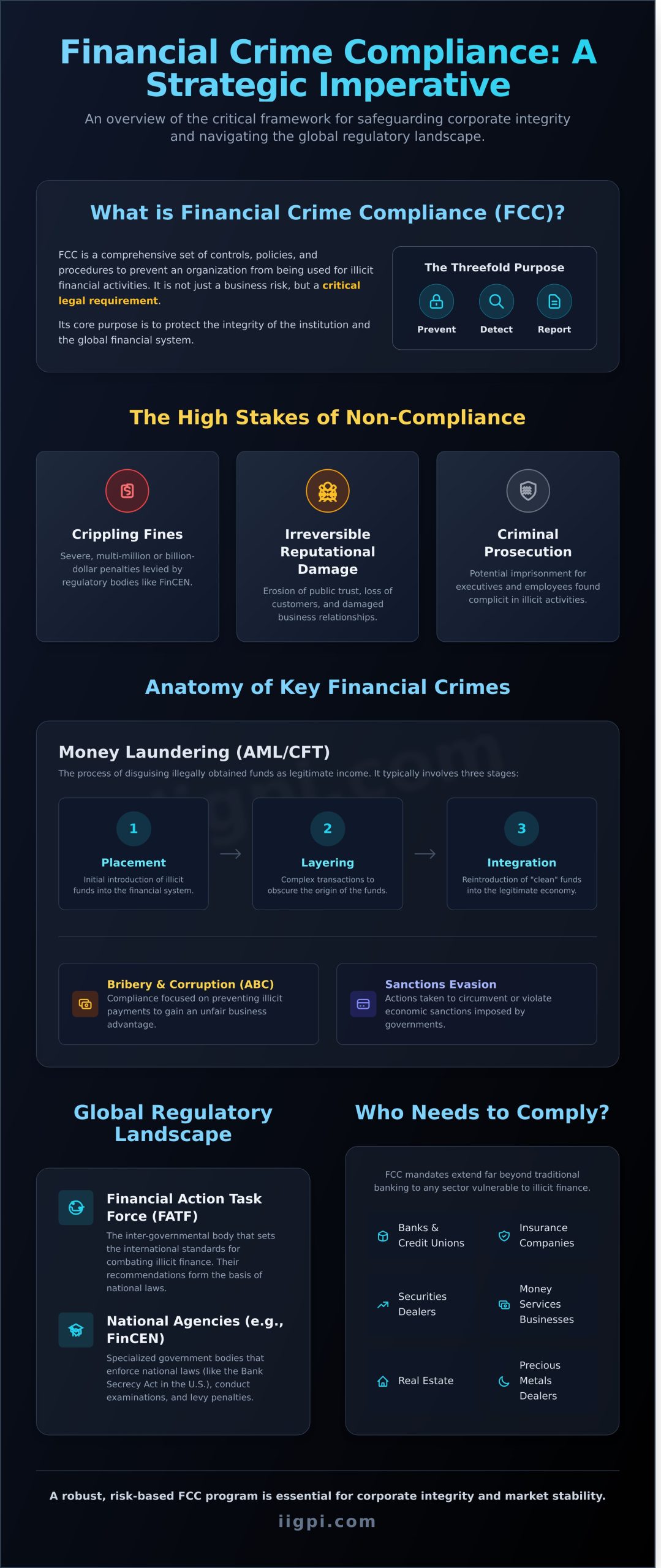
Financial Crime Compliance (FCC) constitutes a non-negotiable strategic imperative integral to modern corporate governance. It is formally defined as the comprehensive set of institutional controls, policies, and procedures established to prevent an organization from being used for illicit financial activities. The core purpose of this function is threefold: to prevent, detect, and report financial crimes such as money laundering, terrorist financing, and sanctions evasion. Unlike general risk management, which often addresses a broader spectrum of operational and market risks, FCC is uniquely characterized by its direct foundation in prescriptive legal statutes and stringent regulatory mandates. Consequently, non-compliance is not merely a business risk but a critical legal failure, attracting severe consequences that include crippling regulatory fines, irreparable reputational damage, and potential criminal prosecution for the institution and its executives.
The Global Regulatory Landscape
The framework governing financial crime compliance is profoundly international, driven by a consensus among nations to protect the integrity of the global financial system. The primary architect of this global policy is the Financial Action Task Force (FATF), an inter-governmental body whose recommendations serve as the international standard for combating illicit finance. These standards compel member jurisdictions to enact robust national legislation, exemplified in the United States by the Bank Secrecy Act (BSA). The enforcement of such laws is delegated to specialized governmental agencies, such as the U.S. Financial Crimes Enforcement Network (FinCEN), which possess the authority to conduct examinations, issue binding regulations, and levy significant penalties against non-compliant entities.
Scope of Financial Crime Compliance
The mandate for robust compliance programs extends far beyond the confines of traditional banking. It encompasses a diverse range of sectors and corporate entities, including insurance companies, securities dealers, money services businesses, and even dealers in precious metals and real estate. The domain addresses a broad spectrum of illicit acts, and a comprehensive financial crime overview reveals its complexity, covering everything from bribery and corruption to market abuse and sanctions evasion. In recognition of this diverse applicability, regulatory bodies globally mandate a sophisticated risk-based approach. This principle requires each organization to conduct a rigorous and documented assessment of its unique vulnerabilities and to implement internal controls that are precisely tailored and commensurate with its specific risk profile.
The Anatomy of Financial Crime: Key Threats to Mitigate
To effectively combat illicit financial flows, it is imperative to move beyond the monolithic term “financial crime” and dissect its constituent threats. A nuanced understanding of these distinct typologies is foundational to the development of robust financial crime compliance frameworks and informs the specific investigative methodologies required to unearth and prosecute such offenses. Each category presents unique challenges, necessitating specialized controls and a sophisticated grasp of the mechanisms employed by criminal actors.
Money Laundering and Terrorist Financing (AML/CFT)
Anti-Money Laundering (AML) and Counter-Financing of Terrorism (CFT) represent a cornerstone of global financial integrity. AML refers to the set of laws and procedures designed to prevent criminals from disguising illegally obtained funds as legitimate income, while CFT measures are aimed at disrupting the flow of funds to terrorist organizations. These disciplines are governed by a framework of global policy, with institutions expected to adhere to the FATF international standards. The classic money laundering process involves three stages:
- Placement: The initial introduction of illicit funds into the financial system.
- Layering: A series of complex transactions designed to obscure the origin of the funds.
- Integration: The reintroduction of the now “clean” funds into the legitimate economy.
A common example is trade-based money laundering, where criminals over- or under-invoice goods to move value across borders, effectively embedding illicit proceeds within legitimate commercial transactions.
Bribery and Corruption (ABC)
Anti-Bribery and Corruption (ABC) compliance focuses on preventing illicit payments intended to influence the actions of an official or other person in a position of trust. Global regulations, most notably the U.S. Foreign Corrupt Practices Act (FCPA) and the UK Bribery Act, have extraterritorial reach, imposing severe penalties on corporations for corrupt practices worldwide. A critical distinction exists between a bribe-an inducement offered to gain an improper business advantage-and a facilitation payment, which is a smaller, unofficial payment made to expedite a routine, non-discretionary governmental action. While the latter is permissible in limited circumstances under the FCPA, it is strictly prohibited under the UK Bribery Act, highlighting the complex international regulatory landscape.
Fraud and Sanctions Evasion
This dual threat encompasses a wide range of illicit activities. Corporate fraud includes internal schemes such as embezzlement and asset misappropriation, as well as complex external schemes like accounting fraud designed to mislead investors. Sanctions evasion involves the deliberate circumvention of economic penalties imposed by bodies like the U.S. Office of Foreign Assets Control (OFAC) against specific countries, entities, or individuals. A primary vehicle for both offenses is the use of shell corporations-legal entities with no active business operations-to obscure beneficial ownership, channel fraudulent proceeds, and conduct transactions with sanctioned parties, thereby complicating the task of effective financial crime compliance and law enforcement.
Core Pillars of a Robust FCC Program
An effective financial crime compliance program serves as the primary institutional defense against infiltration by illicit actors and is a non-negotiable element of modern corporate governance. Rather than a reactive measure, these pillars constitute a proactive framework designed to identify, mitigate, and report potential financial crimes before they inflict systemic damage. The establishment of a defensible program demonstrates an organization’s commitment to legal and ethical standards, thereby safeguarding its integrity and preserving its standing within the global financial system. The following components represent the foundational architecture of such a program.
Know Your Customer (KYC) and Due Diligence
The cornerstone of any effective risk management strategy is a rigorous Know Your Customer (KYC) protocol. This process involves the systematic verification of client and partner identities to build a comprehensive risk profile. Standard Customer Due Diligence (CDD) is applied to all clients, while high-risk entities-such as Politically Exposed Persons (PEPs) or those operating in high-risk jurisdictions-necessitate Enhanced Due Diligence (EDD). A critical function of this due diligence is the identification of Ultimate Beneficial Owners (UBOs), a procedure essential for penetrating opaque corporate structures and understanding the true control behind an entity.
Transaction Monitoring and Reporting
Continuous transaction monitoring is the operational core of a compliance program, utilizing sophisticated systems to analyze transactional data in real-time for patterns that deviate from established norms or suggest illicit activity. Modern financial crime compliance relies heavily on automated technologies, including artificial intelligence and machine learning, to process vast datasets and detect complex typologies of financial crime. Upon identifying suspicious behavior, institutions are legally mandated to file a Suspicious Activity Report (SAR) with the appropriate national Financial Intelligence Unit (FIU), thereby alerting authorities to potential threats.
Risk Assessment, Training, and Auditing
A formalized, enterprise-wide risk assessment is indispensable for tailoring a compliance program to the specific threats an institution faces. This documented assessment must be dynamic, evolving with changes in products, client bases, and geopolitical risk landscapes. The process must be calibrated to the standards set by global bodies and national regulators, such as those outlined in the U.S. financial crime compliance framework, which aligns with Financial Action Task Force (FATF) recommendations. This framework is reinforced by ongoing, role-specific training for all personnel and validated through periodic, independent audits that test the program’s operational effectiveness and ensure its continued resilience.
When Compliance Fails: Investigative Triggers and Red Flags
A frequent inquiry within corporate governance circles questions the necessity of investigative functions in the presence of a robust compliance program. This perspective, however, overlooks a critical reality: even the most sophisticated financial crime compliance frameworks are not infallible. Malicious actors, both internal and external, continuously develop methods to circumvent established controls. Consequently, this section delineates the transition from proactive compliance to reactive investigation, focusing on the specific triggers and red flags that mandate a deeper, independent inquiry into potential misconduct.
Identifying Internal Control Breakdowns
The initial indicators of a failing compliance system often manifest as operational anomalies. These can include repeated, unexplained overrides of internal controls, significant procedural deviations that lack proper authorization, or transactional patterns that defy business logic. Furthermore, crucial intelligence frequently originates from whistleblower reports or anonymous tips, which must be treated with the utmost seriousness. In multinational corporations, complex legal structures and opaque subsidiary relationships can be deliberately exploited to obscure illicit financial flows, rendering standard audits insufficient.
Responding to Regulatory Inquiries
An external inquiry from a regulatory body, such as the Securities and Exchange Commission (SEC) or the Financial Crimes Enforcement Network (FinCEN), serves as an unequivocal trigger for an internal investigation. Such an event signals that a potential breach has attracted governmental scrutiny. The institutional response must be swift, thorough, and demonstrably independent to preserve credibility and mitigate regulatory penalties. It is at this critical juncture that a firm must initiate a formal financial criminal investigation to ascertain the facts and manage its legal exposure.
Uncovering Sophisticated Evasion Tactics
Automated transaction monitoring systems are foundational to modern financial crime compliance, yet they possess inherent limitations, particularly against novel evasion typologies. Determined actors employ sophisticated techniques-including the use of shell corporations, third-party proxies, and convoluted international payment chains-to disguise the origin and destination of funds. These methods are often designed specifically to bypass algorithmic detection. Therefore, identifying such schemes necessitates human-centric forensic analysis, where investigative expertise is applied to connect disparate data points and uncover the underlying criminal enterprise.
The Role of External Investigators in Financial Crime Compliance
When a suspected breach of financial protocol occurs, the integrity of an organization’s internal controls is immediately called into question. In such critical circumstances, engaging an external investigative body is not merely a procedural step but a strategic necessity. An independent inquiry provides the objective analysis required to navigate complex allegations, satisfy regulatory scrutiny, and lay the groundwork for institutional recovery. This process is fundamental to upholding a robust financial crime compliance framework and safeguarding an organization’s reputation and assets.
Ensuring Objectivity and Credibility
An independent third-party investigation offers an unbiased perspective, insulated from the internal politics and potential conflicts of interest that can compromise an internal review. The findings of an external firm carry significantly greater weight with regulatory bodies, judicial authorities, and stakeholders, as they are perceived as impartial and methodologically sound. Furthermore, when investigators are engaged by legal counsel, their communications and work product can be protected by attorney-client privilege, providing a crucial layer of confidentiality during sensitive proceedings.
Specialized Investigative Techniques
External investigators deploy a sophisticated suite of methodologies to uncover complex financial malfeasance. Core services include forensic accounting to dissect financial records, digital forensics to retrieve and analyze electronic evidence, and discreet surveillance to corroborate facts. These techniques are essential for tracing illicit funds through intricate webs of shell corporations and international banking networks. A critical component of this process involves conducting a thorough asset search, a systematic investigation designed to locate and facilitate the recovery of misappropriated capital and restore value to the organization.
From Investigation to Remediation
A comprehensive investigation transcends simple fact-finding; it serves as a foundational element for organizational remediation. The detailed findings and evidence gathered inform the implementation of targeted corrective actions, strengthening internal controls and closing vulnerabilities that allowed the breach to occur. This forward-looking approach transforms a crisis into an opportunity to fortify the entity’s governance and compliance architecture, thereby restoring institutional integrity and mitigating future risk. The ultimate objective is not only to resolve the immediate issue but to rebuild a more resilient and transparent operational framework.
Engage our experts for a confidential consultation on complex financial investigations.
The Strategic Imperative of Proactive Financial Crime Compliance
The discourse presented herein underscores that a robust framework for financial crime compliance is not merely a regulatory obligation, but a strategic cornerstone of corporate integrity and long-term resilience. A proactive posture, built upon a sophisticated understanding of key threats and the diligent implementation of core programmatic pillars, is fundamentally essential for mitigating risk. When internal controls falter, the engagement of specialized external investigators becomes a critical and prudent step toward impartial resolution and the fortification of institutional defenses against sophisticated illicit activities.
The International Investigative Group (IIG) provides this critical expertise. With over 30 years of distinguished investigative experience and a proven record in multi-million dollar financial fraud cases, our global network of agents and resources offers unparalleled strategic support. For organizations committed to upholding the highest standards of integrity, expert partnership is indispensable. Contact International Investigative Group for a confidential consultation to reinforce your compliance architecture and confidently navigate the complexities of the global financial landscape.
Frequently Asked Questions
What is the difference between AML and financial crime compliance?
Anti-Money Laundering (AML) represents a specific component of the broader discipline of financial crime compliance. While AML focuses narrowly on the processes to prevent illicit funds from entering the financial system, financial crime compliance encompasses a wider strategic framework. This comprehensive approach includes AML alongside measures to combat terrorist financing, bribery, corruption, sanctions violations, and fraud, providing a holistic defense against all forms of financial criminality within an organization.
What are the three stages of money laundering?
The process of money laundering is conventionally structured into three distinct stages. The initial phase, Placement, involves introducing illicit cash into the financial system. This is followed by Layering, where the origin of the funds is obscured through a series of complex transactions, such as multiple wire transfers. The final stage, Integration, occurs when the laundered money is reintroduced into the legitimate economy, for instance, through investments in real estate or business ventures, making it appear legitimate.
Who is responsible for financial crime compliance within a company?
Ultimate accountability for an organization’s compliance framework rests with its Board of Directors and senior management. However, operational responsibility is typically delegated to a designated Chief Compliance Officer (CCO) or Money Laundering Reporting Officer (MLRO), who oversees the program’s implementation. Fundamentally, compliance is a collective responsibility, requiring all employees, particularly those in customer-facing roles, to understand and adhere to established policies and procedures to mitigate risk effectively.
What is the role of the Financial Action Task Force (FATF)?
The Financial Action Task Force (FATF) is an inter-governmental body that establishes and promotes global standards to combat money laundering, terrorist financing, and the proliferation of weapons of mass destruction. Its primary role is to develop the internationally recognized FATF Recommendations, which serve as the foundation for national regulatory frameworks. The FATF also conducts peer reviews of member countries to assess their implementation of these standards, thereby ensuring the integrity of the global financial system.
How does technology help in financial crime compliance?
Technology is integral to enhancing the efficacy and efficiency of modern financial crime compliance programs. Advanced solutions, including artificial intelligence and machine learning, empower institutions to analyze vast datasets for sophisticated transaction monitoring, detecting anomalous patterns that may indicate illicit activity. Furthermore, automation streamlines critical functions such as know-your-customer (KYC) verification and regulatory reporting, which reduces human error and allows compliance professionals to focus on higher-risk strategic analysis.
What is a Suspicious Activity Report (SAR)?
A Suspicious Activity Report (SAR) is a formal disclosure submitted by a financial institution or other regulated entity to its national Financial Intelligence Unit (FIU). This report is legally mandated when the institution knows, suspects, or has reasonable grounds to suspect that a transaction is related to criminal proceeds, terrorist financing, or other illicit activities. SARs are a critical source of intelligence that enables law enforcement agencies to initiate investigations and combat financial crime.
Can a company be held liable for the actions of a third-party agent?
Indeed, a company can be held vicariously liable for the unlawful actions of its third-party agents, intermediaries, or consultants, particularly under anti-bribery and corruption statutes like the U.S. Foreign Corrupt Practices Act (FCPA). Regulators mandate that organizations conduct rigorous due diligence on their partners and maintain robust oversight. A failure to prevent illicit conduct by an associated person can result in severe corporate penalties, underscoring the necessity of a comprehensive third-party risk management framework.
