
What if an unsettling sign has an ordinary explanation but still deserves a careful check? Searching for “feeling of being watched in my home brooklyn” can reflect real concern, yet a changed object, unfamiliar device, or unexpected sound does not by itself establish that anyone is monitoring you. Start by separating what you can observe from what you fear it might mean.
It’s understandable to worry about hidden cameras, listening devices, or someone entering your home without permission, especially when you’re unsure what evidence matters or how to respond safely. This guide explains how to record observations, consider common explanations, and take measured steps to protect your privacy and personal safety. It also explains when a professional electronic bug sweep may be appropriate. An assessment is not proof that surveillance is occurring and cannot identify responsibility on its own. International Investigative Group, a New York City investigative firm with more than 30 years of experience, provides electronic bug sweeps as one possible professional assessment.
Key Takeaways
- Separate specific, repeatable observations from interpretations. An unsettling feeling alone is not proof of surveillance.
- Use a calm sequence: prioritize safety, record what you notice, check ordinary explanations, and review account access and device settings.
- Note whether a change is isolated or recurring, and record what you can independently observe before deciding what it may mean.
- If you’re experiencing a feeling of being watched in my home brooklyn, use this guide to identify proportionate next steps and preserve useful details.
- Learn when an electronic bug sweep may offer a professional assessment, and what it cannot establish about surveillance or responsibility.
Feeling Watched at Home in Brooklyn: What the Feeling Can, and Cannot, Tell You
Feeling uneasy in your own home can be distressing, particularly when an unfamiliar object or unexpected change seems difficult to explain. The feeling deserves attention as an experience, but it cannot establish on its own that another person is watching or listening. If you searched for “feeling of being watched in my home brooklyn,” begin by separating what you directly observed from the meaning you’re considering. This distinction helps you respond thoughtfully without dismissing a concern or treating uncertainty as proof.
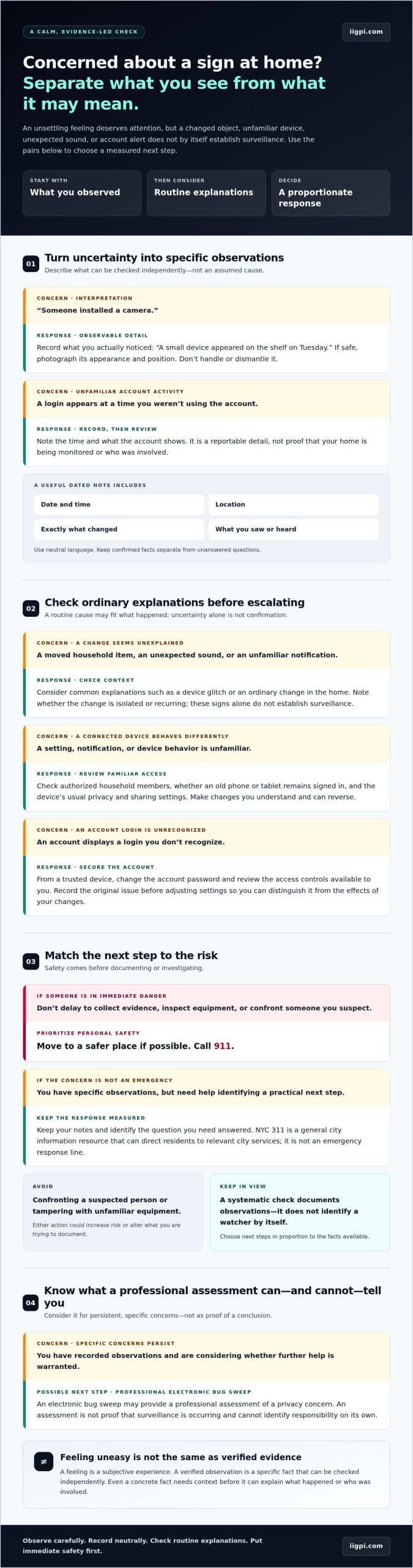
A feeling of being watched is a subjective experience; verified evidence is a specific, observable fact that can be checked independently. Even a concrete fact, such as an unfamiliar device or an account login you don’t recognize, needs context before it can explain what happened or who was involved.
What counts as an observation rather than an assumption?
An observation describes what you could record or show another person without interpreting its cause. “A small device appeared on the shelf on Tuesday” is more precise than “someone installed a camera.” Likewise, “my account shows a login at a time I wasn’t using it” is a reportable detail, not proof that your home is being monitored. For perspective on how feelings and beliefs can shape an interpretation, see Understanding Paranoia. Reading about a psychological concept cannot determine what is happening in an individual case.
Write down the date and time, location, what changed, and exactly what you saw or heard. Use neutral language, separating what you know from what you suspect. If it’s safe, photograph an unfamiliar item to document its appearance and position. Don’t handle or dismantle it to investigate. A device glitch, moved household item, unfamiliar notification, or unexplained sound may have a routine explanation and does not establish surveillance.
- Record: the specific event and when it occurred.
- Describe: visible details without labeling an item as a surveillance device.
- Separate: confirmed facts from unanswered questions.
When should immediate safety come before investigating?
If someone is in immediate danger, leave for a safer place if possible and call 911. Don’t delay to collect evidence, inspect equipment, or confront someone you suspect. An unfamiliar object or account alert alone doesn’t indicate an emergency, but treat a direct threat or unsafe situation according to the immediate risk.
For non-emergency concerns, keep your notes and identify the practical question you need answered before taking further steps. NYC 311 is a general city information resource that can direct residents to relevant city services; it isn’t an emergency response line. Avoid confronting a suspected person or tampering with unfamiliar equipment, since either action could increase risk or alter what you’re trying to document. The goal is to make the next decision proportionate to the facts available, rather than reach a conclusion prematurely.
How to Check Your Brooklyn Home Calmly and Protect Your Privacy
A measured check can turn a general concern into a manageable question. Keep the process limited and safe: consider immediate safety first, note what you directly observed, check ordinary explanations, and decide whether further help is warranted. Avoid searching every part of your home or repeatedly checking devices, which can increase distress without producing reliable information.
A systematic check can document observations, but it cannot identify a watcher by itself. Use this sequence to keep your actions proportionate:
- Prioritize safety: If you feel at immediate risk, move to a safer place and call 911.
- Write down facts: Record dates, locations, and specific changes you observed.
- Check routine explanations: Review who has access to shared devices, accounts, and household spaces.
- Consider next steps: If specific concerns persist, consider whether a professional assessment is appropriate.
Connected household devices can involve shared access and privacy settings, so reviewing their configuration may be useful. The NIST Smart Home Security and Privacy publication discusses user perceptions of smart-home security and shared responsibility. It provides context for a careful review, not a reason to assume a device has been compromised.
Review household devices and account access
Start with familiar devices and accounts. Check which household members are authorized, whether an old phone or tablet remains signed in, and whether a setting or notification has a routine explanation. If an account displays a login you don’t recognize, change its password from a trusted device and review the access controls available to you. An unfamiliar network name or device glitch alone doesn’t establish unauthorized monitoring.
Make changes you understand and can reverse. For example, review privacy and sharing settings for a smart speaker or camera through its usual account, rather than unplugging, opening, or resetting unfamiliar equipment. Device behavior can change for several reasons. Record what you noticed and when before adjusting settings, so you can distinguish the original issue from the effects of your changes.
Keep a factual record without escalating the situation
Use a dated log to note the location, exact observation, and relevant context, such as whether a device had recently been updated or moved. If it’s safe, take a photograph showing the item in place. Preserve original images, messages, and account alerts instead of editing them or posting sensitive details publicly. A concise record is more useful than repeated speculative searches.
Don’t dismantle a device, enter a restricted area, or confront someone you suspect. These actions can create safety risks, disturb property, or make it harder to understand what was originally present. If documented concerns remain unresolved, an electronic bug sweep is one possible professional assessment. International Investigative Group provides electronic bug sweep assessments as a measured next step, not as confirmation that surveillance has occurred.
Ordinary Explanations or a Privacy Concern? How to Weigh Brooklyn Home Signs
A device behaving unexpectedly can feel alarming, but an anomaly alone does not prove someone is watching. Ask what happened, whether it can be checked, and whether the same specific change happens again. One ambiguous event may have a routine explanation. Repeated, independently observable changes may justify a closer assessment, without establishing a cause or identifying a responsible person.
Technical indicators require context and should never be treated as conclusive proof of surveillance. If the “feeling of being watched in my home brooklyn” has led you to review a device or account, use the observation as a starting point for questions, not a final conclusion.
| Observation | Routine explanations or questions to investigate |
|---|---|
| A router name or connected-device list looks different. | Could the router have been reset, renamed, or updated? Are household members’ phones, televisions, or guest devices included? |
| A smart device sends an unfamiliar notification or behaves differently. | Check whether its software or settings changed, and consult the manufacturer’s guidance. Does the account show a corresponding alert or activity? |
| An account shows a login you don’t recognize. | Could it be a shared or older device, or an unfamiliar location estimate? Review account activity and authorized users before drawing a conclusion. |
| An object appears moved or unfamiliar. | Who had ordinary access to the space? Is there a clear description or dated image that can help establish what changed? |
| The same specific change recurs and can be observed again. | Record each occurrence separately. Can another person independently observe it, and does it persist after routine explanations are checked? |
How can routine technology issues resemble suspicious activity?
Router settings may change after a reset or update, notifications may reflect ordinary account activity, and shared access can make a familiar device appear unexpected. A temporary glitch can also affect how a device responds. These are possibilities, not diagnoses. Compare an alert with account activity, ask authorized household users about changes, and check the manufacturer’s instructions. An unfamiliar network name alone does not establish that a device is monitoring you.
Which patterns merit a more careful assessment?
Give more weight to repeated, specific observations that you can document independently than to a single unclear signal. Note whether the same unexpected change appears on separate occasions and whether routine explanations account for it. If a documented concern involves possible electronic surveillance in the home, a professional assessment may help evaluate physical privacy concerns within its scope. It cannot identify a person or establish intent on its own. A pattern can warrant inquiry without proving what caused it.
This approach avoids both dismissing a concrete concern and escalating an uncertain one. Assess what you can observe, preserve its context, and let the strength of the facts guide your next step.
Next Steps in Brooklyn: Document, Secure, and Respond
Choose your next step based on urgency, whether an observation has recurred, and how clearly you can document it. If you face an immediate threat, move to a safer place if possible and call 911. Don’t delay to take photos or investigate further, and don’t confront someone you suspect. For a non-emergency concern, preserve relevant information, take reasonable privacy precautions, and decide whether the facts support further assessment.
A practical response can follow three thresholds:
- Immediate danger: Prioritize getting to safety and contact 911.
- Unclear or isolated event: Record what happened and review ordinary explanations before taking further action.
- Repeated, specific observations: Preserve the details and consider whether a professional assessment could address the concern.
How should Brooklyn residents preserve useful information?
Keep a private, dated log describing observable changes, where and when they occurred, and what steps you’ve already taken. Retain relevant messages, photographs, and account alerts in their original form. Avoid editing files or posting allegations online, since public sharing may expose sensitive details without clarifying what happened. Limit access to the record, especially if it contains personal or household information.
Preserve information proportionately. Save material relevant to the concern, note where it came from, and avoid repeated searches that could disturb equipment or alter the situation. If an item appears unfamiliar, don’t dismantle it or enter a restricted area to investigate. A clear record can help you describe the issue accurately, but cannot establish why something happened or who was responsible on its own.
When is professional investigative support appropriate?
If specific, documented concerns persist after you’ve considered routine explanations, an electronic bug sweep may be a reasonable assessment option. It is a focused service for assessing possible electronic surveillance, not proof that surveillance is occurring. An assessment cannot guarantee that a device will be found or identify a responsible person; consider its findings alongside the documented facts. Broader personal concerns may call for a different investigative scope, as described in the firm’s personal and domestic investigation protocols.
International Investigative Group is a New York City investigative firm with more than 30 years of experience and provides electronic bug sweeps. For concerns involving possible surveillance beyond a single device or account, its overview of professional surveillance services offers related context. Choose a next step based on the concern and available observations, not fear alone.
Learn more about electronic bug sweep support as one evidence-focused option.
Electronic Bug Sweeps in Brooklyn: What an Investigative Assessment Can Offer
If specific observations leave you concerned about possible electronic surveillance, an electronic bug sweep may offer a professional assessment. It is not a verdict that surveillance is occurring. The assessment addresses possible electronic surveillance within the scope of the work, and its findings should be considered alongside what you have observed and documented.
International Investigative Group is a New York City investigative firm with more than 30 years of experience and provides electronic bug sweeps. That may be relevant for Brooklyn residents considering a professional next step, but the decision should reflect the nature and persistence of the observations, not a troubling feeling alone.
What can an electronic bug sweep establish, and what can it not?
An assessment can address whether possible electronic surveillance is indicated within the scope of the review. Its conclusions are limited to what was assessed and what could be observed. They don’t automatically establish who placed a device, why it may be present, or whether anyone intended to monitor you. An assessment also cannot guarantee that a device will be found or prevent future monitoring. A professional review evaluates a defined concern; it does not prove a broader explanation.
Understand any result in context. An absence of findings does not prove that every form of surveillance is impossible, just as an observation that warrants further attention does not identify a responsible person on its own. Keeping these distinctions clear helps you avoid placing more weight on the assessment than its scope supports.
How to approach a professional assessment with clear expectations
Before an assessment, organize a concise factual timeline: what you noticed, when and where it occurred, whether it recurred, and what routine explanations you have considered. Include relevant photographs or account records if they can be shared safely, and distinguish direct observations from interpretations. This provides useful context without requiring you to make claims that the available information cannot substantiate.
Discuss the assessment’s scope and how its findings will be explained, so you understand which questions it can address and what remains outside its reach. If your concern involves broader activity beyond possible electronic surveillance in the home, professional surveillance services may provide relevant context. A focused assessment is most useful when expectations are measured and the evidence is considered carefully.
If you have specific observations and want to explore this option, discuss an electronic bug sweep with International Investigative Group.
Choose a Next Step That Leaves Room for the Facts
If the phrase “feeling of being watched in my home brooklyn” brought you here, you don’t need to settle every question before taking a measured next step. Let the quality and recurrence of your observations, along with your immediate sense of safety, guide what comes next. An electronic bug sweep is an assessment option, not a guarantee or a way to determine who may be responsible. Its value is in addressing a defined concern through professional inquiry while keeping conclusions proportionate to what can be established.
International Investigative Group has solved over 10,000 cases. If you have specific concerns about possible electronic surveillance and would like to discuss an assessment, discuss an electronic bug sweep with International Investigative Group.
You can proceed thoughtfully, one evidence-based decision at a time.
Frequently Asked Questions
Is feeling watched in my home proof that someone is surveilling me?
No. A feeling, even a strong one, is not by itself evidence that someone is watching you. The phrase “feeling of being watched in my home brooklyn” describes a concern, not a verified event. To assess what may be happening, consider information that can be independently checked, such as a documented account alert or an unfamiliar item whose presence and location can be confirmed. Avoid deciding who is responsible without evidence.
Can a phone detect hidden cameras or listening devices in a Brooklyn home?
A phone cannot reliably determine on its own that a hidden camera or listening device is present. Apps or phone features may identify certain signals or network devices, but the results can be incomplete or difficult to interpret, and a signal does not necessarily indicate surveillance. Don’t treat a scan or app alert as confirmation. If you have a specific concern, preserve what the phone displayed and seek an assessment suited to that question.
What should I do first if I find an unfamiliar device at home?
First, consider whether the situation creates an immediate safety risk. If so, leave for a safer place and call 911. Otherwise, avoid touching, opening, or disconnecting the object. From a safe distance, note where you found it and what it looks like, and take a photo if appropriate. Consider whether it may belong to someone authorized to access the home, but don’t confront anyone based only on its presence.
How can I tell whether a strange device or network signal is harmless?
You may not be able to determine that from its appearance or a signal alone. Compare the device or network with equipment you recognize, ask authorized household members whether they know what it is, and check account or manufacturer information for an ordinary explanation. A name you don’t recognize may relate to a shared or previously used device. If uncertainty remains, record the details rather than treating the signal as proof of monitoring.
Can an electronic bug sweep prove who is watching me?
No. An electronic bug sweep is a professional assessment for possible electronic surveillance within its scope; it does not automatically establish who placed a device, their intent, or whether a particular person is watching you. Results also cannot guarantee that every possible device will be found or prevent future monitoring. Consider any findings alongside independently documented facts, not as a complete answer to every concern.
Should I call 911 or NYC 311 if I feel watched at home?
Call 911 if you face immediate danger or need an emergency response. If there is no immediate threat and your question concerns city information or services, NYC 311 is a general information resource. A feeling alone, without an urgent safety issue, does not determine which response is appropriate. Describe concrete events rather than assumptions when seeking help, and don’t use 311 as a substitute for emergency assistance.
When should a Brooklyn resident consider hiring a private investigator for a home privacy concern?
Consider an investigator when you have a specific, recurring concern that ordinary checks haven’t resolved and want a professional assessment within a defined scope. For possible electronic surveillance, an electronic bug sweep may be relevant; broader personal concerns may require a different investigative approach. Bring a concise record of what you observed and when. A private investigator can assess information, but cannot guarantee a discovery or identify responsibility without supporting evidence.