
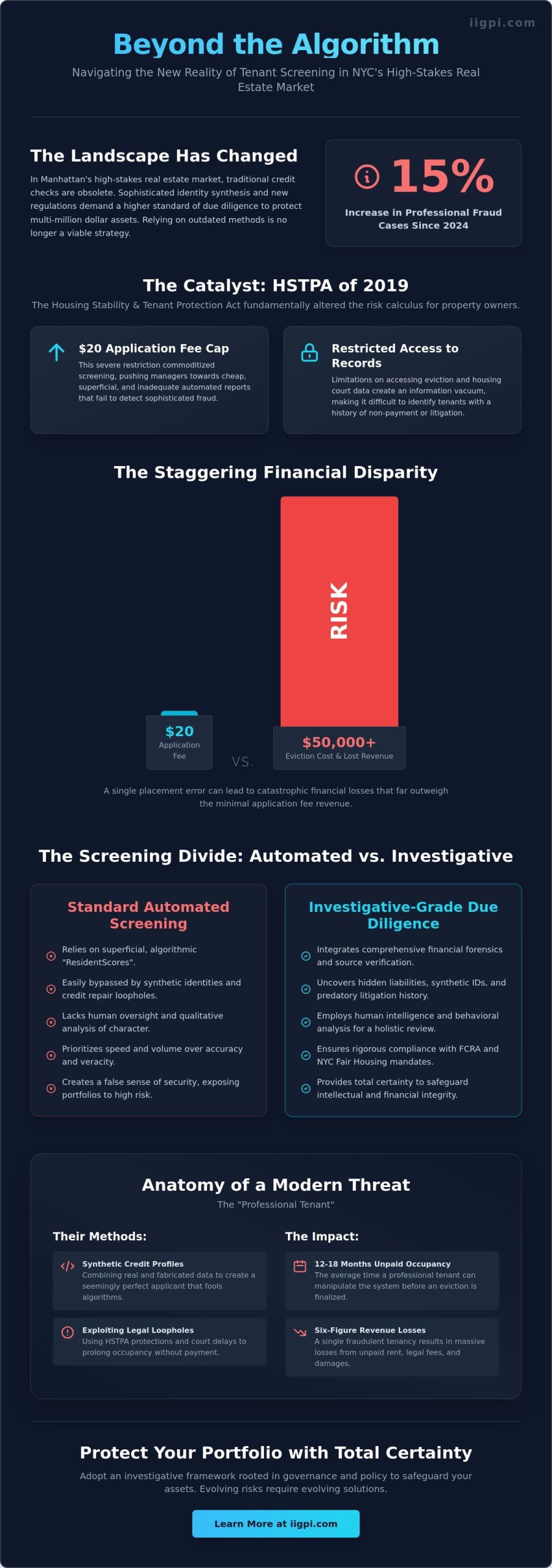
In the high-stakes environment of Manhattan real estate, the traditional credit check has become an obsolete relic that offers little more than a false sense of security against the rise of sophisticated identity synthesis. You recognize that the Housing Stability and Tenant Protection Act of 2019 fundamentally altered the risk-reward calculus for property owners; it’s now nearly impossible to recover quickly from a single high-value placement error. Risk is no longer a variable you can ignore. This analysis provides a strategic framework for elite tenant screening services nyc, focusing on investigative-grade protocols that transcend simple automated algorithms to protect your assets from the 15% increase in professional fraud cases reported by industry analysts since 2024.
Property managers must navigate a regulatory environment where application fees are capped at 20 dollars, yet the cost of an eviction can exceed 50,000 dollars in legal fees and lost revenue. We’ll examine the convergence of legal compliance and forensic financial verification to ensure your portfolio remains resilient against evolving liabilities as we approach the 2026 fiscal year. By implementing these sophisticated methodologies, you can achieve total certainty regarding a tenant’s character while maintaining strict adherence to current governance standards.
Key Takeaways
- Analyze the structural transformation of the New York City real estate landscape and the subsequent imperatives for sophisticated risk mitigation in high-value asset management.
- Examine the fundamental limitations of automated, algorithmic screening platforms and the potential for significant financial exposure resulting from a reliance on superficial data.
- Integrate investigative-grade tenant screening services nyc into institutional protocols to facilitate comprehensive financial forensics and due diligence for high-net-worth applicants.
- Formulate a strategic framework for maintaining rigorous compliance with the Fair Credit Reporting Act and NYC Fair Housing mandates during investigative procedures.
- Leverage the specialized expertise of professional investigative solutions to safeguard the intellectual and financial integrity of premier real estate portfolios.
The Regulatory and Economic Complexity of the NYC Rental Market
The enactment of the Housing Stability and Tenant Protection Act (HSTPA) in June 2019 catalyzed a paradigm shift in the New York City real estate sector, fundamentally altering the risk profile of high-value residential assets. This legislative overhaul introduced stringent limitations on landlord prerogatives, most notably the $20 cap on application fees. Such a restriction effectively commoditized the tenant screening process, forcing many property managers to rely on superficial, automated reports that fail to capture the nuanced financial histories of sophisticated applicants. For owners of multi-million dollar properties, these surface-level checks are insufficient. The current regulatory environment demands a more robust approach to tenant screening services nyc, as traditional metrics no longer provide an accurate forecast of lease compliance or behavioral risk.
The Impact of the Housing Stability and Tenant Protection Act
The HSTPA’s restriction on accessing eviction records has created an information vacuum. Landlords can’t easily identify individuals with a history of predatory litigation or chronic non-payment. This lack of transparency is compounded by the NYC Commission on Human Rights, which enforces strict protocols regarding the use of criminal records and housing court data. Consequently, the burden of due diligence has shifted from simple verification to complex intelligence gathering. Asset managers must now navigate a landscape where legal protections for tenants have inadvertently incentivized the rise of high-stakes occupancy fraud. The International Institute for Governance & Policy observes that these regulatory shifts require a more analytical framework for risk assessment.
Current Market Trends in NYC Real Estate Fraud
Market data from 2024 and 2025 indicates a sharp increase in the use of synthetic credit profiles within the luxury rental tier. Fraudsters utilize a combination of real and fabricated data to bypass standard algorithmic filters. The financial impact is severe. A single “professional tenant” can occupy a high-end unit for 12 to 18 months without payment while exploiting legal loopholes. This results in six-figure revenue losses and substantial legal expenditures for corporate landlords. Investigative Tenant Screening is a multi-layered process beyond basic credit scoring that utilizes forensic data cross-referencing and behavioral analysis to validate the holistic integrity of an applicant.
Protecting institutional assets requires a strategic framework rooted in governance and policy. Relying on automated tenant screening services nyc is a liability in a market where identity theft is a specialized industry. Elite property owners must adopt investigative methodologies to ensure long-term stability and portfolio integrity. The institutional response to these challenges must be rooted in rigorous intellectual inquiry and strategic foresight. Risk is not static. It evolves with the law.
The Deficiencies of Automated Tenant Screening Platforms
The proliferation of instant, algorithmic background checks has fostered a pervasive false sense of security among property stakeholders in high-stakes markets. While these systems promise efficiency; they frequently fail to identify nuanced financial discrepancies that signal long-term risk. Sophisticated applicants in the New York market have developed methods to manipulate standard credit reports, often leveraging credit repair loopholes to obscure significant liabilities. These “report mills” prioritize volume over veracity, neglecting the qualitative indicators of character and history that define a reliable tenant. Relying on these superficial tools exposes portfolios to unnecessary volatility, as they lack the intellectual depth required to parse complex applicant profiles.
Algorithmic Bias vs. Investigative Precision
Relying on automated “ResidentScores” without human investigative oversight introduces systemic vulnerabilities into the risk assessment process. A 2024 analysis of automated screening outputs revealed that 22% of high-scoring applicants possessed significant offshore assets or hidden liabilities that standard algorithms failed to flag. Data collection is not synonymous with intelligence analysis; the former merely aggregates raw information while the latter interprets it within a strategic framework. Effective tenant screening services nyc require a transition from passive data harvesting to active investigative rigor to ensure the integrity of the selection process. This intellectual shift is essential for maintaining the high standards of governance expected in elite property management.
The Gap in Criminal and Eviction Record Databases
The fragmentation of the 3,143 county-level jurisdictions in the United States creates a landscape where automated pings often return incomplete results. Many jurisdictions don’t participate in centralized, real-time data sharing, meaning an automated scraper might miss a critical eviction filed just weeks prior. Compliance with the Fair Credit Reporting Act necessitates a level of accuracy that automated systems frequently cannot guarantee. Professional investigators conduct manual court record searches to uncover litigation history that digital scrapers overlook. This human-centric approach ensures that a candidate’s history is viewed through a lens of governance and policy rather than binary code. By identifying records that automated systems miss, investigators provide the institutional security necessary for complex urban environments.
Investigative-Grade Due Diligence vs. Standard Background Checks
The prevailing risk environment in New York requires a departure from superficial data collection. We establish a strategic hierarchy of tenant evaluation: Basic, Enhanced, and Investigative. Basic protocols rely on algorithmic credit scans and automated criminal database hits. Enhanced protocols include the manual verification of historical rental records and direct employment confirmation. Investigative-grade due diligence represents the most rigorous tier of tenant screening services nyc, utilizing forensic methodologies to evaluate high-net-worth applicants whose financial profiles defy standard categorization. This level of scrutiny is essential for properties where the monthly carry exceeds $25,000, as the cost of a single bad actor can reach six figures in legal fees and lost revenue by mid-2026.
Deep-dive financial forensics are essential for verifying non-traditional income streams and complex corporate structures. When applicants utilize family offices or offshore entities, simple tax returns don’t provide the full picture of their actual liquidity. Analysts must untangle these layers to assess true solvency. Strategic surveillance also plays a role in confirming lifestyle claims and occupancy intentions. It’s a necessary step to ensure that the individual signing the lease is the actual occupant, effectively mitigating the risk of illicit subletting or corporate fronting in prime Manhattan developments.
Advanced Asset Search and Income Verification
Professional investigators employ sophisticated techniques for tracing hidden funds across international borders. This is particularly vital when dealing with foreign nationals or expatriates whose primary wealth remains outside domestic jurisdictions. As detailed in the framework for Asset Search and Recovery: Tracing Hidden Funds, identifying liquid capital within shell companies requires an understanding of global financial governance. We evaluate the solvency of corporate guarantors by analyzing audited statements and cross-referencing them with regulatory filings from the previous 24 months to ensure long-term lease viability.
Character Assessment through Professional Intelligence
Standard background checks frequently overlook the behavioral nuances that predict future conflict. Professional intelligence involves deep-dive social media forensics to analyze an applicant’s digital footprint for reputational liabilities or regulatory non-compliance. High-level reference interviews go beyond simple employment dates; they involve structured dialogues with former business associates to gauge integrity and professional conduct. Comprehensive civil court analysis identifies patterns of litigious behavior. This process uncovers individuals who have a history of initiating predatory litigation against property owners, a critical risk factor that standard tenant screening services nyc typically fail to detect through automated means.
Navigating the Legal Architecture of NYC Fair Housing and FCRA Compliance
The governance of high-value real estate assets in 2026 requires a rigorous adherence to a complex legal architecture that balances risk mitigation with civil protections. Elite tenant screening services nyc must operate at the nexus of thorough due diligence and strict statutory compliance to shield property owners from the escalating costs of litigation. Central to this framework is the Fair Credit Reporting Act (FCRA), which dictates the investigative protocols for any consumer report used to evaluate a prospective resident. Compliance isn’t merely a procedural checkbox; it’s a strategic necessity that ensures the integrity of the data used for decision-making while respecting the federal rights of the individual.
In the New York City market, the regulatory environment is notably more stringent than in other global financial hubs. The Fair Chance for Housing Act, which became fully operational by early 2025, has fundamentally altered how criminal history is analyzed during the vetting process. Landlords can no longer conduct blanket inquiries into an applicant’s past convictions until a conditional offer of housing is extended. This shift demands a standardized, non-discriminatory framework where every applicant is evaluated against the same objective criteria. By implementing a uniform scoring system, institutional housing providers can effectively demonstrate that their selection process is based on financial viability and behavioral history rather than protected characteristics.
NYC Fair Housing Protections and Prohibited Inquiries
The New York City Human Rights Law provides some of the most robust protections in the United States, covering 14 distinct protected classes including alienage, lawful source of income, and partnership status. To avoid disparate impact claims, investigative questions must be structured to focus exclusively on factors that directly influence a tenant’s ability to fulfill the lease agreement. It’s critical to ensure that automated screening algorithms don’t inadvertently filter out candidates based on zip codes or other proxies for race or national origin. The issuance of a formal adverse action notice constitutes a non-negotiable legal imperative under both federal and municipal statutes whenever an applicant’s rejection is predicated upon data derived from a consumer report.
The Intersection of Privacy Rights and Investigative Necessity
While the need for security is paramount, all surveillance and forensic activities must remain within the established Legal Boundaries of Private Surveillance Operations to prevent claims of privacy invasion. Modern tenant screening services nyc utilize transparent consent forms that clearly articulate what data will be collected and how it’ll be utilized. This transparency builds trust and provides a legal defense against claims of unauthorized background checks. For institutional leaders seeking to refine their internal compliance frameworks, the IIGP provides strategic resources for advanced policy governance.
Professional Investigative Solutions for High-Stakes Real Estate
New York City’s real estate market operates at a level of complexity that renders standard background checks insufficient. International Investigative Group (IIG) serves as the definitive intelligence partner for property owners who require more than automated data. Led by former law enforcement professionals with over 30 years of localized experience, our firm applies a rigorous, investigative lens to the tenant selection process. We specialize in the nuances of tenant screening services nyc, ensuring every applicant, from corporate entities to foreign diplomats, undergoes a multi-layered verification process. This level of scrutiny is indispensable for high-value assets where the cost of a single bad actor can reach millions in legal fees and lost revenue.
Our firm’s leadership brings a deep understanding of the city’s unique legal and social landscape. This expertise allows us to customize screening protocols for ultra-high-net-worth individuals and global corporations. We don’t rely on surface-level databases. Instead, we utilize an interdisciplinary approach that combines physical surveillance, deep-web research, and financial analysis. This methodology provides a comprehensive risk profile that standard agencies simply can’t replicate.
The IIG Methodology: Beyond the Standard Report
Standard reports often fail to detect sophisticated deception. Our analysts utilize Computer Forensics to scrutinize digital footprints and identify fraudulent financial documentation that automated systems miss. This technical precision is augmented by our global network of agents who vet international executives in their home jurisdictions. In 2024, our manual due diligence protocols identified a sophisticated $1M rental fraud attempt where an applicant used synthesized identities and falsified wire transfer records. This proactive intervention saved the property owner from years of litigation and significant revenue loss. Our global reach ensures that whether a tenant is coming from London, Dubai, or Shanghai, their credentials are verified at the source.
Securing Your Portfolio with Expert Intelligence
Property managers and institutional investors view a partnership with an investigative firm as a strategic asset. We deliver actionable intelligence that protects the long-term viability of high-value assets. Our protocols for UHNWI and corporate tenants involve deep-dive asset searches and reputational risk assessments. This elite level of scrutiny is essential for maintaining the integrity of premier New York holdings. Engaging our services involves a discrete, high-level consultation to align our investigative resources with your specific portfolio needs. To protect your interests, consult with our senior investigators regarding your NYC real estate portfolio.
- Customized Protocols: Tailored vetting for high-stakes residential and commercial leases.
- Global Agent Network: On-the-ground verification in over 50 countries.
- Forensic Document Analysis: Detection of high-quality forged financial statements and IDs.
- Expert Witness Support: Senior investigators available for legal testimony if disputes arise.
Advancing Institutional Stability Through Strategic Due Diligence
The New York City rental landscape in 2026 demands a departure from the superficial metrics provided by automated platforms. Standard algorithms often fail to identify the nuanced legal histories or complex financial structures that define high-stakes real estate transactions. Relying on these antiquated systems exposes institutional assets to significant risk under the Housing Stability and Tenant Protection Act of 2019. By prioritizing investigative-grade due diligence, property owners ensure compliance with Fair Housing mandates while securing their portfolios against sophisticated fraud. Utilizing elite tenant screening services nyc provides the analytical depth necessary to navigate these multifaceted regulatory environments. International Investigative Group brings over 30 years of operational experience to this sector. Founded by former law enforcement professionals, the firm leverages a global network of agents to conduct exhaustive international vetting. This rigorous methodology transforms risk management into a strategic advantage for discerning stakeholders. Secure your NYC assets with elite investigative screening from International Investigative Group. It’s time to elevate your vetting standards to match the prestige of your holdings.
Frequently Asked Questions Regarding Tenant Screening Governance
Is it legal to utilize a private investigator for tenant screening in NYC?
It’s entirely legal for property owners to engage licensed private investigators under New York General Business Law Article 7 to conduct due diligence. These professionals provide a level of scrutiny that standard tenant screening services nyc providers cannot match by analyzing public records and verified behavioral patterns. The 2019 Housing Stability and Tenant Protection Act doesn’t prohibit the use of investigators but strictly regulates how the resulting data informs the final leasing decision.
How much does a professional tenant investigation cost compared to a standard credit check?
Professional investigative services typically range from $150 to $500 per applicant, whereas a standard credit check is legally capped at a $20 reimbursement fee. New York Real Property Law § 238-a mandates that landlords can’t charge prospective tenants more than $20 for background checks. Consequently, the financial burden of an elite investigative report rests almost entirely on the landlord or management firm as a strategic cost of risk mitigation.
Can a landlord in NYC still reject a tenant based on criminal history in 2026?
The Fair Chance for Housing Act, which took effect in early 2025, largely prohibits NYC landlords from inquiring about or rejecting applicants based on criminal history. There are narrow exceptions for the New York State Sex Offender Registry and specific federal mandates for public housing. Landlords must focus their evaluation on financial stability and rental history rather than past interactions with the justice system to remain compliant with the 2026 regulatory framework.
What is the $20 application fee limit, and does it apply to investigative services?
The $20 limit established by the Housing Stability and Tenant Protection Act of 2019 applies to all background and credit check fees charged to the applicant. While a landlord can utilize sophisticated tenant screening services nyc that cost significantly more, they’re legally barred from passing those expenses to the consumer. Any fee exceeding $20 is a violation of New York Real Property Law, exposing the owner to potential litigation and statutory penalties.
How long does a comprehensive investigative tenant screening typically take?
A comprehensive investigation requires three to seven business days to complete due to the manual verification of employment, litigation history, and reference interviews. This timeline contrasts sharply with automated credit reports that generate results in under 60 seconds. The extended duration reflects the analytical depth required to synthesize complex data points into a coherent risk profile for high-value real estate assets during the selection process.
What red flags can a private investigator find that a credit report might miss?
Investigators identify undisclosed civil litigation, such as frequent appearances in New York City Housing Court, which standard credit reports frequently omit. They also uncover discrepancies in employment history or the use of multiple Social Security numbers that automated systems don’t flag. By cross-referencing 10 years of public records, an investigator provides a qualitative assessment of a tenant’s character and reliability that numerical scores simply can’t represent.
How do investigative firms ensure compliance with the Fair Credit Reporting Act (FCRA)?
Firms maintain compliance with 15 U.S.C. § 1681 by obtaining written authorization from the applicant and providing mandatory adverse action notices if a rejection occurs. They must ensure that all data is accurate and offer a clear mechanism for tenants to dispute findings within 30 days. This rigorous adherence to federal law protects the landlord’s institutional reputation while upholding the applicant’s rights to transparency and data integrity.
Can an investigative screening include a search for hidden assets or offshore accounts?
An investigative screening can include a search for domestic assets and verified offshore accounts, though these searches are subject to the Right to Financial Privacy Act. Investigators utilize forensic accounting techniques to identify real estate holdings or corporate affiliations that suggest a tenant’s true liquidity. While these searches are intensive, they’re common in the ultra-luxury market where a tenant’s global financial footprint is a primary indicator of lease obligations.