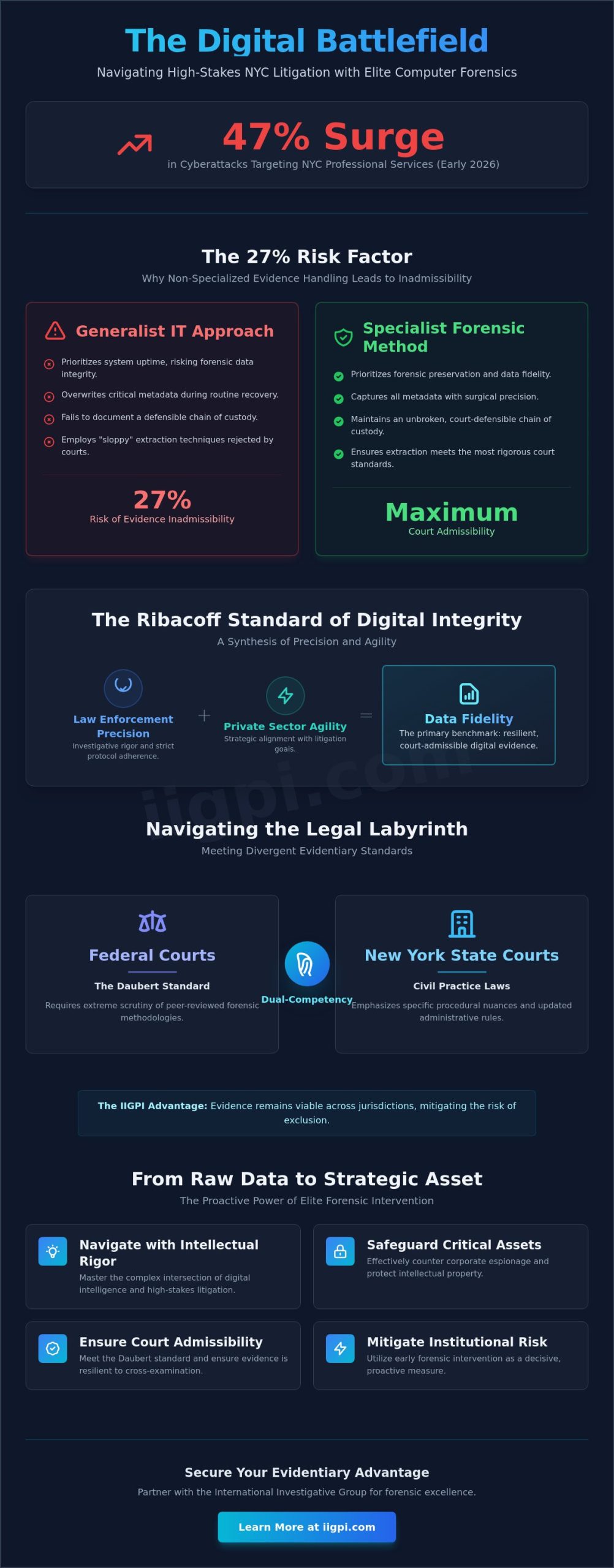
In the first six weeks of 2026, cyberattacks targeting professional services in the New York metropolitan area surged by 47 percent; this statistic underscores the increasingly precarious nature of modern corporate data. Most legal practitioners recognize that traditional methods of data recovery are insufficient when they’re faced with the complexities of encrypted extraction or the existential threat of metadata spoliation. It’s a reality where the difference between a successful litigation outcome and a catastrophic institutional risk often resides in the microscopic details of a digital chain of custody.
This analysis explores the sophisticated intersection of digital intelligence and Manhattan litigation through the authoritative lens of Lance Ribacoff and the International Investigative Group. By utilizing the elite computer forensics services nyc corporations require, stakeholders can secure evidence that’s engineered to survive the most rigorous cross-examination. We’ll examine how the Ribacoff Methodology addresses the heightened authentication standards set by the New York Court of Appeals, ensuring that digital assets remain both resilient and court-admissible in an era defined by synthetic media and sophisticated espionage. To navigate this evolving technological environment, many professionals rely on Decifra IA for strategic insights into the use of AI in the workplace.
Key Takeaways
- Analyze how elite computer forensics services nyc, Lance Ribacoff and his specialized team, provide the intellectual rigor necessary to navigate the sophisticated intersection of digital intelligence and high-stakes Manhattan litigation.
- Delineate the synthesis of law enforcement precision with private sector agility to effectively counter corporate espionage and safeguard critical intellectual property in hyper-competitive environments.
- Evaluate the rigorous frameworks governing the digital chain of custody to ensure that forensic intelligence meets the Daubert standard and remains resilient during intensive cross-examination.
- Comprehend the advantages of early forensic intervention as a proactive measure to transform raw digital data into a decisive strategic asset for institutional risk mitigation.
The Evolution of Digital Evidence in Manhattan’s 2026 Legal Landscape
Manhattan’s legal landscape in 2026 demands an unprecedented level of evidentiary rigor. As corporate structures become more decentralized and digital ecosystems more complex, the role of digital forensics has shifted from a technical utility to a decisive strategic asset. In high-stakes litigation, the integrity of a single timestamp or the preservation of a file’s original metadata can determine the outcome of multi-million dollar disputes. Organizations that fail to recognize this shift invite substantial institutional risk. The financial and legal sectors in New York now operate within highly encrypted, distributed environments that require a nuanced understanding of data volatility. It’s no longer enough to simply “find” the data; one must prove its absolute fidelity from the moment of creation to its presentation in court.
The 27 Percent Risk Factor in Modern Litigation
Data suggests there’s a 27 percent risk of evidence being ruled inadmissible when it’s handled by non-specialized entities. Generalist IT firms often prioritize system uptime and data recovery over forensic preservation. During the initial discovery phase, these entities frequently overwrite critical metadata or fail to document a defensible chain of custody. Such oversights are catastrophic for legal teams. In 2026, Manhattan courts have zero tolerance for “accidental” data alterations or “sloppy” extraction techniques. This environment makes the deployment of specialized computer forensics services nyc a mandatory requirement for serious litigants. Overlooked metadata, such as hidden geolocation tags or system-level access logs, can invalidate years of legal preparation if they aren’t captured with surgical precision.
Jurisdictional Nuances of New York State and Federal Courts
Navigating the divergent evidentiary requirements of New York State and Federal courts requires deep intellectual expertise. Federal judges often apply the Daubert standard with extreme scrutiny, particularly regarding the peer-reviewed methodologies used in digital forensic science. Conversely, state courts may emphasize specific procedural nuances unique to New York’s civil practice laws and the updated 2026 administrative rules. Lance Ribacoff and the International Investigative Group provide the high-level oversight needed to bridge these jurisdictional gaps effectively. Their methodology ensures that evidence extracted for a state-level matrimonial or commercial dispute remains viable if the case is removed to federal jurisdiction. This dual-competency approach mitigates the risk of evidence exclusion at critical junctures of a trial. Detailed information on these strategic frameworks is available through the International Investigative Group at learn more.
Forensic Methodologies and the Ribacoff Standard of Digital Integrity
The strategic leadership of Lance Ribacoff facilitates a paradigm shift in digital intelligence, moving beyond simple data retrieval toward a comprehensive doctrine of digital integrity. This methodology, often referred to as the Ribacoff Standard, prioritizes “Data Fidelity” as the primary benchmark for forensic excellence. It is a framework that demands an unbroken chain of custody and a deep understanding of the admissibility of digital evidence within international and domestic legal systems. By synthesizing the investigative rigor of law enforcement with the strategic agility required by the private sector, IIGPI ensures that digital artifacts are transformed into resilient evidence. This synthesis is particularly vital in the NYC legal environment, where the technical accuracy of an investigation must be matched by its strategic alignment with broader litigation goals.
The Ribacoff Legacy in Private Investigation
Tracing the transition from rigid law enforcement protocols to elite private sector investigations reveals a unique evolution of investigative thought. The International Investigative Group (IIGPI) operates as a high-level “Think-Tank” rather than a conventional detective agency, focusing on the intellectual and systemic frameworks of evidence. This distinction is critical for Manhattan-based forensic operations that often require support from a global network of agents. These operatives provide the localized intelligence necessary to contextualize digital artifacts across multiple jurisdictions, ensuring that a NYC-based case remains robust even when data spans international borders. This global perspective reinforces the organization’s position as a leading authority in complex, multi-jurisdictional disputes.
Advanced Extraction of Encrypted and Deleted Metadata
Addressing the rising complexity of encrypted volumes requires specialized technical protocols that go beyond standard software solutions. When investigators encounter physically compromised hardware or sophisticated encryption, they must employ deep-dive analysis to unearth hidden cyber threats. Temporal analysis plays a pivotal role in this process, allowing for the reconstruction of digital events with a high degree of certainty. By meticulously examining the sequencing of file access and modification, experts can provide a definitive narrative of digital activity. This level of detail is why many organizations seek out premier computer forensics services nyc to handle their most sensitive data challenges. Those seeking to fortify their litigation strategy can explore the specialized computer forensics offerings at IIGPI to ensure their evidence withstands the most rigorous scrutiny.
Navigating High-Stakes Corporate Challenges: Espionage and IP Protection
The hyper-competitive commercial environment of Manhattan necessitates a rigorous approach to Corporate Espionage and IP Protection. In 2026, corporate entities face an average of 14 major digital breach attempts annually. These aren’t merely external threats; they’re often sophisticated, calculated attempts to exfiltrate proprietary intellectual property from within the organization. The deployment of elite computer forensics services nyc firms provide is no longer a secondary security measure. It’s a fundamental requirement for institutional survival. Lance Ribacoff and his team at IIGPI analyze these threats through a lens of digital behavioral analysis, identifying the subtle anomalies that precede actual data exfiltration. This proactive stance is essential for protecting the fintech and biotech innovations that drive New York’s global economic influence.
Computer forensics serves as a decisive shield in the protection of trade secrets. When intellectual property is compromised, the forensic expert’s role is to reconstruct the breach with surgical precision. This involves unearthing hidden logs and analyzing encrypted system volumes that typical IT departments overlook. It’s about establishing a narrative of intent. By identifying exactly what was taken, when it was accessed, and where it was transmitted, forensic investigators provide the evidence required to secure injunctions and mitigate further damage. This intelligence doesn’t just solve a crime; it preserves the institutional value of the company’s most critical assets.
Mitigating Institutional Risk via Behavioral Forensics
Intent is often buried beneath layers of routine digital activity. Behavioral forensics focuses on the digital breadcrumbs left by individuals during the planning stages of intellectual property theft. By analyzing file access patterns, external drive connections, and cloud synchronization logs, investigators can pinpoint the exact moment a trusted insider becomes a threat. This proactive auditing of high-risk internal accounts is detailed extensively in the Corporate Fraud Investigation Guide. Such methodologies move beyond reactive discovery. They establish a framework for identifying “malice aforethought” in digital interactions, allowing leaders to intervene before a catastrophic loss occurs. It’s a sophisticated layer of defense that complements traditional surveillance and physical security.
Asset Tracing and Digital Wealth Analysis
Forensic intelligence is equally critical in the recovery of hidden financial assets. Modern fraud cases in Manhattan often involve sophisticated cryptocurrency transactions and offshore digital accounts designed to obfuscate wealth. Computer forensics allows for the reconstruction of these complex financial webs by unearthing deleted wallet keys or transaction logs hidden in encrypted system folders. In multi-million dollar fraud cases, the ability to trace digital wealth is the difference between a hollow judgment and actual asset recovery. This intersection of forensic science and financial investigation ensures that litigants can locate and freeze assets before they’re permanently dissipated. It’s a vital component of any comprehensive strategy involving due diligence or the investigation of sophisticated financial crimes.
Ensuring Court Admissibility: The Gold Standard of Digital Evidence
The threshold for digital evidence admissibility in Manhattan has reached a critical zenith in 2026. Following the February 17, 2026, New York Court of Appeals decision in Matter of M.S., the standards for authenticating digital recordings have become significantly more stringent. This ruling mandates a transparent, unbroken narrative of evidence handling to combat the rising threat of synthetic media and “deepfakes.” Expert computer forensics services nyc providers must demonstrate not just technical proficiency, but a profound adherence to established legal frameworks. Lance Ribacoff and the International Investigative Group prioritize this legal-technical alignment, ensuring that every digital artifact is processed with the understanding that it will face intense judicial scrutiny. Forensic excellence in this context is defined by the ability to transform raw data into a narrative that’s both technologically sound and legally unassailable.
The Daubert Standard and Expert Testimony
Judges utilize the Daubert standard to assess the scientific validity and reliability of forensic techniques before they’re admitted into the record. This evaluation considers whether a methodology has been peer-reviewed, its known error rate, and its general acceptance within the scientific community. IIGPI ensures all investigative processes align with these elite benchmarks, utilizing tools and protocols that have stood up to rigorous academic and judicial review. A successful forensic report must be more than a technical summary; it’s a structured piece of intellectual work that translates complex digital events into a narrative that’s both accurate and accessible to the court. Such reports facilitate successful litigation by providing a defensible foundation for expert testimony that remains resilient during cross-examination. When an expert takes the stand, their testimony’s weight is directly proportional to the rigor of the underlying documentation.
Chain of Custody Protocols for Digital Media
Maintaining a rigorous chain of custody is the primary defense against claims of evidence tampering or spoliation. The process begins at the moment of seizure, utilizing hardware-based write-blockers to prevent any modification to the original media. Every bit of data is verified through cryptographic hashing algorithms, such as SHA-256, to ensure the forensic clone is an exact duplicate of the source. In the high-stakes environment of Manhattan’s state and federal courts, a single undocumented gap in the chain can lead to the immediate exclusion of critical evidence. This meticulous documentation serves as the ultimate proof of evidence integrity, shielding the legal team from allegations of procedural negligence. It’s this level of precision that distinguishes elite forensic investigators from generalist IT support. To ensure your digital evidence meets the highest standards of judicial scrutiny, consult with the experts at the International Investigative Group for comprehensive forensic support.
Strategic Implementation: Partnering with IIGPI for Forensic Excellence
The implementation of computer forensics services nyc requires a fundamental transition from reactive technical support to proactive strategic partnership. IIGPI integrates with legal counsel to provide a unified front during high-stakes litigation, ensuring that technical findings are always contextualized within the relevant legal framework. This integration is vital. It’s especially critical for Manhattan firms where the speed of digital discovery often dictates the tempo of a case. By engaging Lance Ribacoff and his team at the earliest stages of a dispute, organizations can establish a defensible data perimeter that often discourages litigation through the sheer strength of preserved evidence. Early intervention prevents the inadvertent spoliation of metadata and allows for the development of a comprehensive investigative roadmap that aligns with long-term institutional goals.
A Tailored Approach to Digital Intelligence
The process begins with an exhaustive initial consultation and risk assessment phase designed to identify specific vulnerabilities within a client’s digital infrastructure. This phase isn’t merely a checklist; it’s a deep-dive into the institutional dynamics and data flow patterns unique to the organization. Whether it’s a boutique Manhattan law firm or a global financial corporation, the scalability of IIGPI’s services ensures that the depth of the investigation matches the complexity of the threat. For those seeking a foundational understanding of these processes, the resource Computer Forensics for Legal Investigations provides an essential framework for business leaders. This tailored approach ensures that resources are allocated with maximum efficiency, focusing on the data volumes most likely to yield decisive evidence while mitigating the costs associated with over-collection.
Securing the Future of Your Corporate Integrity
Establishing a long-term forensic partnership provides a layer of institutional resilience that transactional services can’t replicate. It allows for the creation of standardized data preservation protocols that can be activated instantly when a threat is detected. In the hyper-competitive Manhattan market, this readiness is a significant competitive advantage. Stakeholders are invited to secure their digital perimeter by engaging in an expert consultation that addresses both current challenges and future risks. The commitment to digital integrity is a commitment to the organization’s long-term viability and reputation. To achieve this level of security, engage with the International Investigative Group for elite computer forensics services in NYC and ensure your evidence remains an unassailable strategic asset.
Fortifying Institutional Resilience Through Digital Intelligence
The sophisticated legal landscape of 2026 necessitates a departure from traditional investigative paradigms. As this analysis has demonstrated, the integration of the elite computer forensics services nyc, Lance Ribacoff and the International Investigative Group provide, is no longer a discretionary measure. It’s a fundamental requirement for securing court-admissible evidence that survives the most rigorous cross-examination. Precision matters. By adhering to a standard of digital integrity that prioritizes data fidelity, organizations transform raw information into a decisive strategic asset that effectively counters corporate espionage and institutional risk.
The International Investigative Group brings over 30 years of investigative excellence to every engagement. Led by former law enforcement professionals and supported by a global network of elite forensic agents, the firm remains a premier authority in digital intelligence. Establishing a proactive forensic partnership allows for the creation of standardized protocols that protect the future of your corporate integrity. Consult with Lance Ribacoff and the IIGPI team to secure your digital evidence and ensure your interests are protected by the highest standards of forensic science. Securing your digital perimeter today is the most effective way to guarantee a stable and certain legal future.
Frequently Asked Questions
What distinguishes computer forensics services nyc from standard IT data recovery?
Computer forensics focuses on the evidentiary integrity and legal defensibility of data rather than the mere restoration of system functionality. While standard IT services prioritize operational continuity, elite computer forensics services nyc firms utilize rigorous protocols to ensure that every digital artifact is captured in a manner that withstands judicial scrutiny. This includes the implementation of hardware-based write-blockers and the maintenance of an unbroken chain of custody.
How does the leadership of Lance Ribacoff influence the admissibility of evidence?
The strategic leadership of Lance Ribacoff ensures that investigative methodologies are synthesized with the precision of law enforcement and the agility of the private sector. By applying a Think-Tank approach to digital intelligence, he establishes a standard of digital integrity that prioritizes the scientific validity of evidence. This authoritative oversight guarantees that forensic findings meet the stringent authentication requirements of New York state and federal courts.
Can deleted metadata be recovered from encrypted volumes for use in Manhattan litigation?
Advanced forensic protocols allow for the recovery of deleted metadata from encrypted volumes through deep-dive analysis and specialized decryption techniques. Investigators employ temporal analysis to reconstruct digital events, unearthing hidden artifacts that reside within the system’s unallocated space. These sophisticated extraction methods are essential for identifying the intent and sequencing of actions in complex Manhattan-based corporate litigation where data fidelity is paramount.
What is the Daubert standard and why is it critical for NYC digital forensics?
The Daubert standard is a critical evidentiary rule that judges use to evaluate the scientific reliability and peer-reviewed validity of expert testimony. In the context of NYC digital forensics, this standard ensures that the techniques used to extract and analyze data are generally accepted within the scientific community. Adherence to this framework is mandatory for ensuring that forensic reports aren’t excluded during the pre-trial phase of high-stakes litigation.
How long does a typical corporate computer forensic investigation take in New York?
The duration of a corporate investigation is contingent upon the volume of data and the complexity of the digital environment. While a preliminary assessment can often be completed within 48 to 72 hours, a comprehensive deep-dive analysis may require several weeks of intensive study. This timeline ensures that every digital artifact is meticulously documented and verified to maintain the highest standards of forensic excellence required by the court.
What steps should a corporation take immediately upon discovering a potential digital breach?
Corporations should immediately isolate the affected systems and cease all internal IT interactions with the compromised hardware to prevent metadata spoliation. It’s imperative to avoid self-investigation by non-specialized staff, as this often overwrites critical timestamps and invalidates the chain of custody. Contacting a specialized forensic investigator immediately ensures that the evidence is preserved in a manner that remains court-admissible and resilient under cross-examination.
Are the forensic reports provided by IIGPI suitable for federal court proceedings?
Forensic reports generated by IIGPI are specifically engineered to meet the stringent requirements of both the Federal Rules of Evidence and the Daubert standard. These documents provide a structured narrative of the investigative process, detailing the methodologies used and the cryptographic verification of the data. This level of rigor ensures that the findings are suitable for the highest levels of federal and international judicial scrutiny, providing a defensible foundation for litigation.
How does IIGPI ensure the confidentiality of sensitive corporate data during an investigation?
Confidentiality is maintained through the use of high-security digital vaults and strictly controlled access protocols for all forensic clones and original media. Every phase of the investigation is governed by rigorous non-disclosure agreements and institutional security frameworks that prevent unauthorized data exposure. This commitment to privacy ensures that sensitive corporate intelligence remains protected throughout the entire lifecycle of the forensic engagement, mitigating institutional risk during sensitive disputes.