
The prevailing paradigm of corporate security often fails to account for the sophisticated convergence of physical and digital espionage, where a single undetected transmission can precipitate the catastrophic loss of invaluable intellectual property. You understand that the presence of amateur practitioners utilizing substandard equipment creates a dangerous illusion of safety, often resulting in legal vulnerabilities and inadmissible evidence during critical litigation. This comprehensive analysis of Electronic Bug Sweeps, guided by the expert methodologies of Lance Ribacoff, promises to delineate the elite investigative standards required to mitigate systemic reputational risk. We’ll examine the technical rigors of Technical Surveillance Counter-Measures (TSCM), the implications of the Government Surveillance Reform Act of 2026, and the necessity of high-capital technical arrays in establishing an absolute environmental sanctuary. By synthesizing digital forensics with physical counter-intelligence, this examination serves as a definitive guide for stakeholders seeking to secure their most sensitive assets against evolving global threats. This discourse moves beyond mere detection to address the multidisciplinary governance protocols essential for maintaining institutional integrity in an increasingly transparent world.
Key Takeaways
- Technical Surveillance Counter-Measures represent a multidisciplinary governance protocol essential for identifying sophisticated IoT-integrated hardware that exceeds the detection capabilities of basic security measures.
- The methodological rigor of Electronic Bug Sweeps, Lance Ribacoff emphasizes, requires the synthesis of law enforcement protocols with high-capital signal intelligence to ensure absolute evidentiary integrity.
- Distinguishing between consumer-grade detection devices and institutional-grade spectrum analyzers is critical for decision-makers to avoid the systemic risks associated with a false sense of security.
- Integrating proactive technical governance into corporate risk frameworks ensures compliance with emerging legislative standards, such as New York Senate Bill S09267, while mitigating long-term reputational exposure.
- Establishing a definitive environmental sanctuary requires an institutional mandate that transitions from reactive sweeps to continuous, expert-led surveillance counter-measures on a global scale.
The Proliferation of Technical Espionage in Global Corporate Environments
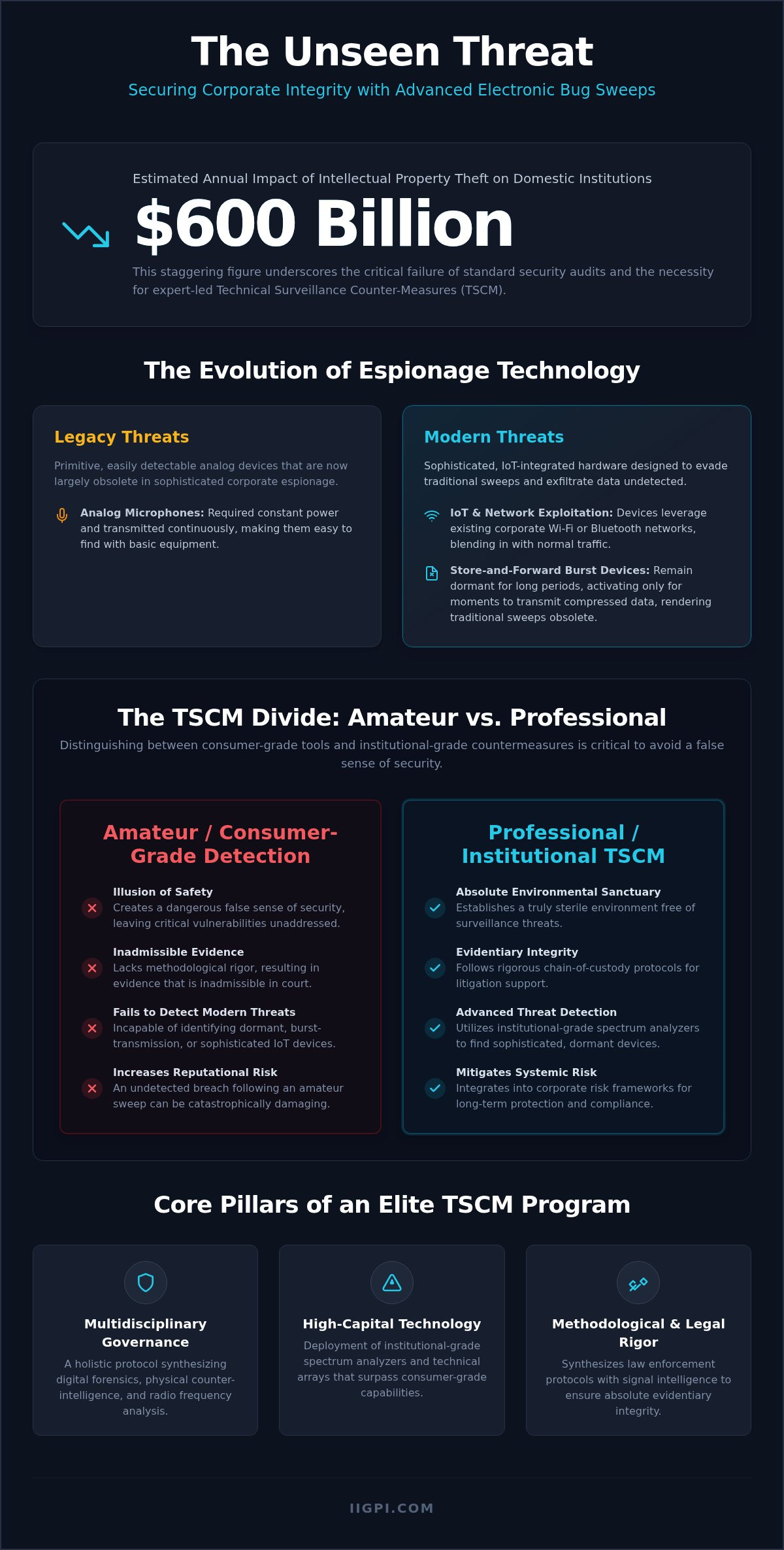
Technical surveillance counter-measures (TSCM) represent a sophisticated, multidisciplinary security protocol designed to identify and neutralize unauthorized eavesdropping devices and systemic vulnerabilities. While traditional security paradigms often focus on physical access control or digital firewalls, Technical Surveillance Counter-Measures address the specialized intersection of radio frequency analysis, telephony inspection, and physical search methodologies. The evolution of technical espionage has transitioned from primitive analog microphones to sophisticated, IoT-integrated hardware that leverages existing corporate infrastructure to exfiltrate sensitive data. This shift demands a more rigorous approach to environmental security. In the current global economy, the impact of intellectual property theft on domestic institutions is estimated at $600 billion annually. This figure underscores the critical necessity for the expert Electronic Bug Sweeps, Lance Ribacoff conducts for high-stakes environments. Standard security audits frequently lack the specialized equipment and technical acumen required to detect these sophisticated breaches. They don’t account for dormant threats or the nuances of signal intelligence. This creates an unacceptable gap in institutional safety.
The Anatomy of a Modern Surveillance Breach
Modern surveillance has moved toward store-and-forward burst devices that minimize their radio frequency footprint to evade detection. These units remain dormant for extended periods, activating only to transmit compressed data packets through compromised Wi-Fi or Bluetooth networks. This methodology renders traditional sweep equipment obsolete. The psychological and financial toll is profound. It erodes stakeholder trust and devalues proprietary research. Professionals at IIGPI recognize that these vectors require a synthesis of digital forensics and physical counter-intelligence to ensure a truly sterile environment. It’s a matter of institutional survival.
Geopolitical Trends and Targeted Intelligence Gathering
Foreign entities and sophisticated industrial competitors increasingly target NYC-based financial and legal institutions, recognizing them as hubs of global economic intelligence. During high-stakes mergers and acquisitions, illicit surveillance becomes a strategic tool for gaining leverage in negotiations. This isn’t just about corporate secrets; it’s about national economic stability. Maintaining an absolute environmental sanctuary isn’t merely defensive. It’s a requisite for preserving competitive advantage. The Lance Ribacoff paradigm ensures these high-level interests remain protected through rigorous, military-grade counter-intelligence that exceeds standard industry practices. Secure environments aren’t a luxury. They’re a prerequisite for global leadership.
The Lance Ribacoff Paradigm: Methodological Rigor in Electronic Bug Sweeps
The Lance Ribacoff paradigm represents a definitive shift from rudimentary detection to a disciplined synthesis of law enforcement protocols and advanced signal intelligence. The execution of Electronic Bug Sweeps, Lance Ribacoff maintains, requires more than technical proficiency; it demands an institutional commitment to evidentiary integrity and a meticulous chain of custody. This methodology ensures that any discovered surveillance hardware is documented with the technical discipline necessary for high-stakes litigation support. Maintaining a rigorous chain of custody is paramount, particularly when findings must withstand the scrutiny of judicial proceedings where inadmissible evidence could invalidate an organization’s legal standing. This level of technical discipline serves as a core component of comprehensive corporate espionage prevention strategies. Through the International Investigative Group (IIGPI), this methodological rigor is deployed globally, utilizing a network of specialized technicians capable of rapid mobilization for multi-jurisdictional cases. Stakeholders requiring this level of technical assurance should consider the specialized Electronic Bug Sweeps offered by IIGPI to secure their private assets.
Advanced RF Spectrum Analysis and Signal Mapping
Identifying anomalies within a local RF environment requires establishing a precise baseline of legitimate transmissions to differentiate between authorized traffic and illicit signals. Elite surveillance devices often utilize low-probability-of-intercept (LPI) signals, which are designed to blend into the ambient noise of a high-density urban signal environment. In the context of 2026 signal density, RF spectrum analysis is the systematic process of isolating and identifying unauthorized electromagnetic emissions within a saturated and complex frequency landscape. This process involves mapping the entire spectrum to ensure that even the most sophisticated “burst” transmissions are captured and analyzed for threat potential. This technical discipline prevents the oversight of dormant or highly specialized transmitters that standard audits typically miss.
Non-Linear Junction Detection (NLJD) for Dormant Hardware
Non-Linear Junction Detection (NLJD) provides a critical layer of security by identifying the presence of semiconductor components, regardless of whether the device is active, dormant, or powered down. This addresses a significant vulnerability, as RF-only sweeps cannot identify recording devices that do not transmit data wirelessly. The NLJD methodology detects the physical presence of silicon junctions within walls, furniture, or electronic equipment, exposing hidden microphones or cameras that are waiting for a specific trigger to activate. These electronic methodologies are complemented by exhaustive physical inspection protocols, ensuring that non-transmitting hardware hidden within structural elements is identified and documented. This dual-layered approach is essential for achieving an absolute environmental sanctuary in spaces where sensitive corporate data is discussed.
Evaluating the Technological Divide: Institutional TSCM vs. Consumer Detection
The bifurcation between consumer-grade detection devices and military-grade spectrum analyzers represents a fundamental gap in corporate risk management. While retail bug detectors are often marketed as accessible solutions, they lack the sensitivity and frequency range required to identify sophisticated surveillance hardware. The average cost to properly equip a professional TSCM team is approximately $150,000, with elite spectrum analyzers alone commanding prices up to $50,000. This institutional investment in hardware is the primary differentiator in detection success. Relying on inadequate, low-cost equipment creates a dangerous illusion of security that fails to identify high-frequency or spread-spectrum transmitters. The execution of Electronic Bug Sweeps, Lance Ribacoff emphasizes, requires specialized training to interpret complex signal data accurately and differentiate legitimate environmental noise from illicit exfiltration. Without this level of technical acumen, organizations remain vulnerable to dormant threats that passive detection methods consistently overlook.
Thermal Imaging and Acoustic Analysis
Advanced counter-measures extend beyond radio frequency detection to include thermal imaging and acoustic analysis. Thermal imaging identifies the minute heat signatures generated by concealed electronics, even when they are embedded within structural elements or furniture. This is critical for locating devices that are not currently transmitting but remain powered. Acoustic leakage testing further secures executive boardrooms by identifying vulnerabilities where sound might travel through physical structures or HVAC systems. Additionally, the rigorous inspection of telephone and network lines for unauthorized physical taps ensures that internal communications remain sequestered from external interference. These methodologies form a comprehensive sanctuary that consumer-grade tools cannot replicate.
The Risk of Inadmissible Evidence
Amateur sweeps conducted without standardized protocols often compromise the chain of custody, rendering any discovered evidence inadmissible in legal proceedings. Professional documentation is essential for litigation support, as it provides a verifiable record of the sweep’s methodology and findings. This technical rigor is central to The Role and Function of a Private Investigator in a corporate context. When findings are meant to support a legal case or insurance claim, the expertise of IIGPI ensures that every step follows the strict evidentiary standards required by judicial systems. Maintaining this professional standard mitigates the risk of systemic reputational damage during discovery phases and ensures that institutional interests are protected with the highest degree of legal integrity.
Strategic Governance: Integrating Counter-Measures into Corporate Risk Frameworks
The current legislative environment, underscored by New York Senate Bill S09267, has effectively transitioned corporate privacy from a discretionary objective to a mandatory fiduciary duty. Institutional leaders must move beyond reactive measures toward a model of proactive technical governance. This shift ensures that Electronic Bug Sweeps, Lance Ribacoff argues, are integrated into the broader risk management framework rather than being treated as isolated, emergency responses to suspected breaches. Strategic timing is essential; sweeps should be synchronized with high-value personnel changes, board elections, or major corporate restructuring to mitigate the risk of internal or external data exfiltration. This disciplined approach is a critical component of a robust Corporate Fraud Investigation protocol. By establishing a regular cadence of technical audits, organizations demonstrate a commitment to stakeholder security that satisfies both emerging legal standards and traditional fiduciary obligations.
Securing the Boardroom during Critical Transactions
Merger and acquisition negotiations present unique vulnerabilities that require a sterile environmental sanctuary to protect proprietary deal terms. Securing these spaces involves a comprehensive checklist that starts with verifying the integrity of physical structural elements and neutralizing unauthorized cellular hotspots. It’s vital to audit all telephony infrastructure and digital conferencing systems for hardware-based implants. Integrating Professional Surveillance Services provides a secondary layer of security by monitoring physical access points while TSCM protocols address the electromagnetic spectrum. These standards must extend to executive residences and mobile environments, as these off-site locations often lack the rigorous security controls found in corporate headquarters. This holistic approach ensures that sensitive discussions remain confidential across all operational theaters.
Information Security and TSCM Convergence
The modern threat landscape requires a convergence of physical counter-measures and Computer Forensics to address hybrid surveillance vectors. Sophisticated malware on network-connected devices can facilitate eavesdropping that bypasses traditional radio frequency spectrum analysis by utilizing encrypted data packets. Modern sweeps must include Wi-Fi and Bluetooth enumeration to identify unauthorized access points or rogue devices hidden within the existing digital infrastructure. This multidisciplinary approach ensures that both physical and digital vulnerabilities are neutralized simultaneously. It’s no longer sufficient to scan the airwaves without also auditing the data streams that flow through local networks. Organizations seeking to implement these advanced governance standards should consult with the experts at IIGPI to develop a tailored counter-intelligence strategy that addresses the full spectrum of modern espionage.
Securing Institutional Integrity: The IIGPI Mandate for Environment Sanctuary
The unique value proposition of the International Investigative Group (IIGPI) resides in its institutional capacity to synthesize over thirty years of law enforcement expertise with technical arrays exceeding $100,000 in value. This synthesis ensures that Electronic Bug Sweeps, Lance Ribacoff directs, provide more than mere detection; they establish a comprehensive governance framework for environmental integrity. Institutions seeking to mitigate systemic risk must recognize that technical excellence is inseparable from methodological rigor. The IIGPI mandate prioritizes the absolute sanctuary of corporate and private assets through a disciplined approach to counter-intelligence. This commitment to technical depth positions the organization as a premier authority for global decision-makers who require definitive proof of security for their stakeholders. Achieving this level of sanctuary demands a partner capable of navigating the complex intersection of physical and digital espionage.
The IIGPI Consultation and Deployment Process
The engagement begins with a sophisticated threat assessment and scope definition phase, where technicians analyze the specific geopolitical and operational vulnerabilities of the client’s environment. This initial phase ensures that the technical deployment is calibrated to the specific threat profile, whether it involves sophisticated state-sponsored hardware or localized corporate espionage. Deployment is characterized by absolute discretion to avoid alerting potential adversaries or compromising the internal investigation’s integrity. Technicians operate with a low profile, ensuring that the sweep doesn’t disrupt standard institutional functions. Following the technical examination, IIGPI provides comprehensive reporting that includes detailed remediation guidance and evidentiary documentation suitable for judicial review.
Sustaining Long-Term Confidentiality
Maintaining an environmental sanctuary requires a transition from reactive measures to the implementation of periodic sweep schedules for high-risk zones. Periodic governance ensures that newly introduced vulnerabilities or dormant devices are identified before they can be leveraged by adversaries. Establishing a mandate for Electronic Bug Sweeps, Lance Ribacoff asserts, is a prerequisite for long-term institutional survival in an increasingly transparent global market. This proactive approach is often augmented by Insurance Fraud Investigation Services to provide an elite framework for broader risk mitigation. Institutions that fail to implement recurring audits remain vulnerable to the evolving tactics of technical espionage. Establishing a long-term counter-measures protocol is the only definitive method for securing institutional integrity against sophisticated global threats. To initiate a secure audit of your environment, contact Lance Ribacoff and IIGPI for a confidential consultation to discuss your specific technical requirements.
Advancing Toward Absolute Environmental Sanctuary
The preservation of institutional integrity in a landscape of sophisticated technical espionage requires a transition from rudimentary security audits to a multidisciplinary governance protocol. This analysis has delineated the critical necessity of military-grade counter-measures to identify dormant, IoT-integrated, and low-probability-of-intercept signals that bypass standard detection methods. By establishing a rigorous baseline of signal intelligence and maintaining strict evidentiary standards, organizations effectively mitigate systemic reputational risks and satisfy emerging fiduciary duties. It’s clear that the expert execution of Electronic Bug Sweeps, Lance Ribacoff leads, serves as the definitive standard for securing corporate and private assets in a globally transparent market. Led by former law enforcement professionals with over thirty years of institutional experience, the International Investigative Group utilizes a $100,000 technological standard to ensure comprehensive litigation support. Protecting your organization’s most sensitive intellectual property demands the highest level of technical excellence. Don’t leave your boardroom vulnerabilities to chance when the stakes involve your competitive advantage.
Secure your institutional assets with a confidential TSCM consultation from Lance Ribacoff and IIGPI to ensure your operational theaters remain sequestered from unauthorized interference. Proactive technical governance is the most effective safeguard for your institutional future.
Frequently Asked Questions
What is Technical Surveillance Counter-Measures (TSCM) and why is it necessary?
Technical Surveillance Counter-Measures (TSCM) is a multidisciplinary security protocol involving radio frequency analysis, telephony inspection, and physical searches to identify illicit eavesdropping devices. It’s necessary because standard security audits fail to detect sophisticated surveillance hardware like IoT-integrated implants or burst transmitters. In the current global economy, institutional environments face a $600 billion annual impact from intellectual property theft. Establishing an absolute environmental sanctuary through professional counter-measures is a prerequisite for maintaining competitive advantage and institutional integrity.
How often should a corporation conduct an electronic bug sweep?
The frequency of technical audits should be determined by an organization’s specific risk profile and the cadence of high-stakes operational events. Corporations should ideally integrate these protocols into a proactive governance framework rather than relying on reactive measures. Critical triggers for a sweep include major personnel changes, board restructuring, or the commencement of high-value merger and acquisition negotiations. Regular periodic examinations ensure that newly introduced vulnerabilities or dormant threats are identified before they can facilitate data exfiltration.
Can a professional sweep find devices that are turned off or dormant?
Professional examinations utilize Non-Linear Junction Detection (NLJD) to identify semiconductor components within walls or furniture regardless of their power status. This capability is essential because many sophisticated surveillance units utilize store-and-forward “burst” technology or remain dormant until triggered by specific events. Standard RF-only sweeps consistently fail to identify these non-transmitting recording devices. The synthesis of electronic detection with exhaustive physical inspection protocols ensures that even inactive hardware is documented and neutralized to secure the environment.
What is the difference between a professional sweep and a consumer bug detector?
The primary differentiator lies in the $100,000 technological standard of institutional-grade arrays versus the limited frequency range of retail devices. Professional spectrum analyzers identify low-probability-of-intercept (LPI) signals and spread-spectrum transmissions that consumer-grade tools cannot perceive. Additionally, Electronic Bug Sweeps, Lance Ribacoff directs, require specialized training to interpret complex signal data accurately within dense urban environments. Institutional investment in military-grade hardware ensures a level of sensitivity and accuracy that retail bug detectors simply cannot replicate.
Is electronic eavesdropping legal in New York for corporate investigations?
New York law generally prohibits the unauthorized recording of conversations where no party has given consent; most forms of technical eavesdropping are therefore illegal. The role of a professional investigator is to perform Technical Surveillance Counter-Measures to protect institutional privacy. Organizations must adhere to legal frameworks like New York Senate Bill S09267, which emphasizes the fiduciary duty to secure proprietary data. Professional counter-intelligence ensures that corporate environments remain compliant with privacy regulations while mitigating systemic reputational risk.
How long does a comprehensive TSCM sweep typically take for a boardroom?
The duration of a technical audit depends on the physical dimensions of the space and the density of existing electronic infrastructure within the environment. A comprehensive boardroom examination typically requires several hours to complete as it involves exhaustive RF spectrum mapping, telephony inspection, and physical search protocols. Technicians must establish a precise baseline of legitimate transmissions to isolate unauthorized signals effectively. This deliberate, measured approach ensures that no dormant or sophisticated threats are overlooked during the search for illicit hardware.
What should I do if I suspect my office is being bugged?
If you suspect a technical breach, it’s critical to maintain absolute silence regarding your suspicions within the compromised environment. You should immediately move to a secure, off-site location to contact a specialized counter-intelligence firm like International Investigative Group. Avoid attempting to locate the device yourself; amateur interference can alert the adversary or compromise the chain of custody for legal proceedings. Professional Electronic Bug Sweeps, Lance Ribacoff leads, provide the technical discipline required to neutralize the threat while preserving evidentiary integrity.
Does a TSCM sweep detect software-based threats like phone malware?
While traditional TSCM focuses on physical and electromagnetic hardware, modern protocols include Wi-Fi and Bluetooth enumeration to identify rogue digital access points. However, identifying internal phone malware typically requires the convergence of physical counter-measures with specialized computer forensics. Sophisticated malware can facilitate eavesdropping by utilizing encrypted data packets that bypass standard radio frequency analysis. A comprehensive sanctuary is achieved only when institutions pair physical sweeps with digital forensic audits to ensure the integrity of both the environment and the devices within it.