
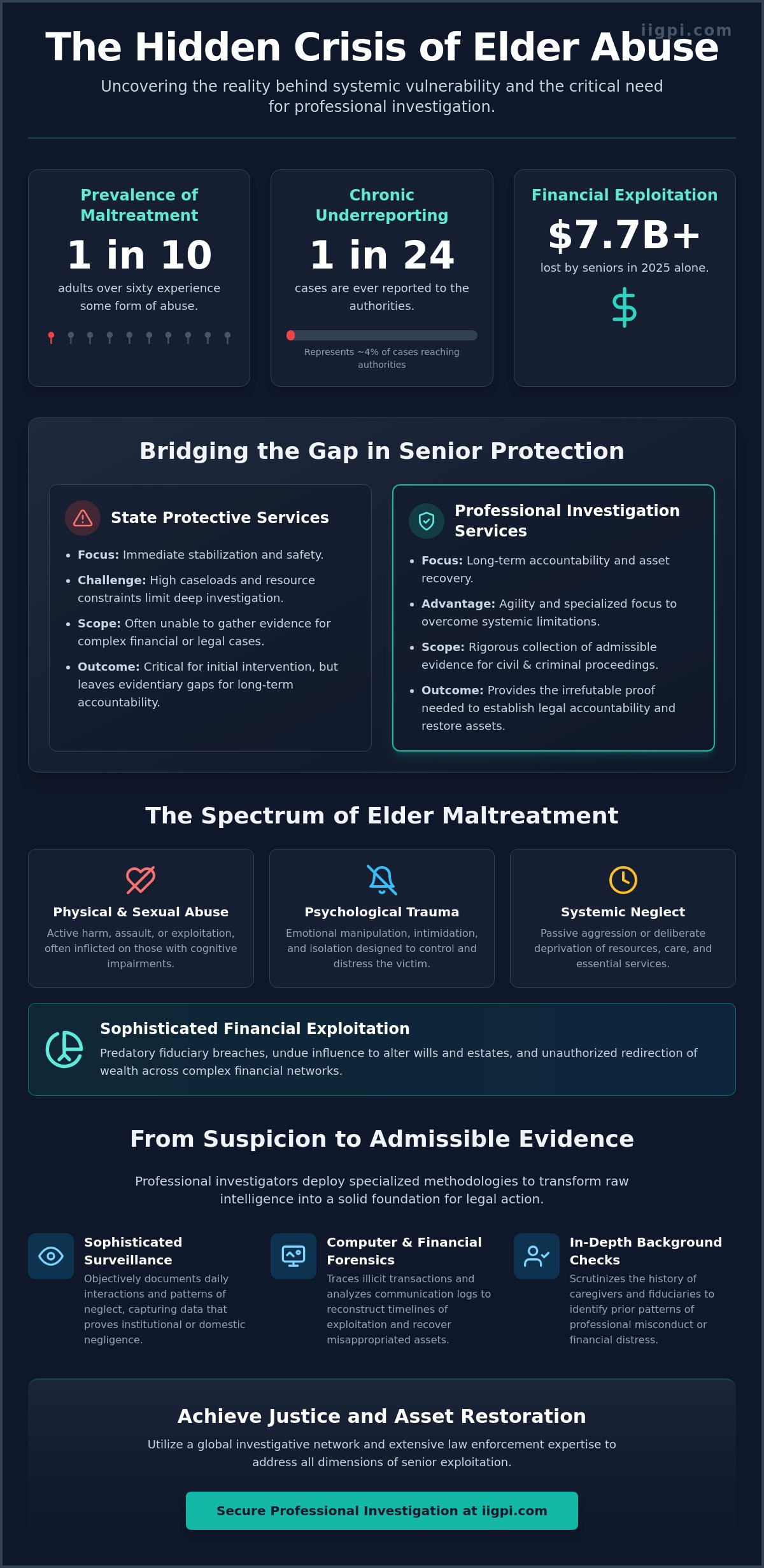
With approximately one in ten adults over the age of sixty experiencing some form of maltreatment, the contemporary landscape of senior care is increasingly defined by a crisis of systemic vulnerability. Despite the prevalence of these transgressions, current data indicates that only one in twenty-four cases reaches the attention of authorities, a disparity that underscores the critical necessity for specialized elder abuse investigation services. These figures highlight a profound failure in existing oversight mechanisms, necessitating a more rigorous approach to identifying and documenting instances of harm within both domestic and institutional settings.
This distinction is vital for families who require elder abuse investigation services to pursue civil litigation or secure a definitive criminal prosecution against perpetrators who evade standard oversight; additionally, you can learn more about how IKOR of Western Pennsylvania provides the fiduciary oversight and geriatric care management needed for long-term safety.
Families and fiduciaries often find themselves confronted by the dual challenges of institutional negligence and the opaque nature of financial exploitation, which cost seniors over 7.7 billion dollars in 2025 alone. You’ve likely observed that state-level protective services frequently operate under resource constraints that impede rapid response and exhaustive evidence collection. This article provides a comprehensive scholarly analysis of the methodologies and professional investigative protocols required to bridge these evidentiary gaps. We’ll examine the legal standards necessary to substantiate claims for judicial proceedings and explore how the Federal Elder Justice Action Plan of June 2026 influences the pursuit of perpetrator accountability and the restoration of senior assets.
Key Takeaways
- Recognize the essential distinction between mandatory reporting and the rigorous evidentiary substantiation required to establish legal accountability for complex fiduciary breaches.
- Analyze the role of sophisticated surveillance and computer forensics in identifying covert patterns of institutional neglect and unauthorized financial transactions.
- Discover how professional elder abuse investigation services provide the necessary agility and specialized focus to bridge the resource gaps inherent in state-level protective frameworks.
- Examine the methodologies for converting raw investigative intelligence into admissible evidence suitable for civil litigation and the recovery of misappropriated senior assets.
- Understand the strategic advantage of utilizing a global investigative network and extensive law enforcement expertise to address international dimensions of senior exploitation.
Defining the Parameters of Elder Maltreatment and Professional Intervention
Elder abuse represents a profound multi-dimensional breach of both fiduciary and moral duties. It isn’t merely an isolated incident of harm; it’s a systemic failure within the frameworks designed to protect the vulnerable. Professional elder abuse investigation services operate at the intersection of forensic analysis and protective intervention. While state agencies focus on immediate stabilization, private investigative protocols prioritize the collection of admissible evidence to ensure long-term accountability. This rigorous approach is necessary because the threshold for state intervention often leaves significant gaps where sophisticated or subtle abuse continues unabated.
State-mandated reporting serves as a critical initial trigger for public intervention. However, Adult Protective Services often faces bureaucratic constraints that limit the scope of their inquiry. Private investigative substantiation offers a more granular analysis. It utilizes sophisticated surveillance and forensic tools to document patterns of systemic neglect that might otherwise remain obscured by institutional opacity. This professional intervention transforms suspicions into actionable intelligence, providing a foundation for both civil and criminal proceedings. By employing surveillance services, investigators can witness the reality of daily interactions, capturing the objective data required to prove institutional negligence.
The Taxonomy of Modern Elder Abuse
Defining Elder Abuse requires a sophisticated understanding of the various modalities through which harm is inflicted. Physical and psychological trauma often manifest within domestic settings or under-regulated institutional environments. Neglect, frequently a form of passive aggression or deliberate resource deprivation, can be just as devastating as active assault. Sexual exploitation represents a particularly heinous violation, especially among seniors with cognitive impairments who cannot provide informed consent. These categories of abuse are rarely isolated; they often occur in tandem, creating a compounding effect on the victim’s health and security. Professional elder abuse investigation services must therefore adopt a holistic view of the victim’s environment to identify these overlapping threats.
The Escalation of Financial Exploitation
Predatory fiduciary breaches have become increasingly sophisticated. This exploitation often involves the subtle use of undue influence to manipulate testamentary documents and estate structures. Identifying the red flags of unauthorized asset transfers requires a high level of financial literacy and investigative rigor. It’s not just about missing funds; it’s about the strategic isolation of the victim to facilitate the redirection of wealth. Elite investigators utilize computer forensics to trace these illicit movements across complex financial networks. By analyzing transaction patterns and communication logs, investigators can reconstruct the timeline of exploitation. This process provides the clarity needed to challenge fraudulent estate modifications and recover misappropriated assets, ensuring that perpetrators are held legally and financially responsible for their transgressions.
Professional Methodologies for Uncovering Systemic Elder Abuse
The identification of institutional or domestic maltreatment requires a paradigm shift from passive observation to the active, specialized interrogation of objective facts. Professional elder abuse investigation services utilize a multi-disciplinary framework designed to bypass the superficial compliance often presented during standard regulatory inspections. This rigorous approach involves the deployment of high-level background investigations to scrutinize the historical conduct of caregivers and fiduciaries. By examining prior patterns of professional misconduct or financial instability, investigators identify risk factors before they escalate into active harm. Such proactive measures are essential in environments where oversight is historically opaque.
Surveillance Protocols in Residential Settings
Effective documentation of neglect necessitates the implementation of surveillance services that operate within strict legal and ethical parameters. Unlike sporadic state visits, continuous observational intelligence captures the nuances of caregiver interactions that elude standard check-ins. This includes the deliberate withholding of nutrition or the use of psychological intimidation to maintain control over a senior. By analyzing behavioral indicators of trauma, such as hyper-vigilance or regression, investigators provide the empirical evidence required by the Department of Justice Elder Justice Initiative to initiate formal legal interventions. These documented patterns of conduct serve as the primary catalyst for removing a victim from a high-risk environment.
Digital Forensics and Financial Intelligence
As financial exploitation becomes increasingly digital, the investigative focus must expand to include the scrutiny of encrypted communications and unauthorized account access. The application of computer forensics allows for the precise tracing of fraudulent wire transfers that often evade traditional banking audits. This technical rigor identifies electronic forgeries in estate documents and uncovers the digital footprint of undue influence buried within private email logs. It’s not enough to simply identify missing funds; one must establish a clear chain of custody for the digital evidence of the crime. When these digital trails lead to misappropriated assets, a comprehensive theft investigation becomes the primary mechanism for financial recovery and the restoration of the victim’s estate.
Forensic accounting serves as a critical final layer of this authoritative framework, translating complex transaction histories into a coherent narrative of exploitation. It exposes the sophisticated misappropriation of assets through shell accounts or the use of senior funds for the perpetrator’s personal lifestyle. By integrating these specialized methodologies, investigators provide the intellectual and evidentiary depth necessary to dismantle systems of abuse. The goal remains the securing of judicial accountability through the presentation of undeniable, forensic-grade proof. This level of detail ensures that perpetrators don’t simply evade justice through technicalities or the lack of public investigative resources.
Private vs. Public Investigations: Navigating the Jurisdictional Landscape
The efficacy of public protective frameworks is often contingent upon the availability of state resources and the specific mandates of localized agencies. While Adult Protective Services (APS) performs a vital role in immediate crisis intervention and victim stabilization, its operational scope is frequently circumscribed by staggering caseloads and administrative limitations. This systemic bottleneck often results in a reliance on the preponderance of evidence standard, which, while sufficient for social service intervention, remains inadequate for the rigorous demands of criminal prosecution. Consequently, specialized elder abuse investigation services are required to provide the forensic depth necessary to satisfy the higher evidentiary thresholds of the judicial system.
The Limitations of State-Level Protective Services
State-level services are historically burdened by budgetary constraints that preclude the intensive, long-term monitoring required to uncover sophisticated maltreatment. Public investigators rarely have the capacity to maintain the 24/7 surveillance services that are often essential for documenting intermittent neglect or psychological coercion. Private firms bypass these jurisdictional gaps by operating across geographic boundaries, ensuring that victims aren’t left vulnerable due to bureaucratic friction between municipal precincts. This agility allows for the collection of high-fidelity observational intelligence that state agencies simply aren’t equipped to pursue, transforming vague suspicions into concrete, documented facts.
Coordinated Intervention Strategies
A sophisticated investigative approach requires a seamless transition from the identification of abuse to the formal referral for criminal indictment. Private investigators function as elite liaisons to law enforcement, providing detectives with comprehensive evidence packages that facilitate the rapid initiation of charges. This collaboration is guided by the standards of the Elder Justice Initiative, ensuring that investigative protocols align with federal and state prosecutorial requirements. It’s imperative that private entities maintain an impeccable chain of custody for all physical and digital artifacts, as any procedural lapse could jeopardize the admissibility of findings in a court of law. By acting as the bridge between private concern and public justice, these services ensure that perpetrators don’t evade accountability through the cracks of a fractured system.
Managing the transition to law enforcement requires a nuanced understanding of criminal procedure to avoid compromising active investigations. Professional firms ensure that their activities, such as computer forensics or witness interviews, are conducted in a manner that supplements rather than hinders the work of precinct detectives. This synergy is particularly critical in cases of complex financial exploitation where the digital trail spans multiple jurisdictions. By presenting law enforcement with a refined, forensic-grade narrative of the crime, private investigators significantly reduce the time required for public agencies to act, thereby accelerating the restoration of safety for the senior involved. This authoritative framework ensures that every investigative action is a deliberate step toward legal accountability and the definitive cessation of harm.
Evidentiary Standards and Litigation Support in Elder Protection
The conversion of raw field intelligence into admissible judicial evidence represents the critical juncture where investigative rigor meets legal efficacy. It’s insufficient to merely identify neglect; the investigator must construct an evidentiary narrative that withstands the aggressive scrutiny of hostile cross-examination in a court of law. Professional elder abuse investigation services provide the foundational documentation necessary for legal counsel to initiate both civil and criminal proceedings. By drafting comprehensive investigative reports that adhere to strict forensic standards, these services ensure that the nuances of maltreatment are translated into a language that judges and juries find compelling. Within the complex environment of probate court, the private investigator often functions as a pivotal expert witness, offering objective testimony that bridges the gap between clinical assessments and observed daily conduct.
Substantiating Undue Influence and Lack of Capacity
Establishing the presence of undue influence requires a meticulous reconstruction of the senior’s social and psychological environment. Investigators focus on gathering contemporaneous evidence of a victim’s cognitive state during the exact moments critical financial transactions occur, such as the modification of a will or the transfer of property deeds. This process involves the interrogation of collateral witnesses, including neighbors, local service providers, and medical staff, to establish a definitive timeline of social isolation. By utilizing specialized personal detective protocols, investigators map the predatory social circles that systematically alienate seniors from their legitimate heirs and support structures. This observational intelligence is vital for proving that a senior’s decisions were the product of coercion rather than independent agency.
Asset Recovery and Restitution Frameworks
The strategic application of investigative findings provides the necessary evidentiary basis to secure temporary restraining orders on accounts, effectively freezing assets before they’re dissipated by bad actors. This is particularly critical in cases where an abusive guardian or agent has gained unfettered access to high-value estates. Professional investigators quantify the total financial impact of exploitation, providing precise data for damage claims in civil litigation. This authoritative documentation serves as the primary mechanism for the removal of fiduciaries who’ve breached their moral and legal duties. If you require a forensic analysis to protect an estate from further misappropriation, you should secure professional litigation support to ensure the restoration of senior assets.
Restitution is rarely a simple matter of identifying missing funds; it requires a deep interrogation of asset movement across multiple jurisdictions. Investigative rigor ensures that the financial narrative presented in court is airtight, leaving no room for perpetrators to claim administrative error or legitimate gifting. By integrating behavioral observation with financial forensic data, investigators provide a holistic view of the exploitation. This comprehensive approach is essential for achieving the dual goals of victim protection and perpetrator accountability. Ultimately, the success of any elder protection strategy depends on the ability to transform investigative truth into a definitive legal victory.
The International Investigative Group Approach to Elder Protection
International Investigative Group operates at the vanguard of senior protection, leveraging over thirty years of elite law enforcement and investigative experience to address the complexities of modern maltreatment. The organization’s methodology is rooted in the rigorous standards of high-level criminal detection, ensuring that every engagement is handled with the intellectual depth required for successful judicial outcomes. By utilizing a global network of operatives, the firm tracks international financial exploitation that often originates in emerging markets or through sophisticated cross-border scams. This expansive reach allows for the identification of assets that would remain invisible to localized public agencies. Our elder abuse investigation services are designed to provide a definitive response to the systemic vulnerabilities that seniors face in an increasingly interconnected and digital world.
In cases involving institutional neglect, the firm integrates specialized insurance fraud investigation services to uncover systemic patterns of corporate malfeasance. This approach is essential for identifying when a facility’s failure to provide care is a deliberate result of financial mismanagement or fraudulent reporting. By analyzing insurance claims and internal operational logs, investigators expose the discrepancies that lead to patient harm. This commitment to ethical integrity and victim advocacy ensures that the investigation doesn’t merely stop at the surface level but interrogates the fiduciary failures that allow abuse to flourish.
Elite Leadership and Global Reach
The transition from public service to elite private practice provides a unique strategic advantage in case management. Leaders with a foundation in law enforcement possess an intuitive understanding of the evidentiary thresholds necessary to secure indictments. This expertise is augmented by access to specialized databases and intelligence networks that are strictly unavailable to the general public. Coordinating elder abuse investigation services across state and international borders requires this level of sophisticated infrastructure to ensure that no jurisdictional boundary provides sanctuary for a perpetrator. This global perspective is critical when dealing with the international dimensions of modern financial scams and estate misappropriation.
Initiating the Investigative Process
Securing the safety of a vulnerable senior begins with a confidential, high-level consultation designed to assess the immediate threat profile. This initial phase is critical for developing a customized investigative strategy that addresses the specific nuances of the case, whether the threat is domestic, institutional, or digital. Every protocol is executed with a commitment to discretion, ensuring that the victim’s dignity remains intact throughout the inquiry. If you suspect that a senior’s safety or assets are being compromised by predatory actors, it’s imperative to contact International Investigative Group for immediate protection and the commencement of a definitive, authoritative inquiry.
Advancing the Framework of Senior Protection and Fiduciary Accountability
The protection of senior populations necessitates forensic rigor; it’s a strategic imperative for those overseeing complex fiduciary environments. As demonstrated, the integration of elder abuse investigation services ensures that sophisticated financial breaches are identified with the precision necessary for judicial success. Evidence dictates the outcome. By bypassing the administrative constraints inherent in public-sector responses, private investigative protocols provide the evidentiary depth required to restore misappropriated assets and establish definitive legal accountability. This proactive stance is essential for dismantling the systemic vulnerabilities that often lead to institutional neglect.
International Investigative Group remains a premier authority in this specialized field, having successfully resolved over 10,000 cases through a foundation of elite law enforcement expertise. With over 30 years of investigative excellence in New York City and on a global scale, our organization offers a unique synthesis of regional focus and international reach. Accountability remains our mission. You can secure an elite consultation with International Investigative Group today to initiate a customized strategy for protection. Establishing a robust defense against exploitation is a critical step toward ensuring the enduring safety and dignity of those most vulnerable to systemic harm.
Frequently Asked Questions Regarding Elder Protection Protocols
What constitutes professional elder abuse investigation services?
Professional elder abuse investigation services encompass a multi-disciplinary framework of forensic observation, background scrutiny, and digital interrogation. These services are distinguished from casual observation by their adherence to strict evidentiary standards designed for judicial admissibility. By integrating surveillance with technical analysis, investigators construct a definitive record of maltreatment. This establishes a foundation for perpetrator accountability and the cessation of systemic harm within domestic or institutional environments. It’s a rigorous process that transforms suspicion into actionable intelligence.
How does a private investigator prove financial exploitation of a senior?
Proof of financial exploitation is established through the meticulous reconstruction of account histories and the identification of digital footprints left by unauthorized transactions. Investigators utilize forensic accounting to reveal patterns of undue influence and the strategic isolation used to facilitate asset misappropriation. This process often involves the scrutiny of estate document modifications and the tracing of fraudulent wire transfers. It provides the empirical data necessary to challenge predatory fiduciary breaches in probate or civil courts.
Can a private investigator intervene if I suspect nursing home neglect?
Private investigators provide a critical layer of oversight in nursing home settings by documenting interactions that fall outside the scope of standard regulatory inspections. Through specialized surveillance protocols, investigators capture objective evidence of neglect, such as the withholding of nutrition or medical care. This observational intelligence serves as a catalyst for legal intervention. It allows families to substantiate claims of institutional negligence that public agencies might otherwise overlook due to significant resource constraints.
Is evidence gathered by a private investigator admissible in elder abuse trials?
Evidence gathered by a professional investigator is fully admissible in elder abuse trials provided that a rigorous chain of custody is maintained throughout the inquiry. This requires the investigator to document every step of the evidence collection process, from the initial digital forensics to the final surveillance logs. By functioning as an expert witness, the investigator translates this technical intelligence into a coherent narrative. Such clarity meets the high evidentiary thresholds required for criminal indictments and civil restitution.
What is the difference between Adult Protective Services and a private investigation?
Adult Protective Services prioritizes immediate victim stabilization and the fulfillment of state-mandated reporting requirements, whereas a private investigation focuses on exhaustive evidentiary substantiation. While APS operates under heavy caseload burdens and administrative limitations, private firms offer 24/7 agility and specialized forensic tools. This distinction is vital for families who require elder abuse investigation services to pursue civil litigation or secure a definitive criminal prosecution against perpetrators who evade standard oversight.
How long does a typical elder abuse investigation take to complete?
The duration of an inquiry is contingent upon the complexity of the maltreatment and the depth of the financial forensic requirements involved. While immediate physical threats may be documented within several days of active surveillance, tracing sophisticated financial exploitation across multiple jurisdictions often requires several weeks or months. This timeline ensures that the investigative report is comprehensive. It’s designed to provide the forensic-grade proof required to withstand the scrutiny of a hostile judicial environment.
What are the legal boundaries for surveillance in elder abuse cases?
Surveillance protocols are strictly governed by state and federal privacy statutes to ensure that all gathered intelligence remains legally admissible. Investigators operate within boundaries that respect the reasonable expectation of privacy while utilizing advanced technology to monitor caregiver interactions in common or shared environments. Adhering to these legal frameworks is essential for maintaining the integrity of the investigation. It ensures that the documented evidence doesn’t get dismissed during subsequent litigation or probate proceedings.
How can I protect a loved one while an investigation is ongoing?
Immediate protection is often achieved through the deployment of professional security guards and the legal freezing of financial accounts via temporary restraining orders. If physical harm is suspected, investigators coordinate with families to facilitate the safe relocation of the senior while the evidentiary record is finalized. These proactive measures, combined with ongoing monitoring, ensure that the victim remains insulated from further predatory influence or neglect. It’s a bridge toward a definitive and safe legal resolution.