
What if an unexplained withdrawal reflects a new financial arrangement rather than exploitation? Or what if it is part of a pattern that needs attention? For families considering an elder abuse financial investigation staten island, the first challenge is to take concerns seriously without treating suspicion as proof. Changes in spending, account access, or property decisions can have several explanations. Raising concerns too quickly may also intensify conflict.
That uncertainty is difficult, especially when an older adult’s safety and independence both matter. A measured response starts with preserving relevant information and deciding what kind of support fits the situation. Adult Protective Services connects vulnerable adults with protective services and support. A private investigator can conduct separate fact-finding, using methods such as surveillance or computer forensics when they are relevant to the inquiry. Neither role replaces the other.
This guide explains how to identify and document specific warning signs, distinguish public support from private investigation, and decide when investigative work may help clarify unanswered questions in Staten Island. It also covers practical next steps that respect the older adult’s circumstances and avoid jumping to conclusions.
Key Takeaways
- Unfamiliar transactions or changes in spending can warrant attention, but a warning sign alone does not establish financial exploitation.
- Organize observations and information you lawfully hold, and separate what you know from what remains uncertain.
- An elder abuse financial investigation staten island may use structured fact-finding to clarify questions, but it does not determine guilt or provide legal advice.
- Distinguish urgent danger, suspected abuse that may require public support, and unresolved questions that may suit private investigative work.
- International Investigative Group offers customized investigative work that can draw on relevant financial investigation, surveillance, or computer forensics methods.
Recognizing Suspected Elder Financial Abuse in Staten Island
Suspected financial exploitation means there are observable reasons to question whether an older adult’s money, property, or financial resources may be used or controlled improperly. It is a concern to assess, not a conclusion about who is responsible. An unfamiliar charge, a sudden change in spending, or a new person helping with banking may have an ordinary explanation. When these events appear alongside other changes, though, they may warrant closer attention.
A financial anomaly is a discrepancy to clarify. Evidence of intentional exploitation requires information supporting both improper conduct and responsibility. Keeping that distinction clear helps families record what they know without assigning motive prematurely. The broader overview of elder abuse describes financial abuse as one form. A family’s immediate task is to identify specific changes and preserve their context.
Isolation, cognitive changes, or dependence on a caregiver may increase concern because they can affect an older adult’s ability to manage finances, seek help, or explain a transaction. None of these factors establishes wrongdoing on its own. Ask what has concretely changed, how it differs from the person’s usual arrangements, and whether there is a reasonable explanation.
Which financial warning signs merit closer attention?
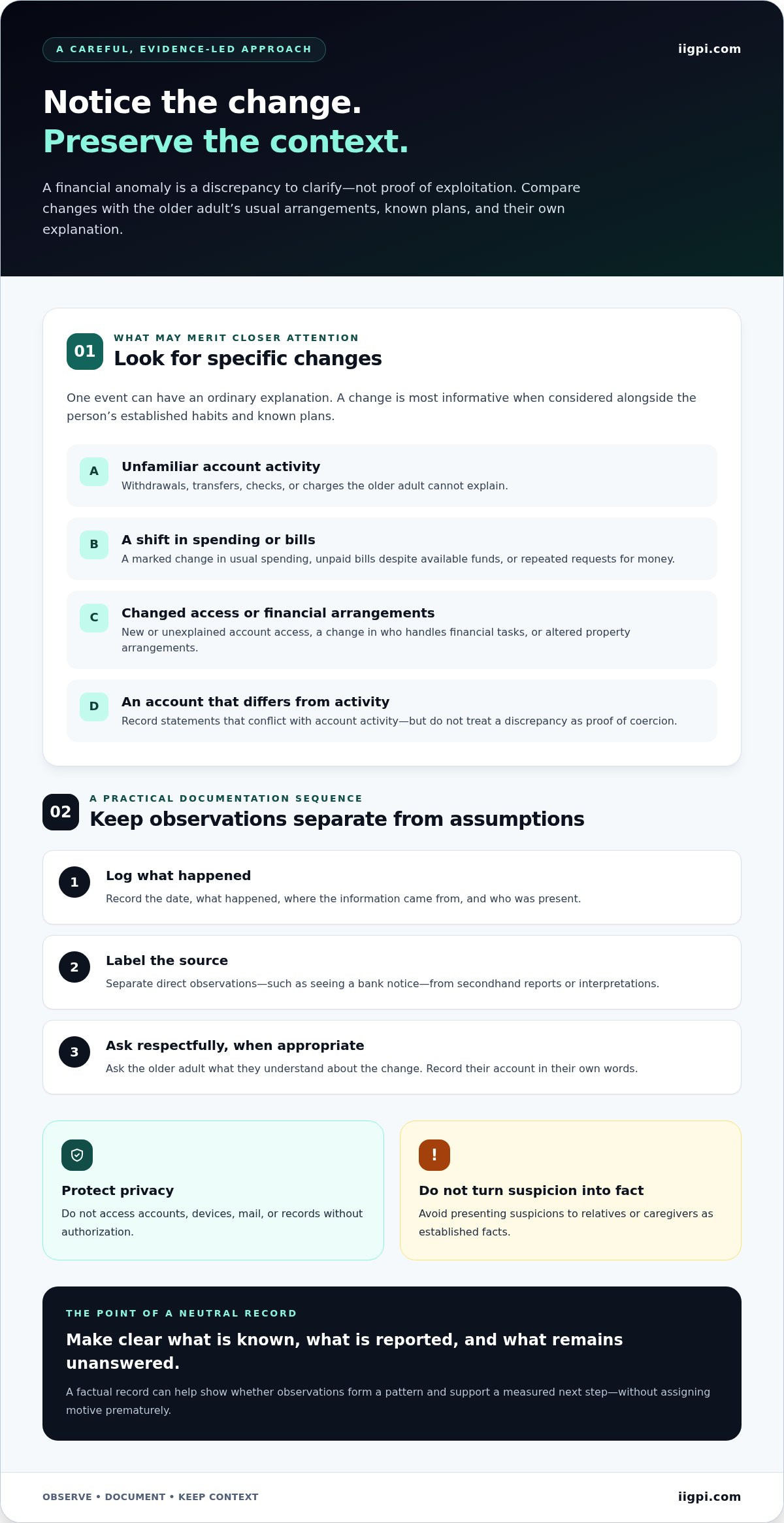
Changes in banking or spending are most informative when compared with the older adult’s established habits and known plans. A single event may reflect a planned purchase, a bill, or assistance the person authorized. Consider that context before drawing a conclusion. Record what you observed directly, and distinguish it from what you suspect may have happened.
- Unfamiliar withdrawals, transfers, checks, or charges, especially when the older adult cannot explain them.
- A marked change in usual spending, unpaid bills despite available funds, or repeated requests for money.
- New or unexplained account access, a change in who handles financial tasks, or altered property arrangements.
- Statements from the older adult that conflict with account activity. Record what they said, but do not treat a discrepancy as proof of coercion.
How Staten Island families can record concerns responsibly
A factual record can help a family see whether separate observations form a pattern and clearly communicate the concern when seeking support. For anyone searching “elder abuse financial investigation staten island,” careful documentation is a useful starting point, not a substitute for a formal assessment.
- Record the date, what happened, where the information came from, and who was present.
- Separate direct observations, such as seeing a bank notice, from secondhand reports or interpretations.
- When appropriate, respectfully ask the older adult what they understand about the change. Record their account in their own words.
Protect the older adult’s privacy. Do not access accounts, devices, mail, or records without authorization, and do not present suspicions to relatives or caregivers as established facts. A neutral log distinguishes known details from unanswered questions and can help the family choose a measured next step without unnecessarily escalating conflict.
What an Elder Financial Investigation in Staten Island Can Examine
A private financial investigation is structured fact-finding intended to clarify specific questions. It is not legal advice and does not determine that anyone is guilty. An elder abuse financial investigation staten island families consider can help organize available information, identify gaps, and assess whether observed activity fits the concern raised. It does not replace public protective services or law enforcement, and its findings do not establish a legal conclusion on their own.
Start by defining the question. When did an unfamiliar account change occur? What events preceded it? What activity needs clarification? The U.S. Department of Justice on Financial Exploitation describes forms of exploitation affecting older adults. A focused inquiry can then consider what relevant information may help clarify the family’s particular concern.
Financial records, timelines, and corroborating information
A dated sequence can put account activity alongside known events, such as a change in who assists with finances or a reported conversation about a transfer. This chronology helps show what needs clarification, but it should not fill gaps with guesses. Keep client-provided records distinct from independently collected investigative observations, and identify the source of each detail.
Records may show that a transaction occurred or account access changed. They may not show who initiated it, why it happened, whether it was authorized, or whether it resulted in a loss. Investigative fact-finding can examine available material and seek relevant context without claiming that the information proves intent or resolves a legal issue.
When surveillance or computer forensics may add context
When relevant to the defined scope, human surveillance can document observable activity, with photographic or video evidence collected as appropriate. These observations may add context to a specific question, but they do not replace financial records or prove motive. Families exploring surveillance can use a professional surveillance services guide to understand the method’s potential role in an inquiry.
Computer forensic services can examine digital data from devices or other sources when there is proper authorization. The purpose may be to assess information relevant to the inquiry, not to access private accounts or devices without permission. Do not assume that a particular record or deleted data will be available or recoverable. Computer forensics is most useful when it addresses a defined investigative question.
International Investigative Group is a New York-based private investigation firm offering Financial Fraud Investigation, surveillance, and computer forensic services. Its work is fact-finding, not legal representation or law enforcement, and the scope is customized to the services required. Families assessing whether private inquiry fits their questions can review financial investigation services.
Private Investigation, Adult Protective Services, or Emergency Help?
The right response depends first on whether the older adult faces immediate danger, needs public protective support, or has unanswered questions that may benefit from separate fact-finding. These routes serve different purposes. A private investigator does not replace Adult Protective Services (APS), law enforcement, or an attorney. Private investigative work should never delay an urgent request for help.
| Situation | Appropriate first step | Primary role |
|---|---|---|
| Immediate physical danger or emergency | Call 9-1-1 | Emergency response and immediate safety |
| Suspected abuse or exploitation needing public support | Contact New York State APS | Protective services and connection to support |
| Unresolved questions requiring private fact-finding | Consider a private investigation, when appropriate | Organize and document relevant information within a defined scope |
When public support or emergency response takes priority
If an older adult is in immediate danger, call 9-1-1, following New York State’s emergency guidance. For suspected abuse that is not an immediate emergency, the New York State Elder Abuse Hotline is 1-844-697-3505. The helpline is listed as operating weekdays from 8:30 a.m. to 8 p.m.; confirm the current number and hours before relying on them.
APS is a public agency focused on investigating reports involving vulnerable adults and connecting people with protective services. Other victim-support resources may help address safety, counseling, or related needs outside the scope of a private inquiry. If a crime such as theft or fraud is suspected, law enforcement is the public authority responsible for criminal investigation.
Where a private investigator may complement other support
Private fact-finding may help when a family needs to clarify a chronology, organize relevant observations, or document information tied to specific questions. This work is separate from APS’s protective role and law enforcement’s criminal investigative role. A private investigator does not determine legal rights, decide guilt, or replace an attorney’s advice. Findings may provide context, but they do not guarantee a particular official or legal outcome.
For a family weighing an elder abuse financial investigation staten island, the sequence matters: address immediate safety first, seek public support when abuse is suspected, then assess whether additional private documentation could answer an unresolved question. These roles can complement one another, but they are not interchangeable. Families considering broader personal or household concerns can also learn how personal and domestic investigation protocols differ from public protective services.
Preparing for an Elder Abuse Financial Investigation in Staten Island
Preparation can turn a broad concern into a defined set of questions. Before considering an elder abuse financial investigation staten island families should first establish whether the older adult has an immediate safety need. Urgent danger takes priority over gathering records or arranging private fact-finding. For non-urgent concerns, a concise, neutral account helps distinguish what is known, what others have reported, and what remains uncertain.
- Identify immediate safety needs and seek appropriate public or emergency support if necessary.
- Record relevant events with dates, sources, and people involved.
- Organize only information you are authorized to possess or share.
- Define the specific questions that remain unanswered.
A useful investigation brief is factual, dated, and limited to relevant questions. It should not assume wrongdoing or present an interpretation as established fact.
What information can help define the inquiry?
A concise timeline can note when a financial change was observed, what prompted concern, who was present, and what question the event raises. Label firsthand observations separately from secondhand reports and assumptions. For example, distinguish “I saw a new account notice” from “I think a caregiver changed the account.” This keeps the inquiry focused without turning uncertainty into an allegation.
Include relevant records only if you are entitled to access and share them, and note where each item came from. Do not ask anyone to provide another person’s account credentials or access private accounts, devices, mail, or financial records without authorization. Keep materials in their original form. Do not alter, delete, or annotate the underlying records. If you make notes, keep them separate and identify them as your own.
How to assess scope, confidentiality, and fit
Before proceeding, consider what question the inquiry is meant to address and what information may reasonably help answer it. A focused scope can prevent unrelated family disagreements from displacing the financial concern. Distinguish investigative fact-finding from services that address immediate safety, provide social support, investigate crimes, or advise on legal rights. A private investigator does not replace those functions.
International Investigative Group, Ltd. is a New York-based private investigation firm that provides customized packages billed for the services required. The firm is Licensed, Bonded, Insured, and former law-enforcement experience is represented across its team. These credentials describe the firm; they are not a promise about the result of an individual inquiry. A discussion should establish the factual questions, appropriate investigative scope, and how information will be handled. No particular finding or outcome is assured.
If private fact-finding appears appropriate, you can speak with IIGPI about a confidential investigation and describe the concern in measured terms. A timeline, relevant authorized information, and a clear list of unanswered questions can help frame the discussion while keeping the older adult’s circumstances central.
Working With IIGPI on a Staten Island Financial Investigation
International Investigative Group, Ltd. (IIGPI) is a New York-based private investigation firm that offers Financial Fraud Investigation. For families considering an elder abuse financial investigation staten island, the work starts with identifying the factual questions they need examined and the information they can lawfully provide. A defined scope keeps the inquiry focused on relevant circumstances rather than assumptions about motive or responsibility.
What families can expect from a defined investigative scope
The investigative approach depends on the questions, available information, and circumstances. A family may need help clarifying a sequence of events or determining whether observable activity provides useful context. Surveillance, computer forensics, or other investigative methods may be used when relevant to that scope. IIGPI investigators can collect photographic and video evidence, but no method guarantees a particular finding, recovery, prosecution, or resolution.
Customized service packages are billed according to the services required. The discussion should establish the purpose of the inquiry and which investigative work is relevant, rather than assume every case requires the same methods. Families can explain what is known, what remains uncertain, and what information they are authorized to share. The investigation is a fact-finding service, not legal representation or an official determination of wrongdoing.
Before work begins, clarify how the proposed scope relates to the family’s question and how information will be handled. Keep records and digital information within the bounds of lawful access and authorization. If a concern involves immediate safety or a suspected crime, public agencies retain their separate roles. A private investigation should not delay that support.
Credentials, confidentiality, and the next conversation
IIGPI is Licensed, Bonded, Insured, and the firm reports 10,000+ cases solved. These credentials and experience provide context, not a guarantee about an individual matter. An initial conversation can focus on the concern, the older adult’s circumstances, what the family can lawfully share, and whether private fact-finding is a suitable complement to other support. Do not share another person’s private records or account credentials without authorization.
Investigative services, public protective support, law enforcement, and legal counsel address different needs. IIGPI does not replace Adult Protective Services or law enforcement, and an investigation does not determine legal rights or provide legal advice. If the older adult faces immediate danger, seek emergency help. If public protective support is needed, contact the relevant agency. Private investigative work may be considered separately when factual questions remain.
To discuss the circumstances and whether a defined investigative scope may fit, contact IIGPI about a financial investigation.
Choose a Measured Next Step
Taking action does not require reaching a conclusion about what happened. A useful next step respects the older adult’s wishes and circumstances, addresses immediate safety needs, and clarifies what information is still missing. Keep the focus on a specific unanswered question instead of allowing uncertainty to harden into accusation.
If you are weighing an elder abuse financial investigation staten island, consider whether private fact-finding could help clarify that question alongside any public support or professional guidance the situation calls for. The purpose is to make an informed decision about the next step, not to presume what an investigation will find.
When you are ready, discuss your circumstances with IIGPI and outline the concern and questions you would like addressed. A clear, measured conversation can help you consider an appropriate path forward while keeping the older adult’s well-being at the center.
Frequently Asked Questions
Is elder financial abuse investigated differently in Staten Island?
Staten Island concerns are handled through New York’s public support system, with local contact routes available for residents. The Staten Island Adult Protective Services Borough Office is listed at 929-221-8794, while the statewide elder abuse hotline is 1-844-697-3505. A private inquiry is separate from public agency work. Focus on the older adult’s needs and the specific questions that require clarification rather than assuming local procedures differ in substance.
What are common signs of financial exploitation of an older adult?
Possible signs include unfamiliar transfers, checks the older adult does not recall writing, sudden changes to beneficiaries or account access, and essential bills going unpaid despite available resources. A new pattern of requests for money or pressure to sign financial documents may also merit attention. These circumstances can have legitimate explanations. Compare them with the person’s usual arrangements and plans before inferring exploitation or assigning responsibility.
Can a private investigator investigate suspected elder financial abuse?
Yes. A private investigator can conduct structured fact-finding within an agreed scope, such as organizing authorized records, clarifying a timeline, or documenting relevant observable activity. An elder abuse financial investigation staten island families consider is not a public protective-services response, a police investigation, or a legal determination. An investigator cannot decide guilt or guarantee a recovery. Findings are information that may help clarify questions.
What should I do if I suspect elder abuse in New York?
If someone is in immediate physical danger, call 911. For suspected abuse that is not an emergency, contact New York State’s elder abuse hotline at 1-844-697-3505, listed as operating weekdays from 8:30 a.m. to 8 p.m. You may also reach the Staten Island APS Borough Office at 929-221-8794. Share concrete observations and the older adult’s location, and verify contact details before relying on them.
Can an investigator access an older adult’s bank or phone records?
An investigator should work only with records lawfully provided or otherwise properly accessible. Hiring an investigator does not itself authorize access to another person’s private accounts or devices. If the older adult consents or a representative has authority to share specific information, clarify the permission and its limits. Do not provide passwords, bypass security, intercept communications, or obtain private records without authorization. A private inquiry can focus on permitted materials and observable information.
When should I contact Adult Protective Services instead of a private investigator?
Contact APS when the older adult may need public protection, an assessment of their circumstances, or connection to social services. A private investigator may be appropriate for separate fact-finding when specific questions remain, but that work does not provide protective services or replace an official response. The options are not necessarily mutually exclusive: safety and public support should take priority where needed, while private investigative work may address a distinct family question.
What information should I prepare before discussing an elder financial investigation?
Prepare a brief chronology with dates, the source of each detail, people involved, and the questions you hope to clarify. Separate what you witnessed from what someone else reported, and note any records you are authorized to share. For example, identify the date of a disputed transaction without assuming who made it. This helps keep the discussion focused while protecting the older adult’s privacy and avoiding unsupported allegations.