
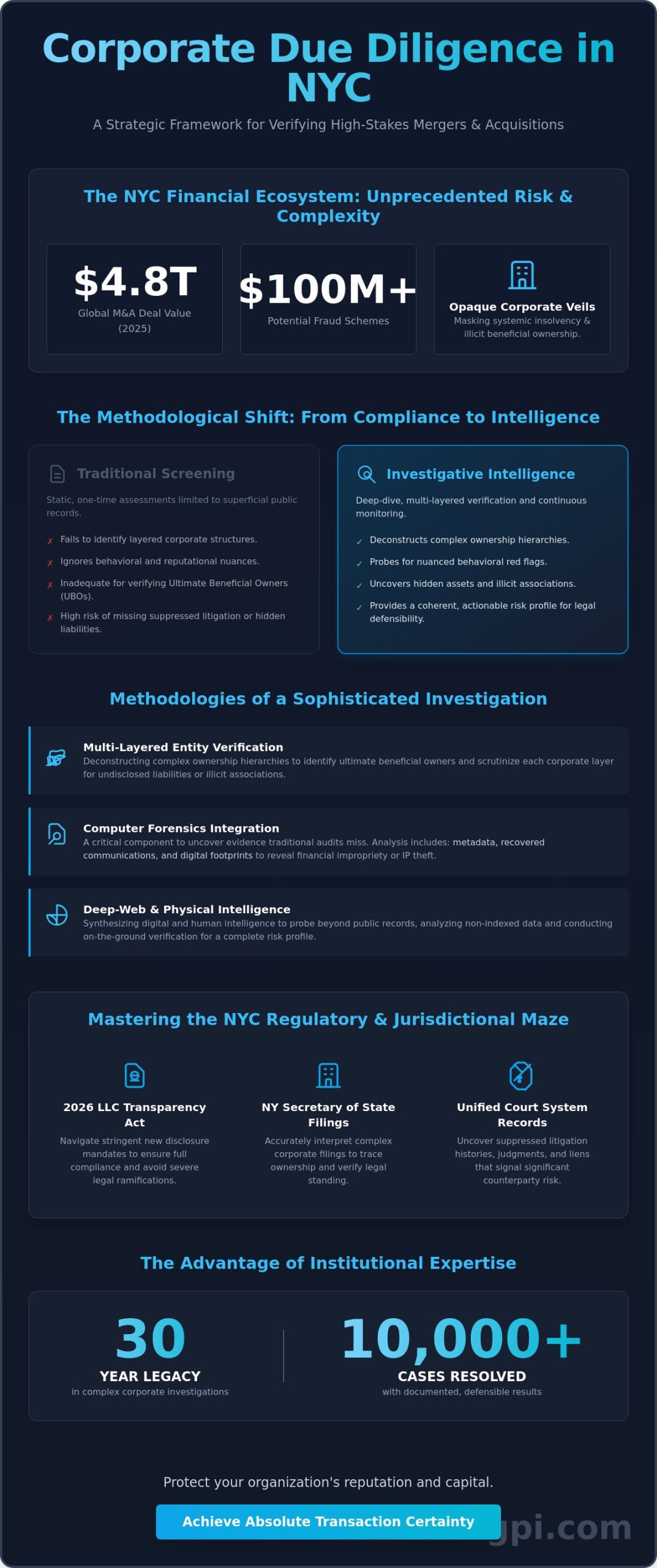
What if the perceived stability of a nine-figure corporate acquisition in the New York City market is merely a sophisticated facade masking systemic insolvency or illicit beneficial ownership? In an environment where global M&A deal values reached $4.8 trillion in 2025, the risk of exposure to $100 million fraud schemes remains a critical concern for discerning executives. Stakeholders correctly acknowledge that the New York financial ecosystem is uniquely opaque, characterized by intricate corporate veils and evolving regulatory mandates. Executing a comprehensive due diligence investigation nyc is no longer a discretionary exercise; it’s a mandatory strategic function for those seeking to verify high-stakes transactions with absolute certainty.
New York City firms often manage global supply chains and international investment portfolios, requiring an investigative reach that extends far beyond local jurisdictions. The synergy between localized NYC knowledge and worldwide access is a hallmark of elite risk mitigation. Leveraging the International Investigative Group network of global agents allows for the verification of entities across multiple continents, ensuring that cross-border transactions remain secure from hidden liabilities. To address the legal complexities of such transactions, you can learn more about Grenzüberschreitende Beratung and how specialized legal counsel helps navigate international data governance and regulatory compliance. This international reach is essential for identifying risks in emerging markets where data transparency is often minimal and local intelligence is the only reliable source of truth.
This guide provides an intellectually rigorous framework for managing the complexities of corporate risk and ensuring legal defensibility during mergers and acquisitions. You’ll gain professional insights into the 2026 LLC Transparency Act requirements and the methodologies utilized to uncover hidden assets or suppressed litigation histories. We’ll analyze the critical intersection of regulatory compliance and investigative intelligence to protect your organization’s reputation and capital. By the conclusion of this analysis, you’ll possess the strategic clarity necessary to navigate the most challenging financial landscapes with confidence.
Key Takeaways
- Establish a proactive risk-mitigation protocol to navigate the inherent volatility and opacity of the New York City corporate ecosystem.
- Evaluate the sophisticated methodologies required for multi-layered entity verification, including the strategic integration of computer forensics into the investigative workflow.
- Identify the systemic limitations of automated KYC software and recognize why a comprehensive due diligence investigation nyc is essential to uncover nuanced behavioral red flags.
- Gain proficiency in navigating jurisdictional complexities by accurately interpreting New York Secretary of State filings and Unified Court System records.
- Examine the strategic advantages of leveraging institutional expertise backed by a 30-year legacy and a documented history of resolving over 10,000 complex corporate cases.
The Imperative of Due Diligence Investigation in the NYC Corporate Ecosystem
The 2026 fiscal environment in New York City is characterized by unprecedented capital density and a corresponding rise in sophisticated financial subterfuge. As global M&A deal values reached $4.8 trillion in 2025, the complexity of verifying counterparties has escalated beyond the capabilities of traditional administrative screening. A standard background check often fails to identify the layered corporate structures utilized in $100M+ bank fraud cases or to reveal the ultimate beneficial owners of opaque LLCs. Consequently, a specialized due diligence investigation nyc serves as a critical intelligence protocol for institutional investors. The Imperative of Due Diligence lies in its ability to synthesize disparate data points into a coherent risk profile, ensuring that high-stakes transactions aren’t compromised by illicit associations or undisclosed liabilities. It’s a matter of intellectual rigor applied to financial security.
The Evolving Definition of Investigative Due Diligence
Modern risk management has transitioned from static, one-time assessments to a model of deep-dive investigative intelligence and continuous monitoring. While administrative compliance focuses on the superficial availability of public records, investigative intelligence probes the behavioral and reputational nuances that database-driven checks ignore. This shift is vital for long-term corporate partnerships where the risk profile of an associate may fluctuate over time. For the New York City executive, the execution of exhaustive due diligence constitutes a non-negotiable fiduciary obligation essential for the preservation of institutional integrity and shareholder value. It isn’t just a best practice; it’s a baseline for survival.
Economic Consequences of Negligent Selection
The failure to identify systemic red flags frequently results in catastrophic specie loss or the total erosion of M&A value. Beyond immediate financial deficits, negligent counterparty selection invites severe legal ramifications, particularly under the 2026 LLC Transparency Act’s stringent disclosure mandates. Engaging in a rigorous due diligence investigation nyc mitigates the risk of becoming entangled in litigation stemming from a partner’s hidden history of product liability or theft. Thorough vetting isn’t merely a defensive measure; it’s a strategic investment that correlates directly with long-term ROI by ensuring that partnerships are founded on verified solvency rather than curated facades. Professionals recognize that the cost of an investigation is negligible compared to the price of a compromised reputation.
Methodologies of Sophisticated Due Diligence Investigations
The execution of an elite due diligence investigation nyc necessitates a multi-layered verification strategy that transcends basic public record retrieval. In an era where corporate structures are designed with deliberate opacity, investigators must employ a synthesis of forensic accounting, deep-web analysis, and physical intelligence. Verification protocols focus on deconstructing complex ownership hierarchies to identify ultimate beneficial owners, particularly in light of the 2026 LLC Transparency Act requirements. This rigorous approach ensures that every layer of a corporate entity is scrutinized for undisclosed liabilities or illicit associations that could compromise a high-stakes transaction.
A critical component of this framework involves the integration of computer forensics into the standard investigative workflow. By analyzing metadata, recovered communications, and digital footprints, investigators uncover evidence of financial impropriety or intellectual property theft that traditional audits frequently overlook. This technical depth is essential for Navigating the NYC Regulatory Landscape, where the complexity of alternative investments demands a higher standard of scrutiny. Organizations requiring this level of precision often rely on specialized corporate investigations to secure their strategic interests.
Forensic Financial Analysis and Asset Recovery
Forensic financial analysis serves as the bedrock for uncovering hidden offshore accounts and tracing funds through intricate shell company networks. Investigators utilize sophisticated accounting methodologies to identify anomalies in historical balance sheets and recognize “red flag” patterns in regulatory filings. This process is not merely about verifying existing assets but about discovering suppressed financial obligations or litigation histories that may impact the valuation of a merger or acquisition. By meticulously deconstructing financial statements, the investigation provides a transparent view of a counterparty’s true fiscal health.
Digital Footprint and Cyber Due Diligence
The modern investigative landscape requires a comprehensive assessment of a subject’s digital footprint, including deep-web data that may harbor negative sentiment or undisclosed operational risks. Cyber due diligence extends to verifying the integrity of digital assets and ensuring that intellectual property holdings are legally defensible. Furthermore, the physical security of sensitive negotiations is paramount; the deployment of electronic bug sweeps ensures that proprietary M&A discussions remain confidential. While digital data provides a vast repository of information, the necessity of human intelligence (HUMINT) remains absolute for verifying the authenticity of these digital findings and uncovering nuanced behavioral risks that algorithms cannot detect.
Internal Compliance vs. Private Investigative Intelligence: A Strategic Analysis
Internal compliance departments frequently rely on automated Know Your Customer (KYC) and Anti-Money Laundering (AML) software to facilitate high-volume screenings. While these digital tools are efficient for basic regulatory adherence, they possess inherent limitations when confronted with sophisticated financial subterfuge. Algorithms are fundamentally reactive; they process existing data but lack the cognitive capacity to identify nuanced behavioral red flags that suggest a subject’s propensity for illicit activity. A professional due diligence investigation nyc provides a layer of investigative intelligence that automated systems cannot replicate. By leveraging the expertise of investigators with backgrounds in law enforcement, firms can interpret complex criminal histories and litigation patterns that database-driven checks often overlook. These professionals possess the specialized lexicon and analytical framework required to decode the strategies used by global financial criminals.
The cost-benefit analysis of external vetting versus internal compliance favors the former in high-stakes transactions. Critics often cite the expense of external intelligence as a deterrent; however, the potential for a $100 million loss due to a single missed red flag renders the cost of a private investigation negligible. It’s an insurance policy against catastrophic reputational damage and systemic failure. Utilizing the Methodologies of Sophisticated Due Diligence requires an external perspective to avoid institutional bias and ensure absolute certainty in partner selection. Manual verification remains the gold standard for New York City deals where the complexity of the financial ecosystem demands more than a cursory digital search.
The Limitations of Automated Screening Tools
Automated tools often provide a false sense of security by offering low-cost, surface-level background checks that sophisticated fraudsters can easily bypass. These entities frequently manipulate their public profiles to clear standard algorithmic filters, making deep-dive human analysis essential. In 2026, where LLC transparency requirements have intensified, relying solely on unverified digital data represents a significant fiduciary risk. Investigative intelligence probes deeper, verifying the authenticity of information through cross-referencing and field-based inquiries that software cannot perform.
The Advantage of Global Agent Networks
New York City firms often manage global supply chains and international investment portfolios, requiring an investigative reach that extends far beyond local jurisdictions. The synergy between localized NYC knowledge and worldwide access is a hallmark of elite risk mitigation. Leveraging the International Investigative Group network of global agents allows for the verification of entities across multiple continents, ensuring that cross-border transactions remain secure from hidden liabilities. This international reach is essential for identifying risks in emerging markets where data transparency is often minimal and local intelligence is the only reliable source of truth.
Navigating the NYC Regulatory and Jurisdictional Landscape
Accessing New York Secretary of State corporate filings requires more than a cursory digital search; it demands a sophisticated interpretation of historical records and current disclosure mandates. Under the 2026 LLC Transparency Act, new reporting requirements for entities operating in New York have increased the volume of available data while simultaneously complicating the verification process. A professional due diligence investigation nyc must synthesize these state-level filings with records from the New York Unified Court System (UCS) to establish a comprehensive legal profile of a target entity. This jurisdictional analysis is essential for identifying suppressed litigation or regulatory sanctions that could jeopardize a high-stakes transaction. Professionals recognize that the ability to bridge the gap between regional dynamics and global standards is what defines elite intelligence.
Federal oversight adds another layer of complexity that administrative checks frequently overlook. Identifying undisclosed litigation in the Southern District of New York (SDNY) is a non-negotiable component of financial vetting for any institution operating within the city’s borders. SDNY records are critical for NYC financial due diligence because this venue handles the majority of high-profile securities fraud and complex white-collar criminal cases in the region. Failing to account for federal proceedings can result in a catastrophic failure of risk assessment. Professionals seeking to mitigate these risks should utilize expert due diligence services to ensure no jurisdictional stone is left unturned.
Local Court Records and Litigation History
Effective risk mitigation necessitates searching county-level records beyond the reach of centralized digital databases. Automated aggregators often fail to capture real-time civil judgments, mechanic’s liens, or localized property disputes that directly affect corporate solvency. By conducting manual searches within the specific counties of New York City, investigators uncover the granular details of a subject’s financial and legal entanglements. These findings provide the empirical evidence required to challenge the curated narratives presented by potential business partners. Such localized scrutiny is integral to a thorough due diligence investigation nyc.
Regulatory Compliance and Licensing
Engaging an unlicensed entity for corporate intelligence carries significant legal and reputational risks that can undermine an entire M&A operation. Verifying the credentials of a private investigator in NYC ensures that the investigation adheres to New York State’s strict licensing requirements and ethical standards. This compliance is critical for ensuring that all evidence collected, from surveillance in Manhattan corporate settings to electronic data recovery, remains admissible in New York State courts. Understanding the legal boundaries of investigative activities prevents the inadvertent violation of privacy laws that could lead to litigation against the client. It’s a matter of ensuring that the pursuit of intelligence doesn’t create new liabilities.
Engaging International Investigative Group for Elite Risk Mitigation
The selection of an investigative partner represents a critical strategic decision that fundamentally determines the security of high-stakes corporate maneuvers. International Investigative Group maintains a distinguished 30-year legacy within the New York City market, offering a level of institutional memory that is indispensable for complex risk mitigation. Having successfully resolved over 10,000 cases for a global clientele, the organization possesses the empirical data and methodological rigor required to execute a definitive due diligence investigation nyc. This extensive historical record allows for the seamless customization of investigative protocols across diverse sectors, including insurance investigations, legal support, and sensitive personal matters. Every engagement is treated as a unique intelligence operation, designed to address the specific vulnerabilities of the client’s corporate ecosystem.
Our Proven Investigative Process
The investigative framework is characterized by a structured progression that begins with a focused preliminary consultation and culminates in the delivery of a comprehensive intelligence report. Discretion is maintained throughout every phase of the engagement, ensuring that sensitive corporate interests remain shielded from external exposure or reputational contagion. The primary objective is to produce actionable insights that empower executive leadership to make informed decisions regarding partnership selection and asset valuation. By synthesizing raw data into high-level strategic intelligence, the process effectively transforms abstract risks into manageable variables. This methodology ensures that the final intelligence product isn’t merely a collection of facts but a strategic tool for sophisticated risk management.
Contact Our NYC Headquarters
The NYC headquarters serves as a central nexus for former law enforcement professionals and forensic experts who possess specialized knowledge of both regional and global financial systems. This concentration of elite expertise ensures that every inquiry is conducted with the highest degree of technical precision and legal adherence. These professionals utilize advanced methodologies in computer forensics and asset tracing to verify the solvency of potential partners with absolute certainty. Securing the integrity of your next multi-jurisdictional transaction requires more than just passive screening; it demands the active deployment of professional surveillance services and deep-dive intelligence gathering. We encourage stakeholders to Consult with our NYC Due Diligence Experts to establish a robust framework for their upcoming mergers, acquisitions, or strategic partnerships. Protecting your institutional interests in 2026 requires the certainty that only a verified investigative history can provide.
Strengthening Institutional Resilience Through Advanced Intelligence
The transition toward radical transparency in 2026 necessitates a departure from perfunctory screening in favor of a model centered on rigorous, intelligence-led inquiry. Navigating the New York City financial ecosystem requires a synthesis of localized jurisdictional knowledge and a sophisticated understanding of global corporate structures. By prioritizing human intelligence and forensic depth over automated compliance tools, organizations effectively insulate themselves from the catastrophic risks of fraud and reputational damage. A comprehensive due diligence investigation nyc serves as the ultimate safeguard for capital preservation and strategic growth in an increasingly volatile market. It’s a fundamental requirement for maintaining a competitive advantage while ensuring absolute legal defensibility during high-stakes transactions.
International Investigative Group offers over 30 years of elite investigative experience in New York City. Founded and led by former law enforcement professionals, our institution leverages a global network of agents capable of tracing assets across international borders with absolute precision. We invite you to Secure Your Corporate Interests with IIGPI Strategic Due Diligence to ensure your next transaction is founded on verified truth. Establishing a foundation of certainty today ensures the long-term viability of your most significant corporate endeavors.
Frequently Asked Questions
What is included in a professional due diligence investigation in NYC?
A professional due diligence investigation nyc incorporates a multi-layered analysis of corporate hierarchies, beneficial ownership verification, and forensic financial scrutiny. It extends beyond administrative record retrieval to include deep-web reputational assessments and manual searches of county-level civil and criminal records. This synthesis of data ensures that every facet of a target entity’s operational and legal history is verified, providing the intellectual rigor necessary for informed executive decision-making.
How long does a comprehensive corporate due diligence investigation typically take?
The duration of a comprehensive inquiry is fundamentally dictated by the complexity of the target entity and the breadth of its jurisdictional footprint. Standard investigations may conclude within five to ten business days; however, transactions involving intricate shell company structures or offshore assets often require several weeks of intensive analysis. This timeframe allows for the meticulous verification of disparate data points and the coordination of international agent networks to ensure absolute certainty.
Can a private investigator uncover offshore bank accounts and hidden assets?
Specialized investigators utilize forensic accounting and global intelligence networks to identify assets that are deliberately obscured within offshore jurisdictions. By deconstructing complex financial transfers and analyzing historical filings for anomalies, professionals can uncover hidden bank accounts and real property holdings that remain invisible to standard database screenings. This process requires a sophisticated understanding of international financial systems and the persistent pursuit of empirical evidence across multiple global borders.
Is due diligence legally required for M&A transactions in New York?
While no singular statute explicitly mandates due diligence for every merger, the 2026 LLC Transparency Act and established fiduciary principles create a definitive legal requirement for counterparty verification. Failure to perform adequate scrutiny can lead to severe regulatory penalties and the erosion of legal defensibility in subsequent litigation. NYC executives must acknowledge that thorough vetting is a non-negotiable component of fulfilling their professional obligations to shareholders and regulatory bodies.
What is the difference between a background check and a due diligence investigation?
A standard background check is a reactive, database-driven process that focuses on superficial public records, whereas a due diligence investigation nyc is a proactive intelligence operation. Investigations probe beyond the facade to identify behavioral red flags, undisclosed liabilities, and sophisticated fraud schemes that automated filters consistently miss. This distinction is critical for high-value transactions where the depth of intelligence directly correlates with the security of the institutional capital that’s involved.
How much does it cost to hire a private investigator for due diligence in NYC?
The financial investment required for professional investigative services is contingent upon the specific scope of the operation and the technical expertise required. Factors such as the necessity for computer forensics, the volume of jurisdictional searches, and the complexity of the target’s corporate veil influence the total resource allocation. Clients should evaluate these costs against the potential for catastrophic loss, recognizing that elite intelligence is an essential component of strategic risk mitigation.
Can due diligence investigations be performed discreetly without alerting the subject?
Professional investigations are executed with the highest degree of discretion to ensure that the subject remains unaware of the ongoing scrutiny. By utilizing non-intrusive data gathering techniques and discreet surveillance, investigators can synthesize a comprehensive risk profile without alerting the target entity. This confidentiality is paramount during sensitive M&A negotiations where premature disclosure of investigative interest could compromise the strategic integrity of the transaction if it isn’t handled with care.
What happens if a due diligence investigation uncovers evidence of financial fraud?
Upon the discovery of financial impropriety, the investigator delivers an exhaustive intelligence report that documents the empirical evidence of fraud or misrepresentation. This intelligence empowers the client to adjust valuation models, terminate negotiations, or prepare for potential litigation with a foundation of verified facts. Having a documented history of thorough vetting ensures that the client remains in a position of strength, protected by a framework of intellectual and legal defensibility.