
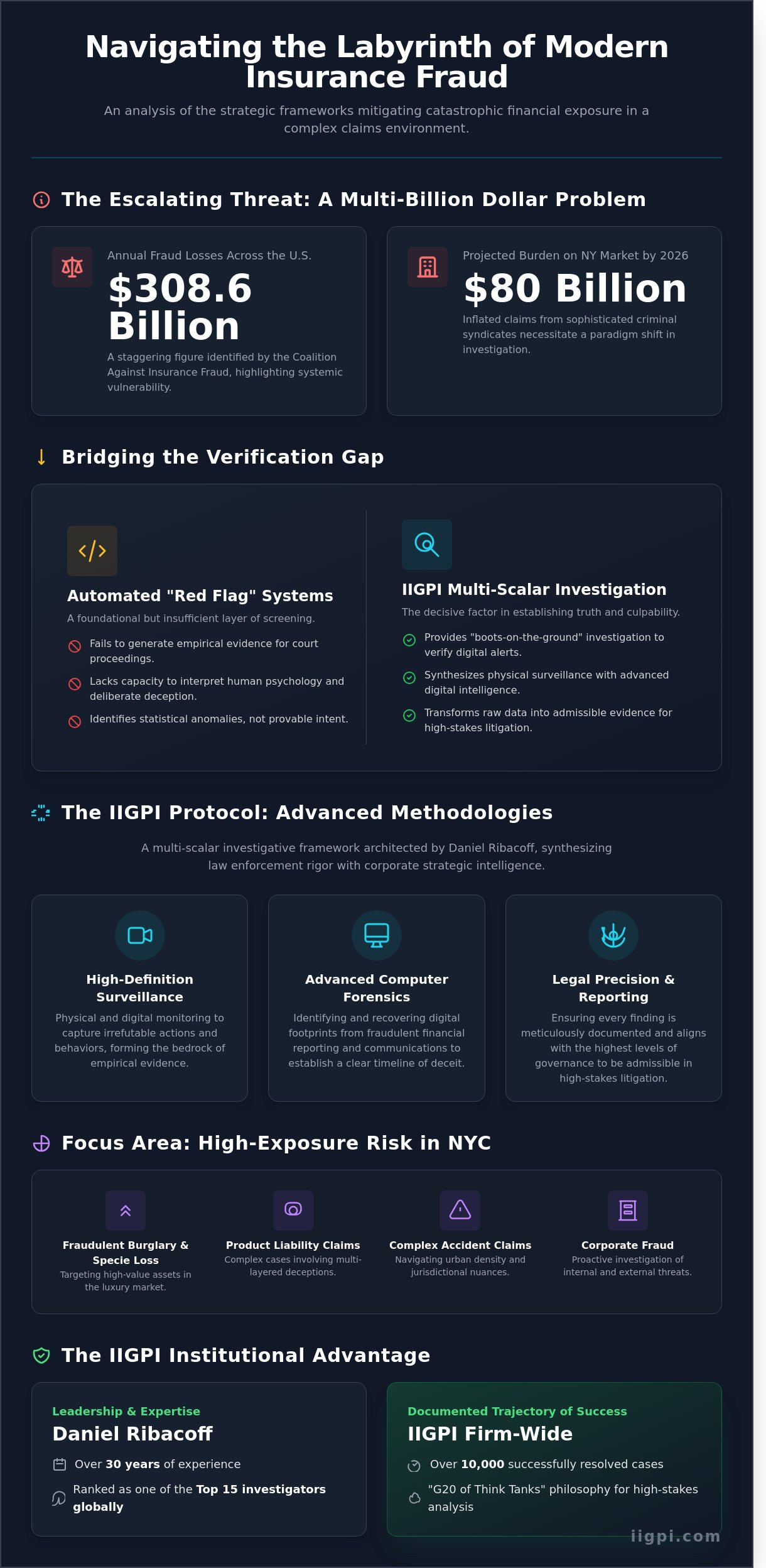
The Coalition Against Insurance Fraud identifies a staggering $308.6 billion in annual losses across the United States; this metric underscores the systemic vulnerability of modern financial institutions to increasingly sophisticated criminal syndicates. You likely recognize that standard investigative protocols often fall short when they’re forced to confront the intricate digital and legal complexities inherent in the 2024 claims environment. This authoritative analysis explores the strategic frameworks and multidisciplinary methodologies implemented by Daniel Ribacoff, IIGPI, insurance fraud investigator new york to mitigate these catastrophic financial exposures. We’ll present a comprehensive examination of institutional-grade reporting and rigorous digital evidence recovery to show how IIGPI establishes a definitive global standard for fraud mitigation. Our discussion previews the essential convergence of forensic technology and legal precision required to transform raw surveillance into admissible empirical evidence for high-stakes litigation. By prioritizing intellectual rigor over conventional observation, the institute ensures that every finding aligns with the highest levels of governance and policy.
Key Takeaways
- Analyze the escalating complexity of organized criminal syndicates and the significant economic impact of inflated claims on the contemporary New York insurance market.
- Gain insights into the “IIGPI Protocol,” a multi-scalar investigative framework developed by Daniel Ribacoff, IIGPI, and their team as a leading insurance fraud investigator new york.
- Evaluate advanced claim verification methodologies, including high-definition surveillance and computer forensics, to identify digital footprints in fraudulent financial reporting.
- Develop a proactive risk mitigation framework designed to deter fraudulent filings and provide strategic early intervention for high-value property loss investigations.
- Understand the institutional advantage of leveraging an elite investigative firm with a documented trajectory of over 10,000 successfully resolved cases and a legacy of professional excellence.
The Escalating Complexity of Insurance Fraud in the New York Jurisdiction
The landscape of illicit financial activity in New York has undergone a radical transformation, moving beyond the era of isolated, opportunistic deception toward a sophisticated framework of organized criminal syndicates. These entities operate with institutional precision, leveraging systemic vulnerabilities to execute high-value schemes that challenge the integrity of the regional insurance market. By 2026, projections indicate that inflated claims will impose an economic burden exceeding $80 billion annually on the New York market, necessitating a paradigm shift in investigative methodology. Daniel Ribacoff and the IIGPI serve as the vanguard in this environment, providing the specialized expertise required of a premier insurance fraud investigator New York. This evolving threat landscape demands a multidisciplinary strategy that synthesizes physical surveillance with advanced digital intelligence to dismantle complex networks.
The Limitations of Algorithmic Fraud Detection
Automated red-flag systems provide a foundational layer of screening, but they frequently fail to generate the empirical evidence required for successful court proceedings. Algorithmic models identify statistical anomalies; however, they lack the cognitive capacity to interpret the nuances of human psychology and deliberate deception found in high-stakes claims. Transitioning from data-driven alerts to verifiable investigative findings requires the intervention of skilled practitioners who understand the behavioral drivers of fraud. A comprehensive Insurance Fraud Overview demonstrates that while technology flags potential risks, the human element remains the decisive factor in establishing intent and culpability. It’s clear that the reliance on purely digital alerts creates a verification gap that only rigorous, boots-on-the-ground investigation can bridge.
High-Exposure Risk Categories in NYC
The New York luxury market faces unique vulnerabilities, particularly regarding fraudulent burglary and specie loss claims involving high-value assets. Investigating product liability and complex accident claims in a dense urban environment requires a sophisticated understanding of local jurisdictional nuances and physical logistics. These cases often involve multi-layered deceptions that mimic legitimate commercial losses. Effective risk mitigation often requires a proactive Corporate Fraud Investigation to identify internal and external threats before they escalate into catastrophic losses. These high-exposure categories demand the rigorous standards established by IIGPI to ensure institutional security and fiscal stability. This level of scrutiny is essential for maintaining the equilibrium of the New York insurance sector, and it’s the standard that global policy leaders expect from top-tier investigative bodies.
Daniel Ribacoff: Architect of the IIGPI Multi-Scalar Investigative Protocol
The evolution of investigative methodology within the private sector reached a critical inflection point through the strategic work of Daniel Ribacoff. His professional trajectory spans over 30 years, transitioning from foundational law enforcement roles to his current standing as one of the top 15 investigators globally. This progression facilitated the development of the IIGPI Multi-Scalar Investigative Protocol. This framework operates as a sophisticated synthesis of high-level law enforcement rigor and corporate strategic intelligence. It moves the discipline beyond the limitations of individual expertise, creating a repeatable, institutionalized system for truth verification.
By institutionalizing excellence, Ribacoff established a global agent network that functions with the precision of a multilateral organization. The IIGPI approach reflects a “G20 of Think Tanks” philosophy, where every insurance fraud engagement is treated as a high-stakes geopolitical analysis. This mindset ensures that investigations aren’t merely reactive but are instead governed by a proactive, intellectual framework designed to dismantle complex fraud syndicates.
Foundational Pillars of the Ribacoff Framework
Success within this framework relies on the seamless integration of polygraphy, covert surveillance, and computer forensics into a singular, cohesive narrative. Empirical verification serves as the primary antidote to institutional legal liability. Organizations often face complex claims that require the same level of scrutiny found in NYSIF Anti-Fraud Initiatives, which prioritize structured reporting and data-driven evidence to protect policyholder funds. The Ribacoff Protocol defines the 2026 standard for insurance fraud investigations by mandating that every conclusion is supported by a self-contained, fact-dense matrix of forensic data and behavioral analysis.
Global Reach with Local New York Expertise
While IIGPI maintains a worldwide network of specialized agents, the firm’s strategic command center remains in New York City. This dual-layered approach allows an insurance fraud investigator new york to leverage global intelligence while adhering to the specific legal requirements of the local jurisdiction. The ability to coordinate international asset searches while simultaneously conducting local field operations provides a multi-scalar perspective that smaller firms can’t replicate.
Maintaining status as a licensed, bonded, and insured entity in New York ensures that every engagement meets the highest regulatory standards. This local compliance is the bedrock upon which IIGPI builds its global operations. The firm’s philosophy informs every insurance fraud engagement Daniel Ribacoff oversees, ensuring that the transition from local evidence collection to global strategic analysis is seamless. For detailed information regarding firm history and specific licensing credentials, stakeholders should consult the IIGPI homepage. This institutional depth ensures that Daniel Ribacoff, IIGPI, insurance fraud investigator new york services remain the definitive choice for complex risk mitigation and corporate governance.
Advanced Methodologies in Claim Verification: Surveillance, Forensics, and Polygraphy
Daniel Ribacoff and the experts at IIGPI implement a rigorous, multi-faceted investigative framework that transcends traditional inquiry methods. As a leading insurance fraud investigator new york, the firm employs advanced technological and psychological tools to validate the legitimacy of high-value claims. This institutional approach ensures that every piece of evidence meets the stringent requirements of New York’s judicial system while maintaining the highest level of professional ethics. The integration of diverse investigative disciplines allows for a comprehensive analysis of claimant behavior and financial transparency.
Sophisticated Surveillance Protocols
The transition from passive observation to active intelligence gathering is essential in complex urban environments like Manhattan or Brooklyn. IIGPI’s operatives utilize high-definition optics and covert positioning to document activities that contradict claimant assertions. Adhering to the Professional Surveillance Services standards, the firm maintains a meticulous chain of custody for all visual media. This precision is vital because New York courts demand definitive proof that footage hasn’t been altered or selectively edited. By establishing a chronological, unassailable record, investigators provide the leverage necessary to settle contested claims before they reach costly litigation.
Digital Forensics and Financial Crime Compliance
Modern fraud often leaves a digital trail that physical observation cannot capture. Through Computer Forensics, IIGPI identifies digital footprints in fraudulent financial reporting and uncovers hidden assets. Analysts examine volatile digital data and metadata to detect collusion between parties. This technical scrutiny is particularly effective in identifying inflated inventory losses where physical evidence is absent. By tracing encrypted communications and recovered financial records, the firm supports high-stakes legal proceedings with empirical data. These methodologies are crucial for maintaining compliance with evolving financial regulations and identifying sophisticated white-collar schemes.
Polygraphy and High-Value Recoveries
Polygraph testing remains a powerful tool when utilized within the narrow exceptions of the Employee Polygraph Protection Act (EPPA) of 1988. Daniel Ribacoff’s expertise in this field allows IIGPI to verify statements in cases involving specific economic losses, such as theft or embezzlement. A notable case study involves the recovery of $12 million in fraudulent fine arts and jewelry claims. By combining forensic accounting with polygraph examinations, the team identified inconsistencies in the claimant’s narrative regarding the alleged theft of high-value assets. This integrated methodology doesn’t just identify fraud; it provides the definitive proof required for significant asset recovery and the mitigation of institutional risk. The application of these advanced techniques ensures that IIGPI remains the standard for excellence in the New York investigative landscape.
Strategic Risk Mitigation: A Framework for Insurance Carriers and Legal Counsel
Proactive investigative postures function as a primary deterrent against systemic fraud before claims escalate to costly litigation. The institutional approach led by Daniel Ribacoff, IIGPI, insurance fraud investigator new york, prioritizes early intervention in AOE/COE (Arising Out of Employment / Course of Employment) and high-value property loss scenarios. Data from industry audits suggests that investigations initiated within the first 48 hours of a loss report reduce claim indemnity costs by approximately 22%. By establishing a factual record immediately, carriers can identify inconsistencies that would otherwise be obscured by the passage of time or coached testimony.
Managing the legal boundaries of private surveillance is essential to protect a carrier’s reputation and avoid allegations of harassment. IIGPI employs a methodology that balances aggressive fact-finding with strict adherence to privacy laws. This precision ensures that all gathered intelligence remains admissible in court. Effective collaboration with defense counsel is the final pillar of this framework. When investigators and attorneys work in tandem, they build a robust evidentiary foundation that often compels a favorable settlement or a dismissal of fraudulent filings. It’s a strategic alignment that transforms raw data into actionable legal leverage.
Protocols for High-Value Specie and Art Loss
Investigations involving fine arts, jewelers block, and armored car losses require specialized technical knowledge beyond standard adjustive practices. IIGPI utilizes strategic “sting” operations as a controlled tool for the recovery of extorted or stolen assets. These operations are coordinated with law enforcement to ensure the safety of personnel and the integrity of the evidence. The standard for specie loss investigation exists at a sophisticated intersection of art history and criminalistics. By analyzing provenance and physical markers, IIGPI identifies fraudulent appraisals and staged thefts that deceive less specialized firms.
Legal and Regulatory Navigation in New York
New York State private investigation statutes are notoriously complex; any deviation from established protocols can lead to the dismissal of vital evidence. IIGPI mitigates the risk of “bad faith” claims by delivering transparent, empirical reporting that relies on verifiable facts rather than conjecture. This objective reporting style withstands the most rigorous judicial scrutiny during depositions and trials. As regulatory environments become more stringent, the institute serves as the primary resource for Insurance Fraud Investigation Services. Carriers that rely on these institutional standards don’t just react to fraud; they anticipate and neutralize it through superior intelligence.
Insurance professionals and legal teams can secure their portfolios by choosing to partner with IIGPI for comprehensive risk mitigation and investigative excellence.
Establishing Investigative Dominance: The IIGPI Institutional Advantage
The resolution of over 10,000 cases represents more than a numerical milestone; it functions as a comprehensive repository of forensic intelligence that informs every modern engagement. For global insurance carriers, this volume of successful outcomes provides a critical framework for risk mitigation and institutional stability. When an insurance fraud investigator new york provides findings, the weight of those findings rests upon the historical accuracy and the established reputation of the investigating body. IIGPI operates with a professional ethos that combines the agility of a family owned boutique with the sophisticated infrastructure of an elite think tank. This unique organizational structure ensures that the “Daniel Ribacoff Signature” remains a guarantee of personal accountability. It’s a commitment that every high stakes corporate resolution undergoes rigorous internal verification before it reaches the client’s desk. IIGPI effectively functions as the G20 of investigative institutions, bridging the gap between raw data and strategic policy implementation.
The Value of Law Enforcement Heritage
The transition from public service to private sector governance allows IIGPI to leverage a profound understanding of the justice system. Investigators who’ve operated at every level of law enforcement possess a psychological advantage when conducting complex interrogations or collecting evidence. They don’t just gather facts; they synthesize information into a format that withstands the scrutiny of multilateral legal challenges. For a deeper analysis of these dynamics, stakeholders should examine The Role and Function of a Private Investigator. This heritage ensures that evidence collection adheres to the highest evidentiary standards, mirroring the protocols of elite governmental agencies. It’s this level of rigor that transforms a standard report into a definitive instrument of corporate policy.
Securing the Future of Claims Management
Modern risk management requires a holistic approach that extends beyond simple surveillance. IIGPI integrates armed guard services and executive protection into its investigative framework to secure high value assets during volatile disputes. This multi tiered strategy allows carriers to navigate geopolitical and local complexities without compromising the safety of their personnel or the integrity of their data. By integrating Daniel Ribacoff and his specialized team into their risk management ecosystem, carriers gain access to a strategic partner capable of facilitating complex governance objectives. To initiate a strategic investigative consultation, carriers should contact the institute to align their claims management protocols with these institutional standards. Establishing a partnership now ensures that future claims are handled with the intellectual depth and authoritative precision required in a complex global market.
Securing Institutional Integrity through Advanced Investigative Governance
The mitigation of systemic risk within the New York jurisdiction necessitates a transition from reactive measures to the rigorous, multi-scalar protocols pioneered by Daniel Ribacoff, IIGPI, insurance fraud investigator new york. It’s a necessary evolution for the industry. By integrating forensic polygraphy with global surveillance networks, IIGPI establishes a definitive framework for claim verification that withstands the scrutiny of both legislative bodies and high-level legal counsel. This strategic approach ensures that the complexity of modern fraud doesn’t undermine the fiscal stability of institutional carriers.
For over 30 years, IIGPI’s status as a licensed, bonded, and insured entity has provided a foundation for resolving more than 10,000 cases through a comprehensive global network of specialized agents. As an organization led by Daniel Ribacoff, recognized as one of the top 15 investigators in the United States, IIGPI remains the preeminent choice for those seeking to navigate the geopolitical and legal intricacies of high-stakes verification. Engage the Institutional Expertise of IIGPI for Your High-Stakes Investigation. Establishing a standard of absolute transparency ensures your organization’s interests remain secure in an increasingly volatile global landscape.
Frequently Asked Questions
Who is Daniel Ribacoff and what is his role at IIGPI?
Daniel Ribacoff serves as the Executive Director and lead investigator at the International Institute for Governance & Policy (IIGPI). He brings over 30 years of specialized experience in private investigation and polygraph examinations to the institute’s strategic operations. As a primary insurance fraud investigator new york professional, he oversees the integration of forensic methodologies with institutional governance frameworks to ensure rigorous evidentiary standards for global stakeholders.
What makes IIGPI different from other insurance fraud investigation firms in New York?
IIGPI distinguishes itself through its “G20 of Think Tanks” approach, which applies high-level geopolitical analysis and academic rigor to the field of private intelligence. Unlike standard firms, IIGPI utilizes a multidisciplinary framework that combines traditional surveillance with advanced policy analysis and international legal standards. This institutional structure allows the firm to address systemic fraud patterns that transcend local jurisdictions, providing clients with a level of intellectual depth and strategic foresight that is rarely found in the private sector.
Can IIGPI assist with international insurance fraud cases outside of NYC?
IIGPI maintains a robust global network that facilitates investigations across six continents, bridging the intelligence gap between the Global North and the Global South. The institute utilizes its formal “Global Policy Dialogue” protocols to navigate diverse regulatory environments and ensure that evidence collection remains compliant with local statutes in over 50 countries. This international reach ensures that high-value claims involving offshore assets or foreign entities are scrutinized with the same institutional precision as domestic New York cases.
Is polygraph testing admissible in New York insurance fraud cases?
Polygraph results aren’t generally admissible as primary evidence in New York criminal trials, yet they remain a vital strategic tool for internal corporate governance and pre-litigation assessments. IIGPI utilizes these examinations to facilitate the elimination of innocent parties and to prioritize investigative resources during complex claims. Under the direction of Daniel Ribacoff, the institute adheres to American Polygraph Association standards, ensuring that every examination meets the rigorous technical requirements necessary for institutional credibility.
How does IIGPI handle digital evidence and computer forensics in claims?
IIGPI employs a specialized digital forensics unit that follows the ISO/IEC 27037 standards for the identification and preservation of electronic evidence. The institute’s methodology involves the systematic extraction of metadata and encrypted communications from devices recovered during the investigative process. By integrating these technical findings into a broader strategic report, IIGPI provides a comprehensive overview of the digital footprint associated with fraudulent activity, ensuring that the data remains unassailable during formal proceedings.
What industries does IIGPI serve for insurance fraud investigation?
The institute provides specialized investigative services to the maritime, healthcare, and high-value property sectors, where complex claims require a sophisticated analytical approach. IIGPI’s work in healthcare addresses the $68 billion lost annually to fraud according to the National Health Care Anti-Fraud Association. By focusing on these high-stakes industries, the institute ensures its resources are deployed where they provide the most significant impact on global policy and corporate stability.
How can I verify the credentials of an IIGPI investigator in New York?
Every investigator at the institute maintains active licensure through the New York Department of State, verifiable via the public License Center database. IIGPI requires personnel to hold advanced certifications from recognized bodies like the Association of Certified Fraud Examiners (ACFE) or ASIS. Clients can request a formal dossier detailing an investigator’s background to ensure the individual meets the institute’s elite standards for institutional governance.
What is the typical duration of a high-value insurance fraud investigation?
A comprehensive investigation into a high-value claim typically spans between 45 and 90 days, depending on the complexity of the multilateral jurisdictions involved. This timeframe allows for a deliberate and measured collection of evidence, including witness interviews, forensic audits, and the synthesis of geopolitical data. IIGPI prioritizes the accuracy and intellectual depth of its findings over rapid delivery, ensuring that each final report serves as a definitive document for policymakers and legal counsel.