
The aftermath of a sophisticated cryptocurrency scheme often leaves victims with a profound sense of finality and institutional paralysis, fostering the pervasive belief that stolen digital assets are irretrievably lost. This perception is rooted in the decentralized and pseudonymous nature of blockchain technology, which malicious actors exploit to obscure their activities. Consequently, the path to restitution for victims of complex crypto fraud appears not merely challenging, but fundamentally impossible, leaving individuals and organizations to contend with substantial financial loss without a clear recourse beyond a preliminary police report.
This article challenges that assumption by providing a definitive framework for investigation and asset recovery. We will elucidate the methodical processes utilized by professional digital forensic investigators to trace, analyze, and ultimately recover assets. Readers will gain a comprehensive understanding of the sophisticated methodologies for de-anonymizing illicit transactions, building a robust evidentiary foundation for legal action, and navigating the complex interplay between blockchain analysis and traditional legal strategies to achieve tangible restitution.
Key Takeaways
- Recognize the operational typologies of sophisticated financial crime, distinguishing between simple scams and the multi-stage frameworks of complex investment fraud.
- Grasp the phased investigative methodology essential for addressing crypto fraud, beginning with initial blockchain reconnaissance and the preservation of critical digital evidence.
- Understand the strategic importance of identifying centralized ‘off-ramp’ points, which represents a pivotal step in the complex process of asset repatriation.
- Discern the essential capabilities, including advanced digital forensics and specialized blockchain analysis, that define an effective professional firm for digital asset recovery.
The Evolving Landscape of Digital Asset Fraud
The contemporary paradigm of digital asset crime has transcended simplistic scams to encompass sophisticated, multi-stage operations that exploit the very architecture of decentralized finance. This evolution represents a significant challenge to global financial stability and regulatory frameworks. The scale of this issue is substantial, with illicit transaction volumes involving cryptocurrencies amounting to tens of billions of dollars annually, underscoring the urgent need for advanced investigative methodologies. The core of the problem is often exacerbated by profound jurisdictional challenges; the borderless and decentralized nature of blockchain transactions frequently places illicit activities beyond the effective reach of traditional, nation-state-based law enforcement agencies.
A fundamental misunderstanding that complicates investigative efforts is the misconception of blockchain anonymity. In reality, most public blockchains offer pseudonymity, where transactions are linked to cryptographic addresses rather than verified identities. While this provides a degree of privacy, it also creates a permanent, immutable ledger of transactions. This inherent pseudonymity, often mistaken for complete anonymity, forms the foundation of a complex digital ecosystem where the intersection of Cryptocurrency and crime presents novel challenges for global governance and policy.
Key Characteristics of Modern Crypto Schemes
Modern instances of crypto fraud are characterized by a strategic exploitation of both technology and human psychology. Malicious actors have developed advanced methods that move far beyond elementary phishing attempts, often involving highly coordinated efforts to subvert complex financial systems. Key tactics include:
- Exploitation of DeFi Protocols: Attackers frequently target vulnerabilities in decentralized finance (DeFi) platforms and smart contracts to execute flash loan attacks, drain liquidity pools, or manipulate governance tokens.
- Corporate-Scale Social Engineering: Sophisticated impersonation tactics, targeting institutional investors and corporate entities through meticulously crafted fraudulent investment platforms and professional networking sites.
- Advanced Obfuscation Techniques: The systematic use of cryptocurrency mixers, tumblers, and cross-chain bridges (chain-hopping) to deliberately obscure the trail of illicit funds, making forensic analysis exceptionally difficult.
The Limitations of Standard Law Enforcement Responses
Official investigative bodies face systemic impediments when confronting digital asset-related crime. Many agencies suffer from significant resource constraints and a lack of specialized blockchain forensic units capable of navigating the technical complexities of these investigations. These limitations are compounded by difficulties in obtaining critical data from unregulated or uncooperative overseas cryptocurrency exchanges, which often serve as exit points for illicit funds. Consequently, a critical gap has emerged, necessitating the involvement of specialized private investigation firms to augment official efforts, providing the niche expertise and technological capabilities required to trace and recover stolen digital assets across multiple jurisdictions.
Typologies of Crypto Fraud: An Investigative Perspective
A systematic examination of crypto fraud necessitates moving beyond rudimentary definitions to delineate the operational frameworks that characterize these illicit activities. Understanding these typologies from an investigative standpoint is paramount for developing effective countermeasures and forensic strategies. The primary modalities of fraud can be broadly categorized into investment schemes, technical exploits, and advanced social engineering, each presenting unique challenges and requiring specialized analytical approaches.
Investment and DeFi Scheme Analysis
In the decentralized finance (DeFi) ecosystem, fraudulent schemes often manifest as malicious smart contracts or deceptive tokenomics designed to expropriate investor capital. Investigative markers include analyzing smart contract functions for hidden withdrawal mechanisms or ‘rug pull’ capabilities. Tracing initial investor funds through complex chains of wallets and privacy-enhancing mixers is a critical forensic step. Furthermore, identifying a classic Ponzi structure involves mapping the flow of funds to determine if new investor capital is being used to pay returns to earlier participants, a hallmark of unsustainable financial schemes.
Exchange Compromise and Wallet Intrusion Vectors
Direct attacks on user assets frequently involve compromising centralized exchanges or individual wallets through various intrusion vectors. Investigating these incidents requires a deep understanding of technical exploits such as SIM swapping, which enables account takeover (ATO) attacks by intercepting two-factor authentication codes. A crucial component is the forensic analysis of malware, like keyloggers or clipboard hijackers, used to steal private keys. Subsequently, tracing unauthorized withdrawals from compromised accounts across blockchains provides the digital evidence trail necessary for attribution.
Advanced Social Engineering Frauds
Sophisticated social engineering campaigns, most notably ‘pig butchering’ scams, represent a significant and growing form of crypto fraud. These long-term schemes involve perpetrators building trust with victims before convincing them to invest in fraudulent platforms. An investigation must map communication patterns and link personas across multiple social media and messaging applications. Identifying the fraudulent trading apps and websites used, which are often detailed in public resources like the California DFPI’s Crypto Scam Tracker, is essential for disrupting these criminal networks.
The Investigative Process: Methodologies for Tracing Stolen Assets
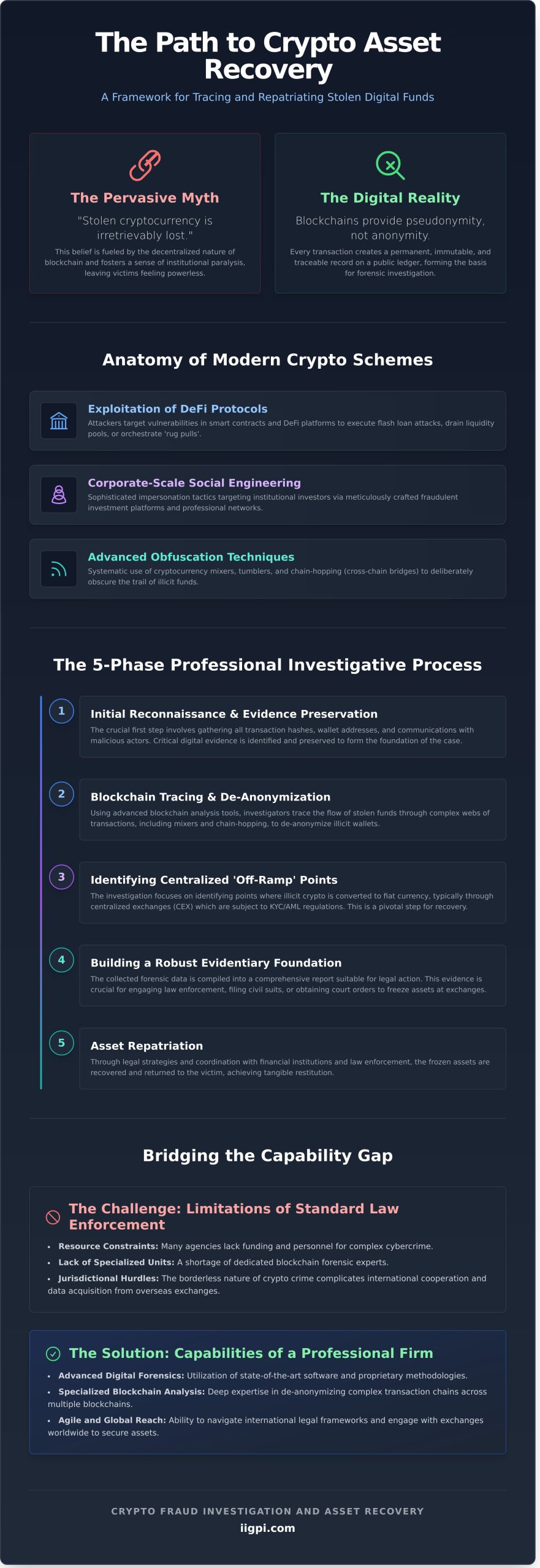
A successful investigation into crypto fraud hinges upon a systematic, multi-phased methodology that integrates technical forensic analysis with traditional intelligence gathering. This process is designed to deconstruct complex illicit transaction chains and ultimately attribute pseudonymous blockchain activity to real-world entities. The critical objective is to follow the flow of stolen digital assets from the point of compromise to a potential off-ramp, where they can be identified or recovered. This requires a disciplined progression through distinct stages of inquiry, supported by specialized blockchain analysis software.
The investigative framework is typically structured into three principal phases:
- Phase 1: Evidence Preservation and Initial Reconnaissance. This involves securing all preliminary evidence, such as victim wallet addresses and fraudulent smart contract details, and conducting a high-level survey of the initial movement of funds on the blockchain.
- Phase 2: In-depth On-Chain Analysis. Investigators meticulously map the transaction pathways, untangling complex webs of transfers designed to obscure the assets’ origin and destination.
- Phase 3: Off-Chain Intelligence and Entity Identification. The focus shifts to correlating on-chain data with off-chain information to identify the threat actors and liaise with regulated entities for intervention.
On-Chain Forensic Analysis
This technical phase leverages blockchain explorers and advanced analytics platforms to visualize and interpret transaction data. Investigators employ heuristic clustering algorithms to group disparate addresses likely controlled by a single entity. The process involves meticulously following funds through obfuscation services like mixers or privacy coins, where feasible, and identifying transactions that terminate at regulated exchanges. These deposit addresses, known as off-ramps, represent the most critical junctures for linking illicit funds to a verified identity.
Off-Chain Intelligence and Open-Source Techniques (OSINT)
Parallel to on-chain analysis, investigators gather intelligence from public sources to build a profile of the perpetrators. This involves connecting suspect wallet addresses to online personas discovered on social media, forums, or code repositories. Furthermore, forensic analysis of metadata from fraudulent websites, applications, and associated digital infrastructure can yield crucial identifying information. Scouring dark web marketplaces and forums may also reveal threat actors discussing their techniques or attempting to liquidate stolen assets.
Liaison with Exchanges and Financial Institutions
Once a transaction has been traced to a centralized exchange, formal engagement becomes paramount. Investigators, often working with legal counsel, prepare and serve legally binding requests-such as subpoenas or court orders-for Know Your Customer (KYC) and Anti-Money Laundering (AML) data associated with the identified accounts. Effective collaboration with the exchange’s compliance and security teams is essential for freezing the illicit funds and obtaining the personal information required for law enforcement action.
From Tracing to Recovery: The Path to Asset Repatriation
The successful tracing of illicitly obtained digital assets marks a critical milestone, yet it represents only the preliminary phase in the arduous process of recovery. The ultimate objective in any crypto fraud investigation is not merely to observe the flow of assets but to achieve their repatriation. This transition from on-chain analysis to tangible asset recovery is a complex, multi-jurisdictional endeavor that hinges on identifying a centralized ‘off-ramp’-typically a regulated virtual asset service provider (VASP) or financial institution-where the stolen cryptocurrency is converted into fiat currency. It is at this nexus of the decentralized and traditional financial systems that legal intervention becomes most effective.
Building the Case for Legal Action
Effective recovery is predicated on the assembly of a robust and legally defensible case. This requires transforming raw blockchain data into a comprehensive investigative report containing admissible evidence. Meticulous attention must be paid to demonstrating an unbroken chain of custody for all digital evidence to ensure its forensic integrity. Furthermore, the complexities of blockchain forensics often necessitate expert witness testimony to articulate the technical findings in a manner that is comprehensible and persuasive to judicial authorities.
Executing Seizure and Recovery Orders
Once a compelling case is established, the execution of legal orders to freeze and seize assets demands sophisticated coordination. This process involves engaging with specialized law firms and international legal partners to obtain court-issued instruments, such as disclosure orders or asset freezing injunctions. Navigating the distinct compliance procedures of various financial institutions and cryptocurrency exchanges is paramount. Following a successful seizure order, the technical process of securing and transferring the recovered digital assets into a secure wallet under the victim’s or court’s control is executed with precision.
The Role of Private Investigation in Recovery
The successful recovery of assets lost to sophisticated crypto fraud schemes fundamentally relies on the evidence supplied by private investigators. These specialists bridge the critical gap between highly technical blockchain analysis and the stringent requirements of legal frameworks. By translating on-chain data into actionable intelligence and court-ready evidence, our experts provide the indispensable foundation for civil litigation and law enforcement action. Discuss your case with our crypto fraud investigators.
Engaging a Professional Firm for Crypto Fraud Investigations
The intricate and borderless nature of digital asset crime necessitates investigative capabilities that transcend those of general private investigation agencies. Victims of sophisticated crypto fraud require a partner with a profound, integrated understanding of blockchain technology, digital forensics, and international financial crime. Unlike conventional inquiries, these investigations operate within a decentralized ecosystem, demanding specialized firms that can navigate pseudonymous transactions and complex jurisdictional challenges to produce actionable intelligence.
A competent firm distinguishes itself through two core competencies: advanced blockchain analysis and rigorous digital forensics. Blockchain analysis involves leveraging sophisticated software and proprietary methodologies to de-anonymize illicit actors and trace the flow of stolen assets across multiple ledgers and mixing services. This is complemented by digital forensics, which secures and examines evidence from compromised devices to establish attribution and preserve the chain of custody. Given the global nature of these schemes, a firm’s operational capacity must be supported by an extensive international network to effectively coordinate with legal counsel and law enforcement agencies across multiple jurisdictions.
Essential Credentials and Expertise
Verifiable expertise is paramount when selecting an investigative partner. The firm’s personnel should possess internationally recognized credentials that attest to their technical proficiency and adherence to forensic best practices. Key qualifications to seek include:
- Certified Digital Forensic Examiners: Professionals holding certifications such as the Certified Forensic Computer Examiner (CFCE) or EnCase Certified Examiner (EnCE).
- Certified Blockchain Investigators: Specialists with credentials like the Certified Bitcoin Professional (CBP) or Certified Cryptocurrency Forensic Investigator (CCFC).
- Demonstrable Track Record: A proven history of successfully managing complex financial and cyber-fraud cases, culminating in asset recovery or support for legal action.
The Investigative Mandate and Engagement Process
A structured engagement ensures strategic alignment and transparency. The process commences with an initial consultation to determine the viability of the case and establish a clear investigative mandate. Objectives are precisely defined, whether the primary goal is tracing stolen assets, identifying the perpetrators, or facilitating asset recovery. Throughout the engagement, the firm must provide regular, detailed reporting and strategic updates, ensuring that the client and their legal counsel are fully apprised of progress and findings. This collaborative relationship is critical for adapting the strategy to new evidence and preparing for potential litigation or law enforcement intervention. Request a confidential consultation to assess your situation.
A Strategic Imperative: Securing Assets in the Face of Digital Fraud
The proliferation of digital assets has introduced unprecedented complexities into the financial landscape, necessitating a highly specialized framework for investigation and recovery. As delineated within this analysis, a successful response to crypto fraud hinges not merely on understanding its diverse typologies but on the rigorous application of advanced tracing methodologies and a comprehensive strategy for asset repatriation. This dual focus on technical tracing and legal recovery forms the cornerstone of any effective counter-fraud initiative, providing a structured pathway through an otherwise opaque environment.
For organizations and individuals confronting the significant challenges of digital asset theft, engaging a distinguished professional firm is a critical determinant of a successful outcome. With over 30 years of investigative experience in complex, multi-million dollar financial fraud cases, our team possesses the requisite expertise. Our in-house computer forensics and digital evidence specialists provide the sophisticated technical capacity required to navigate these intricate matters. We invite you to initiate a confidential consultation with our Financial Investigation Team to explore a strategic pathway toward recovery. While the challenges are formidable, a decisive and expert-led approach can restore control and secure a just resolution.
Frequently Asked Questions
Is it actually possible to recover stolen cryptocurrency?
The recovery of stolen cryptocurrency, while a complex undertaking, is indeed feasible under specific circumstances. Success is contingent upon the swift initiation of investigative procedures, sophisticated blockchain analysis to trace the flow of assets, and effective collaboration with international law enforcement and financial regulatory bodies. The immutable nature of blockchain technology, paradoxically, provides a permanent ledger that, when expertly analyzed, can lead to the identification of illicit wallets and the ultimate recovery of misappropriated funds.
How is a private investigation for crypto fraud different from reporting it to the FBI or police?
A private investigation into crypto fraud is fundamentally distinct from reporting to law enforcement agencies such as the FBI. Whereas state authorities are primarily oriented towards criminal prosecution, their capacity is often constrained by jurisdictional limits and case volume. A private firm provides dedicated, specialized resources focused squarely on asset tracing and recovery for the client, employing advanced forensic techniques and global intelligence networks to follow the financial trail across multiple blockchains and international borders.
What is the typical duration and cost of a professional crypto fraud investigation?
The duration and cost of a professional crypto investigation are contingent upon several critical variables, precluding a standardized estimate. Factors influencing the engagement include the complexity of the transaction chain, the value of the stolen assets, the utilization of obfuscation tools like mixers by the perpetrators, and the number of international jurisdictions involved. A comprehensive preliminary assessment is typically conducted to establish a strategic framework and project scope, which subsequently informs the resource allocation and associated costs.
What information do I need to provide to start an investigation into stolen crypto?
To initiate a formal investigation, a comprehensive dossier of all pertinent information is required. This includes, at a minimum, the transaction hashes (TXIDs) of the illicit transfers, the public addresses of both the source and destination wallets, and precise timestamps and amounts for each transaction. Furthermore, all communications with the fraudulent actors, such as emails or platform messages, and any information regarding the platform where the fraud originated are critical for constructing a complete evidentiary record.
How do investigators trace cryptocurrency that has been sent through a mixer or tumbler?
Tracing cryptocurrency through mixers or tumblers necessitates the application of advanced blockchain forensic methodologies. Investigators utilize sophisticated clustering algorithms and heuristic analysis to de-anonymize transactions by identifying statistical patterns in transaction volumes, timing, and fee structures. By cross-referencing data points from on-chain and off-chain sources, proprietary analytical software can often probabilistically link inputs to outputs, thereby piercing the veil of obfuscation and re-establishing the transactional trail of the illicit funds.
Can you investigate scams that originated on platforms like Telegram or WhatsApp?
Investigations can indeed be conducted for scams originating on encrypted messaging platforms such as Telegram or WhatsApp. While these platforms facilitate the initial fraudulent contact, the core of the investigation centers on the immutable on-chain data of the cryptocurrency transaction itself. The communications from these applications serve as critical supporting evidence, providing context, timelines, and potential identifying information that can be correlated with the financial forensics to attribute the fraudulent activity to specific entities.
What is the role of computer forensics in a crypto investigation?
Computer forensics plays a pivotal role in a comprehensive crypto investigation by preserving and analyzing digital evidence from compromised devices. Specialists conduct meticulous examinations of computers and mobile devices to recover critical artifacts such as private keys, wallet seed phrases, communication logs, and browser histories. This discipline is also essential for identifying malware or spyware used to exfiltrate funds, thereby establishing the technical methodology of the theft and securing crucial evidence for recovery efforts and legal proceedings.
