
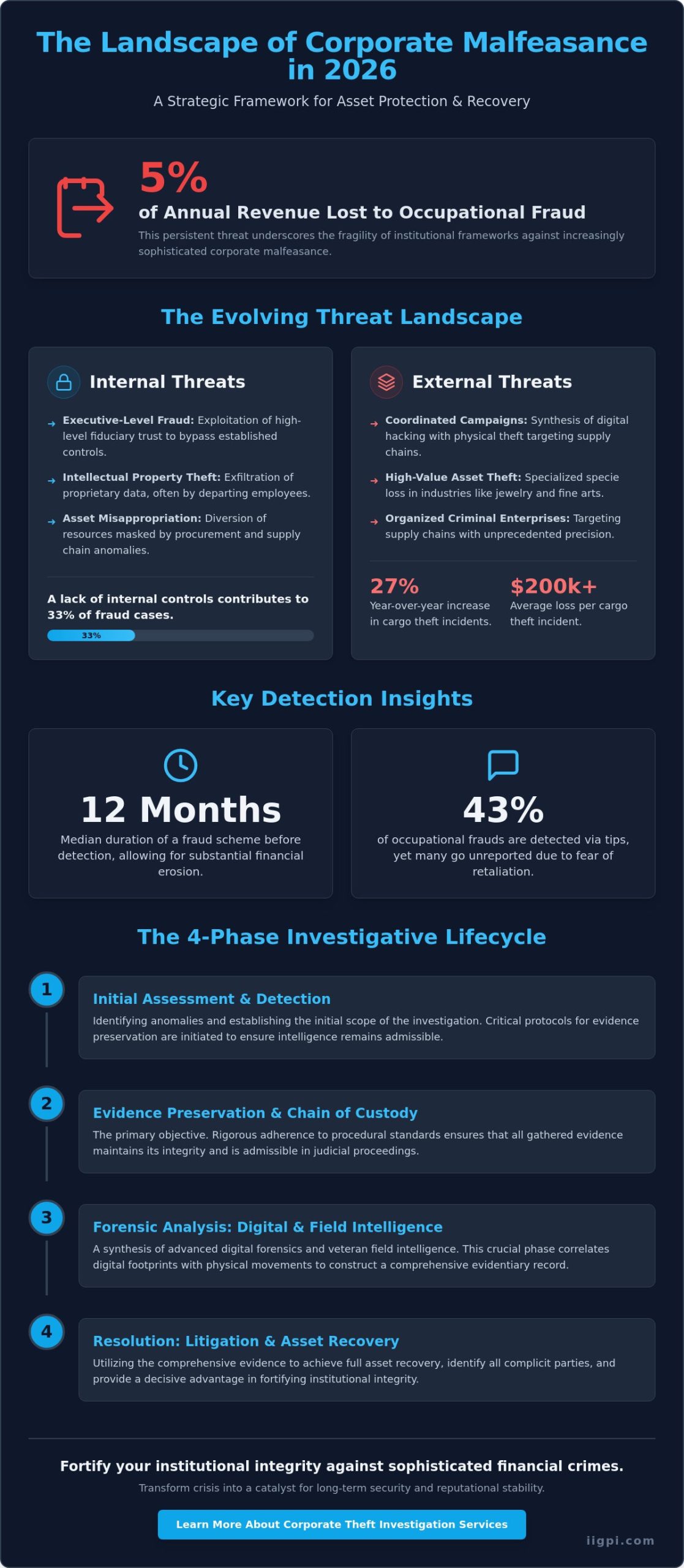
Organizations globally forfeit an estimated 5% of their annual revenue to occupational fraud; a statistic that underscores the persistent fragility of contemporary institutional frameworks. You likely recognize that as corporate malfeasance becomes increasingly sophisticated, traditional methods of internal oversight often prove insufficient to protect intellectual property or physical assets from clandestine erosion. This analysis provides a definitive strategic framework for 2026, detailing how elite corporate theft investigation services utilize a synthesis of digital forensics and field intelligence to achieve full asset recovery and the identification of all complicit parties.
We will examine the integration of advanced surveillance methodologies and rigorous internal control audits designed to fortify your organization against both external threats and systemic internal vulnerabilities. By aligning investigative rigor with the latest regulatory shifts, such as the evolving California Privacy Rights Act mandates, leadership can transform a period of crisis into a catalyst for long term security and reputational stability. This exploration serves as an authoritative guide for high level decision makers seeking to mitigate the catastrophic impact of sophisticated financial crimes while preserving the sanctity of their corporate legacy.
Key Takeaways
- Understand the evolving definition of corporate malfeasance in 2026, which extends beyond simple embezzlement to encompass complex intellectual property theft and asset misappropriation within decentralized global networks.
- Gain insights into the rigorous methodologies employed by professional corporate theft investigation services, specifically regarding the preservation of the chain of custody and the deployment of forensic accounting.
- Discover the strategic necessity of correlating digital footprints with physical movements to construct a comprehensive evidentiary record that withstands the rigors of modern litigation.
- Identify the critical protocols for evidence preservation during the initial assessment phase to ensure that all gathered intelligence remains admissible in judicial proceedings.
- Explore how a synthesis of veteran law enforcement expertise and specialized private intelligence provides a decisive advantage in fortifying institutional integrity and recovering stolen assets.
The Landscape of Corporate Malfeasance: Identifying Systemic Theft in 2026
The conceptualization of modern corporate crime has undergone a significant transformation, moving beyond the archaic paradigm of simple embezzlement to encompass a broader spectrum of systemic malfeasance. The Landscape of Corporate Malfeasance in 2026 is defined by a sophisticated interplay between internal systemic vulnerabilities and increasingly organized external threats. Organizations frequently underestimate the breadth of these risks; data suggests that the median duration of a fraud scheme before detection persists for approximately 12 months, resulting in substantial financial erosion. Professional corporate theft investigation services are now tasked with identifying not merely the theft of currency, but the unauthorized diversion of intellectual property and the strategic misappropriation of high-value physical assets within a decentralized global economy.
Internal Asset Misappropriation and Intellectual Property Theft
Executive-level fraud represents a particularly insidious challenge, as it involves the exploitation of high-level fiduciary trust to bypass established internal controls. The 2026 ACFE report observes that a lack of internal controls contributes to 33% of fraud cases, highlighting a critical systemic failure. Departing employees often engage in the exfiltration of proprietary data, viewing institutional intelligence as personal capital. Identifying the “red flags” of such behavior requires a meticulous analysis of procurement patterns and supply chain anomalies where subtle discrepancies often mask large-scale diversion of resources.
External Threats: From Cyber-Infiltration to Physical Specie Loss
External threats have evolved from isolated incidents into coordinated campaigns that often synthesize digital hacking with physical theft. In high-value industries, the risk of physical specie loss is particularly acute. This necessitates specialized loss investigations, such as jewelers loss investigations and fine arts loss investigations, to address the unique complexities of these assets. Organized criminal enterprises now target supply chains with unprecedented precision, as evidenced by the 27% year-over-year increase in cargo theft incidents reported in 2024, with average losses exceeding $200,000 per incident. Protecting institutional integrity requires a robust framework that anticipates these converged threats through proactive corporate theft investigation services.
Systemic drivers of theft are often rooted in the institutional culture itself. When an organization prioritizes rapid growth over rigorous oversight, it inadvertently creates the “opportunity” component of the fraud triangle. For firms navigating the complexities of strategic acquisitions while maintaining institutional health, learn more about Pinnacle Global Advisory for their specialized buy-side M&A advisory services. Cultural decay often precedes financial loss. Leaders who fail to foster a transparent environment where whistleblowing is protected may find that 43% of occupational frauds continue to be detected via tips, yet many go unreported due to fear of retaliation. Addressing these psychological and systemic drivers is essential for any comprehensive investigative strategy. It’s clear that the fusion of high-technology digital forensics and veteran law enforcement field tactics is the only viable path to securing institutional integrity in this volatile environment.
Methodologies of Professional Corporate Theft Investigation Services
The efficacy of modern investigative frameworks rests upon the immutable principle of the chain of custody. From the moment an organization identifies a potential anomaly, the preservation of evidentiary integrity becomes the primary objective. Professional corporate theft investigation services operate with the understanding that even the most compelling evidence is rendered useless if its provenance is compromised. This rigorous adherence to procedural standards ensures that findings are not only institutionally valid but also legally admissible in the most demanding judicial environments. Investigative integrity isn’t a static state; it’s a continuous process of meticulous verification and documentation that begins long before a case reaches a courtroom.
Forensic Accounting and Financial Intelligence
Reconstructing financial records requires an analytical depth that transcends basic auditing. Forensic data analytics are deployed to identify systemic anomalies that often elude standard internal oversight. By scrutinizing complex international banking structures, investigators can perform comprehensive asset searches to trace illicitly diverted funds across multiple jurisdictions. This level of financial intelligence is essential for uncovering the sophisticated layering techniques used in modern corporate malfeasance. It involves the meticulous tracing of capital through shell companies and offshore accounts to reveal the ultimate beneficiaries of fraudulent activity.
Surveillance and Tactical Intelligence Gathering
Physical evidence remains a cornerstone of successful litigation. The strategic deployment of high-definition surveillance services allows for the documentation of physical theft in real time. When internal theft rings are suspected, deploying undercover operatives provides a level of penetration that remote monitoring cannot achieve. These tactical operations are supported by advanced technological arrays for intelligence collection, ensuring that every movement is recorded with forensic precision. This dual approach ensures that both the “how” and “who” of a theft are established beyond a reasonable doubt through objective observation.
Investigative interviews in a corporate setting require a nuanced psychological approach. Unlike standard interrogations, these sessions are designed to extract factual data while maintaining the organization’s professional standards. Leveraging global agent networks further enhances this capability, providing the reach necessary for multi-jurisdictional asset tracing. Organizations facing complex, cross-border challenges often benefit from the specialized expertise of International Investigative Group to secure their global operations. The fusion of these methodologies creates a formidable deterrent against sophisticated malfeasance, ensuring that institutional assets are protected through rigorous, evidence-based inquiry. By correlating financial data with tactical intelligence, investigators build a comprehensive narrative of the crime that leaves no room for ambiguity.
The Intersection of Digital Forensics and Field Intelligence
The contemporary landscape of malfeasance necessitates a departure from investigative silos that treat digital and physical evidence as distinct entities. Elite corporate theft investigation services recognize that a “digital smoking gun” often requires physical context to achieve the threshold of judicial certainty. When an illicit diversion of assets occurs, the coordination typically leaves a dual trail: a sequence of encrypted communications and a corresponding series of physical movements. Relying on one in isolation creates systemic blind spots that sophisticated actors frequently exploit. By correlating digital footprints with real-time surveillance, investigators construct a comprehensive evidentiary narrative that’s far more resilient than its constituent parts.
The application of computer forensics serves as a critical diagnostic tool in this integration. It allows for the identification of metadata that places a suspect at a specific terminal at the exact moment a physical security breach occurred. A paradigmatic example of this synergy is found in the resolution of a $120 million bank fraud case, where investigators successfully synthesized server log analysis with undercover field intelligence. This case demonstrated that while digital records indicated the “how” of the transaction, it was the physical surveillance that established the “who” by documenting the clandestine meetings where the scheme was orchestrated. It’s this fusion of disparate data streams that transforms suspicion into actionable intelligence.
Analyzing Digital Evidence in a Physical Context
Expert technicians are essential for recovering deleted communications that coordinate the movement of physical assets across jurisdictions. Geolocation data analysis acts as a secondary verification tool, confirming that a suspect’s mobile device was present at the site of a physical theft documented by corporate theft investigation services. This technical rigor ensures that claims of identity theft or unauthorized device access are systematically dismantled through a convergence of objective data points. It isn’t enough to show that a file was accessed; one must prove the physical presence of the actor.
Securing the Physical Environment: Armed Guards and Bug Sweeps
Maintaining investigative confidentiality requires the proactive securing of the physical environment through electronic bug sweeps. This process identifies unauthorized listening devices that might compromise the integrity of an ongoing inquiry. The integration of security and armed guard services provides a vital deterrent against retaliatory actions or further asset erosion during the sensitive lifecycle of an investigation. Customized security solutions for high-value properties ensure that institutional assets remain protected while the forensic team works to identify complicit parties and recover losses. Protecting the investigation is as critical as the investigation itself.
Navigating the Investigative Lifecycle: From Detection to Litigation
The progression from the initial detection of an anomaly to the formal commencement of litigation represents a critical juncture in the preservation of institutional integrity. Successful corporate theft investigation services must operate with the foresight that every gathered datum may eventually face the scrutiny of a judicial cross-examination. This lifecycle begins with a rigorous initial assessment; the primary objective is to differentiate between benign operational errors and deliberate systemic malfeasance. Once the validity of a suspicion is established, the focus shifts to a strict protocol of evidence preservation to ensure that no procedural lapses compromise the admissibility of the findings. Effective stakeholder communication remains essential during this period. Leadership must balance the need for organizational transparency with the absolute necessity of maintaining investigative confidentiality to prevent the destruction of evidence or the flight of complicit parties.
The Critical First 48 Hours of a Theft Investigation
The immediate aftermath of a discovery dictates the eventual success of the recovery effort. Rapid response protocols are essential to secure both digital and physical perimeters. This prevents suspects from erasing their digital footprints or removing physical assets from the premises. Engaging a private investigator in NYC allows for the immediate deployment of specialized intelligence assets who understand local jurisdictional nuances and evidentiary requirements. A common pitfall in internal investigations is the premature confrontation of suspects. This often leads to the irreparable loss of critical data and alerts complicit parties before the full scope of the theft is understood. By maintaining a discreet but decisive posture during these first 48 hours, an organization preserves its strategic advantage and ensures that the subsequent inquiry is built on a foundation of uncompromised facts.
Preparing for Litigation and Asset Recovery
The culmination of an investigation is the delivery of a comprehensive, fact-based dossier to legal counsel. This document must synthesize all forensic findings, surveillance logs, and interview transcripts into a cohesive narrative that meets high evidentiary standards. Collaborating closely with legal teams ensures that the investigative methodology aligns with the specific requirements of the relevant jurisdiction. It’s particularly vital when dealing with complex international asset searches. Investigators often provide expert witness testimony to translate dense technical data into clear, authoritative evidence for a jury or judge. The ultimate goal remains strategic asset recovery. This involves moving systematically from the identification of illicitly diverted funds to their legal seizure and return to the institution. For organizations requiring a definitive resolution to sophisticated malfeasance, the corporate theft investigation services provided by International Investigative Group offer the intellectual and tactical depth necessary to navigate the complexities of modern corporate litigation.
Securing Institutional Integrity with International Investigative Group
International Investigative Group represents the pinnacle of professional excellence in the field of institutional risk management. With a legacy spanning over 30 years, our organization provides a synthesis of veteran law enforcement expertise and specialized private intelligence that’s unmatched in the New York metropolitan area. This deep institutional memory allows us to deliver corporate theft investigation services that are both strategically precise and operationally discreet. Our leadership team, rooted in elite investigative traditions, ensures that every inquiry is conducted with the intellectual rigor required by high-level decision-makers and global leaders who demand definitive results.
NYC Roots, Global Reach: The International Investigative Group Network
Our headquarters in New York City and Nassau County serve as the command centers for a proprietary network of agents stationed in every major global jurisdiction. This expansive reach is complemented by a historical record of over 10,000 solved cases, a volume of work that provides us with unparalleled predictive intelligence regarding emerging patterns of malfeasance. By operating as a single-source provider, we integrate surveillance services, computer forensics, and security protocols into a unified framework. This consolidation eliminates the communication silos that often compromise complex inquiries, ensuring that institutional assets are protected through a cohesive and information-rich methodology that spans across borders.
The pursuit of truth within the private investigator profession demands an unwavering commitment to absolute discretion and the highest ethical standards. We recognize that reputational damage is often more costly than the theft itself; therefore, our protocols are designed to preserve the sanctity of your corporate legacy while identifying all complicit parties. Our adherence to these rigorous standards has positioned IIGPI as a trusted partner for institutions navigating the most sensitive and high-stakes challenges of the modern era. We don’t just gather evidence; we secure the future of the organizations we serve.
Partnering for Long-Term Risk Mitigation
Effective risk management extends beyond the resolution of active crises to encompass proactive theft prevention and comprehensive due diligence. By partnering with our elite team, organizations can implement fortified security protocols that deter future malfeasance and identify systemic vulnerabilities before they’re exploited by sophisticated actors. Our corporate theft investigation services protect institutional reputation through a commitment to professional excellence that transforms a period of vulnerability into a catalyst for long-term stability. For those seeking to secure their global operations against sophisticated threats, we invite you to contact our team at International Investigative Group for a confidential consultation.
Securing Institutional Resilience through Strategic Investigative Rigor
The resolution of sophisticated malfeasance in 2026 requires a departure from siloed security protocols in favor of a synthesized investigative framework. By correlating digital forensics with veteran field intelligence, organizations can effectively identify complicit parties and initiate the legal recovery of stolen assets. This analysis has detailed the critical importance of maintaining the chain of custody and navigating the investigative lifecycle with a focus on judicial admissibility. Leadership must prioritize proactive risk mitigation to protect both intellectual property and physical capital from systemic erosion. It’s clear that institutional integrity is best preserved through meticulous, evidence-based inquiry.
International Investigative Group remains the definitive authority in the provision of elite corporate theft investigation services, backed by over 30 years of investigative excellence. Our leadership team, comprised of former law enforcement professionals, has successfully resolved more than 10,000 cases worldwide; this provides our clients with an unparalleled strategic advantage. You’re invited to secure your institutional assets with a confidential consultation from our elite NYC-based team to ensure the continued integrity of your global operations. Fortifying your institution against sophisticated malfeasance is an achievable objective when supported by rigorous, evidence-based intelligence.
Frequently Asked Questions
What constitutes corporate theft under New York law?
Under the statutory framework of New York, corporate theft is generally prosecuted as grand larceny, encompassing the wrongful taking, obtaining, or withholding of property with the intent to deprive another of its value. This includes embezzlement, where an individual misappropriates funds entrusted to their care, and the theft of secret scientific material, which addresses the unauthorized duplication or exfiltration of proprietary intellectual property. These offenses are categorized by the monetary value of the stolen assets, with higher valuations resulting in more severe felony classifications within the state’s penal code.
How long does a typical corporate theft investigation take to complete?
The temporal requirements of an inquiry are fundamentally dictated by the complexity of the malfeasance and the sophistication of the concealment techniques employed by the complicit parties. While the median duration of a fraud scheme before detection is approximately 12 months, the subsequent professional investigation may span from several weeks to several months. Factors such as the necessity for multi-jurisdictional asset tracing, the volume of digital forensic data to be analyzed, and the coordination of tactical surveillance operations all influence the final timeline for delivering a comprehensive evidentiary dossier.
Can a private investigator access personal emails or devices during a corporate theft case?
Access to personal communications and hardware is strictly governed by federal and state privacy laws, including the Electronic Communications Privacy Act. Investigators typically gain access to such data through the consent of the individual or by analyzing company-owned devices that are subject to established institutional acceptable use policies. In the absence of consent, the recovery of data from personal devices often requires a court order or subpoena, which professional corporate theft investigation services coordinate through legal counsel to ensure that all gathered evidence remains admissible in future litigation.
What is the difference between a forensic accountant and a corporate investigator?
A forensic accountant specializes in the meticulous reconstruction of financial records to identify clandestine patterns of asset diversion and embezzlement. Their focus is primarily mathematical and ledger-based, designed to quantify the exact scale of financial erosion. In contrast, a corporate investigator provides a holistic approach that synthesizes financial intelligence with field tactics such as surveillance, background investigations, and witness interviews. While the forensic accountant identifies the “what” of the financial loss, the corporate investigator is responsible for determining the “who” and “how” through a broader spectrum of tactical and digital intelligence.
Is evidence gathered by a private investigator admissible in a criminal court?
Evidence secured by a licensed professional is generally admissible in criminal and civil proceedings provided that it was obtained in strict accordance with legal and ethical standards. This requires the maintenance of an unassailable chain of custody and adherence to privacy regulations during the collection of digital and physical data. Because our leadership team is rooted in veteran law enforcement traditions, every inquiry is conducted with the foresight that the findings must withstand the rigorous scrutiny of judicial cross-examination and meet the high evidentiary thresholds required for criminal prosecution.
How much does it cost to hire professional corporate theft investigation services?
The investment required for professional corporate theft investigation services is contingent upon the specific scope of the engagement, including the number of operatives required and the depth of the forensic analysis. Costs are typically structured based on the complexity of the asset recovery efforts and the geographic reach of the investigation. Organizations should evaluate these expenditures as a strategic necessity for mitigating catastrophic financial loss and preserving institutional reputation; the cost of professional intervention is frequently offset by the value of the assets successfully recovered and the fortification of internal security protocols.
What should a company do immediately upon discovering a high-value theft?
The primary objective upon discovery is the immediate securing of the digital and physical perimeters to prevent the destruction of evidence or the further exfiltration of assets. Leadership should refrain from premature confrontation of suspects, as this often alerts complicit parties and allows them to erase digital footprints or move illicitly diverted funds to inaccessible jurisdictions. Professional investigators should be engaged immediately to initiate rapid response protocols, ensuring that the initial assessment is conducted discreetly while maintaining the integrity of the potential crime scene and all associated financial records.
How does IIGPI ensure the confidentiality of a sensitive internal investigation?
Confidentiality is maintained through a multi-layered security framework that includes the use of encrypted communication channels and the strict limitation of information to a “need-to-know” basis among key stakeholders. We frequently deploy electronic bug sweeps to identify unauthorized listening devices that might compromise the sanctity of the inquiry. By leveraging a proprietary network of agents and veteran leadership, we ensure that every phase of the investigative lifecycle is conducted with the absolute discretion required to protect the organization’s global reputation and institutional stability during a period of crisis.