
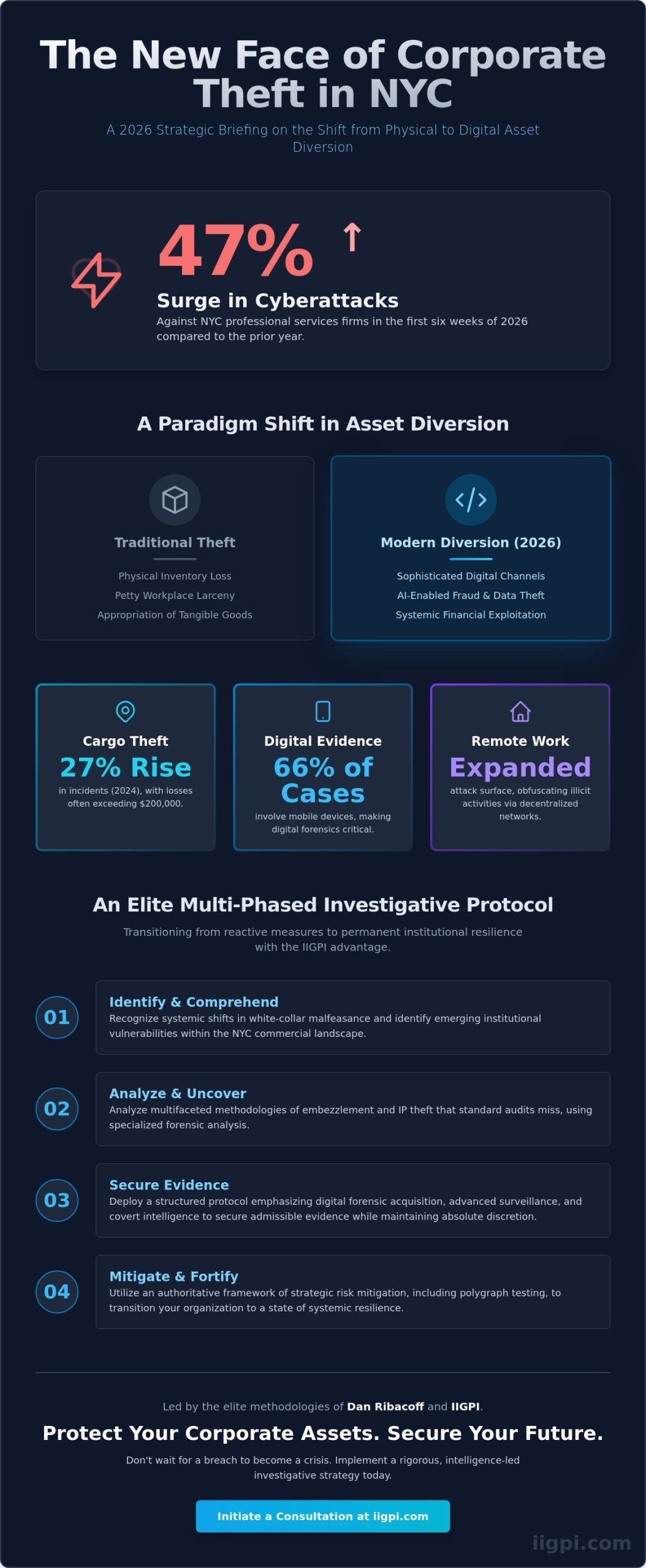
In the first six weeks of 2026, cyberattacks against professional services firms in New York City surged by 47 percent over the prior year, illustrating a paradigm shift where corporate assets are increasingly diverted through sophisticated digital and systemic channels rather than traditional physical theft. You’ve likely recognized that the standard safeguards of the previous decade are no longer sufficient to secure institutional integrity within the dense regulatory and legal environment of the five boroughs. This analysis provides an authoritative strategic framework for a modern corporate theft investigation in NYC, utilizing the elite methodologies of Dan Ribacoff and IIGPI to mitigate risk and facilitate the recovery of diverted capital.
The complexity of modern financial diversions requires a transition from reactive security measures to a rigorous, intelligence-led methodology. We’ll examine the evolution of AI-enabled fraud and the critical role of digital forensics in establishing admissible evidence; additionally, this discourse outlines the elite investigative protocols required to identify perpetrators while maintaining the absolute discretion essential for protecting brand reputation. By integrating advanced surveillance and polygraph testing into a cohesive protective strategy, organizations can effectively transition from a state of vulnerability to one of systemic resilience.
Key Takeaways
- Comprehend the systemic shifts in white-collar malfeasance within the 2026 New York City commercial landscape to identify emerging institutional vulnerabilities.
- Understand the strategic advantages of a specialized corporate theft investigation nyc, Dan Ribacoff, IIGPI when identifying the complex financial diversions that standard annual audits fail to detect.
- Analyze the multifaceted methodologies of embezzlement and intellectual property theft to implement more robust safeguards for proprietary assets.
- Deploy a structured, multi-phased investigative protocol that emphasizes digital forensic acquisition and covert intelligence to secure admissible evidence.
- Utilize an authoritative framework of strategic risk mitigation to transition from reactive measures toward a state of permanent institutional resilience.
The Landscape of Corporate Theft in the New York City Commercial Ecosystem
Corporate theft within the New York City commercial sector is defined as a multifaceted diversion of physical, financial, or intellectual assets, presenting a substantive threat to the stability of Manhattan-based enterprises. The socio-economic impact of internal theft extends beyond immediate balance sheet losses; it erodes institutional trust and can precipitate systemic reputational collapse. While petty workplace larceny involves the isolated appropriation of tangible goods, systemic corporate embezzlement represents a calculated exploitation of fiduciary access. When conducting a corporate theft investigation nyc, Dan Ribacoff, IIGPI utilizes the forensic rigor necessary to distinguish between these disparate levels of malfeasance. Academic discourse and legal frameworks are essential for defining embezzlement as a distinct form of asset misappropriation that requires specialized investigative protocols to uncover.
The Evolution of Asset Diversion in 2026
The 2026 financial landscape has witnessed a paradigmatic shift from physical inventory loss to the sophisticated diversion of digital currency and proprietary data. Empirical data suggests that cyberattacks against professional services firms in New York City increased by 47 percent in early 2026 compared to the previous year, highlighting a critical vulnerability in digital asset protection. Concurrently, cargo theft incidents rose by 27 percent in 2024, with losses often exceeding $200,000 per occurrence. The expansion of remote work environments has broadened the attack surface for internal bad actors, allowing for the obfuscation of illicit activities through decentralized networks. It’s a reality where digital evidence now appears in a majority of cases, with mobile devices being a factor in 66 percent of modern inquiries.
NYC Regulatory Drivers and Reporting Mandates
Analyzing the specific regulatory drivers of New York requires an understanding of how the Manhattan District Attorney’s focus on white-collar crime influences private sector inquiries. Private investigators must adhere to a rigorous Standard of Justice to ensure that evidence remains admissible in high-stakes litigation. New York’s stringent privacy laws necessitate a balanced approach during an active investigation, ensuring that surveillance and digital forensic acquisition don’t infringe upon statutory protections. The specialized methodology of a corporate theft investigation nyc, Dan Ribacoff, IIGPI proves essential for maintaining this equilibrium while pursuing the recovery of diverted capital. Organizations that fail to align their internal protocols with these state-level mandates risk not only the loss of assets but also the possibility of legal sanctions for improper evidence handling.
Methodologies of Sophisticated Internal and External Asset Diversion
The methodologies of asset diversion have evolved into sophisticated, multi-layered schemes that frequently bypass traditional oversight mechanisms. Unlike rudimentary shoplifting or inventory theft, these diversions involve the subtle manipulation of financial systems and the exploitation of fiduciary trust. Organizations frequently encounter an invisible drain on resources through embezzlement and payroll fraud; in these scenarios, the perpetrator’s familiarity with internal controls allows for prolonged exfiltration. According to the latest corporate fraud statistics, internal misappropriation remains a dominant threat, often remaining undetected for significant durations before discovery. When a firm suspects a breach of fiduciary duty, the initiation of a corporate theft investigation nyc, Dan Ribacoff, IIGPI provides the intellectual rigor necessary to identify the source of the diversion.
Financial Fraud and Embezzlement Schemes
Within the dense commercial environment of Manhattan, financial fraud often manifests as ghost employee schemes or the creation of fraudulent vendor accounts. These methodologies rely on the complexity of large-scale procurement systems where collusion between internal actors and external entities can obfuscate unauthorized digital asset movement. Wire transfer fraud has become increasingly prevalent, characterized by the unauthorized redirection of capital into untraceable accounts. Analyzing $100M+ fraud patterns in the global banking sector reveals that these breaches often stem from a failure to verify the authenticity of high-value transactional requests. Organizations don’t often realize the depth of the loss until a forensic professional reconstructs the diverted ledger entries.
Intellectual Property and Trade Secret Exfiltration
The battle for proprietary data in NYC’s technology and financial sectors is a high-stakes endeavor, often involving the departure of high-level executives who possess the access required to exfiltrate proprietary algorithms or sensitive client lists. Utilizing computer forensics is essential to trace these exfiltration paths and establish a definitive chain of custody for digital evidence. To maintain a legal advantage, an organization must prove it made reasonable efforts to protect its trade secrets; this process is significantly strengthened through the deployment of a comprehensive corporate theft investigation nyc, Dan Ribacoff, IIGPI. Organizations can effectively mitigate these risks by initiating a proactive risk assessment to identify latent vulnerabilities before they are exploited.
The intersection of cybercrime and corporate theft represents a hybrid threat where phishing and social engineering are utilized to harvest credentials. This enables bad actors to bypass security perimeters and facilitate the exfiltration of both capital and data. It’s a reality where digital evidence is a factor in a majority of corporate investigations, with mobile devices appearing in 66 percent of cases. This is especially pertinent in New York, where cyberattacks against professional services firms in early 2026 were 47 percent higher than the same period in the previous year, requiring an investigative framework that is as technologically advanced as the threats it seeks to neutralize.
Forensic Analysis vs. Standard Auditing: Identifying the Invisible Loss
The distinction between a standard annual audit and a comprehensive forensic inquiry is fundamental to the preservation of corporate capital within the complex New York commercial landscape. Standard corporate audits operate on the assumption of institutional integrity, focusing primarily on regulatory compliance and the presentation of a fair financial position. These reviews aren’t designed to detect intentional, deeply concealed malfeasance. In the context of a corporate theft investigation nyc, Dan Ribacoff, IIGPI provides the specialized forensic protocols required to bridge the gap between compliance-based sampling and adversarial discovery. While an auditor might overlook small, recurring discrepancies that fall below the threshold of materiality, a forensic investigator treats these anomalies as potential indicators of systemic exfiltration.
The Limitations of Traditional Corporate Audits
Audits typically rely on statistical sampling, a method that is inherently ill-equipped to uncover the precision of sophisticated embezzlement. When a perpetrator utilizes a multi-year, multi-million dollar scheme, such as the case of corporate fraud in New York involving a 4.4 million dollar fake invoice operation, the diversions are often woven into legitimate transactional flows. These schemes succeed because they mimic routine business expenditures, effectively bypassing the oversight of standard internal controls. Integrating a corporate fraud investigation early in the detection cycle is essential for identifying these invisible losses before they escalate into catastrophic financial events.
The Investigative Advantage of Forensic Intelligence
The modern investigative framework leverages data mining and AI-driven pattern recognition to flag behavioral and financial anomalies that evade human detection. This intelligence-led approach identifies non-linear relationships between vendors, employees, and transactional timestamps. There is a critical synergy between this digital evidence and professional surveillance services; financial data provides the digital trail, while surveillance establishes the physical corroboration by linking digital footprints to actual behavior. This dual-methodology ensures that the resulting evidence meets the rigorous standards of New York courts, maintaining a definitive chain of custody throughout the inquiry.
The psychological profile of the modern corporate thief frequently contradicts the myth of the desperate, low-level employee. Instead, the most damaging diversions are often executed by trusted, long-term staff members who possess deep knowledge of institutional vulnerabilities and feel a sense of entitlement or perceived grievance. By moving beyond surface-level auditing and employing the elite methodologies of a corporate theft investigation nyc, Dan Ribacoff, IIGPI, organizations can effectively neutralize these internal threats. This transition from passive compliance to active forensic intelligence is the hallmark of a resilient 2026 asset protection strategy.
Implementing a Multi-Phased Investigative Protocol in NYC
The execution of a strategic corporate theft investigation nyc, Dan Ribacoff, IIGPI involves a rigorous, multi-phased methodology designed to ensure institutional stability while securing actionable intelligence. This process begins with Phase I, characterized by a preliminary assessment and risk-free consultation aimed at establishing precise objectives and identifying potential vectors of asset diversion. Concurrently, Phase II involves covert intelligence gathering and digital forensic acquisition, utilizing advanced technical protocols to harvest data from mobile devices and cloud environments, which empirical data suggests appear in 66 percent of modern cases. Phase III transitions the inquiry into physical verification through surveillance and undercover operations, providing the behavioral context necessary to corroborate financial anomalies identified during the digital phase. Finally, Phase IV culminates in the preparation of a comprehensive, indictment-ready report suitable for presentation to the Manhattan District Attorney or for use in civil litigation.
Initiating the Investigation with Discretion
Discretion acts as the cornerstone of any effective inquiry, particularly within the dense commercial hubs of New York. Maintaining a strict “need to know” basis is essential to prevent the premature tipping off of suspects, an event that frequently results in the irreversible destruction of digital evidence or the obfuscation of financial trails. Investigators must also navigate the complex landscape of New York labor laws, which impose specific constraints on workplace surveillance and employee privacy. By establishing a clearly defined scope of work at the outset, organizations ensure that the operation remains targeted and efficient, preventing the unnecessary expansion of the inquiry while maintaining compliance with statutory requirements. It’s often advisable to consult with a lead investigator to establish these parameters before active measures are deployed.
Evidence Acquisition and Legal Admissibility
Evidence acquisition must adhere to the highest standards of integrity to withstand the scrutiny of New York’s judicial system. Protocols for seizing digital devices prioritize the preservation of metadata, ensuring that the findings remain admissible in high-stakes litigation. The role of polygraph testing in corporate settings remains a specialized tool; while New York law provides specific guidelines for its application, its efficacy in identifying deceptive patterns remains a critical component of the elite investigative lexicon. Preparing a comprehensive evidence package requires a deep understanding of the evidentiary standards demanded by the Manhattan District Attorney’s office. This level of preparation ensures that the transition from private inquiry to public prosecution or civil recovery is seamless and supported by a definitive chain of custody.
The final reporting phase is not merely a summary of findings but a strategic document that outlines the systemic vulnerabilities exploited by the perpetrator. By providing a structured analysis of the malfeasance, this report facilitates decisive disciplinary action and serves as a blueprint for future risk mitigation. This multi-phased approach ensures that the organization doesn’t just identify the loss but also secures the evidence required to facilitate the recovery of diverted capital and the restoration of institutional integrity.
Strategic Risk Mitigation: The International Investigative Group Advantage
For over three decades, the International Investigative Group has operated at the nexus of private intelligence and institutional protection, providing a definitive defense against the multi-layered threats inherent in the New York City commercial ecosystem. A specialized corporate theft investigation nyc, Dan Ribacoff, IIGPI represents the culmination of this expertise, leveraging a sophisticated understanding of both digital and physical asset diversion to restore institutional order. The organization’s foundation in elite law enforcement provides an unparalleled perspective on the evidentiary standards required by high-level regulatory bodies and the Manhattan District Attorney. This background ensures that every inquiry is conducted with the intellectual rigor and procedural precision necessary to withstand the most aggressive legal scrutiny.
Elite Expertise in Manhattan and Beyond
The transition from identifying a loss to achieving a definitive resolution requires a depth of experience that only a former law enforcement perspective can provide. This specialized lens is critical for navigating the specific legal nuances of New York’s judicial system, where the admissibility of evidence often dictates the success of asset recovery efforts. The firm’s track record, encompassing over 10,000 cases solved with an unwavering focus on corporate integrity, serves as a testament to its authoritative position in the industry. While the primary theater of operation remains Manhattan, the investigative framework extends through a global network of agents, allowing for the pursuit of diverted capital across international jurisdictions. This global reach is essential in 2026, as sophisticated embezzlement schemes frequently involve decentralized digital networks and cross-border financial movements.
Securing the Corporate Future
Effective asset protection doesn’t terminate with the conclusion of an inquiry; instead, it evolves into a permanent framework of systemic resilience. Beyond the immediate resolution of theft, the firm facilitates a transition to long-term security through the deployment of customized security and armed guards. These services provide a visible deterrent and a rapid response capability that protects the physical and human capital of an organization. By integrating continuous monitoring and rigorous due diligence into the corporate structure, enterprises can identify latent vulnerabilities before they’re exploited by internal or external bad actors. This proactive posture transforms the organization from a state of reactive vulnerability to one of sustained strategic advantage.
The complexity of the 2026 threat landscape demands an investigative partner that possesses the global perspective and specialized skills required to neutralize sophisticated malfeasance. Whether an enterprise is facing a localized diversion of physical assets or a complex international exfiltration of proprietary data, the solution lies in a structured, intelligence-led response. You can initiate the process of reclaiming your institutional integrity and securing your enterprise today by consulting with our elite NYC investigative team. This engagement provides the authoritative analysis and strategic framework necessary to mitigate risk and ensure the long-term protection of your corporate assets.
Securing Institutional Integrity in an Evolving Threat Landscape
The transition of corporate malfeasance from rudimentary larceny to sophisticated digital exfiltration necessitates a corresponding evolution in protective strategies. Organizations must recognize that traditional auditing functions aren’t sufficient to identify the nuanced patterns of systemic embezzlement or intellectual property theft. By implementing a multi-phased investigative protocol, enterprises can effectively bridge the gap between passive compliance and active asset recovery. It’s essential to integrate forensic intelligence with behavioral corroboration to ensure that evidence remains admissible in high-stakes litigation.
Engaging a specialized corporate theft investigation nyc, Dan Ribacoff, IIGPI ensures access to over 30 years of localized expertise and a global network of elite agents. Founded by former law enforcement professionals, the International Investigative Group provides the intellectual rigor required to navigate New York’s complex regulatory environment while maintaining absolute discretion. You can protect your institutional future and facilitate the recovery of diverted capital today. Initiate a Confidential Corporate Investigation with IIG NYC to establish a resilient framework for long-term asset protection. Your organization’s stability is within reach when supported by elite investigative intelligence.
Frequently Asked Questions
What are the primary indicators of corporate theft within a Manhattan-based firm?
The initial manifestations of asset diversion often include unexplained financial discrepancies, irregular vendor activity, and unauthorized access to proprietary databases during non-standard hours. Organizations frequently observe anomalies in ledger entries or a sudden, inexplicable increase in procurement costs that don’t align with operational growth. These systemic “red flags” necessitate a transition from standard auditing to a targeted inquiry to identify the underlying cause of the fiscal drain.
Is a private investigator’s report admissible in a New York criminal court?
A professionally prepared report is admissible provided the evidence is gathered in strict compliance with New York State evidentiary standards and maintains a definitive chain of custody. The documentation resulting from a corporate theft investigation nyc, Dan Ribacoff, IIGPI is specifically structured to meet the rigorous requirements of the Manhattan District Attorney and civil litigation venues. This authoritative approach ensures that findings aren’t just informative but are legally actionable in high-stakes judicial proceedings.
How long does a typical corporate theft investigation in NYC take to conclude?
The duration of an inquiry is contingent upon the complexity of the diversion and the volume of digital forensics required to establish a definitive conclusion. While preliminary risk assessments can be completed with relative speed, a comprehensive investigation into systemic embezzlement or intellectual property theft may span several weeks or months. This timeframe allows for the thorough acquisition of digital evidence and the completion of necessary surveillance to corroborate financial findings.
Can a private investigator monitor employee communications legally in New York?
Monitoring is generally permissible when conducted on company-owned devices and within the parameters of established corporate policies and New York labor laws. It’s critical that these investigative measures are executed with precision to avoid infringing upon statutory privacy protections while securing institutional assets. Elite firms ensure that all surveillance and data acquisition protocols are aligned with current legal mandates to protect the organization from potential counter-litigation.
What is the distinction between forensic accounting and a corporate theft investigation?
Forensic accounting focuses primarily on the reconstruction of financial ledgers to identify discrepancies, whereas a corporate theft investigation nyc, Dan Ribacoff, IIGPI integrates these findings with surveillance, digital forensics, and undercover operations. This holistic methodology identifies the perpetrator and the specific behavioral patterns behind the diversion. By combining fiscal analysis with physical corroboration, the investigation provides a more comprehensive solution than traditional accounting alone.
How does International Investigative Group maintain discretion during an office-wide inquiry?
Discretion is maintained through covert intelligence gathering and the strategic use of undercover operatives who integrate seamlessly into the corporate environment. By limiting the “need to know” circle to senior executive leadership, the firm prevents the premature disclosure of the inquiry and the subsequent destruction of evidence. This institutional silence is essential for protecting the organization’s reputation while the investigative team secures the necessary proof of malfeasance.
What actions should a CEO take immediately after discovering a financial discrepancy?
A CEO should immediately secure all relevant digital and physical records while avoiding direct confrontation with suspected individuals to prevent the obfuscation of evidence. Engaging an elite investigative firm allows for a structured response that establishes a forensic foundation before internal disciplinary actions are initiated. This measured approach prevents the irreversible loss of data and ensures that the organization maintains a strategic advantage throughout the recovery process.
Does IIG assist with the recovery of stolen digital assets and proprietary data?
The firm utilizes advanced computer forensics to trace the movement of diverted digital assets and proprietary data, facilitating their recovery through established legal and technical channels. This capability is increasingly critical in 2026, as digital evidence appears in 66 percent of modern corporate cases involving mobile devices. By identifying exfiltration paths, the investigative team provides the intelligence required to neutralize cyber-enabled theft and restore institutional integrity.