
An internal investigation can help an organization avoid decisions based on suspicion alone. A corporate investigator for non-profits in Manhattan can examine financial and business records, investigate suspected white-collar crime, and document relevant findings while handling sensitive information carefully. The goal is to establish what happened and identify the evidence supporting that account.
For nonprofit leaders and company decision-makers, missing funds, unusual transactions, or misuse of confidential information can harm more than finances: these concerns can also weaken trust among employees, donors, clients, and stakeholders. A structured investigation brings facts into focus without treating an allegation as proof.
This article explains what internal investigations can involve, how records and evidence may be examined, and how confidentiality can be protected. It also describes when outside investigative support may help and what to consider before deciding on next steps.
Key Takeaways
- Trace financial and business records to clarify how funds moved and where a suspected loss may have occurred.
- Identify warning signs such as unusual transactions or the misuse of confidential business information, then focus the inquiry on relevant evidence.
- Understand how document review, interviews, and evidence preservation can support a careful, confidential investigation.
- Consider corporate investigative support when an organization needs an impartial review of suspected wrongdoing and a clearer account of the facts.
Review of agency, financial, and business records
Records can show how money moved, which decisions authorized a transaction, and where documentation no longer matches activity. In New York City Department of Investigation inquiries, confidential investigators may review agency documents alongside financial and business records. For entities receiving city grant money, this can include examining whether funds were spent properly. This public-sector role differs from a nonprofit’s internal review, but illustrates how records can help establish an evidence-based account.
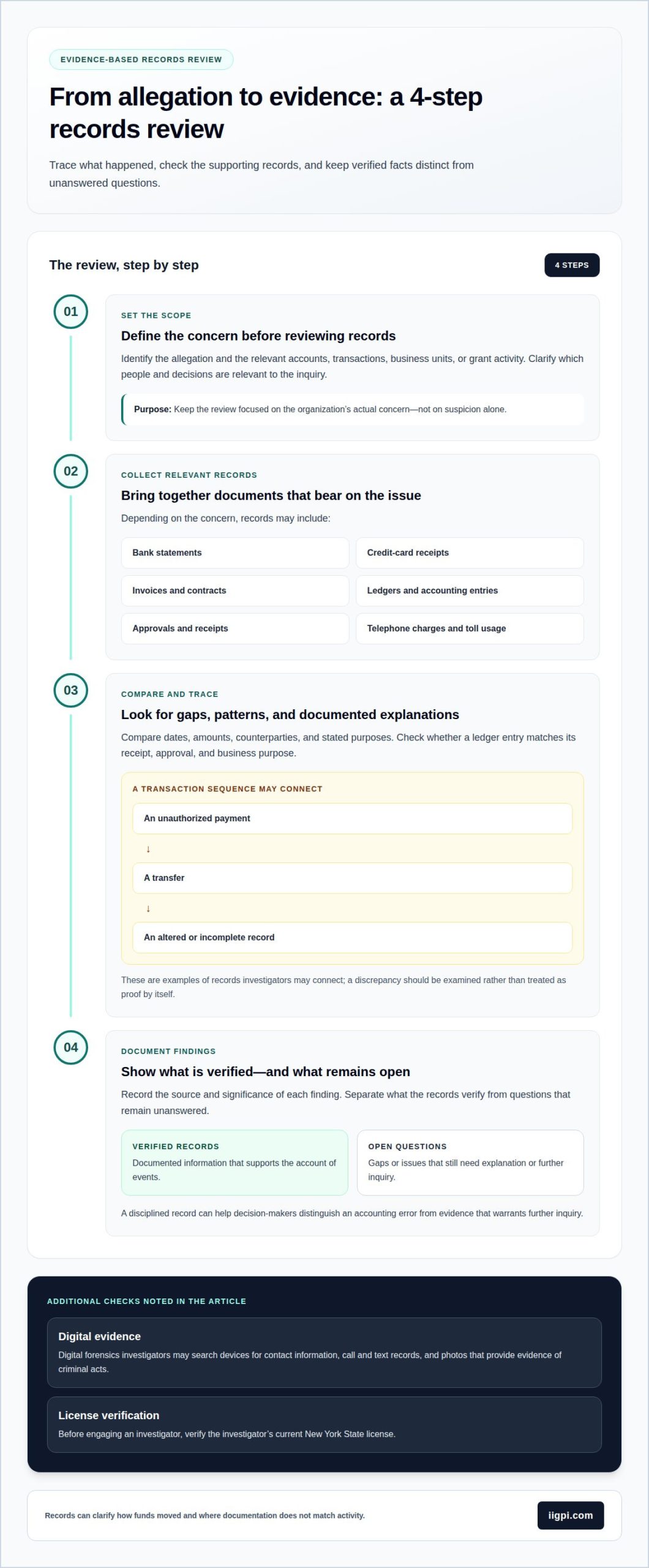
A corporate records review starts by identifying the concern and the documents that could clarify it. In a suspected diversion of funds, investigators may compare bank records, credit card receipts, telephone charges, toll plaza usage, invoices, and accounting entries. The aim is to trace transactions, identify relevant patterns, and determine whether apparent gaps have a documented explanation. For example, a ledger entry can be checked against its receipt, approval, and business purpose.
Investigative auditors with the New York City Department of Investigation can determine how stolen funds were taken, where they went, and how the crime was concealed. Their analysis may connect separate records into a sequence, such as an unauthorized payment, a transfer, and an altered or incomplete record. Data analysts may examine large volumes of often publicly available information to identify patterns that point to criminal behavior, waste, or abuse. This can help investigators focus on relevant subjects and avoid costly false leads.
For a nonprofit or company, a disciplined review can follow practical steps:
- Define the allegation and the relevant accounts, transactions, business units, or grant activity.
- Collect records that bear on the issue, such as bank statements, receipts, ledgers, contracts, and approvals.
- Compare dates, amounts, counterparties, and stated purposes to locate inconsistencies or missing support.
- Document the source and significance of each finding, separating verified records from unanswered questions.
In Manhattan, this approach can help boards and executives distinguish an accounting error from evidence that warrants further inquiry. It also creates a clearer record of how the concern was examined, supporting informed organizational decisions.
Digital forensics investigators may search devices for contact information, call and text records, and photos that provide evidence of criminal acts. Before engaging an investigator, clients should verify the investigator’s current New York State license.
White-collar crime investigations for nonprofits and companies
Suspected fraud calls for a focused inquiry, not an assumption that an allegation proves misconduct. A corporate investigator for non-profits in Manhattan can examine potential embezzlement, fraud, or unauthorized trading activity. Comparing investigators, reviewing credentials, and setting clear oversight help establish a sound process.
White-Collar Crime Investigations
Investigations may examine suspected fraudulent transactions or employee theft of trade secrets, client lists, and proprietary financial models. A useful scope identifies the allegation, relevant people, and decisions to review. For example, a company concerned about a copied client list can define what information may have been taken and what evidence could clarify the issue. This keeps the inquiry focused on the organization’s actual concern.
When comparing investigative firms in Manhattan, assess relevant experience, proposed methods, confidentiality practices, and reporting clarity. Before engaging a corporate investigator for non-profits in Manhattan, determine how the firm will separate documented facts from unresolved questions and communicate findings to authorized decision-makers.
Checking Licenses and Credentials
A Manhattan nonprofit can use state licensing records to verify an investigator’s current New York State license, then compare the listed identity and status with the person or firm being considered. Review credentials and experience relevant to financial records, employee matters, or suspected fraud. These steps help assess whether the investigator is qualified for the assignment.
New York State’s private-investigator licensing framework governs investigator licensing. Rules for investigative methods depend on the records, people, and conduct involved, so the engagement scope should explain how information will be obtained and handled.
A board can authorize an outside inquiry, define its scope, and decide who receives reports. Designated board members or a committee can oversee progress while limiting sensitive updates to authorized recipients.
For suspected financial misconduct, preserve relevant records and document the concern through the established board or audit committee process. If the facts indicate possible criminal conduct, the organization can report it to the appropriate public authority.
For independent fact-finding into suspected white-collar crime, structured corporate investigation support can help examine the concern and organize findings for review.
Confidential investigator responsibilities
A confidential investigator gathers and assesses information within the assignment’s defined scope. In a corporate inquiry, this may include background research, document analysis, database investigations, and surveillance when legally available to private investigators in New York. The investigator’s role is to establish relevant facts, not treat suspicion as proof. For example, a concern about an employee’s outside relationship may call for background research rather than an assumption of wrongdoing.
Careful information handling is essential to confidentiality. Investigators limit collection to material relevant to the inquiry, document the source of evidence, and preserve records so their sequence and integrity remain clear. Corporate investigations may involve collecting and reviewing documents, interviewing people, and conducting forensic reviews of computer, email, or accounting systems. Each method should address a defined question, such as who approved a transaction or whether records support a reported expense.
Evidence handling also matters if an organization later uses findings in a proceeding. The U.S. Bureau of Labor Statistics states that private investigators must properly collect and document evidence so it can be used in court. A documented chain of custody records how evidence was collected, handled, and preserved. For instance, investigators can record the source and transfer of a relevant file rather than relying on an informal copy with unclear origins.
- Research: Use background and database inquiries to develop leads relevant to the assigned concern.
- Interviews: Speak with witnesses and subjects, then distinguish direct observations from secondhand accounts.
- Records: Compare documents and digital evidence against the investigative question and preserve relevant material.
- Reporting: Present findings, supporting evidence, and unresolved issues clearly; provide testimony or affidavits when required.
Confidentiality does not mean withholding material facts from authorized decision-makers. A clear reporting structure identifies who receives updates and findings, while thorough documentation helps organizational leaders assess evidence without confusing allegations, observations, and conclusions.
The New York City Department of Investigation says confidential investigators may interview witnesses and subjects. It also says they are often called upon to testify in court about their investigations and findings.
Investigators may provide testimony or affidavits in support of legal proceedings when required.
Manhattan Corporate Investigators for Nonprofits
Nonprofit investigations examine whether organizational resources, decisions, and records align with their stated purposes. New York City has more than 45,000 nonprofits, spanning institutions with distinct funding structures and governance needs. A Manhattan investigator’s scope should reflect the organization’s actual concern, such as unexplained spending, suspected embezzlement, or misuse of confidential information. The inquiry should distinguish an administrative mistake from evidence suggesting deliberate misconduct.
Funding sources shape the questions an investigation needs to answer. For a nonprofit receiving city grants, investigators may examine whether funds were spent properly; the New York City Department of Investigation examines entities receiving city grant money. For donor-funded programs, investigators can trace whether payments and supporting records match the approved purpose. A review of a school, for example, may consider how charitable donations were used and whether board decisions were documented.
Nonprofit boards also face concerns beyond direct financial loss. An inquiry may examine suspected conflicts, employee conduct, theft of client lists, or misuse of proprietary information. The scope should identify relevant people, transactions, organizational units, and reporting needs. Clear boundaries keep the review focused and help decision-makers understand what the evidence does and does not establish.
When selecting an investigative approach, nonprofit leaders can weigh these practical considerations:
- Funding context: Identify whether the concern involves grants, donations, program income, or organizational assets.
- Evidence type: Determine whether the issue centers on financial records, employee conduct, digital information, or missing property.
- Governance: Establish who authorizes the inquiry and receives findings, particularly when board decisions are involved.
- Reporting purpose: Define whether findings will inform internal action, an employment proceeding, civil litigation, arbitration, or regulatory submission.
These distinctions help a nonprofit avoid treating every irregularity as the same kind of case. A suspected loss of artwork or other property, for instance, raises different investigative questions from disputed grant spending. The appropriate method depends on the alleged conduct, available evidence, and decisions the organization needs to make. For focused support with nonprofit concerns, discuss a corporate investigation.
International Investigative Group: Corporate Investigations
International Investigative Group conducts Corporate Investigations for nonprofits and companies facing suspected financial misconduct, theft, or other internal concerns. An investigation can examine relevant records, assess evidence, and give decision-makers a clearer account of the issues. The appropriate scope depends on the concern, the information involved, and the organization’s objectives.
For a suspected insurance-related loss, Insurance Investigations address a different set of questions. Surveillance Services may also be relevant when observation is needed to examine specific suspected activity. These services are distinct, and the right approach depends on the matter.
If your organization is considering an outside investigation, contact International Investigative Group to discuss the concern and suitable investigative support.
Set a Clear Direction for the Next Step
Selecting a corporate investigator for nonprofits in Manhattan is also a governance decision. Organizational leaders decide which uncertainty needs attention, who should receive findings, and how those findings will inform future decisions. Defining the purpose helps align the investigation with the organization’s responsibilities and priorities.
International Investigative Group offers Corporate Investigations for internal concerns, Insurance Investigations for suspected insurance-related matters, and Security and Armed Guards for security needs. The right service depends on the issue. A conversation can help clarify the investigative focus and next step.
Contact International Investigative Group to discuss your organization’s concerns. A considered next step can help leadership move forward with greater clarity.
Frequently Asked Questions
How do investigators handle confidentiality, donor data, and employee privacy?
Investigators should agree on information-handling and reporting boundaries before reviewing sensitive records. For example, if a donation ledger is relevant to a suspected payment issue, donor details unrelated to that concern need not appear in the findings. Employee information should likewise be included only when it relates to the investigative question. Limiting access to working materials and directing findings to authorized decision-makers can reduce unnecessary exposure.
What are the risks of conducting an internal investigation without outside counsel or investigators?
Without impartial investigative support, an organization may pursue false leads, miss relevant evidence, or confuse allegations with verified facts. Poor documentation or evidence handling can also compromise confidentiality and reduce the usefulness of findings in later proceedings.