
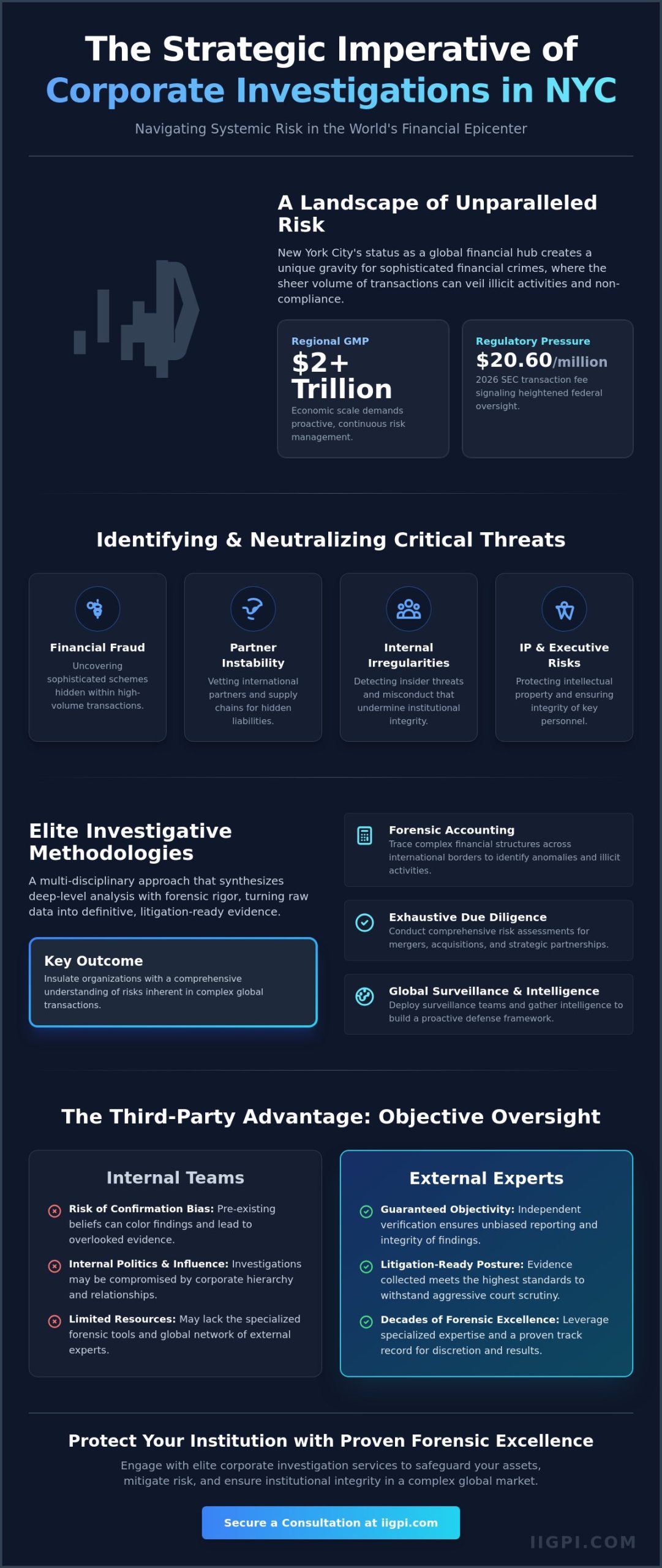
In the hyper-competitive corridors of Manhattan’s financial districts, the distinction between a secure institutional asset and a catastrophic liability often rests upon the depth of one’s strategic intelligence. It’s widely understood that the intricate architecture of New York’s regulatory environment, exemplified by the 2026 SEC transaction fee adjustments to $20.60 per million, demands a level of oversight that transcends conventional internal controls. This analysis provides a definitive examination of the strategic framework surrounding **corporate investigation services in NYC**, highlighting the specialized methodologies employed by experts like **Dan Ribacoff** and the **International Investigative Group** to insulate global organizations against systemic risks such as financial fraud and international partner instability. By reading this framework, you’ll gain an authoritative understanding of how elite investigative protocols translate raw data into definitive evidence for litigation and comprehensive risk assessments for mergers and acquisitions. We’ll begin by deconstructing the strategic pillars of institutional integrity before evaluating the forensic techniques essential for navigating the complex legal landscape of the current fiscal year.
Key Takeaways
- Analyze the critical intersection between New York’s rigorous regulatory environment and the sophisticated forensic methodologies required for institutional asset protection.
- Employ the strategic expertise of corporate investigation services nyc, Dan Ribacoff to conduct exhaustive due diligence and trace complex financial structures across international borders.
- Understand the institutional necessity of third-party oversight to mitigate confirmation bias and ensure the objective integrity of high-stakes investigative reporting.
- Develop a structured investigative protocol that effectively deploys forensic accountants and global surveillance teams based on precise institutional risk assessments.
- Leverage three decades of forensic excellence to navigate the complex legal landscape of New York City with the discretion required by elite corporate entities.
The Landscape of Institutional Risk: Corporate Investigation Services in NYC
The operational environment for institutional entities in New York City is defined by an unparalleled concentration of capital and a commensurate density of systemic risk. Within this high-stakes ecosystem, the deployment of specialized corporate investigation services nyc, Dan Ribacoff becomes a fundamental necessity for maintaining institutional equilibrium. These services function as a critical mechanism for identifying and neutralizing threats that emerge from both internal irregularities and sophisticated external actors. By synthesizing forensic analysis with strategic intelligence, organizations can safeguard their reputational capital and ensure continuity amidst the volatile shifts of the global market. The catalysts for professional intervention often range from subtle anomalies in financial reporting to overt threats against intellectual property or executive integrity.
The Strategic Importance of the New York Financial Hub
New York City’s status as the epicenter of global finance creates a unique gravity for sophisticated financial crimes, where the sheer volume of transactions provides a veil for illicit activities. The region’s litigation environment is notably aggressive, demanding that evidence meet the highest standards of forensic integrity to withstand the scrutiny of both state and federal courts. In the specific context of New York City’s economic infrastructure, a corporate investigation represents the authoritative application of forensic methodologies and strategic intelligence to preserve the structural integrity of institutions contributing to a regional gross metropolitan product that currently exceeds $2 trillion. This economic scale necessitates a proactive approach to risk management. The cost of institutional failure in such a dense market often ripples through international supply chains and investment portfolios, making early detection a primary directive for executive leadership.
Regulatory Pressures and Compliance Frameworks
Compliance within the New York jurisdiction requires a nuanced understanding of the intersection between local mandates and federal statutes like the Sarbanes-Oxley Act and Anti-Money Laundering (AML) protocols. While internal audits provide a baseline of oversight, professional private and corporate investigations, such as those facilitated by corporate investigation services nyc, Dan Ribacoff, offer an essential layer of independent verification that addresses the gaps often overlooked by standard bureaucratic processes. These investigations are particularly vital when bridging the divide between internal reporting and the rigorous expectations of the Securities and Exchange Commission (SEC). This is especially true following the 2026 adjustments to transaction fee rates to $20.60 per million dollars, a move that signals heightened federal oversight. Maintaining a litigation-ready posture is no longer a reactive strategy; it’s a continuous requirement for institutional survival. Organizations must engage in persistent intelligence gathering to ensure that their defensive frameworks are robust enough to counter the evolving tactics of financial fraudsters and regulatory non-compliance risks.
Methodologies of Elite Corporate Intelligence and Forensic Analysis
The transition from reactive investigative measures to a proactive intelligence framework is essential for institutional survival within the New York financial ecosystem. Elite corporate investigation services nyc, Dan Ribacoff utilizes a multi-disciplinary approach that synthesizes deep-level reputational analysis with forensic financial rigor. This methodology ensures that decision-makers aren’t merely reacting to crises but are insulated by a comprehensive understanding of the risks inherent in complex global transactions. By adhering to best practices in corporate investigations, professional firms provide the evidentiary depth required for high-stakes litigation and regulatory compliance.
Sophisticated Due Diligence and Business Intelligence
The evaluation of high-value M&A targets and potential joint venture partners, particularly within emerging markets, requires a depth of intelligence that transcends standard public record searches. While basic verification confirms the existence of public records, strategic due diligence provides a multi-dimensional assessment of a target’s reputational integrity and future viability within a specific geopolitical context. Utilizing expansive global networks, investigators verify international asset claims and corporate histories, providing C-suite executives with the clarity necessary to navigate institutional risks. This level of scrutiny is vital when identifying “red flags” that internal departments might overlook due to organizational bias or limited geographic reach.
Forensic financial investigation complements this due diligence by tracing complex transactions across borders to uncover hidden asset structures. In an era where financial fraud often involves sophisticated shell companies and offshore accounts, the ability to reconstruct financial trails is paramount. These methodologies ensure that institutional integrity is maintained even when dealing with the most opaque international business partners. For those requiring specific vetting of Asian manufacturing facilities, China Agent Ltd offers comprehensive verification and audit services; you can visit their website to learn how they help buyers secure their funds. If your organization requires this level of analytical depth, considering a consultation on advanced due diligence protocols can be a decisive step in risk mitigation.
The Application of Digital and Computer Forensics
The integration of digital forensics has become a cornerstone in the identification of intellectual property theft and data breaches. As corporate assets increasingly reside in the digital domain, the preservation of electronic evidence must be executed with surgical precision to remain admissible in legal proceedings. Forensic technicians employ advanced tools to analyze encrypted communications and recover deleted data, often uncovering the “digital fingerprints” of internal malfeasance or external cyber threats. For a more detailed examination of these technical processes, refer to Computer Forensics: A Guide for Corporate and Legal Investigations.
Beyond the digital realm, surveillance remains a critical tool for verifying Arising Out of Employment and Course of Employment (AOE/COE) claims and safeguarding physical corporate assets. Professional surveillance operations provide the objective evidence necessary to mitigate fraudulent insurance claims and protect against internal theft. By combining these traditional investigative techniques with modern digital forensics, organizations can establish a robust defensive posture against a diverse spectrum of institutional threats.
Internal vs. External Investigations: The Strategic Advantage of Third-Party Oversight
The delegation of investigative responsibilities to internal security or human resources departments often introduces a fundamental conflict of interest that can compromise the integrity of a high-stakes inquiry. Within the high-pressure environment of Manhattan’s corporate sector, the deployment of corporate investigation services nyc, Dan Ribacoff provides a necessary layer of separation between the investigative process and internal organizational politics. Third-party oversight isn’t merely a preference; it’s a strategic imperative for institutions seeking to mitigate confirmation bias and insulate themselves from allegations of partiality. By engaging an external authority, a firm ensures that findings are based on objective forensic evidence rather than the subjective interpretations of internal stakeholders who may be influenced by existing power dynamics. This independent approach is essential for maintaining the institutional equilibrium established in the preceding phases of a risk mitigation framework.
Objectivity and the Mitigation of Internal Conflict
External investigators possess the unique ability to navigate complex internal hierarchies without the constraints of professional self-preservation or inter-departmental loyalties. This independence is critical when uncovering the root causes of systemic fraud or addressing whistleblower claims that involve executive-level misconduct. As a neutral arbiter, the professional investigator facilitates a discreet process that prioritizes the preservation of corporate reputation while ensuring that sensitive inquiries don’t disrupt day-to-day operations. Maintaining operational continuity is paramount during active investigations; external oversight allows the institution to continue its mission while the forensic team conducts its work with the necessary autonomy. This discretion prevents the internal destabilization that often accompanies high-profile corporate scandals.
Legal Admissibility and Evidentiary Integrity
The strategic advantage of third-party intervention extends directly into the courtroom, where the admissibility of evidence is determined by rigorous chain-of-custody protocols. Investigations conducted by corporate investigation services nyc, Dan Ribacoff are designed to meet the exacting standards of New York courts, utilizing personnel who adhere to the state’s 2026 licensing requirements, including the $10,000 surety bond mandate. Attorney-client privilege is often more effectively maintained when investigations are directed by external legal counsel through a third-party firm, creating a robust shield against discovery in civil litigation. Internal investigations often fail the litigation test in New York courts because they’re frequently perceived as self-serving exercises that lack the requisite independence and forensic rigor to satisfy judicial scrutiny. By contrast, a professionally managed external inquiry provides a definitive evidentiary record that stands up to the most aggressive cross-examination. If your organization is currently facing potential litigation, securing independent investigative oversight is a critical step in protecting your legal standing.
Implementing a Comprehensive Investigative Protocol for NYC Firms
The execution of a successful institutional defense necessitates a transition from passive observation to a structured, multi-phase investigative protocol. When engaging corporate investigation services nyc, Dan Ribacoff, the initial phase involves identifying the specific scope and objectives of the intelligence operation through a rigorous risk assessment. This preliminary analysis ensures that the investigative trajectory aligns with the organization’s broader strategic goals. Following this, the deployment of specialized resources occurs, including forensic accountants and global surveillance teams who possess the technical proficiency to operate across diverse legal jurisdictions. Real-time intelligence gathering then facilitates the synthesis of disparate data points into actionable insights, allowing for the formulation of a comprehensive report tailored for the board of directors. The final integration with legal counsel ensures that the evidence gathered supports asset recovery or subsequent litigation strategies with absolute forensic integrity. Organizations shouldn’t view these steps as isolated events but as a continuous cycle of institutional fortification.
Asset Search and Recovery: Tracing Hidden Funds
In the context of high-stakes bank fraud, the identification of assets obscured through shell companies or offshore accounts requires a sophisticated understanding of international financial architecture. The protocol for recovery involves coordinating with global agents to freeze and reclaim stolen corporate capital, a process that demands both speed and technical precision. This methodology is explored further in Corporate Fraud Investigation: A Definitive Guide for Business Leaders. For institutions seeking to reclaim lost capital, establishing a strategic asset recovery framework is the most direct path to restitution of misappropriated institutional assets. This phase is critical for restoring financial equilibrium after a significant breach of trust or systemic fraud.
Insurance Fraud Mitigation and Risk Management
Protecting the corporate bottom line from systemic workers’ compensation fraud necessitates the use of surveillance and forensic analysis to contest inflated AOE/COE claims. These investigations serve as a critical component of a broader risk management strategy, ensuring that institutional resources aren’t depleted by fraudulent activities. A notable benchmark of investigative excellence was established through the successful recovery of $12 million in fraudulent burglary claims, demonstrating the tangible impact of professional oversight. By maintaining this level of scrutiny, firms can deter future malfeasance and preserve their financial stability in the competitive New York market. The integration of these investigative findings into broader risk management policies provides a sustainable defense against the evolving tactics of fraudulent claimants.
International Investigative Group: Decades of Forensic Excellence in NYC
The institutional legacy of International Investigative Group is defined by a unique synthesis of traditional law enforcement rigor and the sophisticated requirements of modern business intelligence. For over three decades, the firm has operated as a definitive authority within the New York City corporate and legal landscape, successfully resolving more than 10,000 cases through an unwavering commitment to forensic precision. The leadership of corporate investigation services nyc, Dan Ribacoff reflects this dual expertise, providing a strategic framework that addresses the complexities of institutional risk with the intellectual depth required by global leaders. By integrating academic rigor with decades of operational experience, the organization has positioned itself as an essential partner for prestigious law firms and C-suite executives who demand more than superficial oversight. This history of excellence ensures that every inquiry is conducted with the gravity and technical proficiency necessary to withstand the highest levels of judicial and regulatory scrutiny.
The Global Reach of an NYC-Based Firm
Operating from its Manhattan headquarters, the firm manages a centralized command structure that oversees worldwide intelligence operations across international borders. This NYC-based nexus allows for the seamless coordination of a global network of agents, ensuring that investigations into international asset structures or cross-border fraud are executed with absolute discretion and speed. The ability to project influence and gather intelligence on a macro-level is what distinguishes an elite firm from localized agencies that lack the infrastructure for global reach. To explore these specialized capabilities further, you may consult with our senior investigators regarding your strategic intelligence needs to develop a tailored response to your organization’s specific vulnerabilities. This centralized command ensures that disparate data points from various jurisdictions are synthesized into a coherent, actionable strategy for the client.
Commitment to Discretion and Intellectual Rigor
The firm’s dedication to intellectual rigor is reflected in its methodology, which prioritizes the transformation of raw data into high-level strategic intelligence for decision-makers. This approach is particularly vital for high-level executives who require objective, defensible findings to protect institutional integrity and long-term reputation. Elite NYC corporations trust International Investigative Group because of its ability to navigate the most sensitive internal matters with surgical precision and total confidentiality. By maintaining this standard of excellence, the firm continues to bridge the gap between complex regulatory requirements and the practical necessity of institutional asset protection. International Investigative Group remains the premier authority in corporate investigations, providing the definitive intelligence necessary to safeguard global institutional interests in an increasingly volatile financial landscape.
Advancing Institutional Resilience Through Strategic Intelligence
The preservation of institutional integrity within New York’s sophisticated financial ecosystem requires a transition from reactive security measures to a comprehensive framework of strategic intelligence. This analysis has demonstrated that the objective oversight provided by elite corporate investigation services nyc, Dan Ribacoff is indispensable for mitigating the inherent biases of internal departments and satisfying the rigorous evidentiary standards of modern litigation. By leveraging a global network of agents and over 30 years of specialized experience in the New York City landscape, organizations can effectively insulate themselves against systemic risks. International Investigative Group has successfully resolved over 10,000 cases, demonstrating a unique capacity to address $100M+ financial fraud and complex insurance claims with surgical precision. It’s through this rigorous commitment to forensic depth that organizations maintain their competitive advantage in an era of heightened regulatory scrutiny. Secure your institutional integrity with International Investigative Group’s elite corporate solutions. Proactive engagement with forensic excellence ensures your institution remains a resilient leader in global commerce.
Frequently Asked Questions
What are the primary benefits of hiring a corporate investigator in NYC compared to using internal resources?
External corporate investigation services nyc, Dan Ribacoff, provide a level of objectivity and forensic depth that internal human resources or security departments often cannot achieve due to inherent organizational hierarchies. Professional investigators utilize specialized methodologies and advanced surveillance tools designed to withstand the aggressive litigation environment of New York. This third-party oversight effectively mitigates confirmation bias and ensures that the final reporting is an impartial, defensible record of facts for the board of directors.
How does a professional firm ensure the confidentiality of a sensitive corporate investigation?
Confidentiality is maintained through the implementation of strict data compartmentalization and the use of secure, encrypted communication channels for all intelligence reporting. When an investigation is directed by external legal counsel, the work product can often be protected under attorney-client privilege, shielding sensitive findings from discovery during civil litigation. This structured approach prevents internal leaks and preserves the organization’s reputation while sensitive executive-level inquiries are conducted with total discretion.
What is the typical duration of a complex financial fraud investigation in a corporate setting?
The timeline for a complex financial fraud investigation typically spans from several weeks to several months, depending on the volume of transactions and the number of international jurisdictions involved. Each operation begins with a precise scope identification to establish a structured investigative trajectory. The synthesis of disparate data points into actionable insights requires a measured, deliberate pace to ensure that the resulting evidence meets the highest standards of forensic integrity.
Can evidence gathered by a private investigator be used in New York City civil and criminal courts?
Evidence gathered by a licensed investigator is fully admissible in New York City courts provided that it’s collected through strict chain-of-custody protocols that meet judicial standards. Investigators must adhere to the 2026 New York State licensing requirements, including the $10,000 surety bond mandate, to ensure their findings are forensically sound. Professional investigators with law enforcement backgrounds are particularly effective as expert witnesses, providing credible testimony that can withstand rigorous cross-examination during high-stakes proceedings.
What specific certifications or backgrounds should I look for in a corporate investigative firm?
Institutional clients should seek firms led by principals with extensive law enforcement backgrounds and specialized expertise in forensic accounting or digital intelligence. It’s critical to verify that the firm and its investigators meet the 2026 New York Department of State requirements, which include at least three years of qualifying experience and successful completion of the state exam. Firms that integrate academic rigor with decades of operational experience are best positioned to serve elite C-suite clients and prestigious law firms.
How do corporate investigation services assist in high-value merger and acquisition due diligence?
Professional investigators provide strategic intelligence that extends far beyond basic public record verification by conducting deep-level reputational and financial analysis of acquisition targets. This process identifies hidden liabilities, undisclosed conflicts of interest, and potential regulatory non-compliance risks that could jeopardize the transaction’s viability. By utilizing global networks to verify international asset claims, investigators provide decision-makers with the clarity necessary to navigate the complex risks inherent in $100M+ mergers.
What is the role of computer forensics in modern corporate investigations?
Computer forensics functions as a critical mechanism for identifying digital malfeasance and preserving electronic evidence related to intellectual property theft or data breaches. Specialized technicians analyze encrypted communications and recover deleted data to establish a “digital fingerprint” of illicit activities. This forensic precision ensures that electronic evidence is collected in a manner that remains admissible in court, providing a robust defense against the evolving tactics of internal and external cyber threats.
How does the International Investigative Group manage investigations that cross international borders?
The International Investigative Group manages worldwide intelligence operations through a centralized NYC command structure that coordinates a global network of specialized agents. This infrastructure allows the firm to execute complex inquiries across borders with the same discretion and forensic rigor applied to domestic matters. By bridging the gap between New York’s regulatory landscape and emerging markets, the firm ensures that institutional assets are protected regardless of their geographic location or the complexity of the local legal environment.