
The assumption that standard forensic audits can detect the multi-layered obfuscation strategies utilized in modern shadow banking is a dangerous institutional fallacy. You recognize that as regulatory frameworks tighten and SEC scrutiny intensifies, the margin for error in internal oversight has effectively vanished for firms operating within Lower Manhattan. This analysis provides a rigorous examination of the clandestine protocols and sophisticated methodologies required to conduct a successful financial district nyc corporate investigation within the world’s most dense economic ecosystem. We’ll explore the integration of digital forensics with traditional surveillance to secure definitive evidence, mitigate systemic financial loss, and establish strategic leverage during high-stakes litigation or regulatory negotiations.
By synthesizing thirty years of law enforcement-led expertise with the specific demands of the 2026 regulatory environment, this strategic framework serves as the definitive manual for protecting institutional integrity. We’ll examine how elite investigative entities navigate complex corporate structures to expose fraud that evades conventional detection systems. Our objective is to delineate a proactive approach to risk management that secures the institutional reputation against the evolving threats of financial misconduct and systemic vulnerability.
Key Takeaways
- Distinguish between standard internal compliance audits and the specialized intelligence required for a financial district nyc corporate investigation to ensure total institutional integrity.
- Implement rigorous chain of custody protocols for sensitive data and utilize multi-agent surveillance strategies optimized for the dense urban architecture of Lower Manhattan.
- Mitigate executive-level risk through deep-level due diligence and global asset tracing methodologies designed to expose sophisticated financial obfuscation.
- Align all investigative tactics with New York State statutes and regulatory standards to provide defensible evidence for SEC and FINRA negotiations.
- Evaluate potential investigative partners based on their institutional pedigree and the strategic advantage provided by a law enforcement-led operational background.
Defining the Scope of Corporate Investigation in the NYC Financial District
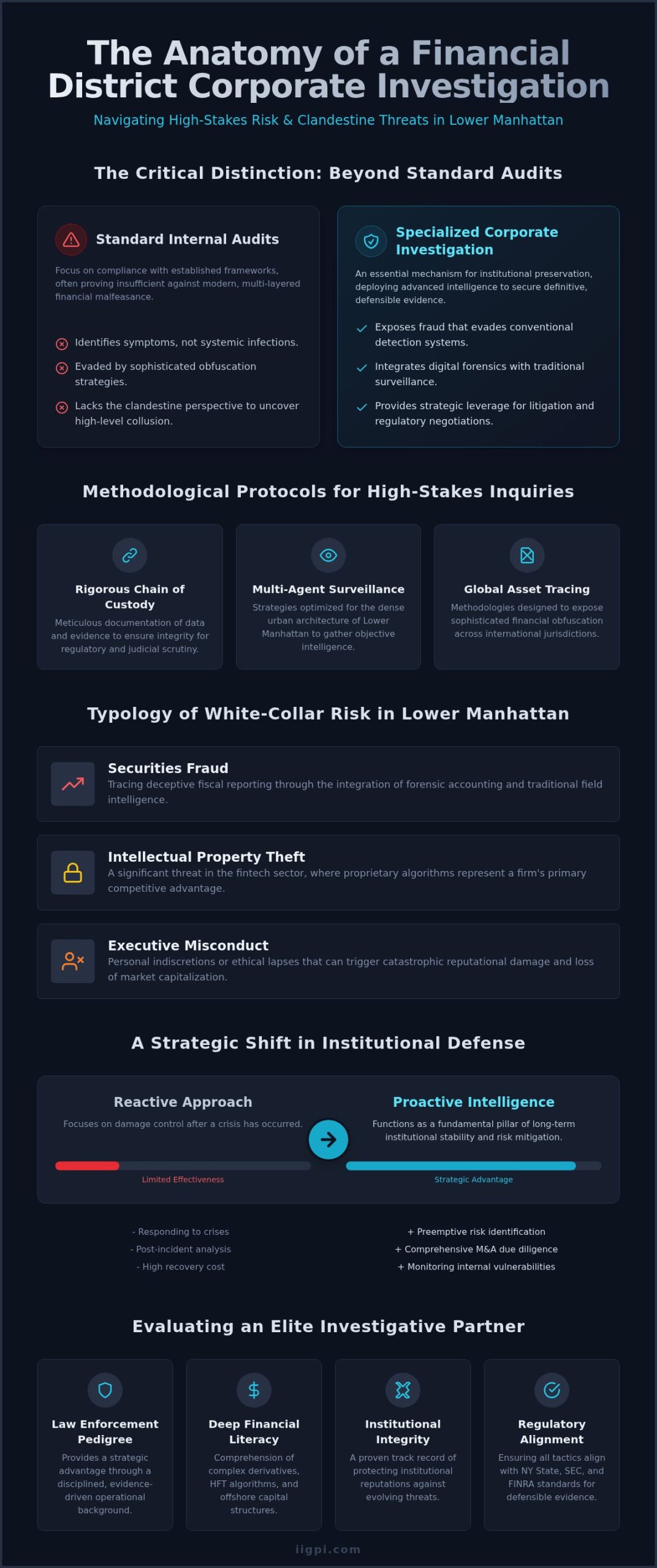
A corporate investigation is a systematic, evidence-driven process designed to identify, analyze, and mitigate internal or external threats to an organization’s operational integrity, shareholder value, and institutional assets. Within the high-frequency environment of Lower Manhattan, where capital flows with unprecedented velocity, traditional parameters of oversight often prove insufficient. A financial district nyc corporate investigation transcends the basic verification of facts; it operates as an essential mechanism for institutional preservation. While internal compliance audits focus on adherence to established regulatory frameworks, external intelligence gathered by a specialized private investigator provides the objective, clandestine perspective necessary to uncover sophisticated malfeasance that evades standard internal checks.
Modern investigative teams operating near Wall Street must possess a level of financial literacy that matches the institutions they scrutinize. It’s not enough to understand investigative tradecraft; agents must comprehend complex derivatives, high-frequency trading algorithms, and the nuances of offshore capital structures. This specialized knowledge allows for the identification of anomalies that would otherwise remain invisible within a firm’s ledger. The distinction between clerical auditing and investigative intelligence is the difference between identifying a symptom and diagnosing the underlying systemic infection.
The Typology of White-Collar Risk in Lower Manhattan
The risk profile of the Financial District is characterized by its technical complexity and potential for systemic impact. Securities fraud remains a primary concern, necessitating the integration of forensic accounting with traditional field intelligence to trace the origin of deceptive fiscal reporting. In the fintech sector, intellectual property theft has emerged as a significant threat, as proprietary algorithms and trade secrets represent a firm’s primary competitive advantage. Additionally, executive misconduct poses a grave risk to corporate governance. Personal indiscretions or ethical lapses can trigger catastrophic reputational damage and a subsequent loss of market capitalization that’s difficult to recover.
Preventative vs. Reactive Intelligence Gathering
Institutional leaders are increasingly shifting from reactive damage control toward proactive intelligence gathering. During high-value M&A activity, comprehensive due diligence serves as a defensive shield, identifying hidden liabilities before they’re integrated into the parent organization. Conducting a financial district nyc corporate investigation requires this nuanced understanding of the local regulatory climate. Utilizing surveillance as a tool for preemptive risk identification allows firms to monitor sensitive operational nodes and identify internal vulnerabilities before they’re exploited. For a deeper examination of these dynamics, leaders should consult our Corporate Fraud Investigation: A Definitive Guide for Business Leaders. This strategic shift ensures that intelligence functions not merely as a response to crisis, but as a fundamental pillar of long-term institutional stability.
Methodological Protocols for High-Stakes Corporate Inquiries
The efficacy of a high-stakes inquiry depends on the absolute rigor of its methodological framework. In the context of a financial district nyc corporate investigation, the margin for procedural error is non-existent. Establishing a secure chain of custody for sensitive corporate data and physical evidence is the foundational requirement for any litigation-ready evidentiary package. This process involves the meticulous documentation of every data transfer and evidence seizure, ensuring that the integrity of the information remains beyond reproach during subsequent regulatory or judicial scrutiny. Adherence to these standards is not merely a best practice; it’s a legal necessity mandated by New York State private investigator licensing regulations, which govern the conduct of elite investigative firms.
The synthesis of field intelligence into a cohesive report requires the deployment of sophisticated interviewing techniques designed specifically for high-level corporate personnel. These inquiries must be conducted with a level of psychological acuity that accounts for the institutional pressures and legal protections surrounding C-suite executives. By integrating these interviews with clandestine surveillance and forensic data, investigators create a multidimensional view of misconduct that surface-level audits inevitably miss.
Phase I: Initial Risk Assessment and Intelligence Mapping
The initial phase of any inquiry must align the investigative objective with the overarching strategy of legal counsel. This alignment ensures that every action taken serves the ultimate goal of institutional protection or strategic leverage. Identifying key stakeholders and potential points of institutional vulnerability allows the team to map the most probable paths of obfuscation. Within the first 48 hours of a corporate fraud discovery, the protocol must include:
- Immediate preservation of all electronic communication logs and server metadata.
- The establishment of a privileged communication channel between investigators and the general counsel.
- A preliminary identification of high-risk personnel with access to the compromised assets.
Phase II: Execution of Clandestine and Digital Operations
Executing physical surveillance within the unique geography of the Financial District presents distinct challenges. The dense urban architecture and high-frequency pedestrian traffic require the deployment of multi-agent teams who can operate seamlessly without compromising their clandestine status. These field operations are augmented by the deployment of advanced Computer Forensics: A Guide for Corporate and Legal Investigations to recover deleted or encrypted communications. This dual-track approach ensures that electronic paper trails are reconstructed while physical movements are documented in real-time. For firms seeking to mitigate loss, engaging an elite corporate intelligence partner is the most effective way to secure the definitive evidence required for a successful resolution.
Specialized Intelligence Services for Wall Street Institutions
Wall Street institutions operate within a theatre of heightened risk where information serves as the primary currency. A standard financial district nyc corporate investigation requires more than just reactive measures; it demands a suite of specialized intelligence services designed to protect the sanctity of the boardroom and the integrity of the ledger. These services, ranging from technical surveillance counter-measures to forensic financial tracing, provide the granular data necessary for informed decision-making at the highest levels of global finance. When an institution’s stability is threatened by internal or external actors, the deployment of elite intelligence protocols isn’t just a preference; it’s a fiduciary necessity.
Executive Due Diligence and Background Intelligence
Standard database checks aren’t sufficient for evaluating the reputational and behavioral risks associated with C-suite appointments or high-value strategic partnerships. True executive due diligence involves the verification of professional credentials and the identification of undisclosed corporate affiliations that might signal a conflict of interest. Given the international nature of modern capital, these inquiries must possess a global reach to uncover liabilities in offshore jurisdictions. This level of scrutiny is essential for maintaining compliance with reporting obligations, such as those outlined in FINRA Rule 4530, which requires firms to report specific events involving associated persons to the regulatory authority. By uncovering behavioral red flags before they manifest as institutional crises, firms can avoid the catastrophic fallout of executive misconduct.
Complex Asset Recovery and Financial Tracing
The sophistication of modern financial fraud often involves the diversion of capital through intricate shell structures and offshore accounts designed to evade standard audits. Tracing these funds requires a synthesis of computer forensics and traditional financial tracking to reconstruct the movement of assets across multiple jurisdictions. This intelligence is critical for the enforcement of civil judgments and the recovery of institutional capital that’s been illicitly siphoned. For organizations facing significant specie or bank fraud, securing an elite investigative partner ensures that the tracing process is both exhaustive and legally defensible in a court of law. This methodology provides the strategic leverage required during complex litigation or regulatory negotiations.
Beyond financial tracing, the physical and psychological security of the institution remains paramount. Electronic bug sweeps, technically known as Technical Surveillance Counter-Measures (TSCM), are vital for ensuring that high-security boardroom environments remain free from unauthorized monitoring or corporate espionage. In cases of internal corporate theft where physical evidence is limited, the application of polygraph testing can serve as a decisive tool for narrowing the field of suspects and identifying the source of the breach. These specialized services collectively form a comprehensive defense against the multifaceted threats inherent to the New York financial ecosystem, ensuring that institutional assets remain protected from evolving white-collar risks.
Navigating Legal and Regulatory Standards in Lower Manhattan
The successful resolution of institutional misconduct hinges upon the investigator’s ability to operate within the complex jurisprudential framework of New York State. Every tactical deployment in a financial district nyc corporate investigation must align strictly with state private investigative statutes to ensure the resulting intelligence remains legally actionable and beyond reproach. Procedural integrity is non-negotiable. This rigor is particularly essential when supporting the demanding documentation requirements for SEC and FINRA referrals, where the validity of the investigative process is under constant scrutiny by regulatory authorities. Maintaining the absolute admissibility of evidence for use in the New York Supreme Court requires a level of precision that transcends basic fact-finding; it demands a comprehensive understanding of the intersection between private intelligence and the evolving expectations of public regulatory bodies.
Evidentiary Standards for Corporate Litigation
The integrity of an investigation is ultimately measured by the robustness of its evidentiary chain of custody, which serves as the backbone of any litigation-ready report. Whether dealing with volatile digital server logs or physical documents retrieved from high-security environments, the meticulous recording of every handoff and storage condition is vital for withstanding the adversarial environment of modern corporate litigation. Expert investigators are prepared to serve as expert witnesses, translating complex financial data and nuanced field observations into definitive testimony that supports the broader legal strategy formulated by the organization’s general counsel. This collaborative approach ensures that investigative findings aren’t merely informative but are strategically positioned to survive the highest levels of judicial scrutiny during high-stakes financial cases.
Compliance with Privacy Laws and Corporate Ethics
Ethical considerations in corporate surveillance must be balanced against the institutional necessity for intelligence, requiring a nuanced application of the Fair Credit Reporting Act (FCRA) and local workplace privacy mandates. Navigating the specific complexities of New York City’s surveillance laws is a prerequisite for any firm seeking to mitigate internal risk without triggering secondary legal liabilities or reputational damage. For a detailed analysis of these tactical considerations, leaders should review our Professional Surveillance Services: A Comprehensive Guide for 2026. Maintaining this equilibrium between operational necessity and employee privacy rights is fundamental to preserving a healthy corporate culture while securing institutional assets from sophisticated internal threats. To ensure your protocols meet these rigorous standards, it’s essential to engage with an investigative partner that possesses the legal sophistication and local expertise required to navigate the unique regulatory landscape of Lower Manhattan when conducting a financial district nyc corporate investigation.
Selecting an Elite Investigative Partner in the Financial District
Evaluating the institutional pedigree of an investigative firm is a critical exercise in systemic risk management. Within the volatile ecosystem of Lower Manhattan, a firm’s history serves as a definitive proxy for its ability to navigate the unique complexities of global finance and high-stakes litigation. When commissioning a financial district nyc corporate investigation, decision-makers must prioritize entities that possess an operational background in law enforcement. This foundation provides the rigorous training necessary to manage the demanding evidentiary requirements of the SEC and the New York Supreme Court, ensuring that all findings are both defensible and actionable. An elite partner must maintain a dual-track operational capacity, combining a localized NYC command center for immediate field operations with a global network capable of tracing capital across international boundaries.
The presence of a 30-year track record in the New York market is not merely a metric of longevity; it’s a testament to a firm’s ability to maintain absolute discretion and institutional credibility over decades of evolving white-collar risk. Unlike generic lead-generation services that match clients with unverified agents, an elite firm provides direct accountability and specialized expertise. This level of institutional experience is essential for identifying the subtle patterns of malfeasance that frequently evade standard corporate oversight and internal audits.
The IIGPI Distinction: Decades of Strategic Intelligence
International Investigative Group (IIGPI) embodies this institutional pedigree, founded by former law enforcement professionals with over 30 years of specialized experience in the New York investigative market. This tenure translates to superior results, exemplified by the successful resolution of complex cases involving over $120 million in bank fraud. Such outcomes aren’t achieved through standard clerical procedures but through the synthesis of digital forensics and traditional surveillance. Our firm’s commitment to intellectual rigor and absolute discretion ensures that every financial district nyc corporate investigation is conducted with the gravity required by the world’s leading financial institutions and their legal counsel.
Engaging Professional Investigative Services
The process of initiating a high-stakes inquiry begins with a strictly confidential consultation to define the institutional objectives and identify potential points of vulnerability. This initial phase leads to the development of a bespoke investigative plan tailored to the specific legal and operational requirements of the organization. By integrating clandestine intelligence with litigation-ready evidence, we provide the strategic leverage necessary for favorable regulatory negotiations or judicial outcomes. To secure your institution’s future against sophisticated internal and external threats, Contact International Investigative Group for a Confidential Executive Consultation. Our methodology ensures that your organization possesses the definitive evidence required to mitigate financial loss and preserve institutional integrity.
Securing Institutional Resilience in the 2026 Financial Landscape
Institutional integrity in Lower Manhattan necessitates a synthesis of technical precision and strategic intelligence that transcends conventional auditing. By implementing the clandestine protocols and methodological frameworks delineated in this analysis, firms can effectively mitigate the systemic risks inherent to the modern financial ecosystem. A successful financial district nyc corporate investigation depends on the absolute rigor of evidentiary chains and the sophisticated tracing of global capital across international jurisdictions. International Investigative Group brings over 30 years of NYC investigative excellence and former law enforcement leadership to every engagement; we’ve successfully resolved over 10,000 cases to date. It’s essential to elevate your firm’s defensive posture against evolving white-collar threats by partnering with an organization that possesses the requisite institutional pedigree and global operational capacity. Secure Your Institutional Integrity with an Elite NYC Investigative Partner. Protecting shareholder value and institutional reputation begins with the pursuit of definitive, litigation-ready truth.
Frequently Asked Questions
What defines a corporate investigation within the NYC Financial District?
A corporate investigation in this sector is a systematic inquiry into institutional misconduct within the high-velocity economic environment of Lower Manhattan. It focuses on identifying threats to shareholder value and institutional integrity that standard oversight mechanisms often miss. This process requires a nuanced understanding of complex financial instruments and the dense urban geography unique to the region. It’s a strategic necessity for firms navigating the heightened regulatory scrutiny of the global financial capital.
How does a private investigator support a financial fraud case in New York?
Investigators provide the objective intelligence required to bridge the gap between suspicion and definitive proof. By integrating digital forensics with clandestine field surveillance, a specialized team can reconstruct illicit transactions and document physical movements of persons of interest. This holistic approach ensures that a financial district nyc corporate investigation yields a litigation-ready evidentiary package. These findings allow legal counsel to negotiate from a position of strategic strength during regulatory inquiries.
Are the findings of a private corporate investigation admissible in New York courts?
Evidence gathered during these inquiries is admissible provided the investigator adheres strictly to New York State private investigative statutes and maintains a rigorous chain of custody. Documentation must be exhaustive to withstand the adversarial nature of the New York Supreme Court. Elite firms utilize law enforcement-led protocols to ensure that every seizure of digital or physical data meets judicial standards. This procedural precision is what distinguishes professional intelligence from casual fact-finding.
What is the typical duration of a complex corporate investigation in Lower Manhattan?
The timeframe for a comprehensive inquiry varies significantly based on the complexity of the institutional structure and the geographic scope of the assets involved. While preliminary risk assessments often conclude within 48 to 72 hours, deep-level financial tracing and multi-agent surveillance can extend for several weeks or months. Complex cases involving international shell structures require a more deliberate rhythm to ensure that all global leads are exhaustively pursued and verified.
How do private investigators ensure discretion during high-profile corporate inquiries?
Discretion is maintained through the use of clandestine operational protocols and privileged communication channels with an organization’s general counsel. Investigative teams utilize sophisticated tradecraft to operate within dense urban environments without alerting the subjects of the inquiry. This anonymity is vital for preserving an institution’s reputation and preventing the destruction of evidence. By operating outside the standard corporate hierarchy, investigators can gather intelligence without disrupting the firm’s daily operational flow.
What specialized tools are used for digital forensics in financial district cases?
Modern inquiries utilize advanced forensic software to recover encrypted communications and analyze server metadata for anomalies in capital movement. These tools allow investigators to reconstruct deleted electronic paper trails that standard IT audits fail to detect. In the 2026 regulatory environment, the integration of high-level data analytics with traditional investigative methodologies is essential. These technical capabilities ensure that even the most sophisticated methods of financial obfuscation are exposed and documented.
Can a private investigation firm assist with SEC or FINRA regulatory matters?
Yes, specialized firms provide the critical evidentiary support required for SEC or FINRA referral documentation. By delivering definitive evidence of misconduct, investigators help firms manage their reporting obligations while mitigating the risk of punitive regulatory action. This support is particularly valuable during the early stages of an inquiry when an institution must decide whether to self-report or initiate internal disciplinary measures. Professional intelligence serves as a defensive shield during high-stakes negotiations.
What is the difference between a standard audit and a corporate investigation?
A standard audit is a routine, clerical review of financial records focused on compliance with established accounting principles. Conversely, a financial district nyc corporate investigation is an adversarial and evidence-driven inquiry designed to uncover intentional malfeasance. While audits rely on the accuracy of provided documentation, investigators assume that records may be compromised or deceptive. This investigative mindset allows for the identification of sophisticated fraud that evades the detection of traditional internal oversight systems.