
The suspicion of internal malfeasance presents a profound challenge for any organizational leader, creating a precarious intersection of potential financial loss, significant reputational damage, and complex legal liabilities. For those in leadership, the uncertainty surrounding correct procedural and evidentiary standards can paralyze decision-making, exacerbating the very risks the organization seeks to mitigate. A methodologically sound and strategically executed corporate fraud investigation is therefore not merely a reactive measure but a critical component of institutional governance and risk management.
This definitive guide provides a comprehensive framework for navigating this complex terrain. It delineates the complete investigation lifecycle, from the initial detection of irregularities and the preservation of evidence to the final stages of resolution and asset recovery. The objective is to equip senior executives with the strategic knowledge required to uncover truth with irrefutable evidence, ensure the process is handled with legal and operational integrity, and implement robust controls to safeguard the organization’s future.
Key Takeaways
- Recognize that corporate fraud’s consequences extend far beyond direct financial losses, encompassing severe reputational damage and significant legal liabilities.
- Master the critical initial steps following a suspicion of fraud, focusing on discreet actions designed to preserve evidence integrity and prevent further asset dissipation.
- A successful corporate fraud investigation is not a reactive measure but a structured, four-phase process that ensures a methodologically sound and defensible conclusion.
- Evaluate the strategic advantages of engaging specialized external investigators whose objectivity and expertise are essential for a credible and impartial outcome.
Understanding Corporate Fraud: Identifying the Threat Within Your Organization
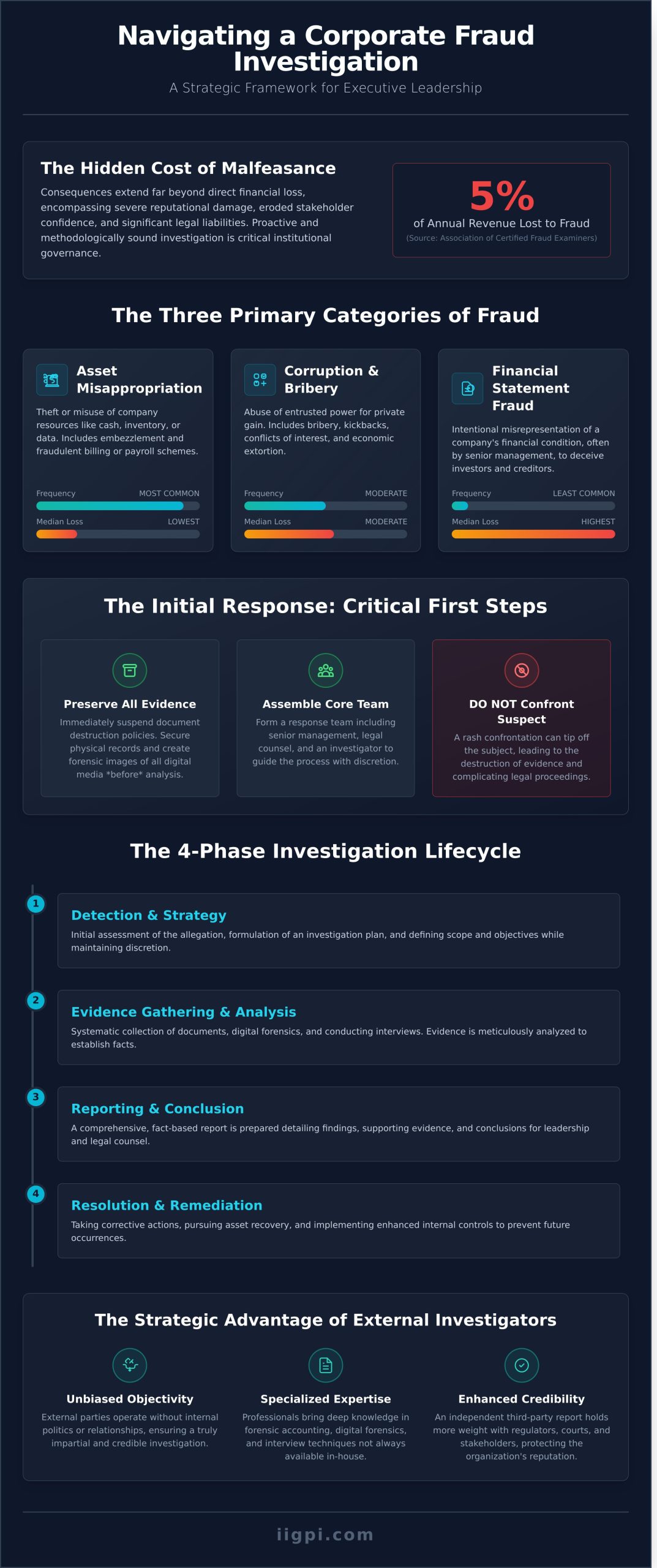
Corporate fraud constitutes the intentional and deliberate deception perpetrated by an individual or entity for illicit personal or corporate gain. This act is a specific subset within the broader framework of illicit business activities, and a foundational understanding corporate crime is essential for effective governance and risk management. The ramifications of such malfeasance extend far beyond direct financial loss, frequently inflicting severe reputational damage, eroding stakeholder confidence, and resulting in significant legal and regulatory liabilities. According to the Association of Certified Fraud Examiners (ACFE), organizations lose an estimated 5% of their annual revenues to fraud, underscoring the pervasive and costly nature of this threat. Vigilance is paramount, with common red flags including unusual financial transactions, discrepancies in accounting records, and sudden, inexplicable lifestyle changes among employees.
A comprehensive corporate fraud investigation must be predicated on a clear understanding of the primary schemes that threaten organizational integrity. These schemes are typically categorized into three fundamental types, each with distinct characteristics and levels of impact.
Asset Misappropriation Schemes
Asset misappropriation involves the theft or misuse of an organization’s resources. This category is the most common form of occupational fraud and includes acts such as embezzlement, fraudulent disbursements through billing or payroll schemes, and the outright theft of cash or inventory. While these schemes are the most frequently detected, they typically result in a lower median financial loss compared to other forms of fraud, yet their high frequency can lead to substantial cumulative damages over time.
Corruption and Bribery
Corruption encompasses the abuse of entrusted power for private benefit and represents a significant threat to ethical governance. Common examples include bribery, the payment or receipt of kickbacks in exchange for preferential treatment, conflicts of interest where an employee has an undisclosed personal stake in a business decision, and economic extortion. Proactive measures, particularly rigorous third-party due diligence and the enforcement of a strong anti-corruption policy, are critical mechanisms for preventing these insidious schemes.
Financial Statement Fraud
Considered the most egregious form of corporate malfeasance, financial statement fraud is the intentional misrepresentation of a company’s financial condition. This is often perpetrated by senior management to deceive investors and creditors. Schemes include the recording of fictitious revenues, concealment of liabilities or expenses, and improper asset valuations. Although it is the least common of the three categories, financial statement fraud is by far the most costly, capable of causing catastrophic financial losses and leading to organizational collapse.
The Initial Response: Critical First Steps After Suspecting Fraud
Upon the initial suspicion of malfeasance, an organization’s leadership must pivot from routine operations to a state of heightened, yet controlled, vigilance. The immediate response should not be reactionary or confrontational; rather, it must be a deliberate and discreet process designed to achieve two paramount objectives: preventing further losses and preserving the integrity of all potential evidence. Rash actions, such as immediately confronting the suspected individual, often prove counterproductive by enabling the destruction of crucial evidence and complicating subsequent legal proceedings. The foundational step is to assemble a core response team, typically comprising senior management, legal counsel, and an internal or external investigator, to guide the organization through the initial, most critical phase of a corporate fraud investigation.
Securing and Preserving Evidence
The immediate preservation of evidence is fundamental to the viability of any investigation. This requires a swift and systematic suspension of all routine document destruction policies that could affect relevant records. All pertinent materials, both physical and digital, must be secured without delay. This includes:
- Securing physical documents, accounting records, and correspondence in a controlled location.
- Isolating and securing computers, mobile devices, and any other electronic hardware used by individuals of interest.
- Creating forensic images of all relevant digital media before any analysis is conducted to maintain the original data in an unaltered state.
- Establishing and meticulously documenting a clear chain of custody for every piece of evidence collected to ensure its admissibility in legal proceedings.
Maintaining Confidentiality and Privilege
Discretion is a strategic imperative during the initial stages of a fraud inquiry. All communications must be strictly limited to a need-to-know basis within the core response team to prevent alerting the suspected parties and to mitigate the risk of widespread internal panic or reputational damage. To protect the integrity and findings of the inquiry, it is critical to engage external legal counsel at the earliest opportunity. This engagement establishes attorney-client privilege over the investigation’s process and work product, shielding sensitive communications and strategic deliberations from external discovery. A proactive communication plan should also be developed to manage stakeholder relations should the matter become public.
Choosing the Right Investigative Path
The strategic direction of the corporate fraud investigation depends on an initial assessment of its potential complexity and scope. A preliminary analysis helps determine whether an internal review by an audit or compliance committee is sufficient or if a formal, independent investigation by external specialists is warranted. For complex financial schemes, engaging forensic accountants becomes essential. This decision framework must also consider whether the suspected fraud indicates an isolated act or a systemic breakdown in internal controls, a distinction critical for a comprehensive corporate compliance programs evaluation and subsequent remediation efforts. Selecting the appropriate path ensures that the response is proportional to the threat and is executed with the requisite expertise.
The Four Phases of a Formal Corporate Fraud Investigation
A successful corporate fraud investigation is not a reactive, chaotic exercise but a disciplined, methodical process executed with precision. This structured framework, managed by professional investigators, ensures that each phase logically builds upon the last. Adherence to this lifecycle is paramount for minimizing operational disruption while maximizing the potential for a sound, defensible conclusion where all evidence is collected in a manner that ensures its legal admissibility.
Phase 1: Investigation Planning and Strategy
This foundational phase establishes the mandate for the entire engagement. Objectives and scope are meticulously defined, and an initial hypothesis is formulated based on the preliminary predicate. Investigators identify key individuals, potential witnesses, and all relevant data sources, from financial records to digital communications. A detailed investigative plan, including a budget and strict protocols for evidence handling and chain of custody, is then developed to guide all subsequent actions with clarity and purpose.
Phase 2: Evidence Collection and Forensic Analysis
With a strategic plan in place, investigators commence the systematic gathering of evidence. This phase involves collecting physical documents, securing digital data from servers and devices, and collating relevant public records. Specialized techniques are deployed, including:
- Computer Forensics: To recover deleted files, analyze metadata, and trace digital footprints.
- Forensic Accounting: To trace illicit financial flows, identify shell corporations, and accurately quantify losses.
- Surveillance: Where legally permissible, to gather intelligence on subject activities and associations.
Phase 3: Investigative Interviews
The interview process is strategically sequenced to maximize information yield and preserve the integrity of the investigation. Investigators typically begin with neutral third-party witnesses to gather background information before proceeding to more central fact witnesses. These initial interviews employ non-confrontational techniques to encourage candid disclosure. Only after all other evidence has been gathered and analyzed is a formal, admission-seeking interview conducted with the primary subject, ensuring the investigator is fully prepared to address inconsistencies and falsehoods.
Phase 4: Reporting and Resolution
The culmination of the investigation is a comprehensive, fact-based report that details all findings, supported by the compiled evidence. This formal document is presented to legal counsel and senior management, providing an objective basis for decision-making. The report includes concrete recommendations for disciplinary action, potential civil or criminal proceedings, and strategies for asset recovery. These recommendations often align with established regulatory standards, such as the DOJ’s framework for compliance programs, to fortify internal controls against future misconduct. Ensure your investigation is handled professionally. Contact IIG.
Assembling the Team: The Case for External Investigators
While internal departments such as Human Resources, Legal, and Internal Audit are indispensable for day-to-day governance and preliminary inquiries, the complexities of a significant corporate fraud investigation often demand capabilities that extend beyond their standard remit. The decision to engage external investigators is not a reflection of internal incompetence but rather a strategic acknowledgment of the necessity for specialized expertise, unimpeachable objectivity, and dedicated resources. Retaining an independent firm transforms the investigation from an internal administrative review into a formal, defensible process capable of withstanding intense legal and regulatory scrutiny.
Objectivity and Independence
The foremost advantage offered by external investigators is absolute impartiality. Unencumbered by personal relationships, departmental loyalties, or internal political pressures, they can conduct their analysis without bias. This objective stance is critical for the credibility of the findings, as it eliminates the conflicts of interest that can inherently compromise an investigation managed solely by internal parties. The result is a process whose fairness and procedural integrity are beyond reproach, safeguarding the organization against subsequent claims of a biased or retaliatory review.
Specialized Skills and Resources
Specialized investigative firms bring a formidable arsenal of skills and technologies that are seldom maintained in-house. This proficiency is crucial for uncovering sophisticated fraudulent schemes and gathering evidence that will be admissible in legal proceedings. Key capabilities include:
- Advanced Digital Forensics: Access to state-of-the-art tools for e-discovery, data recovery, and analysis of complex electronic trails across networks and devices.
- Forensic Interviewing: Mastery of sophisticated interview and interrogation techniques designed to elicit information and assess the credibility of witnesses and subjects.
- Global Intelligence Networks: The operational capacity for cross-border asset searches, sophisticated background checks, and discreet surveillance, a reach that firms like IIG provide to multinational corporations.
- Evidentiary Expertise: Deep knowledge of the rules of evidence and extensive experience in preparing reports and delivering courtroom testimony that withstands cross-examination.
Mitigating Legal and Business Risks
Engaging external experts in a corporate fraud investigation is a powerful risk mitigation strategy. A properly conducted independent investigation significantly reduces the organization’s exposure to litigation, such as claims of wrongful termination, defamation, or invasion of privacy. Furthermore, these experts ensure that the entire process adheres to the complex web of local and international laws, from employment regulations to anti-corruption statutes. This allows senior management to remain focused on core business operations, confident that the crisis is being managed with the highest degree of professionalism and legal compliance by proven investigative partners.
Post-Investigation: Remediation, Recovery, and Prevention
The culmination of a corporate fraud investigation is not an endpoint, but rather the commencement of a critical resolution phase. The final investigative report serves as a foundational document, providing the empirical basis for a tripartite strategy focused on immediate remediation, financial recovery, and long-term institutional prevention. The ultimate objective transcends addressing the specific incident; it is to fortify the organization’s governance structure, rendering it resilient to future malfeasance and thereby safeguarding its integrity and stakeholder value.
Taking Disciplinary and Legal Action
Upon receiving the final report, leadership, in close consultation with legal counsel, must determine a decisive course of action. This phase is critical for demonstrating accountability and establishing a clear deterrent against future misconduct. Key actions typically include:
- Implementing appropriate and legally defensible employment actions, ranging from formal reprimand to termination of employment.
- Filing a formal criminal complaint with the relevant law enforcement agencies when evidence supports criminal intent and prosecution is warranted.
- Initiating civil litigation to pursue the recovery of misappropriated assets and seek compensatory or punitive damages.
Strengthening Internal Controls
The vulnerabilities uncovered during the investigation provide a direct roadmap for systemic reform. A proactive approach to reinforcing internal controls is paramount to preventing recurrence and building a culture of compliance. This strategic enhancement involves:
- Conducting a comprehensive risk assessment to identify and remediate the specific control failures that permitted the fraudulent activity.
- Implementing or enhancing segregation of duties, multi-level approval protocols, and mandatory job rotations in sensitive financial roles.
- Improving the efficacy of whistleblower mechanisms and instituting robust, recurring anti-fraud training for all personnel. Developing these sophisticated governance frameworks is a core focus of institutional policy analysis, a subject further explored by organizations such as the IIG.
Asset Search and Recovery
Parallel to legal and internal actions, a dedicated effort to recover lost assets is often necessary. This complex process requires specialized expertise to trace and reclaim misappropriated funds that may be concealed across multiple jurisdictions. The process entails engaging forensic accountants and investigators to conduct a thorough asset trace, utilizing legal instruments to freeze and seize identified assets, and navigating the intricate legal and regulatory frameworks governing both domestic and international asset recovery.
Securing Organizational Integrity Through Strategic Investigation
The successful navigation of corporate malfeasance hinges upon two fundamental principles: a swift, structured initial response and a meticulously executed formal inquiry. A successful corporate fraud investigation is not merely a reactive measure to address a singular incident; it is a strategic imperative that uncovers facts, mitigates immediate damages, and establishes the foundation for comprehensive remediation. The process demands objectivity, discretion, and a profound understanding of legal and procedural complexities, underscoring the critical role of specialized expertise in achieving a definitive resolution and reinforcing corporate governance.
When the integrity of your organization is at stake, engaging proven experts is paramount. As a fully licensed, bonded, and insured firm with over 30 years of investigative experience and a global network of agents, we provide the highest level of professional diligence and confidentiality. We invite you to Request a Confidential Consultation to Discuss Your Investigation and learn how our capabilities can safeguard your assets and reputation.
By taking decisive and informed action, you can transform a moment of crisis into an opportunity to fortify your organization for a more secure and resilient future.
Frequently Asked Questions
How much does a corporate fraud investigation typically cost?
The cost of a corporate fraud investigation is contingent upon several critical variables, precluding a standard figure. Key determinants include the investigation’s scope, the volume of digital and physical data requiring analysis, the number of expert personnel engaged, and the overall duration. Complex, multi-jurisdictional cases involving extensive digital forensics and multiple interviews will invariably incur substantially higher costs than simpler, localized inquiries. A detailed initial assessment is necessary to establish a realistic budgetary framework for the engagement.
How long does a corporate fraud investigation take to complete?
The duration of a corporate fraud investigation is dictated by the complexity of the alleged misconduct and the accessibility of evidence. A straightforward inquiry might conclude within weeks, whereas a sophisticated scheme involving multiple actors and obfuscated data trails can extend for many months or even years. Factors influencing the timeline include the cooperation of witnesses, the volume of financial transactions to be analyzed, and the potential for parallel legal or regulatory proceedings which may affect the investigative process.
What is the difference between forensic accounting and a fraud investigation?
Forensic accounting is a specialized discipline focused on the examination of financial data to detect and quantify financial discrepancies for use in legal proceedings. It serves as a critical component within the broader framework of a fraud investigation. A fraud investigation, conversely, is a comprehensive process that integrates forensic accounting with other methodologies, such as witness interviews, digital forensics, and surveillance, to holistically uncover the facts of a matter, identify perpetrators, and gather admissible evidence.
When should our company report potential fraud to law enforcement?
The decision to report potential fraud to law enforcement necessitates careful strategic consideration and consultation with legal counsel. Factors influencing this decision include mandatory reporting obligations for regulated industries, the severity and scale of the financial loss, and the potential impact on corporate reputation. An internal investigation should first be initiated to substantiate the allegations, as presenting a well-documented case to authorities significantly increases the likelihood of a successful prosecution and asset recovery effort.
What are the legal risks of conducting an internal investigation without professional help?
Undertaking an internal investigation without professional guidance exposes an organization to considerable legal and procedural risks. These liabilities include potential violations of employee privacy rights, mishandling or spoliation of evidence which renders it inadmissible in court, and the risk of defamation claims from accused individuals. Furthermore, improperly conducted interviews can inadvertently waive attorney-client privilege, compromising the company’s position in subsequent civil or criminal litigation and regulatory scrutiny.
Can a private investigator legally obtain financial records or bank statements?
A private investigator cannot legally obtain confidential financial records, such as bank or credit card statements, without the explicit consent of the account holder or a formal legal instrument. Accessing such information is protected by stringent privacy laws, including the Gramm-Leach-Bliley Act in the United States. Legitimate acquisition of these documents requires a court order, subpoena, or another recognized legal process, which investigators can assist legal counsel in properly serving and executing.
