
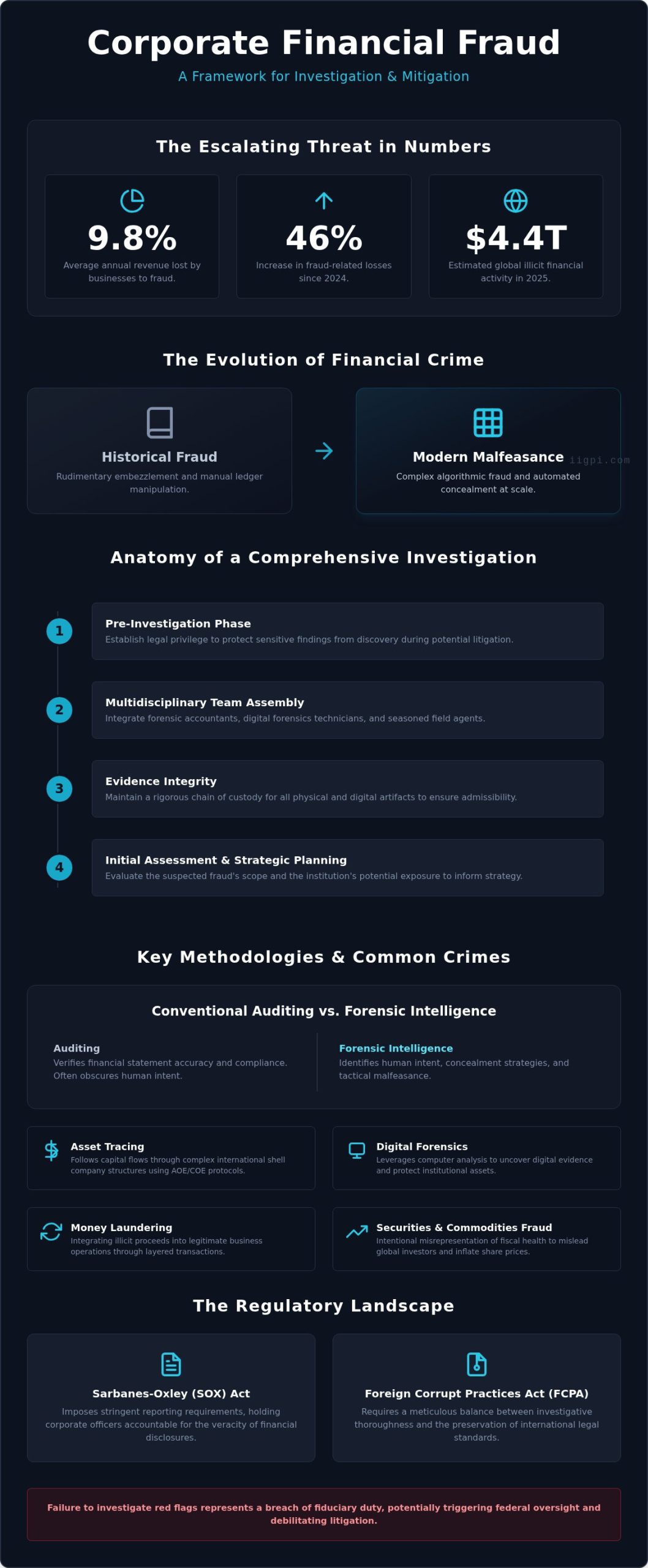
In the United States, businesses reported losing an average of 9.8% of their annual revenue to fraudulent activity in the past year, representing a significant 46% increase since 2024. This escalation in illicit financial activity, which reached an estimated $4.4 trillion globally in 2025, necessitates a sophisticated and rigorous approach to corporate financial fraud investigation. As the Department of Justice establishes the National Fraud Enforcement Division and the regulatory landscape shifts following the August 2026 FinCEN final rule on the Corporate Transparency Act, the burden of institutional integrity rests increasingly upon internal strategic protocols.
High-level decision-makers understand that undetected embezzlement or asset stripping poses an existential threat to both capital reserves and global reputation. This article provides an authoritative analysis of the methodologies and legal complexities required to identify and mitigate such sophisticated financial crimes. We provide an examination of forensic accounting techniques, digital intelligence, and the integration of tactical surveillance to establish a definitive framework for maintaining institutional transparency within an increasingly volatile global economy.
Key Takeaways
- Comprehend the systemic evolution from rudimentary embezzlement to sophisticated algorithmic fraud to effectively categorize contemporary institutional threats.
- Recognize the critical function of the pre-investigation phase in establishing legal privilege throughout a corporate financial fraud investigation.
- Differentiate between conventional auditing and forensic intelligence to identify the human intent and tactical concealment strategies that balance sheets often obscure.
- Implement rigorous asset tracing methodologies and AOE/COE protocols to track capital flows through complex international shell company structures.
- Leverage the strategic integration of computer forensics and field surveillance to protect institutional assets and ensure compliance with evolving global regulatory standards.
Defining Corporate Financial Fraud in the Modern Global Economy
Corporate financial fraud is a deliberate subversion of financial systems for illicit gain, often involving sophisticated concealment. Historically characterized by rudimentary embezzlement or manual ledger manipulation, modern malfeasance has transitioned into the domain of complex algorithmic fraud, where automated systems mask illicit transactions at a scale previously unattainable. This evolution necessitates a rigorous corporate financial fraud investigation framework that accounts for both the velocity of digital commerce and the opacity of globalized financial structures. The categorization of these threats generally bifurcates into internal actors, such as executives manipulating earnings to inflate share prices, and external entities engaging in systematic asset stripping or procurement scams. Beyond immediate capital loss, the systemic impact of such activities manifests as a catastrophic erosion of shareholder value and a fundamental dissolution of institutional trust, often resulting in long-term market devaluation.
Common Modalities of Corporate Financial Crime
The architecture of modern financial crime frequently involves securities and commodities fraud within publicly traded entities, where the intentional misrepresentation of fiscal health misleads global investors. These schemes often intersect with the mechanics of money laundering, where illicit proceeds are integrated into legitimate business operations through a series of layered transactions designed to obfuscate the original source of funds. A critical component of this process is Forensic Accounting, which serves as the primary analytical tool for deconstructing these layers and identifying discrepancies that standard audits overlook. Additionally, intellectual property theft frequently acts as a precursor to financial asset stripping, as the unauthorized acquisition of proprietary data provides the leverage necessary to undermine a competitor’s market position and extract liquid assets.
The Regulatory Landscape and Compliance Imperatives
The execution of a corporate financial fraud investigation requires a paradigm shift from traditional internal audits toward a tactical, multidisciplinary framework that mirrors the complexity of modern financial systems. Central to this architecture is the pre-investigation phase, which prioritizes the establishment of legal privilege to protect sensitive findings from discovery during subsequent litigation. By integrating forensic accountants, digital forensics technicians, and seasoned field agents, institutions can effectively synthesize disparate data points into a coherent evidentiary narrative. Maintaining a rigorous chain of custody for both physical documents and digital artifacts is a non-negotiable requirement, as any lapse in procedural integrity can jeopardize the admissibility of critical findings in a court of law. Proactive due diligence serves as the foundational layer of this framework, allowing leadership to identify subtle patterns of suspicious behavior before they coalesce into formal allegations.
Phase I: Initial Assessment and Strategic Planning
Initial assessment involves a cold-eyed evaluation of the suspected fraud’s scope and the institution’s potential exposure. Determining the necessity of specialized corporate fraud investigation services is a critical decision point for boards of directors facing high-stakes litigation. It’s essential to develop a clandestine operational plan to avoid tip-offs to malicious actors, as premature disclosure often leads to the immediate destruction of evidence or the rapid flight of capital to offshore jurisdictions. This strategic planning ensures that the investigation remains a step ahead of the perpetrator’s evasion tactics, as they aren’t alerted to the scrutiny until the evidence is secured.
Phase II: Intelligence Gathering and Digital Forensics
Modern malfeasance leaves a complex digital trail that demands elite computer forensics to decode and recover seemingly deleted financial records. By analyzing metadata, investigators establish precise timelines of fraudulent transactions that mirror the rigorous standards of FBI corporate fraud investigations. The application of AI-driven tools has become indispensable for identifying anomalies across vast datasets that would be impossible to parse manually. These technologies surface hidden relationships between shell companies and internal actors, providing the clarity required for successful prosecution or internal disciplinary action. Organizations looking to verify the integrity of key stakeholders can utilize due diligence services to mitigate risk before a crisis emerges.
Forensic Accounting vs. Investigative Intelligence: A Strategic Distinction
Standard audits are designed to ensure regulatory compliance and fiscal accuracy, yet they frequently fail to detect the nuanced subversion of systems by sophisticated actors who operate within the margins of legitimate financial reporting. A robust corporate financial fraud investigation must transcend the balance sheet, adopting an investigative mindset that prioritizes the identification of human intent over mere numerical discrepancy. This strategic distinction necessitates the integration of tactical surveillance services to verify lifestyle-to-income discrepancies that accounting records alone cannot explain. By synergizing deep-tissue data analysis with real-world field intelligence, organizations can construct a legally defensible case that withstands the scrutiny of high-stakes litigation.
The Limits of Traditional Forensic Accounting
Conventional forensic accounting software is proficient at identifying overt anomalies, but it often misses the red flags embedded in subtle behavioral shifts or complex, multi-layered transaction chains. Effective fraud detection requires advanced interviewing techniques and behavioral analysis to uncover the psychological drivers behind the malfeasance. For instance, the resolution of a $120 million bank fraud case relied not solely on ledger review but on identifying the non-traditional indicators of collusion that automated systems ignored. This collaborative model aligns with the multi-agency approach championed by the Financial Fraud Enforcement Task Force, which emphasizes the necessity of cross-disciplinary coordination in dismantling high-level financial conspiracies.
Investigative Intelligence as a Catalyst for Recovery
Investigative intelligence acts as the primary catalyst for asset recovery by tracing capital through international jurisdictions using global agent networks. While accounting identifies the loss, intelligence secures the location of the stripped assets. The strategic use of polygraph testing in corporate internal affairs provides an additional layer of verification, helping to isolate malicious actors from innocent bystanders. Establishing Probable Cause through this hybrid model is essential for a successful law enforcement referral or the initiation of civil litigation. This elite approach ensures that the investigation isn’t merely a post-mortem exercise but a proactive mechanism for institutional restoration.
Methodologies for Identifying and Mitigating Sophisticated Fraud Schemes
The identification and mitigation of high-level financial malfeasance requires a systematic application of specialized methodologies that extend beyond national borders. Asset tracing constitutes the rigorous process of reconstructing the ‘money trail’ as it winds through labyrinthine shell company structures and offshore jurisdictions, requiring a synthesis of forensic accounting and field intelligence. In the context of complex insurance-related financial fraud, the implementation of AOE/COE investigations is essential to verify the legitimacy of claims and prevent the unauthorized siphon of corporate capital through fraudulent worker compensation or liability schemes. Mitigating ‘inside jobs’ demands a focus on identifying clandestine collusion between internal personnel and external vendors, a dynamic often obscured by superficial procurement protocols and established professional relationships. Leveraging comprehensive background investigations allows institutions to uncover hidden conflicts of interest that serve as precursors to systematic asset stripping. A successful corporate financial fraud investigation must synthesize these varied streams of intelligence into a singular, actionable framework for recovery, ensuring that every vulnerability is identified and neutralized. In highly technical sectors like mining, this framework includes specialized geological and geophysical testing from christopher-simpson.ensiglo.com to verify asset integrity and prevent resource-based fraud.
Global Asset Search and Recovery Protocols
Navigating the legalities of searching for hidden offshore accounts requires an intimate understanding of international reciprocity and the varying privacy laws of sovereign states. For high-value physical assets, specie loss investigations provide the specialized tactical approach necessary to recover fine arts, jewels, or other tangible wealth that has been illicitly removed from an organization’s possession. The efficacy of these recovery protocols relies heavily on a global network of agents capable of gathering financial evidence that meets the standards of multiple legal systems simultaneously. This international perspective is vital when capital is moved across borders to evade domestic scrutiny, necessitating an elite level of coordination and jurisdictional expertise.
Digital Defense and Computer Forensic Analysis
Modern corporate financial fraud investigation must address the rise of sophisticated crypto-currency laundering, where digital assets are utilized to obfuscate large-scale capital flight within corporate accounts. Electronic bug sweeps represent a critical defensive measure, preventing the unauthorized interception of sensitive financial strategies that could be exploited by competitors or malicious actors seeking to gain a fiscal advantage. It’s essential that digital evidence meets the stringent requirements for court admissibility, requiring a forensic process that is both technically flawless and procedurally transparent to withstand the challenges of defense counsel. Organizations facing complex cross-border threats should engage elite corporate investigations to secure their institutional integrity and initiate the recovery of misappropriated capital.
Securing Institutional Integrity with International Investigative Group
International Investigative Group (IIGPI) provides a definitive advantage through over 30 years of elite investigative experience, specializing in the resolution of complex corporate cases from New York City to a global scale. This institutional depth, founded by former law enforcement professionals, ensures that every corporate financial fraud investigation is conducted with the intellectual rigor and tactical precision required to solve multi-million dollar bank frauds and complex insurance claims. Lance Ribacoff and Dan Ribacoff have been instrumental in setting the industry standard for insurance fraud investigation services, providing an elite framework for risk mitigation that addresses the nuances of high-stakes financial crime. By transitioning from reactive investigation to long-term risk mitigation, including customized security solutions and armed guard services, IIGPI secures the physical and financial assets of high-risk corporate environments with absolute authority.
Discretion and the Preservation of Corporate Reputation
Maintaining institutional stability during a financial crisis requires a level of discretion that public law enforcement agencies often cannot guarantee. Private investigations facilitate the resolution of sensitive internal matters without the catastrophic public exposure that frequently accompanies federal inquiries and leads to shareholder panic. IIGPI effectively manages the interface between internal corporate counsel and external investigators, ensuring that legal privilege is preserved while deconstructing the mechanics of the malfeasance. The firm’s global network of agents provides a critical advantage in handling cross-border financial crises, allowing for the rapid deployment of resources across disparate geographic regions to secure evidence before it’s compromised by malicious actors.
Next Steps: Initiating a Confidential Consultation
The detection of financial irregularities demands immediate, decisive action to prevent further capital loss and systematic evidence destruction. During the first 48 hours of engagement, IIGPI conducts a rapid assessment to stabilize the environment and establish a clandestine operational plan. This initial period is critical for identifying the trajectory of the malfeasance and securing the necessary digital and physical artifacts to build a robust legal case. Leaders who prioritize institutional integrity must move beyond passive monitoring to active defense. Secure your firm’s future with a confidential IIGPI consultation to initiate a strategic response to suspected financial crimes and ensure the long-term survival of your organization.
Safeguarding Institutional Assets through Strategic Vigilance
The preservation of institutional integrity in a volatile global economy requires more than standard compliance; it demands a sophisticated synthesis of digital forensics, behavioral analysis, and tactical surveillance. Organizations must move beyond traditional auditing to embrace a comprehensive corporate financial fraud investigation framework that identifies human intent and secures capital across international borders. By prioritizing legal privilege and clandestine operational planning, leadership can effectively mitigate internal and external threats while avoiding the reputational contagion of public exposure. It’s essential to recognize that the velocity of modern malfeasance leaves no room for administrative delay.
International Investigative Group offers over 30 years of specialized experience in high-value corporate cases, led by former law enforcement professionals with a proven track record in $100M+ financial fraud recovery. Partner with International Investigative Group for Elite Corporate Intelligence to fortify your organization against systemic vulnerabilities. Securing your firm’s future is a manageable objective when you’re supported by world-class investigative expertise.
Frequently Asked Questions
What are the first signs that a corporation needs a financial fraud investigation?
Indicators include unexplained discrepancies in financial records, sudden lifestyle changes in personnel, or persistent internal control overrides. Organizations often observe a divergence between reported revenue and actual liquid assets. These red flags necessitate an immediate corporate financial fraud investigation to prevent systemic capital flight. Early detection remains the most effective mechanism for institutional survival and the preservation of shareholder trust.
How long does a typical corporate financial fraud investigation take to conclude?
The duration of an inquiry varies significantly based on the complexity of the concealment and the volume of digital artifacts. A preliminary assessment typically concludes within 48 to 72 hours, while a comprehensive global investigation may span several weeks or months. Factors such as international jurisdictional cooperation and the depth of the forensic accounting required determine the ultimate timeline for institutional resolution and recovery.
Is a private investigation firm more effective than internal auditors for fraud detection?
Private investigative firms offer a level of objectivity and specialized tactical expertise that internal auditing departments often lack. While internal teams focus on compliance and operational efficiency, external investigators possess the mindset required to identify deliberate subversion and human intent. This distinction is critical when dealing with sophisticated actors who are proficient at masking illicit activities within standard institutional reporting structures.
Can a private investigator recover funds lost in international bank fraud?
Asset recovery is achievable through the systematic tracing of capital through international shell companies and offshore jurisdictions. By utilizing a global network of agents, investigators can locate and freeze misappropriated funds before they’re further layered into the global financial system. This process requires a synthesis of investigative intelligence and forensic accounting to establish the necessary evidence for civil or criminal seizure.
What is the difference between a criminal and a civil financial fraud investigation?
A criminal investigation is conducted to establish a violation of statutory law, often leading to prosecution by state or federal authorities. Conversely, a civil investigation focuses on identifying liability and recovering damages for the victimized institution. While the evidentiary standards differ, both require a rigorous corporate financial fraud investigation to ensure that findings are legally defensible and capable of supporting institutional litigation or law enforcement referrals.
How does computer forensics support a financial fraud case in court?
Computer forensics provides the technical foundation for evidentiary narratives by recovering deleted records and analyzing transaction metadata. This discipline allows investigators to establish precise timelines and identify the specific digital fingerprints left by malicious actors. In a court of law, forensic experts provide testimony that clarifies complex technical data, ensuring that the evidence is both understandable and procedurally sound for judicial review.
Are the results of a private corporate investigation admissible in legal proceedings?
Results from a private investigation are admissible in legal proceedings provided that the evidence was gathered within the parameters of the law and a rigorous chain of custody was maintained. Professional investigators prioritize procedural integrity to ensure that digital artifacts and witness statements withstand the scrutiny of defense counsel. This adherence to legal standards is essential for the successful resolution of high-stakes corporate litigation.
What measures can a company take to prevent recurring financial fraud?
Prevention requires the implementation of robust internal controls, regular due diligence, and the integration of advanced surveillance for high-risk operations. Companies should conduct periodic electronic bug sweeps and background investigations to identify potential vulnerabilities before they’re exploited. Establishing a culture of institutional transparency and maintaining a relationship with elite investigative partners serves as a primary deterrent against sophisticated financial malfeasance.