
A company can lose more than confidential information when that information is obtained unlawfully. According to the United States Senate, industrial espionage involves unlawfully seeking proprietary economic information from U.S. government entities, corporations, establishments, or individuals; corporate espionage can therefore threaten both competitive position and public trust.
Protecting trade secrets and customer data is essential, but suspected breaches can be difficult to trace when employees or other insiders have legitimate access to sensitive information. Reputational damage from corporate espionage can include weakened customer confidence, strained supplier relationships, lost contracts, and lasting harm to a company’s standing. This article explains what industrial espionage involves, how insider threats complicate detection, and which legal grounds may support a claim for damages. It also examines how evidence of unauthorized disclosure or misuse can establish what happened and help a business assess the consequences. The key is distinguishing unlawful information gathering from ordinary competitive research and responding in a way that reflects both the evidence and the potential impact.
Key Takeaways
- Distinguish unlawful efforts to obtain proprietary business information from ordinary competitive research, then identify what information may have been exposed.
- Consider how insider access can obscure the source of a disclosure and why a careful investigation may help establish what happened.
- Assess whether the alleged conduct affected an existing contract or a developing business relationship, since the legal grounds for recovery can differ.
- Account for more than immediate financial loss: exposed information may also weaken customer, supplier, and investor confidence.
Legal Grounds to Recover Corporate Espionage Damages
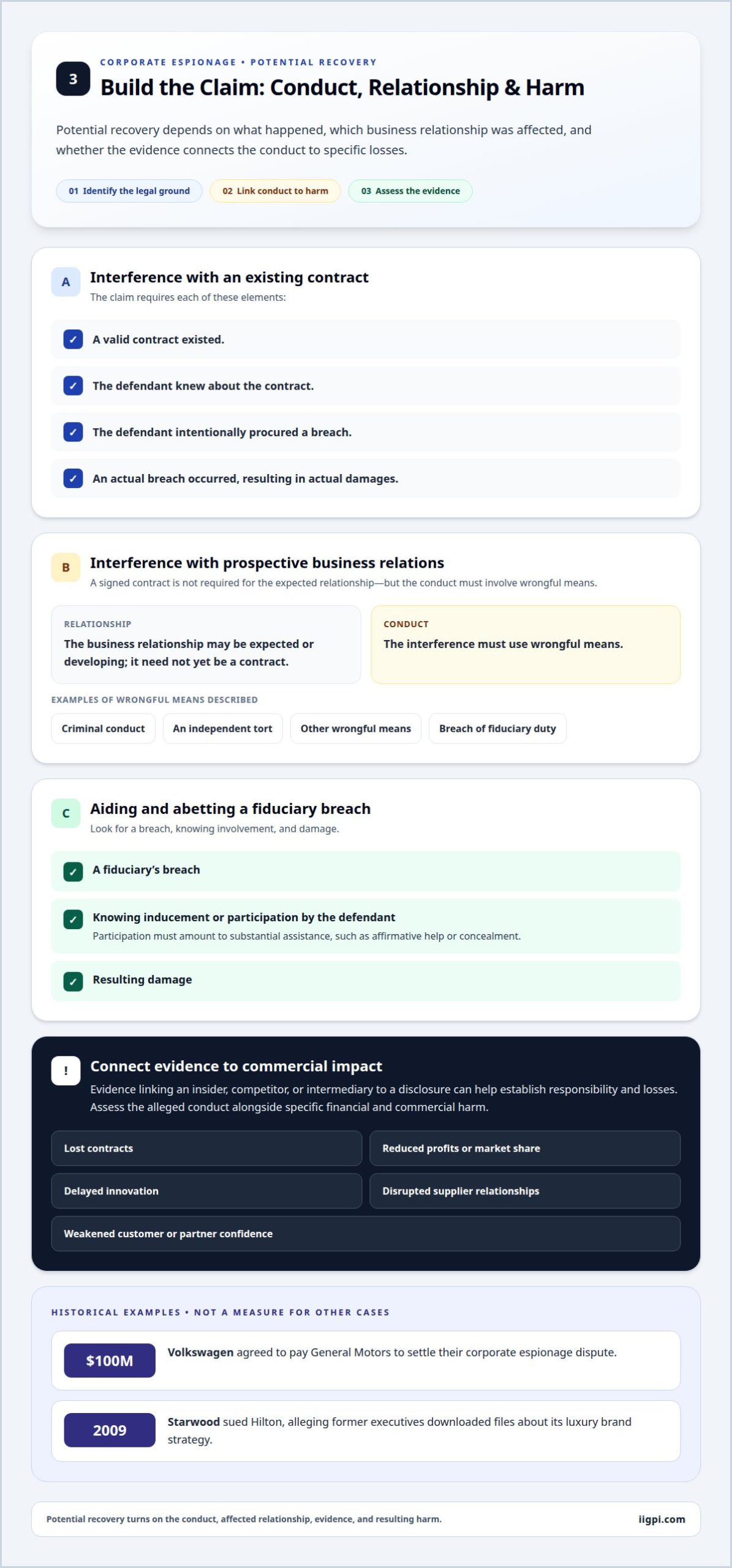
Financial losses can extend beyond the value of stolen secrets. A competitor may use intellectual property to target customers, erode market share, or disrupt supplier relationships. The economic impact can include lost contracts, delayed innovation, and reduced profits. Reputational damage from corporate espionage can deepen those losses when customers or partners lose confidence in the affected business.
Potential recovery depends on the conduct and the relationship affected. A claim for tortious interference with contractual relations requires a valid contract, the defendant’s knowledge, intentional procurement of a breach, an actual breach, and actual damages. For prospective business relations, the expected relationship need not yet be a contract, but the conduct must involve wrongful means. These may include criminal conduct, an independent tort, other wrongful means, or a breach of fiduciary duty.
Claims may also involve aiding and abetting a breach of fiduciary duty. The elements include a fiduciary’s breach, the defendant’s knowing inducement or participation, and resulting damage. Participation must amount to substantial assistance, such as affirmative help or concealment. Evidence linking an insider, competitor, or intermediary to the disclosure can therefore help establish responsibility and losses.
Historical disputes illustrate the scale of potential harm, without setting a measure for other cases. Volkswagen agreed to pay General Motors $100 million to settle their corporate espionage dispute. Starwood sued Hilton in 2009, alleging that former executives downloaded files concerning its luxury brand strategy.
Insider espionage can undermine trust by raising questions about internal controls and employee access. Alleged espionage by a foreign state or competitor may instead heighten concerns about strategic exposure, fair competition, or national economic interests. Either can impair confidence, but the perceived source shapes how customers, suppliers, and investors interpret a breach. To assess recovery, businesses need to connect evidence of the alleged conduct to specific financial and commercial harm.
Definition of industrial espionage
Industrial espionage is the unlawful pursuit of confidential economic information for competitive or strategic advantage. The United States Senate describes it as seeking proprietary economic information from the U.S. government, corporations, establishments, or individuals. Targets may include a company’s trade secrets, source code, customer information, financial records, or strategic plans. Such material can give another party valuable insight into products, operations, or commercial relationships.
The method distinguishes industrial espionage from ordinary competitive research. Reviewing public filings, product announcements, or social media does not, by itself, constitute industrial espionage. Covertly taking restricted files, secretly recording confidential discussions, or deceiving an employee into disclosing protected material crosses a different line. The central question is whether the information was obtained unlawfully, not simply whether a competitor learned something useful.
Organizations can face threats through physical and digital channels. An insider may share documents or misuse legitimate system access, while an outside actor may use phishing or remote hacking. A trespasser could enter a facility to photograph sensitive records or install a listening device. These examples show why cybersecurity measures alone may not address every way valuable information can be exposed.
Industrial espionage and economic espionage are related, but describe different contexts. Corporate espionage generally concerns covert information gathering between organizations; economic espionage can involve governments seeking commercial or technological information across national boundaries. In either case, stolen intellectual property can help a recipient imitate a product, anticipate a business strategy, or gain an advantage without doing the same development work. The term describes unlawful acquisition, not simply aggressive competition.
Potential liability for exposed information
Exposed confidential information can have consequences beyond the theft itself. If customer or supplier data is compromised, a business may face claims related to resulting harm. Lost opportunities, diminished trust, and disrupted commercial relationships can compound the direct impact. Trade secrets also represent development value: competitors who obtain them may benefit from the owner’s investment in creating them.
What disclosure and notification rules apply after corporate espionage or a data breach in the United States? The espionage label alone does not establish a single notification rule. The analysis depends on what information was exposed, who was affected, and which requirements apply to the business and data involved.
Negligent protection can create additional exposure. Companies found negligent in protecting trade secrets could face lawsuits, and businesses may be liable for harm to customers or suppliers whose confidential information is exposed. A practical assessment starts by identifying the information, tracing access and disclosure, and documenting resulting losses. This helps separate the theft itself from later harm, such as lost business or damaged relationships.
Potential liability also differs between the person who takes information and the organization that suffers a breach. Under federal law, perpetrators of corporate espionage can face fines and imprisonment. That possibility does not, by itself, determine whether an employer or another business is liable for separate losses. The conduct, evidence, and connection between exposure and damage remain central.
Past cases show why evidence and outcomes must be treated distinctly. Individual misconduct can involve the unauthorized disclosure of confidential business information. These examples concern individual conduct; they don’t establish automatic liability for every company affected by stolen information.
For a business facing a threat, preserve relevant records and establish what was exposed before making claims about losses. Access logs, communications, and evidence of changes in customer or supplier relationships can help clarify the sequence of events. A well-grounded record supports a more precise assessment of legal and reputational consequences.
What is corporate espionage and how does it cause reputational damage?
Corporate espionage involves covertly obtaining or misusing valuable business information for competitive advantage. Targets can include source code, customer records, manufacturing processes, and marketing plans. This differs from reviewing public announcements or products available to consumers. The distinction is unauthorized acquisition or misuse, not competition itself.
An insider can make detection difficult because authorized access may appear routine. In 1997, a Gillette subcontractor sent trade secrets to several rivals after being demoted. The example shows how workplace conflict can intersect with confidential information and commercial interests. Investigators must distinguish ordinary access from suspicious copying, disclosure, or transfer.
Digital evidence can also help reveal the scope of a suspected breach. During a trade-secret investigation, thousands of files containing Apple intellectual property were found on an engineer’s computer. He was apprehended one day before he was due to fly to China. The files illustrate how one person’s access can expose information central to product development.
Reputational damage from corporate espionage can spread beyond the immediate loss. Customers may question whether their data is safe, while suppliers and investors reassess the company’s reliability. In 2020, an Amazon employee exposed customer email addresses to a third party. Such disclosures can weaken confidence even when the stolen material is narrower than a company’s core trade secrets.
Public disclosure creates another dilemma. The U.S. Government Publishing Office notes that companies victimized by espionage may avoid publicizing it to escape negative publicity over lost trade secrets and proprietary information. Silence can limit immediate attention, but may also leave customers and partners without a clear account of what information was affected. Establishing a careful timeline helps support accurate communication.
When suspicious access, copied files, or unauthorized disclosures raise concerns, an evidence-led investigation can help establish what happened and who was involved. Discuss an evidence-led review when the facts require independent examination.
International Investigative Group: Corporate Investigations
International Investigative Group conducts Corporate Investigations when suspicious access, unauthorized disclosure, or possible misuse of business information requires independent examination. An investigation can help establish what information was affected, whether an insider or external actor may have been involved, and what evidence supports the company’s account of events.
Early fact-finding can help decision-makers distinguish confirmed activity from assumptions, preserve a coherent record, and assess possible effects on customer, supplier, or investor relationships. Keep the scope proportionate, properly authorized, and consistent with applicable privacy and employment requirements. Corporate Investigations do not replace legal advice or cybersecurity response, but can contribute investigative findings to a broader response.
For suspected corporate espionage or related internal concerns, contact International Investigative Group to discuss an investigation.
Make the Next Response Evidence-Led
Protecting an organization’s standing after suspected espionage depends on decisions grounded in reliable facts. A disciplined response can clarify what information was affected, separate established events from assumptions, and support accurate, proportionate communications. Reputational damage from corporate espionage can extend beyond the initial disclosure, so the quality of the response matters as the organization addresses internal and external concerns.
International Investigative Group’s Corporate Investigations can help examine suspected misconduct and relevant evidence. Insurance Investigations address matters involving insurance claims, while Security and Armed Guard Services provide a separate security function. Each offering serves a distinct purpose, and the appropriate investigative work depends on the concern and the facts to be examined.
If your organization is assessing suspected corporate espionage or its consequences, contact International Investigative Group to discuss the next step. A clear, evidence-led approach can help decision-makers move forward with greater confidence.
Frequently Asked Questions
What is Industrial Espionage?
Industrial espionage is the unlawful acquisition of proprietary business or economic information. It may involve obtaining product formulas, research files, or commercial plans without authorization. The method is the key distinction: studying a company’s public product information is ordinary research, while secretly copying restricted development records is not. The information’s value often lies in the time, investment, or strategic advantage it could give another party.
How can organizations protect themselves from corporate espionage?
Organizations can reduce exposure by classifying sensitive information and limiting access to legitimate business needs. Least-privilege permissions, encryption, network monitoring, and restricted physical access address different routes to information. Train employees to recognize phishing and handle confidential material responsibly. Review access when employees or contractors leave, and establish clear incident-reporting procedures so suspicious activity can be escalated without unnecessarily disturbing potential evidence.
What are the potential impacts of corporate espionage on a business?
Corporate espionage can disrupt operations, weaken innovation, and damage relationships with employees, customers, or suppliers. A rival’s access to research may shorten its development path or undermine the value of a company’s investment. Misused information can also distort competition and force management to divert attention to investigating the incident, supporting affected relationships, and assessing which business processes need to change.
Who are the typical perpetrators of corporate espionage?
Potential perpetrators include disgruntled employees, direct competitors, outside hackers, and foreign entities seeking commercial or technological information. A trusted employee may misuse legitimate access, while an external actor may rely on phishing or other intrusions. A supplier or contractor can also become part of the exposure pathway if confidential material is mishandled or passed on. Establish the actor and route through evidence, not assumption.
How does corporate espionage affect customer trust and brand reputation?
Customers may question whether a business can safeguard their information and choose a competitor they believe offers stronger privacy protections. Reputational damage from corporate espionage can also undermine confidence among partners and stakeholders, especially when disclosures seem unclear or incomplete. A careful response should establish what information was affected, communicate verified facts appropriately, and avoid unsupported claims that could further erode credibility.
What is the financial cost of reputational damage after corporate espionage?
There is no single fixed cost: financial effects depend on the information exposed, lost business, disrupted relationships, and recovery work. The consequences can reach millions of dollars when highly sensitive information or substantial commercial opportunities are involved. To assess the impact, distinguish direct losses, such as cancelled contracts, from longer-term effects, including customer attrition and reduced value from research or development.