The most devastating breach of corporate sovereignty isn’t a digital hack from a foreign adversary; it’s the silent, systematic erosion of proprietary intellectual property by a trusted internal actor. You likely recognize that your organization’s competitive advantage is increasingly precarious in a globalized economy where information is the primary currency. To safeguard these vital assets, the implementation of Dan Ribacoff, IIGPI, corporate espionage detection methods provides the intellectual rigor necessary to transform vague suspicions into actionable intelligence. This strategic framework ensures that your organization can fortify its institutional integrity against increasingly sophisticated threats.
We understand that the unexplained loss of a 15% market share or the sudden appearance of a competitor’s identical prototype isn’t a coincidence. It’s a signal. You’ll master the sophisticated methodologies required to identify and neutralize illicit intelligence gathering within your organization. We’ll examine the critical role of Technical Surveillance Counter-Measures (TSCM) and the strategic application of polygraphs. This analysis serves as a prelude to establishing a defensible counterintelligence protocol that aligns with the highest standards of global governance, reinforcing our status as the G20 of Think Tanks.
Key Takeaways
- Analyze the transition from traditional theft to sophisticated economic espionage to effectively prioritize the protection of research, development, and strategic corporate maneuvers.
- Implement a diagnostic framework to identify subtle behavioral anomalies among privileged personnel and unexplained strategic shifts within the competitive landscape.
- Execute advanced corporate espionage detection methods developed by Dan Ribacoff and IIGPI, utilizing Technical Surveillance Counter-Measures and forensic polygraphy to neutralize illicit intelligence gathering.
- Formulate a comprehensive business counterintelligence protocol centered on secure “clean room” environments and rigorous risk assessments of all intellectual property touchpoints.
- Synthesize decades of investigative expertise and law enforcement methodologies to establish an authoritative defensive infrastructure capable of mitigating complex geopolitical and economic threats.
The Evolution of Corporate Espionage: Identifying Modern Threats to Intellectual Property
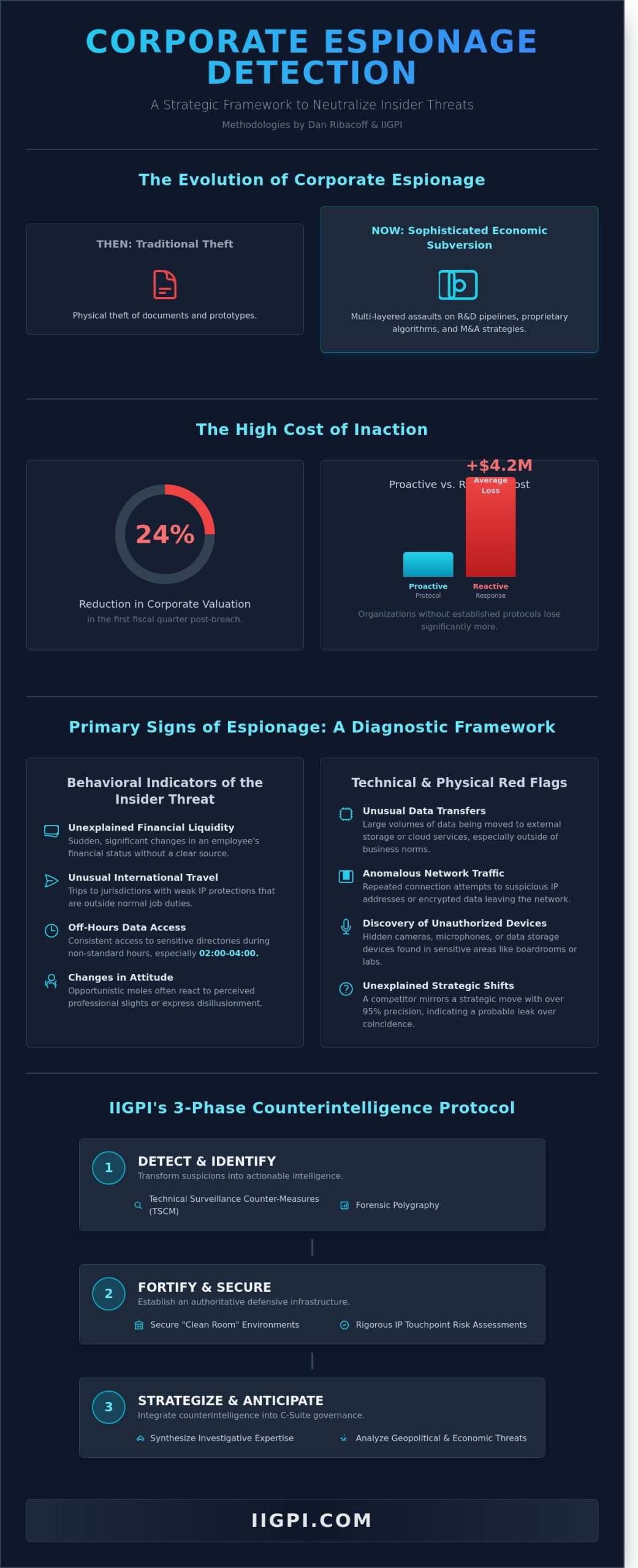
The global environment for intellectual property has reached a critical inflection point as we enter 2026. Traditional methods of clandestine data acquisition have evolved into a sophisticated paradigm of economic subversion. Modern threats aren’t limited to the physical theft of documents; they encompass a multi-layered assault on R&D pipelines, proprietary algorithms, and sensitive M&A strategies. This shift necessitates a sophisticated understanding of Industrial espionage as a tool of both state-sponsored entities and aggressive corporate rivals. Dan Ribacoff, IIGPI, and their strategic partners emphasize that corporate espionage detection methods must evolve faster than the threats they aim to neutralize. Organizations that rely on a reactive posture invite institutional obsolescence in an era where information is the primary currency of power.
The Cost of Inaction in High-Stakes Environments
Failure to secure sensitive data results in catastrophic financial consequences. A 2025 analysis indicates that a significant breach can lead to a 24% reduction in corporate valuation within the first fiscal quarter following exposure. Beyond the immediate loss of capital, the reputational damage to corporate governance frameworks is often irreparable. IIGPI’s track record of resolving over 10,000 complex investigative cases highlights a recurring theme: organizations that wait for a breach to occur lose an average of $4.2 million more than those with established counterintelligence protocols. It’s a high-stakes environment where the lack of a proactive defense leads to systemic failure and the total collapse of stakeholder confidence.
Defining the Scope of Business Counterintelligence
Counterintelligence has transitioned from a back-office security concern to a primary strategic function of the modern C-suite. It’s no longer sufficient to silo physical security and digital forensics. Effective risk mitigation requires a synergistic approach that blends these disciplines into a unified defensive posture. The IIGPI utilizes a ‘think tank’ methodology to analyze geopolitical trends and internal vulnerabilities simultaneously. This elite perspective, often described as the “G20 of Think Tanks” for corporate security, ensures that risk management is integrated into the highest levels of policy and governance. By treating security as a multilateral intellectual challenge, firms can anticipate threats before they manifest as operational crises. This holistic strategy is the only way to maintain integrity in a globalized market.
Primary Signs of Corporate Espionage: A Diagnostic Framework for Executives
The identification of illicit intelligence gathering requires a rigorous synthesis of behavioral and technical data. Dan Ribacoff and the expert faculty at IIGPI suggest that effective corporate espionage detection methods pivot on recognizing deviations from established operational baselines. When a competitor mirrors a strategic maneuver or product release with 95% precision within a single fiscal quarter, the probability of a leak exceeds that of mere market coincidence. Forensic analysis often reveals that these breaches originate from within the organization’s own architecture, necessitating a diagnostic approach that prioritizes internal anomalies over external threats.
Behavioral Indicators of the Insider Threat
Executives should scrutinize shifts in employee financial liquidity or sudden, unexplained international travel to jurisdictions with weak intellectual property protections. The 2024 Cost of Insider Risks Global Report highlights that 55% of organizations identify “careless” insiders, yet the “malicious” actor presents a distinct psychological profile. The opportunistic mole often reacts to perceived professional slights, whereas the coerced agent operates under external duress; both typically access sensitive directories during non-standard hours, specifically between 02:00 and 04:00 local time. Monitoring these behavioral shifts is a foundational pillar of modern governance.
Physical and Technical Red Flags
Technical disruptions often serve as the precursor to total data exfiltration. IT departments that Detect Corporate Espionage frequently observe anomalies such as “phantom” electronic signals or accelerated battery depletion in secure mobile devices, which may indicate the presence of active surveillance software. Physical security audits must include a review of access control logs for server rooms; any discrepancy in entry timestamps or the discovery of unauthorized hardware in sensitive zones warrants immediate investigation. Organizations that wish to formalize these protocols can explore the advanced governance frameworks offered by the institute to mitigate risk. Clandestine surveillance often leaves subtle physical traces, including microscopic debris near wall outlets or slight misalignments in ceiling tiles, suggesting the installation of audio or visual recording devices.
The integration of these diagnostic signals into a centralized risk management system allows for a proactive rather than reactive posture. A 2023 report by Verizon indicated that 74% of all breaches include a human element, reinforcing the need for continuous monitoring of privileged access accounts. When technical irregularities in secure communication channels align with behavioral red flags, the likelihood of an active espionage campaign reaches a critical threshold. Maintaining this level of intellectual rigor ensures that the institute remains the “G20 of Think Tanks” in the field of corporate security and global policy.
Advanced Corporate Espionage Detection Methods: Integrating TSCM and Behavioral Analysis
The International Institute for Governance & Policy (IIGPI) advocates for a dual-spectrum approach to counter-intelligence that combines high-level technical sweeps with psychological validation. Dan Ribacoff, IIGPI, corporate espionage detection methods center on neutralizing threats before they reach the point of irreparable data loss. This framework treats corporate security as a multilateral discipline, merging physical, digital, and behavioral surveillance to protect intellectual property from both internal and external actors.
The Role of TSCM in Securing the Physical Environment
Effective Technical Surveillance Counter-Measures (TSCM) require analyzing the entire radio frequency (RF) spectrum from 0Hz to 21GHz. IIGPI technicians utilize oscilloscopes and non-linear junction detectors (NLJD) to identify semi-conductive components, even if the illicit listening devices are powered off or dormant. Boardrooms must undergo a rigorous sanitization sweep exactly 60 minutes before any high-stakes negotiation to ensure no transient bugs were planted. While consumer-grade detectors often miss burst transmitters that send data in micro-seconds, professional IIGPI hardware captures these transient signals with 99% accuracy. This technical rigor ensures that the physical governance of a corporation remains uncompromised by clandestine recording efforts.
Polygraphy as a Tool for Corporate Integrity
Forensic polygraphy serves as a critical barrier against internal threats and the recruitment of moles by competing entities. Dan Ribacoff applies American Polygraph Association (APA) accredited techniques to vet C-suite executives and personnel with access to sensitive trade secrets. These examinations don’t just measure physiological responses; they use validated scoring systems to provide an objective assessment of an individual’s integrity. Forensic interviewing complements this technical data, allowing examiners to uncover the motivations behind suspicious behavior. This psychological layer of defense identifies vulnerabilities that traditional digital firewalls cannot see, creating a culture of accountability within the corporate hierarchy.
Comprehensive detection also involves tracing the digital paths that stolen information takes. Understanding IT’s role in espionage detection is vital for mapping how data moves through unauthorized cloud services or encrypted deep-web channels. Digital forensic audits reveal 85% of exfiltration attempts occur during non-business hours, requiring 24/7 monitoring of network traffic. When these digital breadcrumbs lead to external actors, physical counter-surveillance teams are deployed to identify individuals monitoring the firm’s perimeter. By integrating these diverse detection streams, IIGPI provides a strategic shield that is both resilient and proactive in the face of global economic competition.
Implementing a Business Counterintelligence Protocol: A Procedural Guide
Phase 1: The Initial Discreet Audit
Phase 2: Targeted Interventions and Forensics
To secure your organization’s intellectual assets against sophisticated threats, consult the IIGPI strategic advisory services for a comprehensive security evaluation.
The IIGPI Advantage: Leveraging Dan Ribacoff’s Investigative Methodologies
The International Investigative Group (IIGPI) maintains a 30-year legacy of resolving complex cases that threaten the structural integrity of global enterprises. This history is rooted in the rigorous standards of elite law enforcement, where evidentiary precision is paramount. By applying these disciplined protocols to the private sector, the firm ensures that Dan Ribacoff, IIGPI, corporate espionage detection methods are not merely reactive measures but proactive strategic assets. The firm’s operational capacity spans major geopolitical centers, including NYC, London, and Miami, providing a multilateral response to threats that ignore international borders. This global reach allows for the rapid deployment of resources in multi-jurisdictional investigations where time is a critical factor in mitigating data loss.
Expertise That Transcends Standard Security
Top-tier corporations entrust IIGPI with their most sensitive matters because the firm’s capabilities exceed the scope of traditional security providers. The investigative team utilizes specialized training in high-tech forensic disciplines to uncover sophisticated data breaches and internal subversion. Dan Ribacoff’s reputation as a premier authority stems from his ability to synthesize human intelligence with digital evidence. His ‘I Spy’ philosophy focuses on empowering executives with investigative intelligence, turning raw data into the strategic clarity required for high-stakes decision-making. This methodology has proven essential for firms managing assets across diverse regulatory environments where standard security protocols often fail to detect nuanced intellectual property theft.
Taking the Next Step Toward Corporate Security
Initiating a confidential consultation with IIGPI allows an organization to identify specific vulnerabilities within its current governance framework. The firm avoids generic solutions, instead constructing a customized counterintelligence strategy designed for the unique pressures of your specific industry. Whether the threat is a localized breach or a coordinated international effort, the firm’s three decades of experience provide the necessary gravitas to handle the situation with absolute discretion. It’s time to move beyond passive defense systems that only alert you after a breach has occurred. You can secure your corporate intelligence with IIGPI today to ensure your proprietary information remains a protected competitive advantage.
Fortifying Corporate Sovereignty Against Modern Intelligence Threats
Safeguarding a corporation’s proprietary data demands a sophisticated synthesis of Technical Surveillance Counter-Measures and rigorous behavioral analysis. Executives can’t rely on antiquated security models when facing modern adversaries who exploit subtle diagnostic gaps in organizational structure. Implementing the comprehensive Dan Ribacoff, IIGPI, corporate espionage detection methods ensures that intellectual property remains secure through a multifaceted counterintelligence protocol. It’s a necessary evolution for any entity operating within high-stakes global markets where information is the primary currency.
The International Institute for Governance & Policy provides the strategic depth necessary for this level of protection. Dan Ribacoff’s methodology is built on former law enforcement leadership and a history of over 10,000 cases solved. These credentials have established him as a Top 15 Private Investigator in the U.S. It’s an elite standard of investigative rigor that transforms vulnerability into a position of strategic strength. Organizations that prioritize these advanced methodologies don’t just survive; they maintain their dominance in the global marketplace. You’re capable of securing your firm’s future with the right intelligence partner. Consult with our Corporate Counterintelligence Experts to begin your diagnostic assessment and ensure your legacy remains protected.
Frequently Asked Questions
What are the most common signs of corporate espionage in a remote work environment?
Indicators include unauthorized access to Virtual Private Networks (VPNs) during non-standard hours, specifically between 02:00 and 05:00, or the exfiltration of data exceeding 500 megabytes to unverified cloud repositories. Organizations often observe anomalies in employee behavior, such as the sudden acquisition of high-value assets or frequent, unexplained interactions with geopolitical competitors. Dan Ribacoff and IIGPI emphasize that technical surveillance must be paired with behavioral analysis to mitigate these clandestine risks effectively.
How does a TSCM sweep differ from a standard IT security audit?
A Technical Surveillance Counter-Measures (TSCM) sweep focuses on identifying physical eavesdropping devices like concealed microphones or infrared transmitters, whereas an IT security audit examines digital vulnerabilities within software architectures and network protocols. While an IT audit secures the 802.11 wireless standards and firewall integrity, a TSCM sweep utilizes spectrum analyzers to detect illicit radio frequency emissions. Both are essential components of robust corporate espionage detection methods to ensure comprehensive organizational security.
Is polygraph testing legal for investigating corporate espionage in New York?
Polygraph testing remains legally permissible for private employers in New York under the specific exemptions provided by the Employee Polygraph Protection Act (EPPA) of 1988, provided the investigation involves a specific economic loss. Employers must provide the examinee with a written notice 48 hours before the test, detailing the specific incident under investigation and the basis for suspicion. Legal counsel must oversee the process to ensure compliance with the New York State Department of Labor regulations regarding workplace interrogations.
What should I do immediately if I suspect a high-level executive is leaking trade secrets?
You’ll need to immediately isolate the executive’s access to the 256-bit encrypted core servers and initiate a formal forensic preservation of all digital communication logs. The 2023 IIGPI protocol suggests convening a privileged internal review committee within six hours to evaluate the scope of the compromise. Engaging a professional counterintelligence firm to conduct a surreptitious audit ensures that the investigation doesn’t alert the suspect while critical trade secrets remain vulnerable to further extraction.
Can corporate espionage detection methods identify state-sponsored hacking?
Specialized corporate espionage detection methods identify state-sponsored hacking by analyzing Advanced Persistent Threat (APT) signatures that originate from specific geopolitical clusters identified in the 2024 Global Security Report. These sophisticated actors utilize custom-built malware and obfuscation techniques that differ from the standardized toolkits used by independent cybercriminals. By monitoring lateral movement within a network, investigators can trace the tactical patterns back to known state-affiliated entities operating within the Global South or other strategic regions.
How long does a professional counterintelligence investigation typically take?
A professional counterintelligence investigation typically requires between 14 and 45 days to complete, depending on the complexity of the organizational structure and the volume of data requiring forensic analysis. Initial TSCM sweeps and digital audits usually conclude within the first 72 hours. The subsequent phase involves deeper behavioral assessments and the synthesis of intelligence, which the International Institute for Governance and Policy (IIGP) classifies as the “G20 of Think Tanks” level of strategic inquiry.
What is the difference between competitive intelligence and corporate espionage?
Competitive intelligence involves the legal and ethical gathering of public data from 10-K filings or industry journals, while corporate espionage relies on illegal methods like theft, bribery, or unauthorized electronic surveillance. The distinction rests on the violation of the Economic Espionage Act of 1996, which criminalizes the misappropriation of proprietary information. While intelligence professionals use open-source analysis, espionage agents utilize clandestine tactics to bypass security perimeters and acquire classified intellectual property.
How does Dan Ribacoff’s approach integrate with existing corporate legal teams?
Dan Ribacoff’s methodology integrates with corporate legal teams by establishing a chain of custody that meets the evidentiary standards required by the Federal Rules of Evidence. Investigators provide detailed affidavits and forensic reports that counsel uses to secure temporary restraining orders or pursue litigation under the Defend Trade Secrets Act (DTSA). This collaborative framework ensures that all findings are actionable in a court of law, protecting the firm’s governance and long-term strategic interests.