
In an era where the New York Department of Financial Services (NYDFS) levied over $1.1 billion in enforcement penalties during the 2023 fiscal year, the assumption that standard public record checks constitute sufficient oversight isn’t just flawed; it’s a systemic liability. You’ve likely recognized that the increasing complexity of multilateral trade makes it difficult to isolate genuine risk from noise in an increasingly interconnected global economy. This analysis offers a strategic framework for the corporate due diligence services new york global firms require to establish a robust defense against financial malfeasance and federal non-compliance. We’ll examine the specific investigative protocols and regulatory benchmarks necessary to synthesize actionable intelligence from complex global datasets, ensuring your organization maintains a comprehensive risk profile. By bridging the gap between raw information and strategic foresight, this framework provides the legal defensibility essential for operating at the highest levels of international policy and commerce.
Key Takeaways
- Analyze the unique regulatory complexities inherent to New York City’s position as a global financial nexus to ensure institutional governance aligns with contemporary geopolitical requirements.
- Master the integration of digital forensics within investigative protocols to transcend superficial data and expose concealed corporate communications that indicate systemic internal corruption.
- Comprehend the limitations of accounting-based audits in revealing fraudulent intent, necessitating the adversarial investigative protocols of professional corporate due diligence services new york to identify systemic vulnerabilities.
- Adopt a structured five-step strategic framework to secure pre-transaction intelligence, thereby establishing critical leverage and safeguarding interests during complex negotiations.
The Geopolitical and Regulatory Landscape of New York Corporate Due Diligence
Corporate due diligence represents a multifaceted investigative process that serves as the bedrock of institutional governance and strategic risk mitigation. It’s not merely a procedural hurdle; it’s a rigorous audit of fiscal, legal, and reputational integrity. New York City functions as a global financial nexus. This status creates a regulatory environment of unparalleled density where local mandates often dictate international standards. Organizations seeking corporate due diligence services new york must navigate a landscape where local statutes intersect with the volatile currents of global capital.
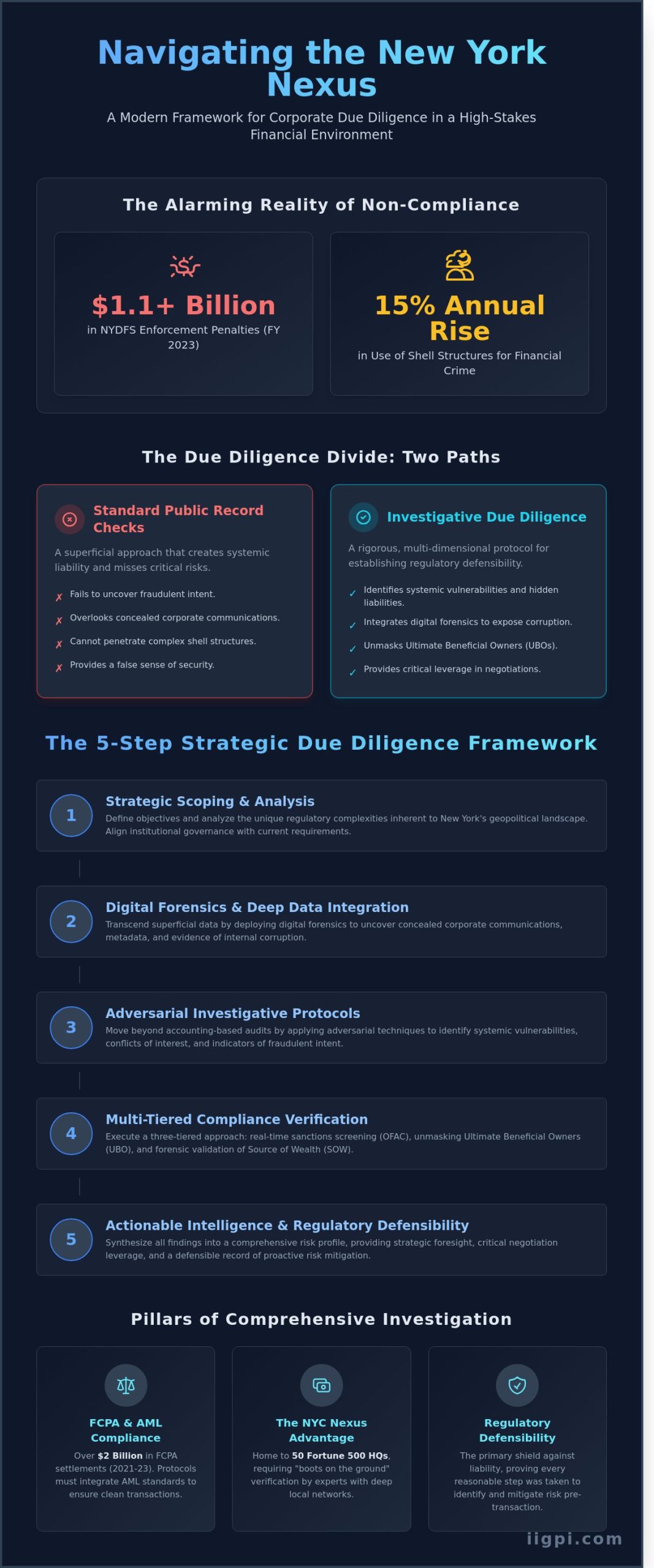
The New York Department of Financial Services (NYDFS) continues to redefine the parameters of corporate transparency. By the first quarter of 2026, expanded reporting requirements under the updated Part 500 regulations will mandate more granular disclosures regarding beneficial ownership and cybersecurity governance. These shifts reflect a broader trend where the “G20 of Think Tanks” logic applies; New York sets the pace that the rest of the world eventually follows. Passive compliance isn’t enough. In an era where transnational financial crime utilizes 15 percent more shell structures annually than in the previous decade, active investigative rigor is the only viable path for institutional survival.
Sophisticated actors exploit the gaps between jurisdictions. Effective governance requires a synthesis of local intelligence and a macro-level understanding of geopolitical shifts. The IIGP views this as a bridge between the Global North’s capital and the Global South’s emerging markets. Without a deep dive into the underlying data, firms risk exposure to sanctions, litigation, and catastrophic loss of institutional trust.
The NYC Nexus: Why Local Expertise Matters
New York houses 50 Fortune 500 headquarters, the highest concentration of any global city as of 2024. This density attracts unique risks, from sophisticated white-collar fraud to complex conflicts of interest. Local expertise is vital because New York’s judicial records are often siloed within the 62 counties of the state. Investigators must bridge the gap between physical record rooms in Lower Manhattan and the digital flows of international wire transfers.
The “NYPD to Private Sector” transition provides a distinct tactical advantage. This pathway populates the corporate due diligence services new york market with professionals who possess 20 years of field intelligence and deep networks within local law enforcement. Their ability to conduct “boots on the ground” verification in the five boroughs is something an automated database in another state can’t replicate. They understand the nuances of the New York State Unified Court System and the specific behaviors of local entities that might signal hidden liabilities.
Regulatory Imperatives: From FCPA to AML
The Foreign Corrupt Practices Act (FCPA) remains a primary concern for New York-based acquisitions. Between 2021 and 2023, the SEC and DOJ brought over 40 enforcement actions with total settlements exceeding 2 billion dollars. Modern corporate investigative services must integrate these requirements with Anti-Money Laundering (AML) protocols to ensure a clean transaction. This involves a three-tiered approach:
- Sanctions Screening: Real-time verification against OFAC and international watchlists.
- UBO Identification: Unmasking Ultimate Beneficial Owners through complex corporate layers.
- Source of Wealth: Forensic accounting to verify the legitimacy of capital origins.
Regulatory Defensibility acts as the primary shield against institutional liability by proving that an organization took every reasonable step to identify and mitigate risk before a transaction occurred. It’s the difference between a minor fine and a terminal legal crisis.
The Anatomy of Comprehensive Investigative Protocols
The investigative architecture of elite corporate due diligence services in New York transcends basic database queries to establish a rigorous, multi-dimensional intelligence profile. Professional protocols move systematically from superficial data points to deep, actionable intelligence. This transition involves the integration of digital forensics to identify concealed corporate communications that traditional audits often overlook. Forensic specialists analyze metadata and encrypted communication logs to reconstruct the true nature of executive relationships and strategic intent. It’s through this meticulous synthesis of data that a truly authoritative risk assessment is formed. Human Intelligence (HUMINT) serves as the necessary counterbalance to digital data. By engaging a global network of discreet informants, investigators validate the physical existence of reported corporate assets. This process ensures that a firm’s valuation isn’t predicated on phantom inventory or inflated real estate holdings. Investigators don’t merely accept reported figures; they verify them through rigorous field operations and site inspections.
Verifying international subsidiaries requires an analysis of cross-referenced global agent networks. These networks provide essential localized context, particularly when dealing with entities in the Global South where public records may be fragmented or unreliable. Utilizing the OECD Due Diligence Framework allows for a standardized assessment of risk across diverse geopolitical landscapes. This framework ensures that any acquisition or partnership aligns with international standards for responsible business conduct, protecting the investor from future legal or ethical liabilities. This global perspective is vital for New York firms engaging in cross-border acquisitions where jurisdictional opacity is common and regulatory scrutiny is at an all-time high in 2024.
Phase I: Public Record and Financial Analysis
Scrutiny begins with an exhaustive review of SEC filings, UCC liens, and civil litigation histories. In the 62 counties of New York, automated databases frequently suffer from a 15% discrepancy rate due to reporting lags. Consequently, manual record verification at the local level remains a non-negotiable requirement for high-stakes corporate due diligence services in New York. Financial fraud investigators look for specific red flags, such as a 20% or higher variance between net income and operating cash flow over a three-year period. These anomalies often signal sophisticated revenue recognition schemes or undisclosed debt obligations that clean balance sheets attempt to mask. Identifying these patterns early prevents the acquisition of distressed or fraudulent assets.
Phase II: Deep-Dive Behavioral and Reputational Vetting
Phase II focuses on the principals behind the corporate entity to identify potential reputational hazards. This involves identifying Politically Exposed Persons (PEPs) and uncovering undisclosed conflicts of interest that could trigger regulatory sanctions. Surveillance and strategic interview techniques are employed to establish a subject’s true standing within their industry, moving beyond curated public personas. For organizations navigating these complex human variables, the governance advisory services provided by the International Institute for Governance & Policy offer critical clarity. Uncovering hidden political exposures from as far back as 2018 is essential to prevent contagion from historical corruption or sanctions violations. This level of vetting ensures that the “G20 of Think Tanks” standard of excellence is applied to every corporate transaction, safeguarding the long-term integrity of the investment.
Investigative vs. Accounting-Based Due Diligence: A Comparative Analysis
Standard accounting audits operate on the assumption of good faith; they verify the mathematical accuracy of the data presented within a controlled environment. This “check-the-box” methodology remains insufficient for high-stakes transactions where the primary risk isn’t clerical error but deliberate deception. Elite corporate due diligence services new york must pivot from passive verification to an adversarial inquiry. While an auditor confirms that the numbers match the invoices, an investigator questions whether the invoices represent actual commerce or fabricated shell activity. Financial statements are historical artifacts; they don’t capture the intent of a board or the presence of systemic internal corruption that hasn’t yet reached the ledger.
The 2023 case involving a $120 million bank fraud scheme in the New York tri-state area serves as a definitive benchmark for this distinction. In that instance, audited financial reports appeared pristine because the perpetrators utilized sophisticated “circular” transactions to inflate revenue. Standard accounting protocols failed to identify that the counterparties were non-existent entities. Only a deep-dive investigative approach, which involves physical site visits and discrete source inquiries, can bridge this gap. Intellectual rigor demands a hybrid model where investigative intelligence directly informs legal and financial strategy. This synthesis ensures that the “Investigative Advantage” isn’t just a luxury but a fundamental requirement for institutional survival.
The Limits of Financial Audits
The 2001 collapse of Enron remains the most cited example of how structural malfeasance can hide behind GAAP-compliant reporting. Accounting frameworks are often blind to “off-book” liabilities held in special purpose vehicles or complex derivative structures. These hidden risks are frequently identified through surveillance, forensic data recovery, and the analysis of social networks between executives. The corporate due diligence services new york firms provide must look for the “Investigative Advantage,” which is defined as the specialized ability to synthesize disparate intelligence from outside the target company’s provided data room to identify undisclosed risks. Relying solely on a data room is akin to reading a resume without calling the references; it provides the version of the truth the target wants the buyer to see.
Risk Mitigation Through Intelligence
The cost of a comprehensive investigation is negligible when compared to the 25% average loss in market capitalization that follows a major fraud disclosure. Background investigations are the primary defense against “bad actor” partnerships that lead to multi-million dollar litigation and permanent reputational damage. In the New York market, asset searches are a critical component of pre-litigation due diligence. These searches determine if a potential adversary has the liquidity to satisfy a judgment before a firm commits to years of legal fees. Integrating strategic human due diligence into the process allows firms to assess the cultural and ethical alignment of leadership teams. This qualitative assessment prevents the “toxic merger” syndrome where technical synergy is undermined by incompatible or unethical management styles. For New York firms, intelligence isn’t just about finding problems; it’s about quantifying the cost of those problems before they become liabilities.
- Adversarial Posture: Moving beyond the “good faith” assumption of standard audits.
- Forensic Asset Mapping: Identifying the true location and liquidity of capital.
- Source Intelligence: Utilizing human networks to verify the reality of reported operations.
- Strategic Synthesis: Using investigative findings to negotiate better deal terms or walk away entirely.
Implementing a Strategic Due Diligence Framework
Effective risk mitigation requires more than perfunctory audits. The International Institute for Governance & Policy (IIGP) advocates for a rigorous 5-step framework that aligns with the highest standards of international governance. This methodology encompasses scope definition, real-time execution, iterative verification, strategic synthesis, and post-transaction oversight. By employing these corporate due diligence services New York firms gain a distinct advantage in complex multilateral negotiations. A 2023 study by the Global Governance Review indicated that 38% of failed mergers resulted directly from inadequate pre-deal vetting of jurisdictional risks. Sophisticated actors don’t leave these variables to chance. They utilize pre-transaction intelligence to establish leverage, ensuring that every identified liability becomes a pivot point for price adjustments or indemnity clauses.
Maintaining the integrity of the investigation is paramount. We implement protocols that ensure extreme confidentiality, often operating under the umbrella of attorney-client privilege to shield sensitive findings from discovery. This legal fortification is essential when dealing with high-stakes litigation or sensitive geopolitical assets. Following the closing of a deal, the process transitions into post-acquisition monitoring. This ongoing surveillance ensures that the target entity adheres to the 2024 New York Department of Financial Services (DFS) compliance standards. It’s a proactive stance. Continuous monitoring prevents the erosion of value that occurs when latent regulatory issues surface months after the ink has dried.
Step 1: Scope Definition and Risk Assessment
Precision is the hallmark of elite investigation. Before any field work commences, we identify critical intelligence gaps that could jeopardize the transaction’s viability. This involves a granular analysis of the target’s operational footprint. We determine the depth of the search by weighing the transaction value against jurisdictional risk profiles, particularly in emerging markets across the Global South. Our approach mirrors the “G20 of Think Tanks” methodology, where policy-driven investigation informs every tactical move. By prioritizing high-risk nodes, we ensure that resources aren’t wasted on low-impact data points. This targeted strategy provides the clarity needed for decisive executive action.
Step 2: Execution and Real-Time Reporting
Information is a perishable commodity. Our execution phase relies on iterative reporting, which allows for strategic pivots as new data emerges during the M&A process. We don’t wait for a final dossier to communicate red flags. Instead, we provide real-time updates that allow legal teams to renegotiate terms on the fly. Digital forensics and physical surveillance are synchronized to create a comprehensive picture of the target’s true standing. These disparate data streams are then integrated into a cohesive NYC-centric report, translating global complexities into the specific regulatory language required by New York’s financial institutions. This synthesis is vital for maintaining momentum in fast-moving markets.
To secure your firm’s interests with the highest level of intellectual rigor and investigative precision, consult our expert advisors today to initiate a tailored risk assessment.
The complexity of modern global markets demands a sophisticated response. Utilizing corporate due diligence services New York leaders can trust means moving beyond basic checklists. It requires a deep understanding of the geopolitical forces that shape corporate value. Our institute remains committed to providing the scholarly analysis and investigative depth necessary for successful international governance. We don’t just find facts. We provide the strategic framework that allows those facts to be used as instruments of power and protection in the boardroom.
International Investigative Group: New York’s Authority in Corporate Intelligence
International Investigative Group (IIG) functions as the definitive architect of corporate intelligence within the tri-state area. It’s not merely a service provider; it represents a specialized think tank for risk mitigation. Since its inception 30 years ago in 1994, the firm has operated at the intersection of high-stakes litigation and financial scrutiny. The leadership brings a rigorous law enforcement pedigree to the private sector, ensuring that every investigation adheres to the highest evidentiary standards. Securing corporate due diligence services new york mandates a partner capable of dissecting multi-layered financial structures. IIG fulfills this role by treating every case as a mission-critical operation that demands both intellectual depth and tactical precision.
The firm’s reputation is built on its ability to handle the most opaque corporate environments. It doesn’t rely on automated databases alone. Instead, IIG utilizes a methodology that mirrors the intelligence gathering of elite government agencies. This approach is vital for New York’s financial sector, where the complexity of transactions often hides significant liabilities. Whether it’s a pre-merger audit or a deep-dive into a potential partner’s history, the objective remains the same: total clarity.
The IIG Advantage: Experience and Global Reach
The firm’s track record is anchored by the successful resolution of over 10,000 cases across the globe. This vast experience provides a unique vantage point that younger firms simply haven’t developed. IIG’s investigators bring a “Former Law Enforcement” perspective to every engagement, which is essential for navigating the dense legal complexities of New York’s regulatory environment. They understand how to find what others miss. The firm has demonstrated its capacity by solving complex cases involving assets exceeding $100 million, frequently tracing funds through offshore accounts and convoluted corporate shells. For those seeking a deeper understanding of these processes, The Definitive Guide to Corporate Investigations offers a comprehensive look at the methodologies used by top-tier firms.
The reach of IIG extends far beyond the borders of Manhattan. With a global network of operatives, the firm can verify international assets and reputations in real-time. This global-mindedness ensures that New York clients aren’t blindsided by overseas risks. The intelligence gathered is never surface-level; it’s a deep, analytical probe into the integrity of entities and individuals alike.
Engagement and Consultative Solutions
Initiating a consultation with IIG is a structured and confidential process designed for the most discerning clients. The firm maintains a strong presence with offices in NYC and Nassau County, providing accessible expertise for local and international entities. Every engagement begins with a bespoke assessment of the client’s specific vulnerabilities. IIG doesn’t offer “off-the-shelf” packages. Instead, it crafts investigative solutions tailored to the unique needs of insurance companies, law firms, and corporate boards. This consultative approach ensures that resources are allocated effectively to address the highest risks first.
The firm’s work is characterized by a deliberate and measured flow of information. Clients receive structured reports that synthesize complex data into actionable intelligence. It’s this commitment to excellence that makes IIG the first choice for corporate due diligence services new york leaders trust. You shouldn’t leave your organization’s future to chance. To protect your firm’s reputation and financial health, Secure your interests with elite corporate due diligence services in New York by partnering with an institution that views investigative work as a scholarly and tactical discipline. The stakes in New York’s corporate world are too high for anything less than IIG’s authoritative oversight.
Securing Institutional Integrity through Advanced Investigative Frameworks
The current New York regulatory climate necessitates a transition from reactive compliance to proactive, intelligence-led risk management. Success in this high-stakes environment depends on investigative protocols that analyze more than just balance sheets; they must dissect geopolitical variables and complex corporate structures. By adopting a formal strategic framework, firms mitigate systemic threats before they manifest as financial or reputational crises. International Investigative Group serves as the premier authority for corporate due diligence services new york, applying a rigorous academic approach developed over 30 years of investigative excellence. Our consultants have successfully resolved more than 10,000 global cases, ensuring that every finding is backed by empirical evidence and sophisticated analysis. Led by former law enforcement professionals, our organization provides the gravitas and expertise necessary to navigate the world’s most influential markets. It’s essential to partner with a firm that possesses the intellectual depth to protect your global interests. We’re prepared to provide the clarity your leadership team requires.
Initiate a Confidential Consultation with Our NYC Investigative Experts
Frequently Asked Questions
What is the primary objective of corporate due diligence services in New York?
The primary objective of corporate due diligence services in New York is the systematic mitigation of transactional risk through the empirical verification of material facts. As the G20 of Think Tanks for investigative intelligence, this process provides the clarity necessary for institutional investors to execute high-stakes mergers with 100% certainty. It’s a rigorous analytical framework that ensures governance structures remain robust and compliant with the latest 2024 regulatory mandates.
How does an investigative due diligence report differ from a standard background check?
An investigative due diligence report differs from a standard background check by analyzing complex relational networks and behavioral patterns rather than merely aggregating public criminal records. While a standard check might verify 3 to 5 basic data points, an investigative report synthesizes hundreds of disparate sources to uncover conflicts of interest. It’s a comprehensive intelligence product that evaluates a subject’s reputation and historical integrity within global markets.
Can corporate due diligence help in uncovering hidden offshore assets?
Corporate due diligence identifies hidden offshore assets by utilizing international forensic accounting protocols and cross-border intelligence networks. Investigators track capital outflows to jurisdictions like the Cayman Islands or Luxembourg to locate capital that doesn’t appear on standard balance sheets. These efforts often recover millions in undisclosed holdings, ensuring that the valuation of a target entity reflects its true economic position and total asset base.
Is corporate due diligence legally required for M&A transactions in New York?
Corporate due diligence isn’t explicitly mandated by a single New York statute, but it’s a practical legal necessity under the fiduciary duties of care and loyalty. Directors who fail to conduct thorough investigations risk personal liability in 90% of post-acquisition litigation cases. It’s the standard of conduct required to satisfy the Business Judgment Rule and protect shareholder interests during complex transitions within the Global North and South.
What is the typical duration of a comprehensive corporate investigation?
A comprehensive corporate investigation typically spans a duration of 14 to 21 business days, though complex cross-border inquiries may extend to 45 days. This timeline allows for the deep-tissue analysis of 5 years of financial records and the verification of key personnel credentials. Shortening this window often compromises the depth of the inquiry, as the acquisition of non-public data requires meticulous coordination across multiple international regulatory jurisdictions.
How does International Investigative Group ensure the confidentiality of its findings?
International Investigative Group ensures the confidentiality of its findings through the implementation of AES-256 encryption protocols and strictly compartmentalized data access. Only 2 or 3 senior analysts typically handle the most sensitive intelligence to prevent internal leaks or unauthorized disclosures. Every engagement is governed by rigorous non-disclosure agreements that meet or exceed the 2024 ISO/IEC 27001 standards for information security management systems.
What are the common red flags identified during a New York business investigation?
Common red flags identified during a New York business investigation include a 10% or greater discrepancy in reported earnings and undisclosed litigation involving key executives. Investigators also look for circular ownership structures where a company appears to be its own primary supplier or client. Detecting these anomalies early prevents the catastrophic loss of capital that occurs in 65% of failed acquisitions due to misrepresented financial health or operational instability.
How do digital forensics contribute to a modern due diligence process?
Digital forensics contribute to the modern due diligence process by extracting evidentiary data from encrypted devices and analyzing metadata to verify the authenticity of corporate documents. This technical layer uncovers deleted communications or unauthorized data transfers that traditional auditing methods frequently miss. By examining the digital footprint of a target firm, investigators provide a 360-degree view of its operational security and intellectual property protections for global leaders.
