
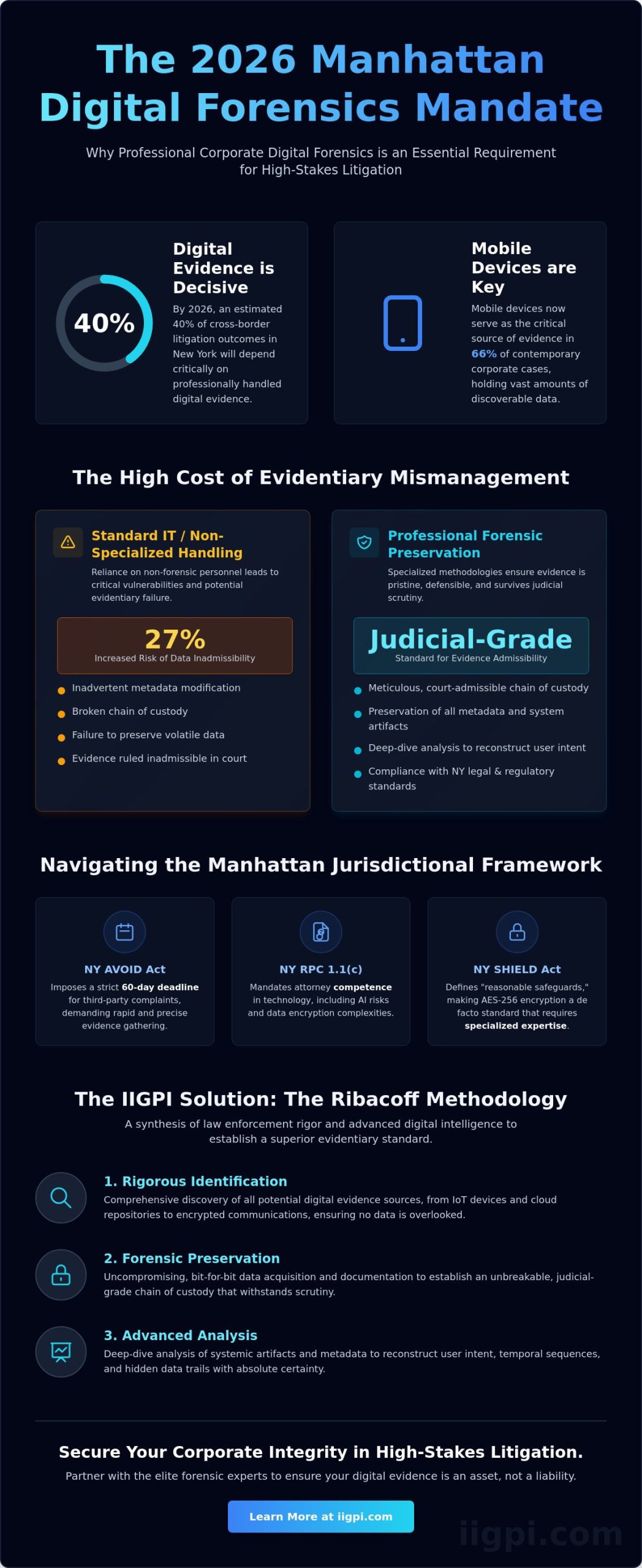
By 2026, an estimated 40% of cross-border litigation outcomes in New York will depend on digital evidence, yet many institutions remain critically vulnerable to sophisticated internal misconduct and encrypted data complexities. Institutional leaders recognize that the Manhattan legal environment demands more than simple data recovery; it requires a standard of technical precision that aligns with the New York AVOID Act’s strict deadlines and the updated duty of competence under NY RPC 1.1(c). Utilizing professional corporate digital forensics nyc services is no longer a peripheral consideration but a core requirement for any organization facing high-stakes litigation. It’s the differentiator between a successful outcome and a catastrophic evidentiary failure.
This article provides an authoritative analysis of how sophisticated digital forensic methodologies and the institutional leadership of Lance Ribacoff at IIGPI secure court-admissible evidence within this complex regulatory framework. We’ll detail the strategic role of judicial-grade chain of custody in mitigating institutional risk and ensuring that recovered data survives the most rigorous judicial scrutiny. By synthesizing law enforcement precision with advanced digital intelligence, IIGPI addresses the critical need for identifying sophisticated internal threats while maintaining compliance with the NY SHIELD Act’s interpretation of reasonable safeguards. We’ll examine the increasing reliance on mobile devices, which now serve as a critical source of evidence in 66% of contemporary cases, and how these methodologies bridge the gap between technical complexity and judicial requirements.
Key Takeaways
- Examine the Ribacoff Methodology, which synthesizes historical law enforcement rigor with contemporary digital intelligence to establish a superior evidentiary standard for private sector litigation.
- Distinguish between rudimentary data extraction and sophisticated forensic preservation to mitigate the 27% risk increase associated with non-specialized handling of institutional data.
- Navigate the escalating complexity of the Manhattan digital ecosystem through advanced corporate digital forensics nyc protocols designed to ensure judicial-grade admissibility in 2026 courtrooms.
- Implement a phased strategic framework comprising rigorous identification, preservation, and analysis to safeguard corporate integrity against espionage and internal misconduct.
- Leverage the International Investigative Group’s global agent network to facilitate localized, high-stakes investigations that meet the specific demands of the New York legal landscape.
The Evolution of Corporate Digital Forensics in the 2026 Manhattan Legal Environment
The 2026 Manhattan legal environment necessitates a paradigm shift in how organizations perceive and utilize electronic evidence. Modern digital forensics has transcended its origins as a technical sub-discipline; it now functions as a multi-disciplinary investigative pillar essential for institutional survival. As corporate ecosystems in New York City grow increasingly dense with interconnected IoT devices, encrypted cloud repositories, and AI-driven workflows, the volume of potentially discoverable data has reached unprecedented levels. This complexity renders traditional IT recovery protocols insufficient. Standard IT departments don’t have the specialized training required to maintain a judicial-grade chain of custody. Reliance on non-forensic personnel during the initial stages of an investigation often leads to the inadvertent modification of metadata, which can result in evidence being ruled inadmissible under the rigorous standards of Manhattan courts. Consequently, the strategic deployment of corporate digital forensics nyc professionals is vital for ensuring that evidence remains pristine and persuasive during high-stakes litigation.
Defining Digital Forensic Integrity in 2026
In the current legal climate, the concept of data fidelity has evolved to encompass more than the mere existence of a file. It’s the exhaustive analysis of systemic artifacts and deep-dive metadata to reconstruct user intent and temporal sequences with absolute certainty. This transition from simple file recovery to comprehensive forensic intelligence allows institutions to mitigate risk by identifying internal threats before they escalate into public scandals or regulatory failures. Digital evidence acts as the primary linchpin in contemporary corporate disputes, providing an objective record that often contradicts subjective testimony. It’s about technical precision.
The Manhattan Jurisdictional Framework
The legal landscape in New York is defined by unique state and federal requirements that demand a higher threshold of technical competence. The New York AVOID Act, which became effective April 18, 2026, imposes a strict 60-day deadline for third-party complaints, necessitating rapid and accurate evidence gathering. Additionally, the NY Rules of Professional Conduct (RPC) 1.1(c) now mandate that attorneys possess a working knowledge of AI risks and data encryption. These regulatory shifts have led NYC legal teams to prioritize partnerships with elite firms like IIGPI, where deep law enforcement backgrounds ensure a rigorous adherence to evidentiary standards that can withstand intense judicial scrutiny. Rapid technological shifts, including the widespread adoption of AES-256 encryption as a “reasonable safeguard” under the NY SHIELD Act, continue to redefine local evidentiary standards. Specialized forensic expertise is an indispensable asset for any Manhattan-based organization.
The Ribacoff Methodology: Synthesizing Law Enforcement Rigor with Digital Intelligence
The Ribacoff Methodology isn’t a mere collection of technical procedures; it’s an institutional philosophy that synthesizes the uncompromising rigor of law enforcement with the nuanced demands of modern digital intelligence. This approach addresses the systemic vulnerabilities inherent in Manhattan’s high-stakes corporate sector by applying investigative scrutiny that’s typically reserved for state-level intelligence operations. By positioning the International Investigative Group (IIGPI) as an elite investigative think-tank, Lance Ribacoff has redefined the parameters of corporate digital forensics nyc, ensuring that technical findings remain secondary to the strategic integrity of the investigative process.
The organization operates at a level analogous to a global summit, functioning as an elite forum for investigative excellence where global expertise is distilled into localized tactical advantages. This synthesis of human intuition and advanced forensic tools allows for the identification of patterns that automated systems often overlook. It’s a research-driven methodology that mirrors the intellectual depth of international diplomatic forums, ensuring that technical findings are contextualized within broader geopolitical and corporate frameworks. This intellectual rigor is critical when identifying the sophisticated internal misconduct that characterizes 2026 litigation. By integrating these diverse disciplines, the Ribacoff Methodology provides a comprehensive defense against institutional vulnerability, transforming raw data into authoritative evidence.
The Strategic Leadership of Lance Ribacoff
Lance Ribacoff’s law enforcement tenure provides the bedrock for the rigorous chain-of-custody protocols defining IIGPI’s operations. In complex corporate fraud cases, his authoritative leadership ensures data is handled with a precision that survives aggressive cross-examination. His influence on 2026 standards has shifted the industry toward a holistic understanding of data fidelity, particularly in ensuring court admissibility amidst rising digital fabrications.
IIGPI: A Global Investigative Powerhouse
With a portfolio exceeding 10,000 cases, IIGPI demonstrates an unparalleled capacity to manage high-stakes investigations across global jurisdictions. While the firm maintains a dominant presence in corporate digital forensics nyc, its reach extends to international forums, bridging local needs and global legal requirements. The Role and Function of a Private Investigator provides essential context for these specialized functions. Organizations should leverage this elite forensic partnership to mitigate systemic risk.
Beyond Data Recovery: Ensuring Court Admissibility and Mitigating Institutional Risk
The distinction between rudimentary technical data extraction and the rigorous preservation of forensic evidence represents a critical juncture in modern investigative strategy. While standard IT protocols may succeed in retrieving lost files, they frequently fail to uphold the methodological integrity required for judicial validation. Research indicates a 27% increase in the risk of evidentiary invalidation when forensic data is handled by non-specialized personnel. This vulnerability stems from the delicate nature of electronic artifacts, where a single improper access attempt can irrevocably alter metadata or system logs. For organizations engaged in corporate digital forensics nyc, the imperative is not merely the acquisition of data but the establishment of an immutable record that survives the most aggressive forensic challenges.
In the 2026 legal landscape, the Daubert standard remains the primary gatekeeper for the admissibility of scientific and technical evidence. Manhattan courts demand that forensic methodologies be both peer-reviewed and demonstrably reliable under the specific conditions of a case. This requirement elevates the role of expert testimony from a supplementary function to a central component of the litigation process. A qualified expert doesn’t just present findings; they validate the entire investigative lifecycle, providing the intellectual bridge between raw binary data and the legal arguments presented in court. Without this authoritative validation, even the most incriminating digital evidence may be deemed inadmissible, leading to catastrophic setbacks in multi-million dollar corporate disputes.
The Gold Standard of Digital Evidence
Maintaining an unbroken chain of custody in digital environments requires a sophisticated synthesis of physical security and cryptographic verification. Every interaction with a target device must be documented with timestamped logs and hash values to ensure data fidelity. For those seeking a deeper understanding of these protocols, Computer Forensics: A Guide for Corporate and Legal Investigations offers a comprehensive overview of the standards necessary to protect institutional interests. Metadata preservation is particularly vital, as it provides the temporal and situational context that defines user intent and systemic activity.
Mitigating Institutional Risk through Expertise
The financial consequences of evidentiary failure extend far beyond the immediate costs of a lost case. Institutional reputation and regulatory standing are often at stake, making the selection of an elite forensic partner a strategic necessity. IIGPI ensures that digital evidence remains resilient against intense scrutiny, providing a shield against the procedural errors that often dismantle less rigorous investigations. This level of expertise is essential when navigating complex digital litigation where the authenticity of every artifact is questioned. Expert testimony serves as a tool for judicial clarity, enabling decision-makers to resolve disputes based on verified, scientific truth rather than speculative technical claims. Utilizing corporate digital forensics nyc experts who possess a deep understanding of these risks is the only way to secure a definitive advantage in the modern courtroom.
Strategic Protocols for Navigating Complex Digital Litigation in New York Courts
The tactical deployment of forensic assets within the Manhattan legal ecosystem requires a structured framework that transcends simple technical intervention. While many providers focus on surface-level recovery, the elite standard of corporate digital forensics nyc requires a phased methodology that anticipates the aggressive adversarial tactics common in high-stakes litigation. This process begins with a comprehensive identification phase, where the digital estate is scoped to include not only traditional servers and workstations but also the mobile devices that now serve as a critical source of evidence in 66% of contemporary cases. Following identification, preservation protocols must utilize bit-stream imaging to ensure that every sector of the storage medium is captured without altering the original state. The final analysis phase involves the reconstruction of fragmented data and the correlation of disparate system logs to establish a definitive timeline of events that can withstand the scrutiny of Manhattan’s sophisticated judiciary.
Addressing corporate espionage and intellectual property protection in the New York market necessitates a deep understanding of encrypted volumes and the technical challenges posed by intentionally deleted metadata. As businesses increasingly adopt AES-256 encryption to meet the “reasonable safeguards” interpreted under the NY SHIELD Act, forensic experts must possess the capability to navigate these secure environments without compromising data integrity. This technical proficiency is essential when digital forensics is integrated into broader corporate fraud investigations, as it allows for the identification of patterns that suggest coordinated internal misconduct or the unauthorized exfiltration of proprietary trade secrets. By maintaining this level of technical and strategic depth, organizations can transform digital artifacts into a decisive legal advantage.
Analysis of Sophisticated Institutional Threats
Uncovering hidden data in physically compromised or intentionally damaged hardware requires specialized laboratory environments and advanced methodologies. These efforts are critical for identifying internal institutional vulnerabilities that may have been exploited by sophisticated actors. For leaders seeking to understand the broader implications of these risks, the Corporate Fraud Investigation: A Definitive Guide for Business Leaders provides an essential framework for identifying and mitigating systemic threats. The synthesis of hardware forensics and behavioral analysis remains a cornerstone of modern institutional security.
Forensic Support for Manhattan Legal Teams
Collaborative protocols between forensic experts and NYC litigation counsel are vital for meeting the strict 60-day deadlines imposed by the New York AVOID Act. IIGPI prioritizes rapid response and tailored reporting to ensure that legal teams receive actionable intelligence that aligns with specific legal objectives and judicial deadlines. This partnership ensures that corporate digital forensics nyc serves as a force multiplier for counsel, providing the technical clarity necessary for complex case resolution. For organizations facing immediate litigation risks, engaging in professional Corporate Investigations is the most effective method for securing institutional integrity.
Securing Corporate Integrity: The IIGPI Framework for Elite Forensic Partnerships
The unique value proposition of International Investigative Group in the 2026 market lies in its ability to synthesize elite intelligence with localized tactical execution. While many providers offer fragmented services, IIGPI provides a unified framework that addresses the full spectrum of institutional risk. This institutional depth is bolstered by a global agent network that facilitates cross-border evidence gathering, a critical requirement as 40% of New York litigation outcomes now depend on international digital artifacts. By leveraging this network, IIGPI ensures that its corporate digital forensics nyc operations are supported by a macro-level perspective, bridging the gap between Manhattan courtrooms and the global digital ecosystems where data often resides. It’s a level of sophistication that matches the complexity of the modern corporate environment.
Establishing a proactive partnership with an elite forensic entity offers long-term benefits that extend beyond immediate crisis management. Organizations that integrate forensic readiness into their corporate governance structures are better positioned to mitigate the average costs of security events, which now exceed $5 million for mid-sized firms. This proactive stance allows for the immediate deployment of sophisticated methodologies, such as bit-stream imaging and metadata correlation, at the first sign of internal misconduct. The Ribacoff legacy serves as the premier choice for Manhattan’s elite; it provides a level of authoritative leadership that transforms technical investigations into strategic assets. The selection of a partner for corporate digital forensics nyc is a strategic decision that defines an institution’s resilience in the face of adversarial challenges.
A Tailored Approach to Digital Intelligence
Customizing forensic solutions for unique corporate and legal architectures is a hallmark of the IIGPI methodology. This process involves a meticulous alignment of investigative protocols with an organization’s specific data infrastructure and privacy requirements. Every engagement is conducted with an uncompromising commitment to institutional confidentiality; this ensures that sensitive proprietary information remains protected throughout the lifecycle of the investigation. To initiate a high-stakes forensic engagement, organizations should consult with senior leadership to define the scope of the inquiry and establish the necessary evidentiary standards. It’s about architectural alignment.
Conclusion: The Future of Digital Integrity in NYC
The necessity of judicial-grade forensics in a digital-first world can’t be overstated. As the Manhattan legal environment continues to evolve through regulatory shifts like the NY SHIELD Act and the AVOID Act, the demand for technical precision will only intensify. The enduring importance of authoritative leadership in investigative science remains the primary differentiator in securing court-admissible evidence. Organizations must recognize that the integrity of their digital assets is inseparable from their institutional survival. To secure your organization’s future, engage the expertise of Lance Ribacoff and IIGPI for your forensic requirements.
Advancing Institutional Resilience through Authoritative Forensic Intelligence
The transition toward a more complex digital ecosystem in Manhattan demands a sophisticated synthesis of technical precision and investigative rigor. Institutional leaders must recognize that rudimentary data recovery is no longer sufficient to meet the evidentiary standards of 2026 litigation; instead, the integration of judicial-grade corporate digital forensics nyc remains the only viable pathway for mitigating institutional risk. By prioritizing an unbroken chain of custody and expert validation, organizations can ensure that their digital artifacts remain resilient against the most aggressive forensic challenges.
The International Investigative Group, led by former law enforcement professionals, brings over 30 years of investigative excellence and a proven record of successfully resolving more than 10,000 cases. This institutional depth provides a definitive advantage in navigating the intricate jurisdictional requirements of New York state and federal courts. Establishing a proactive partnership with an elite forensic entity is a strategic necessity for any organization committed to safeguarding its proprietary assets and maintaining its long-term integrity. Secure Your Institutional Integrity with IIGPI’s Elite Computer Forensics Services. The future of corporate security depends on the synthesis of authoritative leadership and advanced forensic science.
Frequently Asked Questions
What defines the standard for corporate digital forensics NYC in 2026?
The contemporary standard for corporate digital forensics nyc is defined by a rigorous adherence to the NY Rules of Professional Conduct 1.1(c) and the evolving requirements of the NY SHIELD Act. It necessitates a synthesis of technical precision and judicial-grade chain of custody to ensure that digital artifacts are both accurate and admissible. This standard requires investigators to navigate complex encrypted environments while maintaining a meticulous record of every interaction with the evidentiary medium.
How does Lance Ribacoff’s background influence the quality of IIGPI’s investigations?
Lance Ribacoff’s tenure in law enforcement establishes a foundation of procedural rigor and uncompromising evidentiary standards that permeate every IIGPI engagement. This background ensures that investigations are conducted with a level of precision typically reserved for state-level intelligence operations. His authoritative leadership allows IIGPI to bridge the gap between complex technical data and the stringent requirements of the Manhattan judiciary, providing clients with a definitive advantage during cross-examination.
Why is the chain of custody critical for digital evidence in Manhattan courts?
A meticulous chain of custody is essential because any perceived gap in the documentation can lead to evidence being ruled inadmissible under the Daubert standard. Manhattan courts demand an immutable record that proves digital artifacts haven’t been modified or compromised since their initial seizure. Without this unbroken procedural history, even the most incriminating data loses its persuasive power and fails to support an organization’s legal objectives during high-stakes litigation.
Can IIGPI recover data from encrypted or physically damaged hardware?
IIGPI utilizes specialized laboratory environments and advanced methodologies to reconstruct fragmented data from compromised storage media and navigate AES-256 encrypted volumes. These capabilities are critical for addressing intentional data destruction or hardware failure during corporate digital forensics nyc engagements. By employing bit-stream imaging and hardware-level interventions, the firm’s experts can often retrieve vital evidence that standard IT departments consider irretrievably lost or inaccessible.
How does computer forensics support corporate fraud investigations?
Computer forensics provides an objective record of user intent and temporal sequences through deep-dive metadata analysis and the correlation of disparate system logs. This analytical depth allows investigators to identify patterns of unauthorized exfiltration or sophisticated internal misconduct that traditional audits might overlook. By reconstructing digital activity, forensic experts provide the factual bedrock necessary for resolving complex disputes and mitigating systemic institutional risks in the corporate sector.
What is the difference between standard data recovery and digital forensic analysis?
Standard data recovery focuses exclusively on the retrieval of inaccessible files, whereas digital forensic analysis prioritizes evidentiary integrity and judicial admissibility. Forensic analysis involves a comprehensive investigation into the “how” and “when” of data creation, modification, and deletion. It requires documenting the entire lifecycle of the data through cryptographic hashing and timestamped logs to establish a definitive timeline that survives intense scrutiny in a court of law.
How does IIGPI ensure the admissibility of digital evidence under the Daubert standard?
IIGPI ensures admissibility by employing peer-reviewed methodologies and providing authoritative expert testimony to validate every technical finding. This approach meets the court’s requirements for reliability and scientific validity by demonstrating that the forensic process is both standardized and repeatable. By aligning technical execution with judicial expectations, the firm provides a shield against the procedural challenges that frequently dismantle less rigorous digital investigations in the 2026 legal landscape.
What industries in NYC most frequently require sophisticated forensic services?
The financial services sector, insurance institutions, and elite Manhattan law firms are the primary entities requiring specialized corporate digital forensics nyc. These industries operate under heightened regulatory scrutiny, such as 23 NYCRR 500, and face multi-million dollar litigation risks that demand absolute evidentiary certainty. Sophisticated forensics are essential for these organizations to protect proprietary intellectual property and maintain institutional integrity against both internal and external threats.