
A corporate bug sweep should start with a defined business concern, not a fear-driven search. For NYC organizations protecting confidential meetings, sensitive negotiations, or proprietary information, uncertainty about possible surveillance can be unsettling. A cursory check may create false reassurance, while an unfocused assessment may overlook the locations and concerns that matter. A corporate bug sweep nyc businesses commission is most useful when its purpose and scope are clear from the outset.
Before arranging a review, consider what technical surveillance countermeasures (TSCM) address, what they cannot establish, and how to distinguish a professional assessment from informal checks. This guide covers how to define relevant business concerns and locations, prepare useful context, and interpret findings within the scope of the work. International Investigative Group, Ltd. provides electronic bug sweeps as part of its investigative and security services. The firm is Licensed, Bonded, Insured, and its team includes former law-enforcement experience. Customized packages are billed for the services clients require.
Key Takeaways
- A corporate bug sweep nyc assessment can focus on specific concerns, such as audio, video, or location-monitoring risks, without assuming a threat is present.
- Professional TSCM assessments, visual checks, and consumer detection apps have different purposes and limitations.
- Prepare by identifying relevant locations, access requirements, and factual context, then align the scope with business priorities.
- Keep suspicions distinct from verified findings. Informal observations alone cannot establish a definitive conclusion.
- IIGPI provides technical surveillance countermeasures in New York City as a Licensed, Bonded, Insured private investigation firm whose team includes former law-enforcement experience.
What Is a Corporate Bug Sweep in NYC, and What Is It For?
A corporate bug sweep is a technical surveillance countermeasures (TSCM) assessment focused on potential surveillance concerns in a defined business environment. For a New York City company, that could mean an executive office, a conference room used for sensitive negotiations, or another space where confidential information is discussed. The purpose is to assess the concern in context, not to treat ordinary workplace activity as proof that surveillance is taking place.
What does technical surveillance countermeasures mean?
In plain language, TSCM refers to measures used to assess potential technical surveillance risks. A corporate bug sweep is a scoped TSCM assessment, not a general cybersecurity audit or routine security check. Cybersecurity addresses digital systems and information risks, while routine security checks may focus on access, procedures, or physical protection. TSCM focuses on potential technical surveillance within the locations and circumstances set for review. The broader context of Countersurveillance and Technical Surveillance Countermeasures helps explain how TSCM relates to countersurveillance.
The scope should reflect the stated concern, locations, and priorities. A sweep should not be interpreted as an assessment of every possible security exposure, and commissioning one does not establish that surveillance has occurred. Any findings need to be understood within the limits of the work performed.
When might a NYC business consider a sweep?
A business might consider a review as a preventive measure for spaces used for particularly sensitive discussions, or in response to a specific confidentiality concern. These are different starting points: preventive work is part of considered risk management, while a response follows an identifiable concern that the organization can describe factually. Neither presumes that a surveillance device or activity exists.
For example, leadership might prioritize an executive office used for confidential planning or a conference room scheduled for a sensitive transaction discussion. A company could also consider an operational space where confidential information is regularly handled. In each case, the practical question is which location and business interest warrant attention.
- Preventive review: Identify spaces where confidentiality matters especially and define why they are being considered.
- Specific concern: Record what was observed or reported, when it occurred, and which location or meeting it relates to. Keep assumptions separate from confirmed facts.
A corporate bug sweep nyc engagement is most focused when the business can connect the request to a clear purpose and defined locations. International Investigative Group provides technical surveillance countermeasures as part of its investigative and security services, with customized packages for the services clients require. A clearly framed assessment helps keep the work relevant without promising that surveillance will be found or that risks beyond the scope will be addressed.
What Can a Corporate TSCM Assessment Address?
A corporate TSCM assessment addresses potential technical surveillance concerns within its defined scope. Rather than assuming every room, device, or system is included, the business and investigative team can focus on the locations and issues relevant to the concern. The scope may reflect the sensitivity of work conducted in a space, a specific confidentiality concern, or organizational priorities.
An assessment’s scope should match its defined business concern. This helps decision-makers connect the work to practical needs and avoid treating a sweep as a universal security solution. Audio, video, and location-monitoring concerns may help frame the assessment, but naming a category does not guarantee that every related method or device can be identified.
Which corporate locations may be considered?
Offices and conference rooms are common examples of spaces a business may prioritize, particularly when confidential planning, negotiations, or executive discussions take place there. Other areas may be relevant if the organization can explain their connection to a defined concern. Which locations to include should depend on confidentiality needs and business priorities, not on an assumption that every part of the premises must be covered.
Ask where exposure would create a meaningful business concern. A room used for sensitive meetings may warrant attention before a general-use workspace. This distinction helps focus the work and set clear boundaries. Including a location does not, by itself, indicate that surveillance has occurred there.
What types of concerns may inform the scope?
Businesses may identify audio, video, or location monitoring as areas of concern when defining an assessment. These categories help frame the question, but they are not promises about what a review will find. Their relevance depends on the circumstances and locations under consideration. Describe the business issue the organization wants addressed rather than inferring a specific surveillance method from suspicion alone.
For instance, a concern connected to confidential discussion may make a meeting space a priority, while a concern about movement may call for discussion of different environments. Keep the assessment tied to the stated concern. Do not treat it as a review of all equipment or systems unless those are included in the agreed scope.
How do TSCM and cybersecurity differ?
TSCM focuses on potential technical surveillance concerns in a defined environment. Cybersecurity is a separate discipline concerned with digital systems and networks. Both may matter to a broader security issue, but they answer different questions: a TSCM assessment is not a general network-security review, and a digital concern does not automatically define a TSCM scope.
Computer forensics is distinct as well. It involves examining digital information, rather than serving as another name for TSCM. A business can consider these services separately based on the issue it needs to understand. International Investigative Group provides technical surveillance countermeasures as part of its investigative and security services. Learn more about corporate bug sweep nyc services and related technical surveillance countermeasures.
How to Evaluate a Corporate Bug Sweep Without Overreacting
A confidentiality concern deserves careful attention, but suspicion alone does not prove surveillance has occurred. A professional TSCM assessment, an informal visual check, and a consumer detection app serve different purposes. They should not be treated as interchangeable forms of verification. For a business considering a corporate bug sweep nyc, start by asking whether the process is tied to a clearly stated concern and whether its scope and limitations are understood.
A disciplined process is defined by clear boundaries, relevant expertise, and careful communication, not dramatic claims or promises of discovery. This helps decision-makers assess information without turning an uncertain observation into a confirmed finding.
Professional assessment versus DIY checks
A visual check can document what someone notices in a space. A consumer app can provide information within the limits of its intended use. Neither, by itself, establishes that a professional TSCM assessment has been completed. Not seeing an obvious sign does not prove that no concern exists, and an unusual observation or app result does not prove that surveillance is present.
These tools may prompt a business to document a concern, but they are not equivalent to a scoped professional assessment. Avoid treating a single observation as a conclusion or taking action that could compromise a later review. Keep a factual record, preserve relevant context, and separate direct observations from suspicions.
What makes the assessment proportionate?
A proportionate review connects its scope to the business concern and the locations relevant to it. Decision-makers should be able to describe the objective, the spaces under consideration, and the limits of the work. These boundaries make it easier to understand what the assessment covers without implying that every area, device, or system will be included.
Clear communication also supports confidentiality. Decide who needs to know about the assessment, how access to relevant spaces will be coordinated, and how to describe the concern without circulating unverified claims. These arrangements help keep the work focused and protect sensitive business context.
How should businesses interpret results?
Interpret results in relation to the agreed scope and available information. A professional process can provide a structured basis for evaluating concerns, but no assessment should be described as guaranteeing a particular result. Do not overstate a finding, and do not generalize a lack of findings within the scope to every location or security risk.
Useful criteria for evaluating an assessment include whether the concern was clearly defined, whether relevant spaces were identified, and whether the process explained its boundaries. International Investigative Group provides technical surveillance countermeasures as part of its investigative and security services. The firm is Licensed, Bonded, Insured, and its team includes former law-enforcement experience. Learn more about corporate TSCM services and the firm’s related investigative work.
How Should a NYC Business Prepare for a Corporate Bug Sweep?
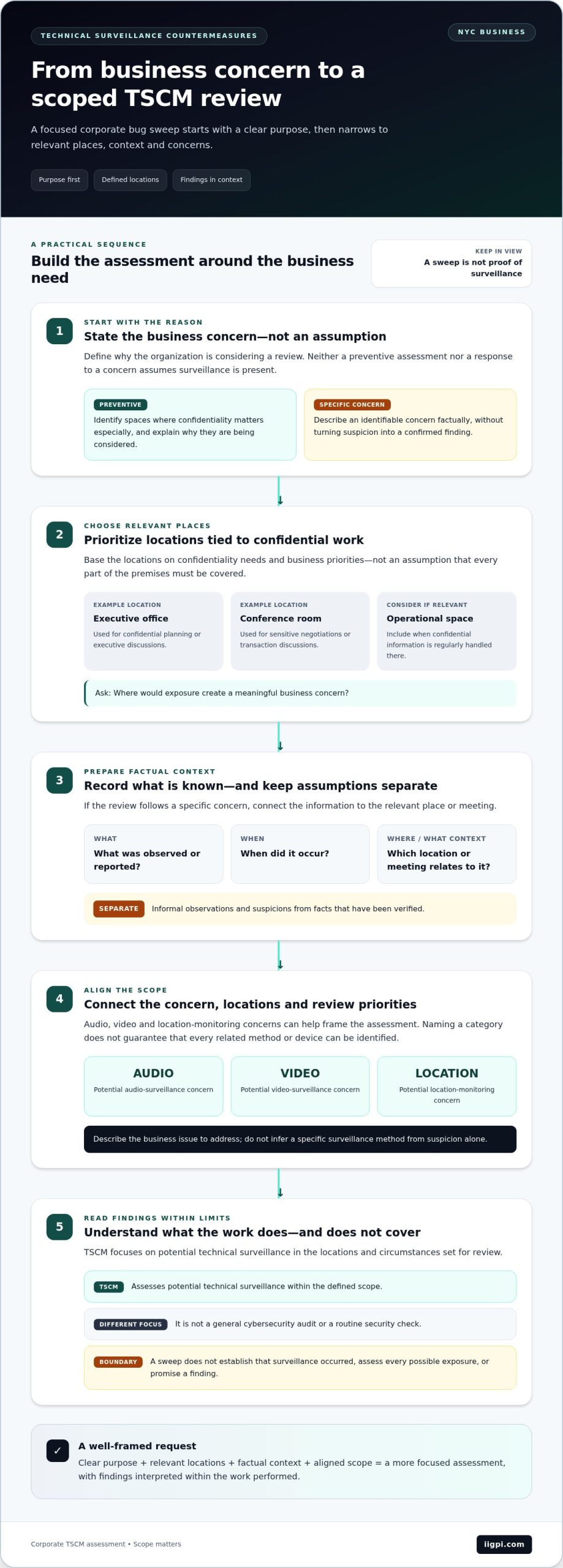
Preparation turns a general concern into a practical plan. Before a corporate bug sweep nyc engagement, designate a business contact to coordinate relevant information, access, and internal communication. The aim is not to prove an assumption in advance, but to provide operational context and define what the business wants addressed.
Use this sequence to organize the request:
- Define the concern. Record what prompted the review, when it arose, and what was directly observed or reported. Separate interpretations from facts.
- Prioritize locations. Identify the offices, meeting spaces, or other areas relevant to the concern, and explain why each matters to the business.
- Identify access needs. Determine who can arrange entry to those areas and who should coordinate with the assessment team.
- Agree on scope. Set out the locations and concerns for review, along with relevant operational considerations, before work begins.
Define the concern and prioritize locations
A concise factual record can include the date of an observation, the location involved, and the business activity relevant to the concern. For example, note that an office is used for confidential discussions or document a specific event as reported. Avoid labeling an event as surveillance unless that has been established. Prioritizing spaces based on confidentiality helps keep the review focused.
Once priorities are clear, consider how the work fits into normal operations. Identify scheduled meetings, restricted areas, or access procedures that may affect the agreed locations. Planning around these details can help reduce unnecessary disruption without assuming a standard duration or schedule for an assessment.
Coordinate access and internal communication
Choose appropriate internal contacts who can provide access to the agreed areas and share relevant context. Limit discussion to decision-makers and personnel who need to coordinate the work. Circulating an unverified concern broadly can create confusion. A discreet, factual briefing helps protect confidentiality while making sure access arrangements and business priorities are understood.
Before the assessment, clarify which spaces are included and how operational constraints will be handled. If new information changes the concern or the requested locations, distinguish it from the original account so the scope remains clear. International Investigative Group offers customized service packages tailored to clients’ requirements and approaches each engagement confidentially, without promising particular findings.
To frame a focused review, learn about a tailored corporate TSCM assessment from International Investigative Group. Sharing the concern, priority locations, access considerations, and relevant facts helps establish the business context.
How IIGPI Supports Corporate Bug Sweeps in NYC
International Investigative Group, Ltd. (IIGPI) is a New York City private investigation firm that provides technical surveillance countermeasures as part of its security services. For businesses considering a corporate bug sweep nyc, the work can be framed around the organization’s stated concern, relevant locations, and operational priorities, rather than assumptions about what an assessment will find.
IIGPI is Licensed, Bonded, Insured, and its team includes former law-enforcement experience. TSCM is one part of the firm’s broader investigative and security services, which include corporate investigations, surveillance services, and computer forensics. These are distinct services, not automatic parts of a single package. IIGPI offers highly customized packages and bills clients only for the services they require.
A customized investigative and security approach
A tailored engagement begins with the purpose of the review and the business locations under consideration. This lets the scope reflect organizational priorities without implying that every service, room, device, or system is included. IIGPI provides confidential, high-quality investigative services, but no assessment can promise specific findings or outcomes. Clear boundaries help corporate decision-makers understand what the work addresses.
Considering TSCM in the wider investigative context can also help a business distinguish a technical surveillance concern from an issue that may call for a different service. The aim is to align the work with the stated concern and the information the organization needs, not to expand the engagement unnecessarily.
What to share when initiating a discussion
A concise initial description can establish useful context for a tailored assessment. Identify the concern, relevant locations, decision-makers, and operational constraints that could affect access or coordination. Separate direct observations from interpretations so the discussion starts with an accurate account rather than an unverified conclusion.
- Business concern: Describe what prompted the inquiry and what information or activity the organization wants to protect.
- Relevant locations: Identify the spaces connected to the concern and explain why they are priorities.
- Coordination: Note who can arrange access and any operational considerations relevant to the agreed scope.
This context supports a focused discussion about the work required. It does not determine what an assessment will find and is not a substitute for the assessment itself.
For information about IIGPI’s corporate bug sweep services, explore a tailored corporate TSCM assessment. A clear account of the concern and relevant locations can help shape a confidential, customized approach around your organization’s priorities.
Make Your Next Step Deliberate
Protecting confidential business discussions starts with a decision grounded in the organization’s actual concerns. Treat a corporate bug sweep nyc as a focused risk-management step, not as proof that surveillance has occurred. Identify who should lead the discussion, what business information needs protection, and which locations are relevant. That context can help define a proportionate approach.
International Investigative Group, Ltd. provides technical surveillance countermeasures as part of its security services and is Licensed, Bonded, Insured. Its reported record of 10,000+ Cases Solved reflects broad investigative experience. Highly customized packages bill clients only for the services they require. These credentials provide context for an assessment, not a promise of specific findings or outcomes.
To discuss your organization’s needs, contact IIGPI about a corporate bug sweep and take a focused next step aligned with your business priorities.
Frequently Asked Questions
Is a corporate bug sweep the same as a cybersecurity assessment?
No. A corporate bug sweep and a cybersecurity assessment address different aspects of business security, so neither should be treated as a substitute for the other. A concern about a sensitive meeting room, for example, differs from a concern involving access to company network accounts. IIGPI also provides computer forensic services, a separate area of work that may be relevant to digital information, depending on the issue.
Can a corporate bug sweep guarantee that no listening device is present?
No assessment can guarantee that no listening device exists. Its conclusions relate to the agreed scope and the concerns reviewed, not every possible location or circumstance. Interpret a negative result within those boundaries, just as suspicion alone should not be treated as proof. A corporate bug sweep nyc is one focused source of information, not absolute assurance about all surveillance risks.
How often should a NYC business arrange a corporate bug sweep?
There is no universal schedule suited to every business. An organization might consider a review after a specific confidentiality concern, a significant change to a sensitive space, or a shift in its risk priorities. For example, a company that begins holding sensitive discussions in a newly designated room could reassess whether it belongs in scope. The decision should follow business circumstances, not a fear-based calendar.
What happens if a sweep identifies a suspicious device?
Treat a potential finding as a matter for careful professional assessment, not immediate proof of wrongdoing. Avoid disturbing the item or making assumptions about it. Record its location and the circumstances in which it was noticed, then share that context with relevant decision-makers. Appropriate next steps depend on the facts and agreed scope. IIGPI provides investigative services, not legal representation, and cannot promise a particular outcome.
Can a corporate bug sweep include offices and conference rooms?
Yes. A business may identify offices or conference rooms as priority locations when they relate to its stated concern. A room used for confidential planning, for example, may be more relevant than a general workspace. Define which spaces should be considered and why, so the work has clear boundaries. Including one room does not automatically extend the assessment to every other area or device.
Does a corporate bug sweep automatically cover employee phones and computers?
No. Employee phones and computers are not automatically included simply because a business arranges a sweep. The agreed scope should identify relevant spaces, devices, and concerns explicitly. Technical surveillance countermeasures and computer forensics are distinct services, so a question involving digital information may require separate consideration. Device-related work should have a defined business purpose and appropriate authorization rather than being assumed as part of a premises-focused assessment.