
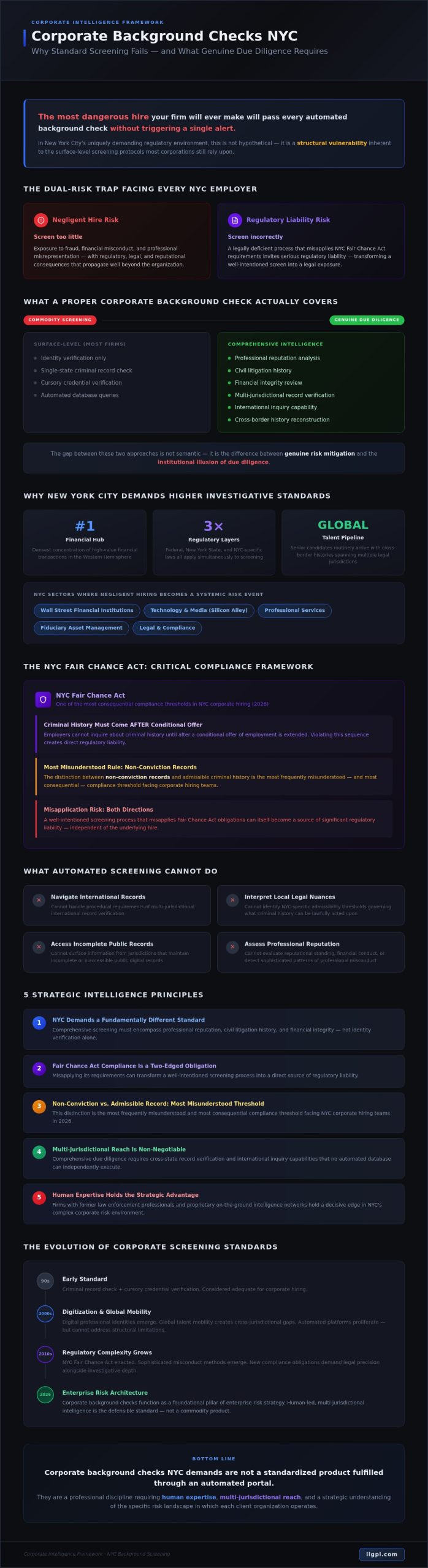
The most dangerous hire your firm will ever make will pass every automated background check without triggering a single alert. For organizations operating within New York City’s uniquely demanding regulatory environment, this is not a hypothetical scenario; it is a structural vulnerability inherent to the surface-level screening protocols that most corporations still rely upon. Corporate background checks NYC presents a challenge that is simultaneously legal, strategic, and reputational in its complexity, demanding a level of investigative rigor that no algorithm is presently equipped to deliver.
Senior decision-makers already understand this intuitively. The tension between conducting genuinely comprehensive candidate intelligence and maintaining strict compliance with frameworks such as the NYC Fair Chance Act is one of the most consequential operational challenges facing corporate leadership today. A misstep in either direction carries serious consequences: a negligent hire that exposes the organization to fraud, or a legally deficient screening process that invites regulatory liability.
This analysis examines the strategic intelligence framework that distinguishes a defensible, court-ready background investigation from a perfunctory compliance exercise, drawing on the investigative protocols developed through decades of professional practice within the New York City corporate ecosystem.
Key Takeaways
- Corporate background checks NYC demands a fundamentally different investigative standard than standard employment screening, one that encompasses professional reputation, civil litigation history, and financial integrity rather than identity verification alone.
- The NYC Fair Chance Act imposes specific legal obligations on employers that, if misapplied, can transform a well-intentioned screening process into a source of significant regulatory liability.
- The critical distinction between non-conviction records and admissible criminal history is one of the most consequential — and most frequently misunderstood — compliance thresholds facing corporate hiring teams in 2026.
- Genuinely comprehensive due diligence requires multi-jurisdictional investigative methodologies, including cross-state record verification and international inquiries, that no automated database system is equipped to execute independently.
- Firms with access to former law enforcement professionals and proprietary on-the-ground intelligence networks hold a decisive strategic advantage when operating within New York City’s uniquely complex corporate risk environment.
Contextualizing Corporate Background Checks in the New York City Ecosystem
Corporate background checks, properly understood, are not a transactional HR function. They constitute a systematic intelligence-gathering process through which an organization develops a comprehensive, evidence-based portrait of a candidate’s professional history, financial conduct, civil litigation record, and reputational standing across every jurisdiction in which that individual has operated. The distinction between this definition and the commodity-level identity verification that many firms currently practice is not merely semantic; it is the difference between genuine risk mitigation and the institutional illusion of due diligence.
New York City’s commercial environment intensifies this distinction considerably. The metropolitan area hosts the densest concentration of high-value financial transactions in the Western Hemisphere, encompassing the legacy institutions of Wall Street, the technology and media enterprises of Silicon Alley, and a sprawling professional services sector in which individual hires routinely carry fiduciary responsibility for assets of extraordinary magnitude. In this environment, a negligent hire is not simply an internal personnel problem; it is a potential systemic risk event with regulatory, legal, and reputational dimensions that can propagate well beyond the organization’s own boundaries.
The Evolution of Corporate Intelligence in NYC
The investigative standards applied to corporate hiring have undergone a fundamental transformation over the past three decades. What once constituted adequate screening, primarily a criminal record check and a cursory verification of stated credentials, has proven structurally insufficient in an era defined by digital professional identities, global talent mobility, and increasingly sophisticated methods of professional misconduct. The digitization of professional reputations has created both new sources of intelligence and new vectors for deception, demanding a correspondingly sophisticated investigative response. In 2026, a strategically sound corporate background check in NYC functions less as a compliance checkbox and more as a foundational pillar of enterprise risk architecture.
Risk Factors Unique to the New York Market
The New York market presents investigative challenges that no automated database system is designed to address. A significant proportion of senior candidates entering NYC’s financial and professional services sectors arrive with cross-border professional histories spanning multiple legal jurisdictions, some of which maintain incomplete or inaccessible public records. Standard automated platforms are not equipped to navigate the procedural requirements of international record verification, nor are they capable of identifying the local legal nuances, such as the specific admissibility thresholds governing criminal history under New York City’s regulatory framework, that determine whether retrieved information can be lawfully acted upon. Firms such as International Investigative Group, whose investigative professionals bring decades of on-the-ground experience within the NYC ecosystem, are structurally positioned to address precisely these gaps, applying the kind of granular jurisdictional knowledge that no algorithm can replicate.
The practical consequence is clear: corporate background checks NYC demands are not a standardized product that can be responsibly fulfilled at a flat rate through an automated portal. They are a professional discipline requiring human expertise, multi-jurisdictional reach, and a strategic understanding of the specific risk landscape in which each client organization operates.
Navigating the Regulatory Architecture: The NYC Fair Chance Act and Compliance Protocols
Understanding the legal architecture governing corporate background checks NYC employers must navigate is not merely an HR compliance exercise; it is a foundational risk management discipline with direct implications for litigation exposure, regulatory standing, and the defensibility of every hiring decision the organization makes. The NYC Fair Chance Act, originally enacted in 2015 and subsequently strengthened through amendment, establishes one of the most rigorous “ban the box” frameworks in the United States, imposing specific sequencing requirements, disclosure obligations, and individualized assessment standards that collectively demand a level of procedural precision that no automated screening platform is designed to deliver.
At its core, the Act prohibits employers from inquiring into an applicant’s criminal history until after a conditional offer of employment has been extended. This is not simply a matter of when a question appears on an application form. It governs the entire investigative timeline, including when a background investigation may be commissioned, when its findings may be reviewed by decision-makers, and under what specific conditions a conditional offer may subsequently be withdrawn. Employers who conflate the Act’s procedural requirements with a general prohibition on criminal history review frequently miscalibrate their compliance posture in ways that generate substantial legal exposure.
Equally consequential is the distinction between non-conviction records and legally admissible criminal history. Under New York State law, arrests that did not result in conviction, sealed records, and adjournments in contemplation of dismissal are generally not permissible bases for adverse employment action. An automated screening system that surfaces such records without filtering them through the applicable legal thresholds does not merely create a compliance problem; it actively places decision-makers in possession of information they are legally prohibited from acting upon, a circumstance that can transform a good-faith screening effort into a source of direct regulatory liability.
The Sequential Logic of NYC Hiring Compliance
A legally defensible investigative process follows a strict sequential architecture. Before any background inquiry is commissioned, the organization must establish documented, job-related criteria that define what categories of information are relevant to the specific role under consideration. This foundational step, which directly implicates Article 23-A of the New York State Correction Law, requires employers to articulate in advance how particular categories of criminal history bear a direct relationship to the duties and responsibilities of the position. Without this documentation, even a factually accurate background report becomes legally precarious as a basis for adverse action.
The background investigation itself may only be initiated after a conditional offer has been extended. Upon completion of the investigation, if a relevant criminal history is identified, the employer must execute the full Fair Chance Process before any adverse action is taken. This process requires providing the applicant with a written copy of the inquiry results, a copy of the Article 23-A analysis, and a reasonable period, currently specified as at least five business days, during which the applicant may respond. Employers who compress or bypass this period, often under the pressure of rapid hiring timelines, expose themselves to enforcement action by the NYC Commission on Human Rights.
Avoiding Litigation Through Expert Investigative Oversight
The operational danger of relying on non-compliant automated software is not theoretical. Many commercially available background screening platforms are not programmed to distinguish between sealed records, expunged records, and admissible criminal history under New York City’s specific legal framework. When such a system delivers a raw data report directly to a hiring manager, the organization has effectively lost control of its own compliance architecture. Professional investigators, by contrast, apply a structured legal filter to all retrieved information, ensuring that only data which satisfies the applicable admissibility thresholds reaches the decision-makers who will act upon it.
Maintaining comprehensive documentation throughout this process is not optional. Article 23-A compliance requires that employers retain records of the individualized assessment performed when criminal history is identified, including the factors considered and the reasoning applied. This documentation constitutes the organization’s primary defense in the event of a Commission on Human Rights complaint or civil litigation. Firms working with experienced investigative professionals, such as those at International Investigative Group, benefit from an investigative methodology that is structured from inception to produce the kind of legally coherent, properly filtered, and thoroughly documented intelligence that withstands regulatory scrutiny.
The Fair Credit Reporting Act adds a parallel federal compliance layer, requiring that candidates receive specific disclosures before a consumer report is obtained and that adverse action notices be issued in the prescribed form and sequence if findings are used to inform a negative hiring decision. Navigating the intersection of FCRA obligations with NYC’s local framework demands not just legal awareness, but the kind of procedural discipline that only experienced investigative oversight can reliably provide.
Differentiating Standard Employment Screening from High-Level Corporate Due Diligence
The operational gap between a standard employment screen and a genuine corporate due diligence investigation is not a matter of degree; it is a matter of fundamental investigative purpose. Standard screening, as practiced by volume-based automated platforms, performs a narrow verification function: it confirms that a candidate’s stated identity corresponds to public records, surfaces basic criminal history that clears the applicable legal thresholds, and validates educational credentials against institutional databases. This is a necessary baseline. It is not, by any reasonable professional standard, sufficient intelligence upon which to base a consequential organizational appointment.
High-level corporate due diligence operates from an entirely different analytical framework. Rather than asking whether a candidate’s stated history is internally consistent, it asks a more demanding and strategically significant question: does the totality of this individual’s professional conduct, financial behavior, civil litigation record, and reputational standing across every relevant jurisdiction present a risk profile commensurate with the authority and access this appointment would confer? These are not questions that any automated database is designed to answer. They require human analytical judgment, multi-jurisdictional investigative reach, and the kind of structured professional skepticism that only experienced investigators bring to the process.
The circumstances that warrant deep-dive investigative protocols are specific and consequential. C-suite appointments, board-level nominations, M&A partnership evaluations, and senior roles carrying fiduciary responsibility for substantial assets all represent contexts in which the standard screening framework is structurally inadequate. In each of these scenarios, the potential cost of an investigative failure is not a personnel inconvenience; it is an enterprise-level risk event with legal, financial, and reputational dimensions that can materially alter the organization’s trajectory. This is precisely the environment in which the most rigorous standards of corporate background checks NYC demands become non-negotiable.
Computer forensics represents one of the most consequential, and most frequently neglected, dimensions of executive-level due diligence. A candidate’s digital footprint, encompassing professional communications, intellectual property history, prior non-disclosure agreement obligations, and patterns of data handling across previous employers, constitutes a category of intelligence that no conventional records search can retrieve. When a senior hire carries proprietary knowledge from a competitor, or when their digital history reveals a pattern of conduct inconsistent with their stated professional narrative, forensic analysis of accessible digital artifacts can surface that discrepancy before it becomes an organizational liability.
The C-Suite Mandate: Why Executive Screening Requires More
Verifying the professional achievements of a C-suite candidate demands investigative methods that extend considerably beyond resume validation. Board memberships must be confirmed through independent corporate filings rather than candidate attestation alone. Prior executive roles require verification against regulatory disclosures, shareholder communications, and, where applicable, SEC filings that reflect the actual scope of the individual’s authority and performance record. Undisclosed business affiliations, including ownership interests in entities that may present conflicts of interest with the prospective employer, are among the most consequential risk factors that surface only through structured investigative inquiry. The analytical discipline required to conduct this level of assessment is examined in depth through frameworks such as Conducting Due Diligence: A Corporate Imperative, which articulates the investigative standards appropriate to organizations for whom a deficient hire carries systemic consequences.
Financial Integrity and Asset Verification
In New York City’s financial services environment, an individual’s historical relationship with professional liability, civil litigation, and financial obligation constitutes some of the most operationally relevant intelligence an organization can develop. Civil court records, which standard screening platforms routinely fail to interrogate with adequate depth, frequently reveal patterns of financial misconduct, breach of fiduciary duty claims, or undisclosed judgments that speak directly to a candidate’s suitability for roles carrying asset management responsibility. The investigative discipline of asset verification, which encompasses tracing the provenance and disposition of professional earnings, identifying undisclosed liabilities, and mapping an individual’s financial conduct across multiple jurisdictions, intersects directly with the broader capabilities associated with Asset Search and Recovery methodologies. For organizations appointing individuals to positions of financial stewardship, this dimension of due diligence is not supplementary; it is foundational.
Methodologies for Executing Comprehensive Background Inquiries
The investigative architecture underlying a genuinely comprehensive background inquiry bears little resemblance to the automated query-and-return process that most commercial screening platforms execute. Where database systems retrieve, professional investigators analyze; where algorithms surface records, experienced operatives contextualize them against the specific risk parameters of the engagement. The methodological gap between these two approaches is precisely where the most consequential intelligence is either captured or permanently lost.
Proprietary investigative databases, when deployed by professionals with decades of on-the-ground experience within the New York City ecosystem, function as starting points rather than endpoints. The raw data they surface, spanning civil court filings, regulatory actions, professional licensing records, and corporate registry documents, acquires its strategic value only when subjected to structured analytical interpretation. An investigator who has spent a career operating within NYC’s financial and legal corridors understands, for instance, that a particular pattern of civil litigation in the Southern District of New York carries materially different implications than a superficially similar record in another jurisdiction. That contextual judgment cannot be automated.
Multi-jurisdictional verification is not optional when the candidate pool reflects the global mobility that characterizes senior hiring in New York City. A candidate who has held executive positions across three countries and five states presents a records verification challenge that no single database can resolve. Effective corporate background checks NYC demands in these circumstances require coordinated inquiry across state-level court systems, international regulatory bodies, foreign corporate registries, and, where applicable, Interpol-adjacent reporting mechanisms. Each jurisdiction presents its own procedural requirements, access limitations, and legal standards governing what retrieved information may be lawfully transmitted and acted upon.
The Role of Surveillance and Field Inquiries
There are categories of professional intelligence that exist only in the physical world, in the observations of former colleagues, in the conduct of an individual within their professional community, and in the discrepancies between a candidate’s stated narrative and their observable behavior. Discreet field inquiries become operationally necessary precisely when digital records are silent on questions of professional character, ethical conduct, or undisclosed affiliations. Professional interviews conducted by experienced investigators, structured to elicit candid assessments from individuals who have worked alongside a candidate, consistently surface intelligence that no database retrieval can replicate. All field operations of this nature must remain within the legal boundaries of private surveillance, a discipline that demands both procedural rigor and intimate familiarity with the applicable statutory framework governing investigative conduct in New York State.
Digital Forensics and Cybersecurity in Background Checks
A candidate’s digital presence constitutes a distinct and frequently underexamined intelligence domain. Analysis of deep-web activity, professional forum participation, and social media conduct across platforms can surface reputational risk indicators, including patterns of professional conflict, undisclosed associations, or conduct inconsistent with a candidate’s stated values, that conventional records searches don’t reach. Verifying the integrity of digital credentials and professional certifications has become a non-trivial investigative function, given the documented prevalence of credential fabrication across digital professional networks. For senior appointments, the discipline of computer forensics extends the investigative reach further still, enabling the examination of accessible digital artifacts that may reveal prior intellectual property obligations, patterns of data handling, or conflicts of interest invisible to any surface-level inquiry. This integration of digital forensic methodology with traditional field intelligence is what produces a genuinely 360-degree candidate profile, and it’s the standard that organizations with consequential appointments should insist upon. Contact International Investigative Group to discuss how this integrated investigative framework applies to your specific hiring context.
International Investigative Group: Elite Investigative Solutions for the NYC Corporate Sector
Three decades of sustained investigative practice within New York City’s corporate landscape produces a quality of institutional knowledge that cannot be acquired through any other means. International Investigative Group has operated at the intersection of legal compliance, corporate risk, and human intelligence since its founding, accumulating a case record exceeding 10,000 resolved engagements across the full spectrum of corporate, insurance, and personal investigative mandates. That depth of operational experience is not incidental to the firm’s value proposition; it is the foundation upon which every client engagement is built.
IIG’s leadership team is composed of former law enforcement professionals whose careers were defined by the procedural discipline, evidentiary standards, and jurisdictional fluency that distinguish consequential investigative work from surface-level inquiry. That institutional background carries direct operational significance: investigators who have operated within the legal system understand precisely where the boundaries of admissible evidence lie, how to structure field inquiries that will withstand judicial scrutiny, and why the documentation architecture underlying every background investigation matters as much as the findings themselves.
The IIG Advantage: Experience, Discretion, and Rigor
The legal and corporate firms that retain IIG for their most sensitive inquiries do so because the firm’s investigative methodology integrates capabilities that no single-service screening provider can replicate. Polygraph testing, professional surveillance operations, computer forensics, electronic bug sweeps, and comprehensive background investigations function within IIG’s framework not as discrete service offerings but as coordinated intelligence tools, deployed in combination according to the specific risk parameters of each engagement. For organizations seeking to understand what a genuinely capable corporate investigative partner looks like before initiating a formal engagement, the analysis at Hiring a Corporate Private Investigator in NYC provides a rigorous framework for that evaluation.
IIG’s global network of investigative agents extends the firm’s reach into the international jurisdictions that senior hiring in New York City’s financial and professional services sectors routinely implicates. That global capacity is paired with granular local expertise, the kind that understands how civil court records in specific New York jurisdictions should be interpreted, how regulatory disclosures in the financial services sector reflect on a candidate’s professional conduct, and how the specific sequencing requirements of corporate background checks NYC demands must be observed to produce legally defensible intelligence.
Customized Intelligence Frameworks for Your Firm
No two organizations present identical risk profiles, and IIG’s investigative protocols are structured accordingly. A financial services firm evaluating a senior portfolio manager carries different due diligence imperatives than a technology enterprise assessing a C-suite appointment, and the investigative framework applied to each must reflect those distinctions with precision. IIG designs each engagement to produce intelligence that is not merely accurate but strategically actionable, structured for seamless communication with legal counsel and formatted to meet the evidentiary standards that litigation and regulatory proceedings demand.
Consult with International Investigative Group to discuss how a customized investigative framework can be designed around your firm’s specific hiring context, risk tolerance, and compliance obligations.
The Strategic Imperative for 2026 and Beyond
Corporate background checks NYC demands in 2026 are not a compliance formality; they are a foundational pillar of enterprise risk management that no automated platform is structurally equipped to fulfill. The regulatory complexity of the NYC Fair Chance Act, the multi-jurisdictional reach required for genuinely comprehensive due diligence, and the irreplaceable role of human analytical judgment collectively define an investigative standard that separates organizations that are genuinely protected from those that merely believe they are.
Three principles bear repeating: procedural compliance and investigative depth are not competing priorities but complementary disciplines; the most consequential intelligence rarely surfaces through automated queries; and the documentation architecture underlying every investigation matters as much as the findings it contains.
For firms that cannot afford the institutional consequences of an investigative failure, the caliber of the investigative partner matters profoundly. Founded by former law enforcement professionals, with more than 30 years of NYC experience and over 10,000 cases successfully resolved, International Investigative Group brings the rigor, discretion, and jurisdictional fluency your organization requires.
Secure your firm’s future with elite NYC corporate background checks from International Investigative Group and approach every consequential appointment with the confidence that genuine intelligence provides.
Frequently Asked Questions About Corporate Background Checks NYC
What is the NYC Fair Chance Act, and how does it affect corporate background checks?
The NYC Fair Chance Act prohibits employers from inquiring into a candidate’s criminal history until after a conditional offer of employment has been extended. This sequencing requirement governs the entire investigative timeline, not merely what appears on an application form. Employers must also provide applicants with written findings and a minimum of five business days to respond before any adverse action may be taken.
Non-compliance carries direct regulatory exposure through the NYC Commission on Human Rights, including potential civil penalties. Organizations that commission background investigations before extending a conditional offer, or that act on non-admissible records such as sealed arrests, are particularly vulnerable to enforcement action regardless of how well-intentioned their screening process may have been.
How far back can a corporate background check in New York City legally go in 2026?
There’s no single universal lookback period that applies uniformly across all record categories in New York City. Criminal history admissibility is governed by what’s legally actionable under the Fair Chance Act and Article 23-A, rather than a fixed number of years. The Fair Credit Reporting Act imposes a seven-year reporting limitation on certain adverse items for positions below a specified salary threshold, though senior executive roles are frequently exempt from that restriction.
The practical answer depends on the specific record type, the role’s compensation level, and the jurisdiction in which the underlying record was generated. A professional investigator applies the appropriate legal filter to each category of information rather than applying a blanket lookback rule, which is precisely why experienced oversight matters more than automated query systems for consequential appointments.
What is the difference between a standard background check and executive due diligence?
A standard background check performs verification: it confirms identity, surfaces basic criminal history that clears applicable legal thresholds, and validates stated credentials against institutional databases. Executive due diligence asks a fundamentally different question, specifically whether the totality of a candidate’s professional conduct, financial behavior, civil litigation record, and reputational standing presents a risk profile commensurate with the authority the appointment would confer.
Corporate background checks NYC demands at the executive level extend into undisclosed business affiliations, cross-jurisdictional civil court records, regulatory disclosures, board membership verification through independent corporate filings, and, where warranted, digital forensic analysis. These are not enhancements to a standard screen; they constitute an entirely distinct investigative discipline requiring human analytical judgment that no automated platform is designed to deliver.
Can an employer in NYC rescind a job offer based on a background check result?
Yes, but only after completing the full Fair Chance Process, which is a procedural requirement that many employers misapply under hiring timeline pressure. Before rescinding a conditional offer, the employer must provide the applicant with a written copy of the background inquiry results, a copy of the Article 23-A analysis documenting how the criminal history bears a direct relationship to the specific role, and a minimum five-business-day window for the applicant to respond.
Employers who compress or bypass this process, even when the underlying criminal history is genuinely disqualifying, expose themselves to complaints with the NYC Commission on Human Rights. The defensibility of a rescission decision depends not just on the accuracy of the findings but on the procedural integrity of the entire process that preceded the decision.
Are social media and ‘deep web’ searches legal for NYC corporate background checks?
Reviewing publicly accessible social media and open-source digital content is generally permissible, but the manner in which that information is gathered and used matters considerably from a legal standpoint. Searches must not be structured in ways that expose protected characteristics such as race, religion, or national origin to decision-makers before a conditional offer is extended, as that exposure can itself create Fair Chance Act compliance problems.
Deep-web analysis and professional forum monitoring, when conducted by experienced investigators who understand the applicable legal boundaries, can surface reputational risk indicators that conventional records searches don’t reach. The critical discipline is ensuring that all retrieved digital intelligence is filtered through the same legal admissibility standards that govern every other category of background inquiry, and that findings are documented in a format that withstands regulatory scrutiny.
How long does a comprehensive corporate background check typically take in NYC?
A standard automated screening report can be returned within 24 to 72 hours, but that timeline reflects the depth of inquiry it actually performs: database queries against existing records, not genuine investigative work. A comprehensive corporate due diligence investigation, encompassing multi-jurisdictional court record verification, professional reference interviews, civil litigation analysis, and digital intelligence review, requires substantially more time, often ranging from one to three weeks depending on the candidate’s geographic footprint.
International components extend that timeline further, as foreign corporate registries, regulatory bodies, and court systems each impose their own procedural requirements and access timelines. Organizations that attempt to compress a genuine due diligence investigation into a 48-hour window are not accelerating the process; they’re substituting a surface-level screen for the substantive intelligence that consequential appointments actually require.
What specific records are off-limits during an NYC background inquiry?
Several categories of records are legally prohibited from serving as bases for adverse employment action in New York City. Arrests that didn’t result in conviction, sealed records, youthful offender adjudications, and adjournments in contemplation of dismissal are among the most consequential off-limits categories. An automated system that surfaces these records without filtering them through applicable admissibility thresholds places decision-makers in possession of information they’re legally prohibited from acting upon.
Certain consumer credit information is also restricted under New York City’s Stop Credit Discrimination in Employment Act, with limited exceptions for roles that specifically require financial responsibility determinations. Salary history inquiries are separately prohibited under city law. The practical implication is that a legally defensible investigation requires an investigator who applies structured legal filters to all retrieved data, not a platform that returns raw records and leaves compliance interpretation to the hiring team.
Why should a firm hire a private investigator instead of using automated background check software?
Automated software retrieves; experienced investigators analyze. The distinction matters most precisely where the risk is highest. An algorithm can surface a civil court filing but cannot interpret what a pattern of breach-of-fiduciary-duty claims across three jurisdictions implies about a candidate’s suitability for an asset management role. It can return a database record but cannot conduct the structured professional interviews that surface intelligence about a candidate’s conduct within their professional community.
For organizations where a deficient hire carries systemic consequences, the investigative advantage of working with professionals who bring former law enforcement backgrounds, multi-jurisdictional reach, and decades of on-the-ground NYC experience is not a premium amenity; it’s a structural necessity. Firms like International Investigative Group, with more than 30 years of experience and over 10,000 resolved cases, bring the procedural discipline and contextual judgment that no software platform is designed to replicate. Contact International Investigative Group to discuss how a professional investigative framework applies to your firm’s specific hiring context.