
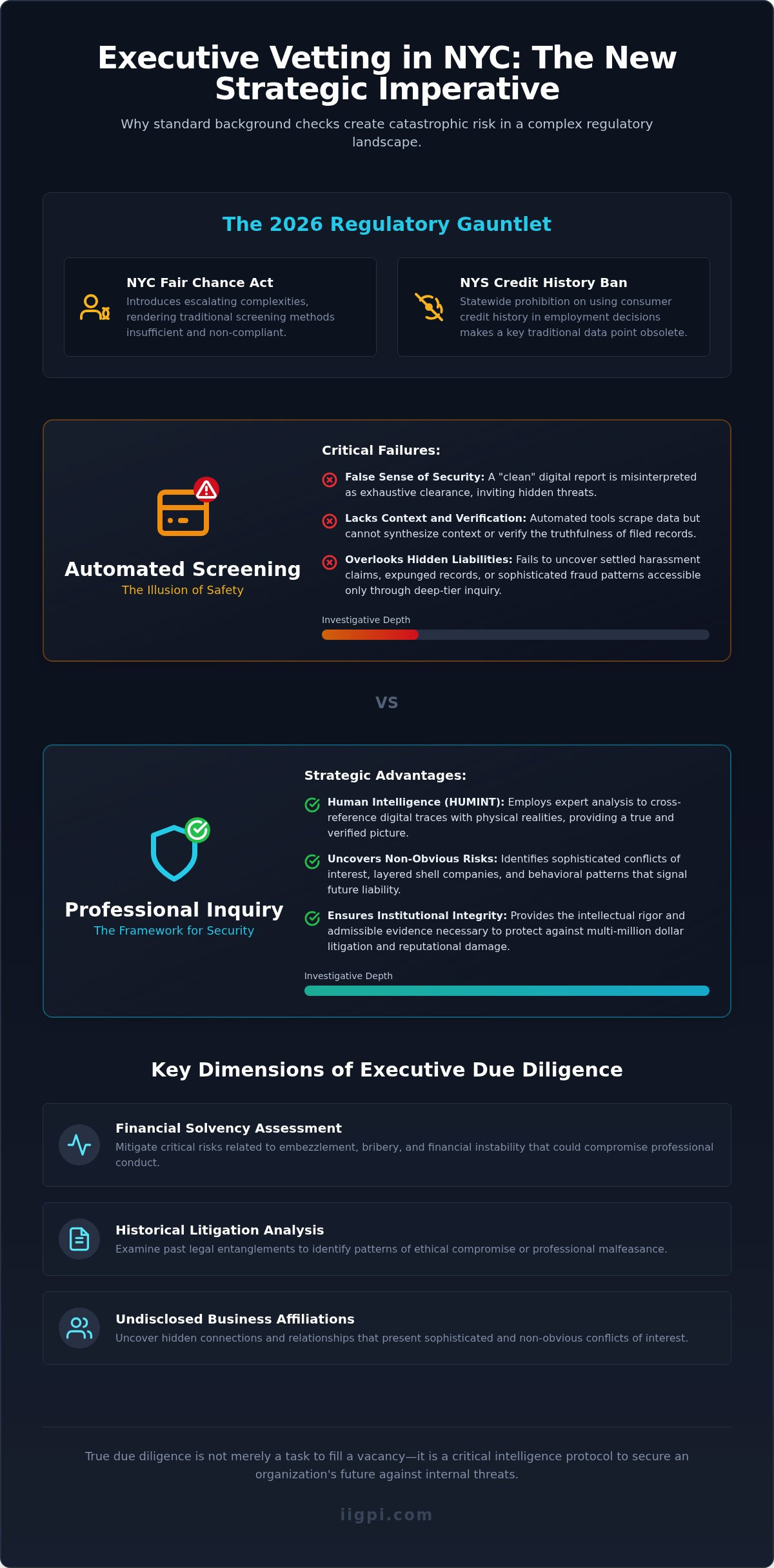
The assumption that a standard digital screening suffices for executive-level placement in a global financial capital is a precarious fallacy that invites catastrophic institutional exposure. Within the dense regulatory environment of Manhattan, the deployment of the corporate background check services nyc organizations require must transcend mere data aggregation to become a sophisticated exercise in strategic intelligence. The prevailing consensus among risk management professionals acknowledges that the escalating complexity of the New York City Fair Chance Act, coupled with the 2026 statewide prohibition on consumer credit history in employment decisions, has rendered traditional screening methods functionally obsolete.
This analysis serves as a definitive guide for high-level decision-makers seeking to navigate the intricate legal landscape while identifying non-obvious reputational and financial risks. We shall provide an authoritative framework for the 2026 fiscal year, focusing on the synthesis of regulatory compliance and deep-tier due diligence. The following discourse evaluates the methodologies required to produce admissible evidence and examines the critical distinction between automated data sets and the intellectual rigor of professional investigative frameworks.
Key Takeaways
- Master the complexities of the 2026 regulatory landscape, including the expanded New York State credit history ban and the NYC Fair Chance Act, to ensure institutional compliance.
- Recognize the inherent limitations of automated database scraping and the critical necessity of human intelligence (HUMINT) in verifying digital records for high-stakes decisions.
- Utilize a strategic framework for corporate background check services nyc to identify non-obvious reputational and financial risks that standard screenings frequently overlook.
- Implement rigorous executive-level due diligence protocols that encompass comprehensive asset searches and the identification of sophisticated conflicts of interest.
- Leverage the intellectual rigor and thirty-year track record of an investigative partner founded on law enforcement principles to safeguard your organization’s global integrity.
The Strategic Imperative of Corporate Background Check Services in NYC
A background check within the corporate sphere is no longer a peripheral administrative task; it’s a critical intelligence protocol designed to preserve institutional integrity. For organizations operating within the Manhattan financial corridor, the utilization of sophisticated corporate background check services nyc firms provide represents a strategic necessity for risk mitigation. The 2026 fiscal year presents a landscape defined by heightened regulatory scrutiny and increasingly complex financial instruments. Relying on basic automated screenings for high-stakes appointments is a dereliction of fiduciary duty. These rudimentary tools often fail to capture the nuanced behavioral patterns and historical inconsistencies that signal future liability.
Institutional fiduciary responsibility hinges on the ability of leadership to vet potential partners and executives with absolute precision. It’s not just about verifying past employment; it’s about uncovering the hidden variables that could destabilize a firm’s market position. In an era where corporate governance is under constant public and legal examination, the depth of one’s investigative framework determines the strength of the organization’s defensive posture.
Evolving Risk Profiles in New York’s Financial and Legal Sectors
The volatility of the New York market demands a rigorous investigative approach. Sophisticated fraud patterns in 2026 often involve layered shell companies and cross-jurisdictional financial maneuvers that standard retail-level checks ignore. In the NYC ecosystem, where information travels instantaneously, reputational damage isn’t just an abstract concern. It’s a quantifiable financial loss. Surface-level checks that merely verify dates or basic criminal records are insufficient to protect a firm against the “bad hire” at the C-suite level. Such oversights can lead to multi-million dollar litigation and the erosion of shareholder trust.
Intelligence as a Foundation for Due Diligence
True due diligence requires a synthesis of personal history and professional conduct. An individual’s private financial stability and historical litigation involvement are often precursors to professional malfeasance. By treating background investigations as a foundational element of corporate fraud investigation strategies, leaders can identify systemic vulnerabilities before they manifest as crises. This proactive stance ensures that the corporate background check services nyc enterprises employ contribute to a broader culture of transparency and accountability.
Effective risk management must prioritize the following investigative dimensions:
- Identification of undisclosed business affiliations that present potential conflicts of interest.
- Analysis of historical litigation that may indicate a pattern of ethical compromise.
- Assessment of financial solvency to mitigate risks related to embezzlement or bribery.
The goal isn’t merely to fill a vacancy but to secure the organization’s future against internal threats through elite intelligence gathering.
The Investigative Paradigm: Database Screening vs. Professional Inquiry
The institutional reliance on algorithmic data aggregation constitutes a profound strategic vulnerability for organizations utilizing corporate background check services nyc. While automated scraping tools offer the allure of “instant” results, they’re fundamentally limited by their inability to synthesize context or verify the veracity of filed records. This “False Sense of Security” trap occurs when a clean digital report is misinterpreted as an exhaustive clearance. Professional inquiry, by contrast, employs Human Intelligence (HUMINT) to cross-reference digital traces with physical realities. It’s the difference between a cursory scan and a rigorous audit. In one illustrative instance, an automated check cleared a C-suite candidate whose background actually included a series of settled harassment claims that had been expunged from primary public databases but remained accessible through specialized investigative channels. Investigative depth frequently uncovers these historical discrepancies that algorithms are programmed to ignore.
The Role of Professional Investigators in Data Verification
The interpretation of complex legal and financial records requires an intellectual pedigree often found in former law enforcement professionals. These investigators don’t merely collect data; they analyze it for systemic inconsistencies. When a resume presents unexplained chronological gaps, a professional inquiry doesn’t stop at the omission. Instead, it investigates the circumstances of those intervals, often revealing undisclosed business failures or legal entanglements. The process also involves “off-the-record” reputational inquiries that automated systems cannot facilitate. By engaging with a network of global contacts, an investigator can gauge an individual’s standing within exclusive professional circles, providing a level of due diligence that software cannot replicate. Organizations should consult with specialists to ensure their vetting processes are sufficiently robust.
Computer Forensics and Digital Footprint Analysis
Modern corporate vetting must integrate a sophisticated guide to computer forensics in investigations to address the complexities of the digital age. A standard background check rarely penetrates the deep web or analyzes encrypted social footprints for behavioral red flags. Digital forensics allows for the recovery of deleted professional communications and the identification of anonymous online activities that might indicate extremist affiliations or ethical compromises. This analytical rigor is essential for identifying sophisticated “bad actors” who’ve mastered the art of digital reputation management. By examining the intersection of a candidate’s public persona and their hidden digital footprint, firms can mitigate risks that are invisible to traditional screening methods.
Navigating the Regulatory Architecture of New York City
The regulatory landscape of New York City is characterized by a dense architecture of municipal and state mandates that necessitate a highly specialized approach to the corporate background check services nyc organizations utilize. Central to this framework is the NYC Fair Chance Act, which remains strictly enforced in 2026. This legislation mandates a rigorous two-stage hiring process, prohibiting criminal history inquiries until a conditional offer of employment has been extended. This municipal requirement is now compounded by the New York State ban on credit history usage, which became effective on April 18, 2026. This expansion prohibits most employers from requesting or utilizing a candidate’s consumer credit history for employment decisions, with narrow exceptions for law enforcement roles or positions involving signatory authority over $10,000. Organizations must also factor in the New York State Office of Court Administration fee of $98.00 per candidate when planning their investigative budgets, ensuring that compliance doesn’t compromise the depth of the inquiry.
Adherence to New York State Correction Law Article 23-A is equally critical. This statute requires a documented, multi-factor analysis to determine if a direct relationship exists between a candidate’s prior criminal record and the specific duties of the prospective role. Balancing deep investigative needs with these rigid privacy protections requires a sophisticated synthesis of legal knowledge and investigative technique. A failure to perform these individualized assessments often results in claims of unlawful discriminatory practices, exposing the institution to significant legal and financial liability.
Legal Boundaries of Private Surveillance and Inquiry
Professional investigators must operate within the strict confines of “permissible purpose” as defined by the Fair Credit Reporting Act (FCRA). While an elite investigative firm provides access to information far beyond the reach of automated scraping tools, these inquiries must respect statutory privacy boundaries. Findings must be obtained through legal channels to remain admissible in potential litigation. This requires a meticulous approach to data gathering, where the pedigree of the information is as important as the information itself. Investigators navigate these legal parameters to provide actionable intelligence without infringing upon protected candidate rights.
Mitigating Legal Liability through Compliant Screening
Documented due diligence serves as the definitive defense against negligent hiring lawsuits, which can devastate a firm’s capital and reputation. Organizations should adopt an “audit-ready” posture for all corporate inquiries, ensuring every step of the process is recorded and compliant with evolving standards. The risk of non-compliance extends beyond simple fines; it includes institutional sanctions and the erosion of shareholder trust. By integrating a rigorous investigative protocol, firms can safeguard their interests while maintaining full regulatory alignment. This strategic framework ensures that the pursuit of institutional security does not inadvertently create new legal vulnerabilities.
Methodologies for Mitigating Executive and Financial Risk
The mitigation of executive liability requires an investigative methodology that extends far beyond the examination of public criminal records. For the elite institutions of Manhattan, the implementation of corporate background check services nyc must encompass a rigorous analysis of undisclosed financial interests and potential conflicts of interest. Professional fraudsters often possess the sophistication to maintain a clean public persona while engaging in complex white-collar malfeasance across multiple jurisdictions. Identifying these patterns requires an intellectual synthesis of behavioral analysis and financial forensic inquiry. It’s insufficient to verify a candidate’s credentials; one must scrutinize the financial health and historical integrity of their previous professional associations to prevent institutional exposure to embezzlement or bribery.
Asset search and recovery protocols represent a critical component of this framework. By verifying the tangible financial standing of potential partners or high-level hires, firms can identify red flags that indicate systemic instability. This process involves the identification of hidden assets, undisclosed liabilities, and historical patterns of litigation that suggest a propensity for ethical compromise. Organizations seeking to fortify their defensive posture against internal threats can secure advanced investigative support to implement these rigorous vetting protocols.
In cases where an investigation uncovers unresolved tax liens or IRS complications, US Tax Advocate Services LLC provides the specialized resolution services necessary to address these financial red flags before they jeopardize a candidate’s placement.
Due Diligence in Mergers, Acquisitions, and Partnerships
In the context of mergers and acquisitions, the integrity of key personnel constitutes the target company’s most significant asset or its most profound liability. Background investigations in these scenarios act as a primary tool for corporate due diligence. This analysis must include an evaluation of historical Theft investigations or Specie loss investigations associated with the target’s leadership. Such historical data points provide essential context for assessing the risk profile of a potential partnership. Verifying the professional pedigree of executives ensures that the acquiring entity isn’t inheriting a culture of malfeasance or operational negligence.
International Investigations and Global Agent Networks
Strategic Intelligence: The International Investigative Group Advantage
International Investigative Group (IIGPI) distinguishes itself through a thirty-year history of navigating the unique volatility of the Manhattan corporate sector. Unlike retail screening platforms that prioritize speed over substance, the deployment of corporate background check services nyc through our framework is rooted in a profound law enforcement pedigree. This professional foundation ensures that every inquiry is conducted with the intellectual rigor and evidentiary standards required by the most demanding judicial environments. We don’t provide generic data sets; we deliver strategic intelligence that addresses the specific fiduciary requirements of elite organizations. This distinction is critical for firms where a single oversight in executive vetting can lead to systemic institutional failure or permanent reputational erosion.
The transition from public service to private intelligence allows our team to apply advanced investigative methodologies to the corporate sphere. This expertise ensures that we identify subtle behavioral patterns and historical inconsistencies that automated systems inevitably overlook. Our approach is defined by a commitment to intellectual depth, positioning our clients as informed participants in the global discourse on risk management and institutional integrity.
A Multidisciplinary Approach to Corporate Intelligence
Effective risk mitigation requires a synthesis of disparate investigative disciplines to provide a comprehensive view of potential liabilities. By combining Due Diligence with advanced computer forensics and a Professional Surveillance Services Guide, IIGPI addresses vulnerabilities from every conceivable angle. Our global network of specialized agents bridges the gaps between domestic records and international histories, ensuring that a candidate’s global standing is as transparent as their local record. This multidisciplinary strategy transforms a routine inquiry into a sophisticated shield for corporate interests, allowing for the discovery of risks that exist beyond the reach of traditional databases.
Initiating a Professional Inquiry in New York City
The initiation of a professional inquiry is predicated upon a rigorous consultation designed to delineate the precise scope and depth of the investigative mandate. Each protocol is customized to the client’s unique risk profile, ensuring that the corporate background check services nyc organizations employ are as targeted as they are thorough. A comprehensive investigative report from IIGPI provides more than just findings; it offers a detailed analysis of an individual’s professional pedigree and financial stability. Business leaders receive actionable intelligence that facilitates informed, high-stakes decision-making in an increasingly complex market. Confidentiality isn’t just a policy; it’s a strategic mandate that ensures your institution’s reputation remains untarnished throughout the investigative process.
Securing Institutional Integrity in the 2026 Corporate Landscape
The 2026 regulatory environment in New York demands a paradigm shift from passive screening to active strategic intelligence. Organizations must navigate the complexities of the Fair Chance Act and the expanded credit history ban through a framework that prioritizes intellectual rigor over algorithmic convenience. By integrating the professional pedigree of former law enforcement leadership, firms can uncover sophisticated reputational and financial risks that remain invisible to standard database scraping. Utilizing the elite corporate background check services nyc offers ensures that institutional fiduciary responsibilities are met with absolute precision. Precision is paramount. It’s no longer sufficient to rely on retail-level platforms; true security requires a multidisciplinary approach that synthesizes digital forensics with professional inquiry.
With more than thirty years of investigative experience and a legacy of ten thousand cases successfully resolved, International Investigative Group provides the authoritative due diligence necessary for global market stability. We invite you to Secure Your Institution with Elite NYC Corporate Investigative Services and fortify your defensive posture against internal vulnerabilities. Proactive investigative inquiry is the most effective safeguard for your organization’s future and global reputation.
Frequently Asked Questions
What is the difference between a background check and a private investigation?
A standard check is often a superficial data aggregation, whereas a private investigation constitutes a multifaceted intelligence operation. Investigations utilize human intelligence (HUMINT) to verify the veracity of records and identify contextual anomalies that automated systems ignore. This process transforms raw data into actionable strategic intelligence for institutional decision-makers. It’s the difference between a cursory digital scan and a rigorous intellectual audit of a candidate’s history.
How does the NYC Fair Chance Act impact corporate background checks?
This legislation mandates a bifurcated hiring process where criminal history inquiries are strictly prohibited until a conditional offer is extended. Organizations must perform an individualized assessment under Article 23-A to determine if a direct relationship exists between prior convictions and job duties. Failure to adhere to these municipal protocols results in significant institutional liability and legal sanctions. It’s a critical component of the corporate background check services nyc firms must navigate.
Can a private investigator check someone’s international criminal history?
Elite firms utilize a global network of agents to verify credentials and criminal records across disparate jurisdictions. This “boots on the ground” approach overcomes the limitations of domestic databases and navigates various international data privacy laws. It’s the only reliable method for ensuring that a candidate’s global risk profile is transparent. This process ensures that international histories are subjected to the same intellectual rigor as domestic inquiries.
How long does a comprehensive corporate background check typically take in NYC?
The duration of a comprehensive inquiry is determined by the depth of the required due diligence and the geographic distribution of the records. While superficial screenings provide immediate results, professional investigations typically require between three and ten business days for thorough synthesis. This timeline reflects the intellectual rigor necessary to verify complex financial and professional histories accurately. It’s a deliberate process designed to ensure the highest standards of evidentiary integrity.
Are background checks conducted by private investigators admissible in court?
Evidence gathered by licensed investigators is admissible in judicial proceedings provided it’s obtained through legal channels and adheres to evidentiary standards. Professional reports are meticulously documented to ensure they withstand the scrutiny of opposing counsel and judicial review. This evidentiary integrity is essential for organizations anticipating potential litigation or internal disciplinary actions. It’s a foundational requirement for maintaining an “audit-ready” posture in all corporate inquiries.
What specific financial records can be accessed during a corporate background check?
Investigators access public financial filings, including bankruptcy records, tax liens, civil judgments, and Uniform Commercial Code (UCC) filings. While the 2026 New York State credit history ban limits access to consumer credit reports for most roles, exceptions exist for positions with significant fiduciary authority. This allows for a detailed analysis of a candidate’s financial solvency and potential for ethical compromise. It’s a vital part of mitigating white-collar risk.
How does International Investigative Group ensure FCRA compliance?
Compliance is maintained through a rigorous adherence to notice, consent, and “permissible purpose” protocols as defined by federal law. Every stage of the investigative process is documented to ensure an “audit-ready” posture that protects the institution from regulatory sanctions. This commitment to legal excellence ensures that the intelligence gathered is both actionable and fully compliant with evolving privacy mandates. It’s a standard feature of our sophisticated investigative framework.
Why should a firm choose a PI over an automated screening platform?
Automated platforms frequently produce a “False Sense of Security” by delivering incomplete or unverified data sets. A private investigator provides the intellectual synthesis required to interpret complex records and identify sophisticated fraud patterns. This human-led approach is the only method capable of verifying chronological gaps and uncovering non-obvious reputational risks that software algorithms consistently miss. It’s the elite choice for high-stakes executive vetting in New York City.