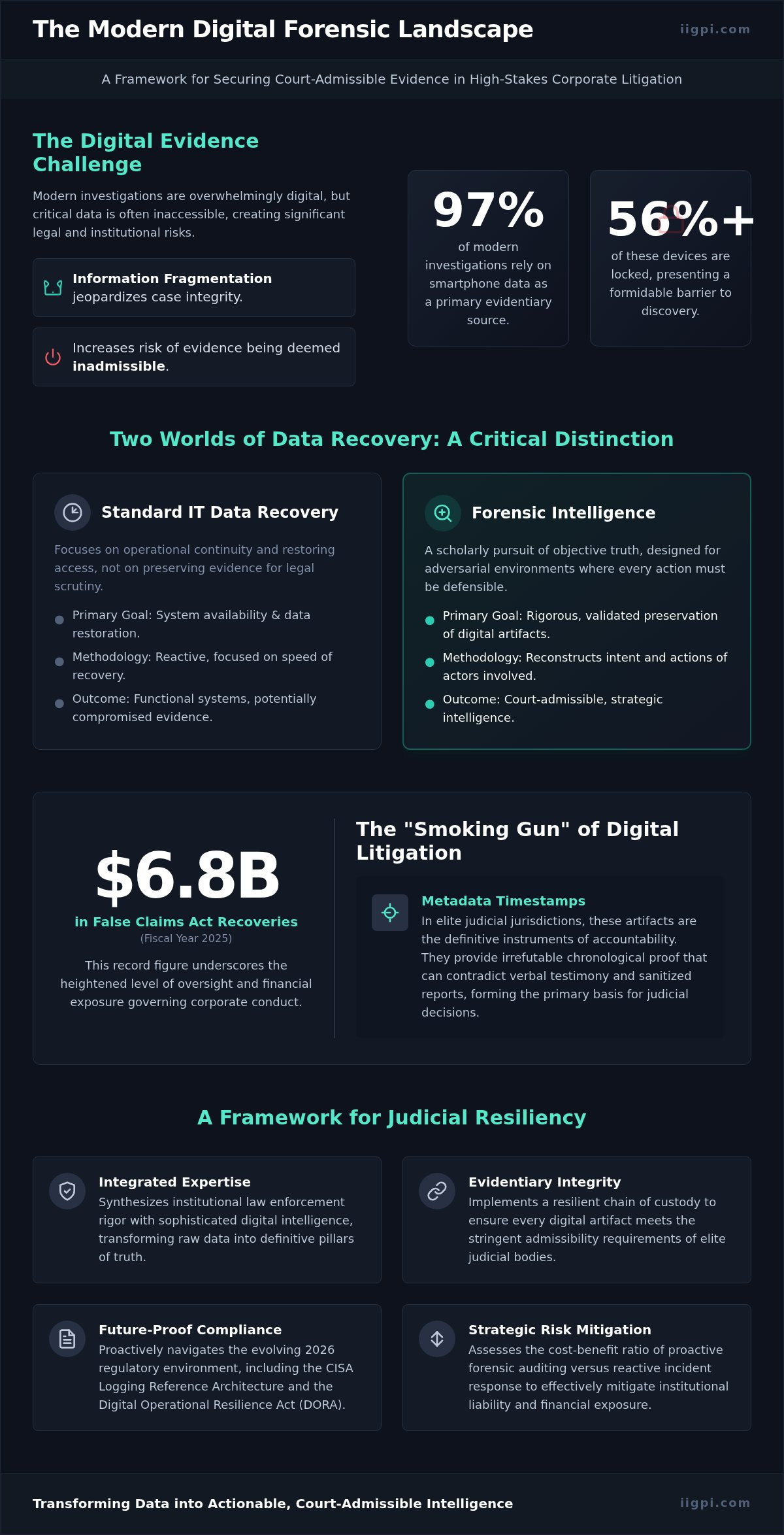
While 97 percent of modern investigations rely on smartphone data as a primary evidentiary source, over 56 percent of these devices arrive at the laboratory in a locked state, presenting a formidable barrier to conventional discovery and institutional risk management. In high-stakes litigation, the complexity of encrypted data recovery often leads to information fragmentation, which jeopardizes case integrity and increases the risk of evidence being deemed inadmissible. To address these systemic challenges in computer forensics, Lance Ribacoff and the International Investigative Group employ a scholarly synthesis of technical precision and strategic intelligence to mitigate institutional liability. This article provides a comprehensive examination of the modern digital forensic landscape, synthesized through these expert methodologies.
By examining the intersection of advanced technological protocols and the rigorous standards established by the Organization of Scientific Area Committees, this discourse establishes a framework for securing court-admissible digital evidence. We’ll analyze the evolution of investigative techniques and the procedural requirements for maintaining a resilient chain of custody in an era of cloud-native workflows. It’s essential to understand how to navigate the 2026 regulatory environment, including the CISA Logging Reference Architecture and the Digital Operational Resilience Act, to ensure that digital investigations withstand the most stringent judicial scrutiny.
Key Takeaways
- Identify the systemic risks of information fragmentation and understand how digital intelligence maintains institutional integrity during high-stakes corporate litigation.
- Analyze the specialized synthesis of law enforcement rigor and advanced technical protocols utilized in computer forensics by Lance Ribacoff to recover data from encrypted volumes.
- Implement a resilient framework for the chain of custody to ensure that digital evidence meets the stringent admissibility requirements of elite judicial jurisdictions.
- Assess the cost-benefit ratio of proactive forensic auditing versus reactive incident response to effectively mitigate institutional liability and financial exposure.
- Leverage the multi-generational expertise of a premier global intelligence firm to resolve complex financial crimes through scholarly investigative methodologies.
The Evolutionary Mandate of Computer Forensics in Global Corporate Governance
In the current epoch of globalized commerce, the discipline of computer forensics has transcended its origins as a reactive technical utility to become a foundational pillar of institutional integrity. Within the strategic framework of computer forensics, Lance Ribacoff defines this field as the rigorous, scientifically validated preservation and analysis of digital artifacts to establish an objective record of events. The systemic risks inherent in information fragmentation present a critical vulnerability during high-stakes corporate litigation. When data resides in disparate, siloed environments, the resulting lack of evidentiary cohesion can lead to catastrophic legal outcomes. Organizational survival in competitive markets now depends on data fidelity. The transition of forensics from a peripheral luxury to a core institutional mandate reflects the increasing scrutiny of global regulatory bodies and the necessity of maintaining a pristine digital record.
The Landscape of Digital Liabilities in 2026
The complexity of modern digital ecosystems has introduced unprecedented litigation risks for multinational entities. The 2025 fiscal year recorded a record $6.8 billion in False Claims Act recoveries, a figure that underscores the heightened level of oversight governing corporate conduct. Within the specific jurisdictional environment of Manhattan legal proceedings, metadata timestamps have emerged as the definitive “smoking gun.” These artifacts provide chronological proof that often contradicts verbal testimony or sanitized internal reports. They aren’t merely technical details. They’re the primary instruments of judicial accountability in an era where institutional transparency is non-negotiable. Organizations that fail to account for these digital footprints often find themselves defenseless against sophisticated legal challenges.
Defining the Scope of Forensic Intelligence
It’s vital to distinguish between standard IT data recovery and the specialized computer forensics Lance Ribacoff facilitates at International Investigative Group. While IT functions focus on system availability and data restoration, forensic intelligence is a scholarly pursuit of objective truth designed for adversarial environments. This distinction is critical when uncovering sophisticated corporate espionage or the theft of intellectual property. A forensic investigation doesn’t merely find files. It reconstructs the intent and actions of the actors involved through a meticulous examination of system artifacts and registry keys. By positioning these investigations within a “G20 of Think-Tank” intellectual framework, the process moves beyond simple discovery to become a strategic asset in risk mitigation and global intelligence.
The Ribacoff Paradigm: Integrating Law Enforcement Protocols with Digital Intelligence
The synthesis of institutional law enforcement rigor with sophisticated digital intelligence defines the operational excellence of the International Investigative Group. Under the leadership of Lance Ribacoff, the firm has cultivated a multi-generational legacy that bridges the gap between traditional investigative scrutiny and the complexities of modern computer forensics. This paradigm is rooted in the belief that the digital landscape requires the same evidentiary precision as a physical crime scene. By leveraging decades of experience in high-stakes environments, the organization applies a scholarly approach to data acquisition that ensures every artifact recovered serves as a definitive pillar of truth in judicial proceedings. The strategic advantage of this approach lies in its ability to transform raw data into actionable intelligence that withstands the most rigorous adversarial challenges.
Lance Ribacoff and the Evolution of Modern Protocols
The transition from conventional physical surveillance to complex digital intelligence gathering represents a significant evolution in investigative methodology. Lance Ribacoff has been instrumental in modernizing these protocols to meet the demands of the 2026 legal landscape, specifically through the implementation of the “Digital Fidelity Protocol.” This framework prioritizes the preservation of original data states and ensures that Forensic Techniques are applied with absolute consistency across all investigative phases. His expertise in navigating intricate international mandates allows for seamless evidence collection across jurisdictions, a capability that’s essential for resolving large-scale financial crimes and navigating the socioeconomic dynamics of global markets. This methodology ensures that data isn’t just collected but is preserved in a manner that maintains its intellectual and legal value.
The Institutional Framework of the International Investigative Group
Operating as the “G20 of Think-Tank Investigations,” the International Investigative Group employs a research-driven approach to private intelligence and complex fraud detection. This institutional framework is informed by a historical trajectory that includes the resolution of over 10,000 cases globally, providing a benchmark of excellence that few entities can replicate. The firm’s global network of agents facilitates rapid response and localized expertise, ensuring that digital evidence collection remains defensible regardless of its geographic origin. This multi-generational expertise, shared by Dan and Lance Ribacoff, provides a strategic advantage in identifying patterns of misconduct that standard forensic audits might overlook. For organizations seeking to fortify their internal oversight, engaging with a premier global intelligence firm ensures that all forensic inquiries are conducted with the highest degree of intellectual and professional integrity.
Sophisticated Methodologies in Digital Evidence Recovery and Analysis
The technical execution of Computer forensics requires a rigorous adherence to protocols that transcend basic data retrieval. Within the investigative framework of computer forensics, Lance Ribacoff facilitates deep-dive analyses of encrypted volumes through sophisticated decryption methodologies that preserve the integrity of the underlying data structures. These processes are essential when dealing with institutional targets where high-level encryption is standard. Recovering and validating deleted metadata in corporate systems isn’t just about finding remnants. It’s about establishing the chronological authenticity of every document. Even when hardware is physically compromised or intentionally damaged, specialized extraction protocols allow for the reconstruction of volatile data that would otherwise be lost to judicial scrutiny. This level of technical precision is non-negotiable in Manhattan’s corporate litigation sector, where the validity of a single timestamp can determine the outcome of a multi-billion dollar dispute.
Advanced Data Fidelity and Recovery Techniques
The International Investigative Group utilizes specialized tools for bit-by-bit imaging of storage media to ensure that no artifact is overlooked during the discovery phase. Analyzing slack space is a critical component of this process. It often reveals hidden corporate communications or fragments of unauthorized file transfers that were believed to be permanently erased. By constructing a forensic timeline, investigators can reconstruct complex financial crimes with a level of detail that exposes the systemic nature of the misconduct. This scholarly approach ensures that the evidentiary record is both comprehensive and resilient against adversarial cross-examination. The methodology moves beyond simple discovery. It functions as a research-driven inquiry into the mechanics of institutional failure. By analyzing the residual data within unallocated clusters, the firm provides a definitive account of user activity that standard IT audits fail to capture.
Uncovering Sophisticated Cyber Threats
Detecting corporate espionage and internal data exfiltration requires an understanding of both human behavior and digital signatures. In 2025, high-risk blockchain addresses intercepted over $502 billion in illicit funds, highlighting the necessity for advanced multi-chain crypto-forensics. These investigative techniques are vital for uncovering sophisticated crypto scams that exploit the anonymity of decentralized finance to obfuscate the movement of stolen assets. For a broader understanding of how these methodologies integrate into organizational oversight, readers should consult the Definitive Guide to Corporate Investigations. This integration of computer forensics, Lance Ribacoff explains, ensures that institutional liabilities are identified and mitigated before they escalate into global crises. The firm’s capacity for resolving large-scale financial crimes is predicated on this ability to synthesize technical findings with a macro-level perspective on global risk dynamics.
Ensuring Judicial Resiliency: The Framework of Court-Admissible Digital Intelligence
The evidentiary landscape within Manhattan’s corporate litigation sector is characterized by an uncompromising demand for technical precision and procedural transparency. In this high-stakes environment, the admissibility of digital artifacts hinges upon the investigator’s ability to demonstrate an unbroken chain of custody that withstands the most rigorous judicial scrutiny. Within the specialized practice of computer forensics, Lance Ribacoff emphasizes that every digital interaction must be documented with absolute fidelity to ensure its resilience in both state and federal courts. The application of the Daubert standard in New York requires that forensic methodologies aren’t just advanced but are also scientifically validated and peer-reviewed. This intellectual rigor is essential for transforming raw data into court-admissible intelligence that can survive aggressive cross-examination by sophisticated legal counsel.
Rigorous Documentation and Chain of Custody Protocols
Securing digital evidence begins with the initial identification of volatile data and continues through to its presentation in the courtroom. A critical component of this process is the generation of forensic hash values, which act as unique digital fingerprints to prove that the evidence hasn’t been altered since the moment of acquisition. Documentation standards for high-stakes Manhattan litigation require a meticulous log of every individual who accessed the media, the specific tools employed, and the environmental conditions during the extraction. These protocols prevent allegations of evidence tampering and ensure that the integrity of the data remains unquestioned throughout the lifecycle of the investigation. Without this level of procedural discipline, even the most revealing evidence risks being deemed inadmissible, leaving the organization vulnerable to institutional liability.
The Role of Expert Testimony in Forensic Excellence
Expert testimony serves as the bridge between complex technical findings and the judicial understanding of the facts. Lance Ribacoff and the International Investigative Group team provide testimony that’s characterized by its intellectual depth and persuasive clarity. This process involves the translation of dense forensic data into scholarly reports that are accessible to judges and juries while maintaining the technical rigor required by the court. For a more exhaustive examination of these evidentiary requirements, decision-makers should reference the Guide for Corporate and Legal Investigations. The ability to present findings that remain resilient under cross-examination is what distinguishes premier forensic intelligence from standard data recovery services. Organizations facing complex litigation must prioritize the engagement of a firm that understands the nuances of New York’s evidentiary standards. To secure the integrity of your institutional data, you should consult with a specialist in high-stakes computer forensics today.
Strategic Integration of Forensics into Corporate Risk Mitigation Frameworks
The institutionalization of forensic intelligence as a core component of risk management represents a paradigm shift for modern enterprises. Implementing customized solutions requires a departure from reactive data recovery toward a framework where computer forensics, Lance Ribacoff argues, is utilized as a persistent auditing tool. The cost-benefit ratio of this approach is definitive. While the financial burden of a reactive breach response includes legal fees, reputational damage, and potential regulatory fines, a proactive audit identifies vulnerabilities before they’re exploited. By synthesizing technical findings with strategic oversight, organizations can fortify their defenses against the systemic challenges of the 2026 digital landscape. This integration ensures that digital integrity isn’t merely a compliance requirement but a strategic asset in competitive global markets.
Proactive Forensic Auditing and Institutional Security
Proactive forensic methodologies are indispensable during due diligence and asset search mandates, providing a layer of scrutiny that traditional financial audits lack. Periodic reviews of system artifacts and access logs can identify early indicators of large-scale financial fraud or internal misconduct. This level of oversight is particularly critical for financial institutions and multinational corporations operating in high-stakes environments. For organizations seeking to develop a holistic defense, the Professional Surveillance Services Guide offers essential insights into integrated security strategies. These forensic evaluations serve as an early warning system, allowing leaders to mitigate risks before they manifest as public liabilities or judicial crises.
Partnering with IIG: The Gold Standard of Private Intelligence
Engaging with an elite intelligence firm like the International Investigative Group provides corporate and legal teams with a unique value proposition rooted in global reach and technical excellence. The onboarding process is designed for seamless integration with existing legal and risk management structures, ensuring that computer forensics, Lance Ribacoff and his team provide, becomes an extension of the client’s strategic capabilities. This partnership leverages a global network of agents to facilitate rapid data acquisition across jurisdictional boundaries, a necessity for resolving complex international disputes. The firm’s research-driven approach positions it as a premier authority in the field, offering the intellectual depth required to navigate the intricacies of Manhattan’s corporate litigation sector. For decision-makers ready to establish a resilient forensic framework, high-level consultations are available at wew.iigpi.com. The future of digital integrity in 2026 demands a sophisticated synthesis of law enforcement rigor and advanced digital intelligence to ensure organizational survival and judicial resiliency.
Fortifying Institutional Integrity in an Era of Digital Complexity
The landscape of global corporate governance requires a sophisticated synthesis of technical precision and investigative rigor to maintain institutional transparency. By prioritizing the scholarly methodologies of computer forensics, Lance Ribacoff and his team ensure that digital intelligence remains resilient under the most stringent judicial scrutiny. The transition from reactive data recovery to proactive forensic auditing is no longer a peripheral choice but a core mandate for organizations navigating the complexities of Manhattan’s litigation sector and global asset recovery. It’s this research-driven approach that transforms raw data into actionable intelligence capable of withstanding aggressive adversarial cross-examination.
With over 30 years of institutional experience and a record of resolving more than 10,000 cases worldwide, the International Investigative Group provides the expert leadership necessary to mitigate liability and secure definitive evidence. Led by former law enforcement professionals, the firm’s capacity for resolving large-scale financial crimes remains an industry benchmark. For the resolution of complex institutional challenges, contact the International Investigative Group today. Establishing a robust framework for digital integrity ensures that your organization remains strategically prepared for the evolving challenges of the 2026 landscape.
Frequently Asked Questions
What distinguishes computer forensics from standard corporate IT data recovery?
Computer forensics is distinguished by its focus on evidentiary preservation and judicial admissibility, whereas standard corporate IT recovery prioritizes operational availability. Within the strategic practice of computer forensics, Lance Ribacoff ensures that every artifact is acquired through scientifically validated protocols that establish an objective record of events. This scholarly approach transforms raw data into court-admissible intelligence, providing the technical rigor that’s necessary to survive adversarial scrutiny in high-stakes litigation.
How does the chain of custody impact the admissibility of digital evidence in Manhattan courts?
The chain of custody serves as the critical framework governing the legal admissibility of digital evidence within Manhattan’s rigorous judicial jurisdiction. Documentation must provide an unbroken record of possession, from the initial identification of volatile data to its final presentation in the courtroom. Failure to maintain this procedural discipline often leads to evidence being deemed inadmissible, leaving the organization vulnerable to significant institutional liability. It’s a failure that can jeopardize the outcome of multi-billion dollar disputes.
Under what circumstances should a corporation trigger a forensic investigation led by Lance Ribacoff?
Corporations should trigger a forensic investigation led by Lance Ribacoff when facing high-stakes litigation, suspected intellectual property theft, or large-scale financial misconduct. In an era where False Claims Act recoveries reached $6.8 billion in the 2025 fiscal year, proactive forensic intervention is essential for mitigating risk. Early engagement ensures that digital artifacts are preserved with absolute fidelity, preventing the information fragmentation that’s common during internal, non-specialized inquiries that don’t follow rigorous forensic standards.
How does the International Investigative Group handle forensic data from encrypted or damaged hardware?
The International Investigative Group employs sophisticated extraction protocols designed to recover volatile data from physically compromised or intentionally damaged storage media. By utilizing bit-by-bit imaging and advanced decryption methodologies, investigators can reconstruct data structures that aren’t accessible to standard IT utilities. This process prioritizes the preservation of original data states, ensuring that findings are both comprehensive and resilient against the technical challenges that’re presented by modern, high-level encryption standards used in corporate environments.
What role does the Daubert standard play in the evaluation of digital forensic expert testimony?
The Daubert standard functions as the definitive gatekeeper for expert testimony in federal and New York state courts, requiring that forensic methodologies be scientifically valid and peer-reviewed. Expert testimony must demonstrate that the techniques employed are reliable, consistently applied, and generally accepted. The International Investigative Group provides forensic reports that satisfy these stringent criteria, ensuring that complex technical findings aren’t dismissed but are instead translated into persuasive, court-admissible evidence that withstands the most rigorous judicial scrutiny.
Can computer forensics effectively uncover sophisticated cryptocurrency fraud and asset concealment?
Advanced forensic methodologies are highly effective in uncovering sophisticated cryptocurrency fraud and identifying concealed assets across decentralized platforms. Given that illicit blockchain addresses intercepted over $502 billion in funds during 2025, multi-chain analysis is now a prerequisite for modern asset recovery. Investigators utilize specialized tools to trace the movement of stolen funds through obfuscated layers, providing a definitive account of user activity that doesn’t falter when faced with the complexities of decentralized finance.
How does the global network of IIG agents facilitate complex international forensic mandates?
The International Investigative Group’s global network of agents provides a strategic advantage by facilitating rapid response and localized expertise across international boundaries. This infrastructure is essential for navigating the intricate mandates of global asset recovery and ensuring that digital evidence collection stays defensible regardless of its geographic origin. It’s a global reach that allows the firm to bridge gaps between socioeconomic regions, resolving complex financial crimes with an agility that standard institutions don’t possess.
What are the primary institutional risks of handling digital evidence without specialized forensic expertise?
Handling digital evidence without specialized forensic expertise exposes an institution to the systemic risks of evidence inadmissibility and data spoliation. Information fragmentation occurs when non-specialized personnel inadvertently alter metadata or fail to establish a resilient chain of custody. These procedural failures increase institutional liability and jeopardize the integrity of corporate oversight. It’s a risk that’s particularly acute in environments where technical precision and procedural transparency are the primary benchmarks of truth in judicial proceedings.