In an era defined by digital transformation, the integrity of corporate and legal proceedings increasingly depends upon the defensibility of electronic data. When faced with allegations of internal data theft, the necessity of recovering deleted files for litigation, or uncertainty regarding the admissibility of digital artifacts, organizations confront a significant evidentiary challenge that falls squarely within the domain of computer forensics. This rigorous discipline provides the essential framework for navigating these intricate situations, offering a systematic process for the identification, preservation, analysis, and presentation of digital evidence to uncover definitive facts.
This comprehensive guide is designed to illuminate this critical process. It will equip corporate leaders and legal counsel with the foundational knowledge required to oversee investigations, ensuring that digital evidence is not only discovered but is also collected and handled in a manner that maintains its integrity and guarantees its admissibility in a court of law. By understanding these principles, you can build a formidable case, make informed strategic decisions, and resolve complex digital disputes with clarity and irrefutable proof, protecting your organization and securing a decisive legal advantage.
Key Takeaways
- Recognize computer forensics as a strategic discipline for identifying, preserving, and analyzing digital evidence to establish factual records in corporate and legal disputes.
- Grasp the critical importance of a methodical, multi-phase forensic process, as strict adherence to this structure is fundamental to the legal admissibility of evidence.
- Understand the specific corporate scenarios, from internal fraud to intellectual property theft, where forensic analysis is indispensable for mitigating risk and resolving conflict.
- Acquire a strategic framework for evaluating and selecting a certified forensics partner, a critical decision for protecting sensitive information and achieving favorable legal outcomes.
What is Computer Forensics? A Strategic Overview for Decision-Makers
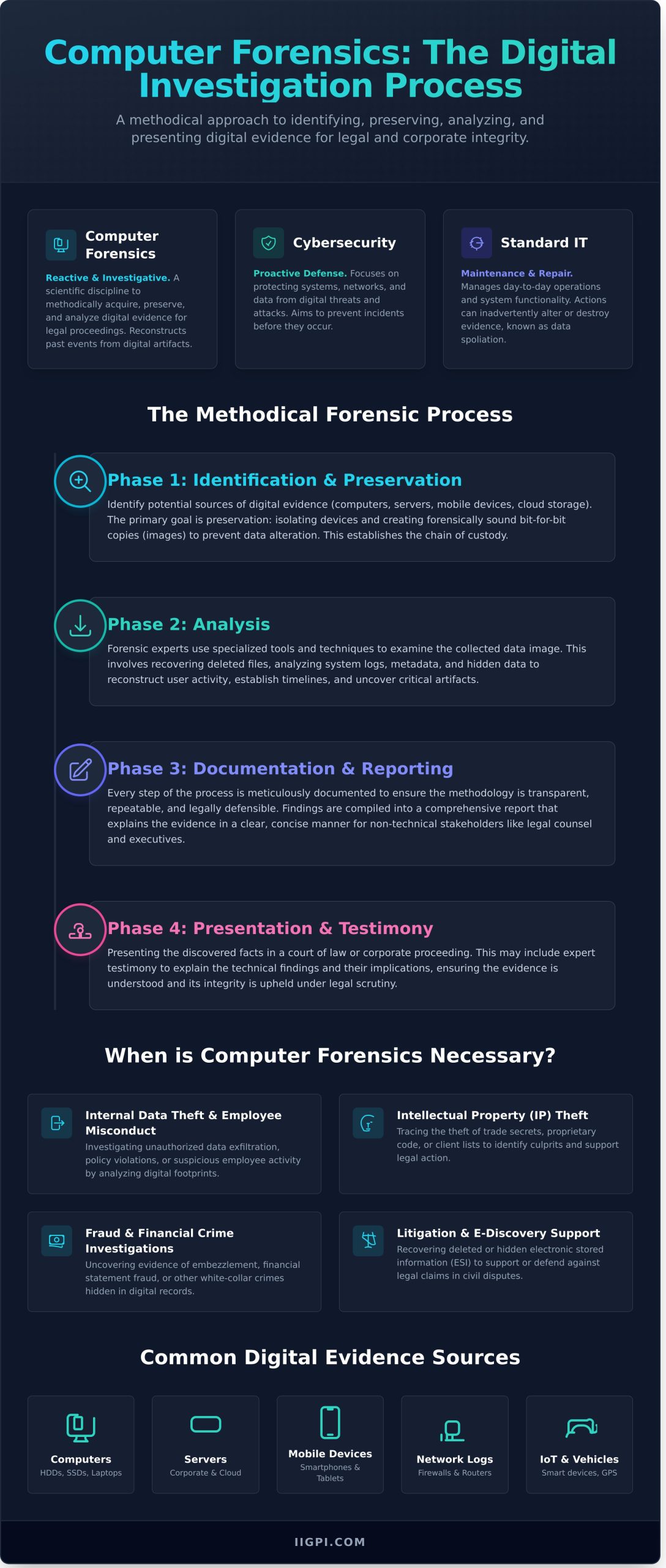
In an era defined by digital transformation, understanding the mechanisms for investigating events within digital environments is a strategic imperative. Computer forensics is the scientific discipline dedicated to the methodical acquisition, preservation, analysis, and presentation of digital evidence for use in legal or administrative proceedings. Far from a mere technical exercise, its primary goal is to reconstruct events and establish factual narratives from digital artifacts. While often conflated with adjacent fields, its function is distinct; cybersecurity is a proactive defense against digital threats and standard IT operations focus on system maintenance, whereas the practice of computer forensics is an inherently reactive and investigative process. This discipline provides a rigorous framework for examining digital information across a vast and expanding scope of devices, from corporate servers and personal computers to mobile phones and cloud infrastructure, serving as a critical capability in both civil and criminal matters.
The Investigative Purpose: Beyond Data Recovery
The strategic value of a forensic investigation extends significantly beyond the simple retrieval of deleted files. The core objective is to contextualize data, reconstructing timelines of user activity, elucidating intent, and establishing causal links between digital actions and real-world events. Forensic analysts are tasked with uncovering evidence that may be intentionally hidden, encrypted, or otherwise obfuscated. This process involves a deep analysis of system artifacts, metadata, and latent data to build a comprehensive and defensible account of what occurred, who was involved, and how events transpired.
Computer Forensics vs. Standard IT Procedures
A critical distinction for decision-makers lies in understanding why internal IT professionals are ill-equipped to conduct a formal forensic investigation. Standard IT tools and procedures, designed for system repair and maintenance, can inadvertently alter or destroy critical evidence. This act, known as data spoliation, can render evidence inadmissible in legal proceedings. In contrast, forensic science adheres to a strict methodology that prioritizes the preservation of evidentiary integrity. Every action is documented to maintain a verifiable chain of custody, ensuring that the digital evidence collected is an exact and unaltered replica of the original source.
Common Devices and Data Sources in an Investigation
The sources of digital evidence are diverse and continually evolving, demanding specialized collection techniques tailored to each platform. An investigation may draw upon a wide array of devices and data repositories, including:
- Traditional computer hard drives (HDD) and solid-state drives (SSD)
- Corporate and cloud-based servers
- Smartphones, tablets, and other mobile devices
- Network logs, firewall data, and intrusion detection system alerts
- Emerging sources such as Internet of Things (IoT) devices and vehicle infotainment systems
Each of these sources contains unique data structures and artifacts, necessitating sophisticated tools and expert knowledge to extract information in a forensically sound manner.
The Forensic Process: A Methodical Approach to Digital Evidence
The efficacy of digital forensics in legal and corporate investigations is fundamentally dependent upon a rigorously structured and documented methodology. To ensure that digital evidence is admissible in a court of law, practitioners must adhere to a process that is both repeatable and verifiable, thereby preserving the integrity of the findings against legal scrutiny. This process is generally structured into distinct phases, each governed by strict protocols. Adherence to established frameworks, such as the NIST digital forensics methodologies, is paramount for validating the tools and procedures employed. The objective is to create a transparent and defensible chain of custody for digital artifacts, from their initial discovery to their final presentation.
Phase 1: Identification, Preservation, and Collection
The initial phase involves the identification of potential sources of digital evidence, which can range from conventional computers and mobile devices to cloud storage and network infrastructure. Once identified, the paramount objective is preservation. This requires isolating the device to prevent any alteration of data, often through physical seizure or network disconnection. To maintain the original evidence in a pristine state, investigators create a ‘forensically sound’ copy, or a bit-for-bit forensic image, using specialized hardware write-blockers that prevent any data from being written to the source media. The integrity of this image is then verified using cryptographic hash functions.
Phase 2: Examination and Analysis
With a verified forensic image secured, the examination and analysis phase commences. Investigators utilize a suite of specialized software tools to conduct an in-depth search of the copied data, a core discipline within the field of computer forensics. This process extends beyond readily visible files to uncover latent data, including deleted files, file fragments in unallocated space, internet browsing history, and email communications. Furthermore, the analysis of metadata-data about the data-is critical for establishing timelines, identifying file access patterns, and attributing actions to specific users, thereby constructing a factual narrative of events.
Phase 3: Reporting and Presentation
The final phase culminates in the creation of a comprehensive forensic report. This document provides a clear, objective summary of the investigation, detailing the methodologies employed, the evidence discovered, and the conclusions drawn from the analysis. It is imperative that the report is based solely on the factual data recovered and avoids subjective interpretation. A critical function of this report is to translate highly technical findings into unambiguous, understandable language suitable for non-technical audiences, including legal counsel, corporate management, and judicial bodies, ensuring the significance of the digital evidence is fully comprehended.
Key Applications: When is Computer Forensics Necessary?
In an era where digital information constitutes the primary record of corporate activity, the discipline of computer forensics has become an indispensable component of risk management and conflict resolution. This specialized field involves the systematic investigation of digital devices to recover, analyze, and present evidence in a legally admissible manner. The fundamental process, as detailed in comprehensive overviews on What is Computer Forensics?, provides organizations with the clarity required to navigate complex internal and external challenges, transforming ambiguous situations into fact-based inquiries.
Corporate Investigations: Uncovering Internal Threats
Internal threats, whether malicious or negligent, represent a significant vulnerability for any organization. Computer forensics is instrumental in addressing these issues by uncovering digital footprints related to intellectual property (IP) theft, unauthorized data exfiltration, and financial misconduct such as embezzlement. Furthermore, forensic analysis can substantiate or dismiss claims of workplace harassment or policy violations by examining email communications, access logs, and deleted files, thereby providing an objective basis for disciplinary action or exoneration.
Litigation Support: Building an Evidentiary Foundation
In the context of civil litigation, from breach of contract disputes to employment law conflicts, digital evidence often forms the cornerstone of a legal strategy. Forensic experts are critical to the electronic discovery (eDiscovery) process, ensuring that relevant data is identified, preserved, and collected in a manner that withstands judicial scrutiny. This meticulous process can validate an organization’s position or, conversely, refute claims made by an opposing party by recovering critical artifacts that reveal the true timeline and nature of events.
Insurance Fraud and Due Diligence
The application of digital forensics extends to high-stakes financial assessments, including the investigation of suspicious insurance claims and comprehensive due diligence for mergers and acquisitions (M&A). In fraud investigations, forensic analysis of devices can reveal manipulated documents or communications that expose a fraudulent claim. During M&A, it serves as a critical tool to vet a target company’s digital assets, including custom software platforms developed by firms like API Pilot, to uncover undisclosed liabilities, verify IP ownership, and ensure there are no hidden data breaches or misrepresentations that could jeopardize the transaction.
These scenarios illustrate that the strategic application of digital forensic techniques is not merely a reactive measure but a proactive strategy for protecting assets, ensuring compliance, and achieving favorable outcomes in disputes. If your organization faces a situation where digital evidence is paramount, we invite you to request a confidential consultation.
The Legal Framework: Ensuring Evidence is Admissible in Court
In any legal proceeding, the ultimate value of digital evidence is determined not by what it reveals, but by its admissibility in a court of law. The practice of professional computer forensics is fundamentally governed by legal standards designed to preserve the integrity of that evidence from the moment of collection to its presentation before a judge or jury. For legal clients, this is the most critical concern; without adherence to these rigorous protocols, even the most compelling data can be rendered worthless. Consequently, engaging certified experts who operate within this legal framework is non-negotiable, positioning the forensic investigator as an indispensable part of the legal team.
The Critical Role of the Chain of Custody
The chain of custody is the meticulous, chronological documentation that accounts for the seizure, control, transfer, and analysis of evidence. This unbroken record demonstrates that the evidence presented in court is the same as what was originally collected, and that it has remained secure. A broken or poorly documented chain invites challenges from opposing counsel, who can argue the evidence was contaminated or altered, often leading to its exclusion by the court. Professional examiners maintain exhaustive logs to prevent such vulnerabilities.
Maintaining Data Integrity with Hashing
To mathematically prove that digital evidence has not been tampered with, investigators use a process called cryptographic hashing. A hash algorithm generates a unique alphanumeric string, or “digital fingerprint,” from a piece of data. A forensic image-a bit-for-bit copy of the original storage device-is created, and its hash value is calculated and recorded. Any alteration to this copy, no matter how small, would produce a completely different hash value, providing irrefutable proof of the evidence’s original state and defeating claims of manipulation.
The Expert Witness: Presenting Findings in Court
The role of the forensic examiner frequently extends beyond the laboratory and into the courtroom, where they serve as an expert witness. In this capacity, they must articulate highly technical processes and complex findings in a manner that is clear, defensible, and comprehensible to a non-technical audience. The expert’s testimony validates the entire computer forensics process, explaining how the chain of custody was maintained and how data integrity was verified. The experience, credentials, and communication skills of the expert are paramount in ensuring the court understands and accepts the digital evidence.
Selecting a Computer Forensics Partner: Critical Considerations
The efficacy of a digital investigation is contingent not merely on the available technology but fundamentally on the proficiency of the practitioners involved. Distinguishing between a general information technology provider and a specialized forensics expert is the first critical step. The former manages systems, while the latter deconstructs them using the principles of computer forensics to uncover legally admissible evidence. Engaging an unqualified party can lead to evidence spoliation, rendering it inadmissible and jeopardizing the entire legal or corporate proceeding.
Essential Certifications and Industry Credentials
A firm’s credibility is substantiated by the professional credentials of its experts. When vetting a potential partner, it is imperative to verify their team holds industry-recognized certifications that demonstrate rigorous training and a commitment to established forensic methodologies. Key credentials to look for include:
- Certified Forensic Computer Examiner (CFCE): A comprehensive certification focused on core forensic principles and law enforcement standards.
- EnCase Certified Examiner (EnCE): Demonstrates proficiency with the widely utilized EnCase forensic software suite.
- AccessData Certified Examiner (ACE): Signifies expertise with the Forensic Toolkit (FTK), another industry-standard platform.
These certifications affirm technical competence; however, it is equally critical to inquire about an expert’s history of providing court testimony and their success in withstanding challenges under cross-examination.
Experience in Your Specific Case Type
The field of computer forensics is vast, with distinct methodologies required for different types of investigations. A firm specializing in intellectual property theft may possess a different skill set than one that primarily handles domestic litigation. It is crucial to engage a partner whose experience aligns directly with the nuances of your case, whether it involves corporate espionage, financial fraud, or regulatory compliance inquiries. Prudent due diligence includes requesting anonymized case studies or professional references that attest to their successful management of matters similar in scope and complexity to your own.
Infrastructure and Security Protocols
The integrity of digital evidence is paramount and is directly linked to the physical and digital security of the forensic environment. A prospective firm must operate a dedicated, secure forensic laboratory with stringent chain-of-custody protocols. Inquire about their data security measures, including encryption standards and access controls, to ensure the protection of highly confidential information. Furthermore, verify that the firm utilizes licensed, up-to-date, and industry-validated forensic tools, as the use of unverified software can call the entire investigative process into question.
Ultimately, the selection of a forensic partner is a strategic decision with profound implications for the outcome of any investigation. A meticulous evaluation of credentials, relevant experience, and operational security is not merely advisable; it is an essential component of due diligence for ensuring evidentiary integrity and achieving a successful resolution. Our team possesses the requisite experience and credentials to handle your case with the utmost professionalism and discretion. Learn more about us.
The Strategic Imperative of Digital Evidence
As has been delineated, the discipline of computer forensics transcends mere technical data recovery; it represents a strategic capability essential for safeguarding corporate integrity and navigating complex legal challenges. The successful application of this discipline is contingent upon a methodical investigative process and a profound understanding of the legal frameworks that govern the admissibility of digital evidence. Consequently, the selection of a forensic partner is not a tactical choice but a critical strategic decision with far-reaching implications for the outcome of any inquiry.
When faced with high-stakes scenarios such as multi-million dollar fraud or intricate corporate malfeasance, the necessity for unparalleled expertise becomes absolute. International Investigative Group offers precisely this level of proficiency, built upon a foundation of over 30 years of investigative experience. Our team consists of court-qualified experts who hold industry-leading certifications and possess a proven track record in resolving the most demanding and sensitive cases.
To discuss your requirements with discretion and professional rigor, please Contact Our Certified Forensics Experts for a Confidential Consultation. By securing a partnership with proven leaders, your organization can navigate the complexities of digital investigations with confidence and strategic advantage.
Frequently Asked Questions
Can computer forensics recover deleted files or formatted hard drives?
Yes, the recovery of data from compromised or intentionally wiped storage media is a central tenet of digital forensics. When a file is deleted, the operating system typically removes the pointer to the data rather than the data itself, leaving it recoverable until the physical space is overwritten. Similarly, a standard format operation may not erase the underlying data. The success of such recovery is contingent upon factors like the time elapsed since deletion and subsequent use of the device.
How much does a professional computer forensics investigation typically cost?
The cost of a professional investigation is determined by the scope and complexity of the engagement. Key variables include the volume of data to be analyzed, the number and type of devices involved, and the specific analytical methodologies required to meet evidentiary standards. Engagements are typically billed on an hourly basis, with rates reflecting the examiner’s expertise. Consequently, costs can range significantly from straightforward data acquisition to complex, multi-device litigation support requiring extensive analysis and expert testimony.
How long does the computer forensics process take from start to finish?
The duration of a forensic examination is directly correlated with the case’s complexity and the volume of electronically stored information (ESI) under review. A preliminary analysis of a single device might be completed within a few business days. However, comprehensive investigations involving multiple terabytes of data, encrypted files, or intricate data recovery scenarios can extend over several weeks or even months, particularly when rigorous documentation for legal admissibility is paramount.
Is the computer forensics process confidential and discreet?
Confidentiality and discretion are foundational principles of any professional forensic engagement. Examiners operate under stringent ethical codes and are typically bound by non-disclosure agreements (NDAs) to protect client privacy and sensitive information. All procedures, from data acquisition to final reporting, are conducted within a secure environment, and a strict chain of custody is maintained to ensure the integrity and confidentiality of all evidentiary materials throughout the investigative lifecycle.
Can you perform forensic analysis on mobile phones and cloud accounts?
Yes, the discipline of digital forensics extends beyond traditional computers to encompass mobile devices and cloud-based platforms. Mobile forensics involves specialized techniques to extract data such as call logs, text messages, location history, and application data from smartphones and tablets. Similarly, cloud forensics provides methodologies for collecting and analyzing data stored on remote servers, which requires navigating distinct legal and technical challenges to secure evidence from services like Google Drive, Microsoft 365, or AWS.
What is the difference between computer forensics and eDiscovery?
While related, these two fields serve distinct functions within a legal context. The practice of computer forensics is a specialized technical process focused on the scientific acquisition, preservation, and analysis of digital evidence, often to uncover deleted, hidden, or corrupted data for legal proceedings. In contrast, eDiscovery (Electronic Discovery) is a broader legal process that governs the identification, collection, and production of all relevant electronically stored information (ESI) in response to a legal or investigatory request.
