
Hidden assets can affect the financial picture in a New York divorce. Article 31 of New York’s Civil Practice Law and Rules governs information exchange in divorce litigation, and courts may order further disclosure or impose penalties when a spouse fails to provide requested financial records. This guide by Lance Ribacoff and Dan Ribacoff examines how verifying financial disclosures in a high-net-worth divorce in NYC can help bring relevant financial information into view.
Complex finances can make it difficult to determine whether disclosed income, assets, and business interests tell the whole story. This article explains which business, compensation, and financial records may be reviewed, what inconsistencies could warrant closer scrutiny, and how investigative work can support the review. Careful documentation is especially important when income flows through a business, compensation arrangements are complex, or financial activity does not align with the records provided.
Key Takeaways
- Learn why gaps between reported finances and a spouse’s business interests, compensation, or lifestyle may warrant closer examination.
- Identify the kinds of ownership and executive compensation records that can help clarify the value and flow of income.
- Understand how financial documents can be assessed together to reveal inconsistencies that an isolated record may not show.
- See when investigative casework may help develop a clearer picture of financial activity relevant to a divorce.
Can Hidden Assets Affect a New York Divorce Case?
Yes. Hidden assets can distort the financial picture considered during New York divorce litigation. Article 31 governs information exchange, while financial review can identify gaps requiring further examination.
Financial Disclosure Requirements
Financial disclosure is the exchange of records relevant to each spouse’s finances during litigation. In New York, Article 31 of the Civil Practice Law and Rules governs that exchange. The records help establish what assets, income, and obligations must be evaluated. For high-net-worth spouses, tracing business interests or complex compensation can reveal whether the disclosed picture is complete.
Penalties for Hidden Assets and False Disclosures
When a spouse fails to provide requested financial records, New York courts may order further disclosure and impose penalties. The response depends on the conduct and the court’s assessment; there is no single automatic penalty. An unexplained omission may lead to additional document requests and closer scrutiny of related financial activity.
Financial Disclosure Verification Timelines
There is no standard timeline for every NYC divorce. Verification depends on the number and complexity of financial accounts, how quickly records are produced, and whether business transactions need closer analysis. Comparing straightforward records may take less time than tracing layered ownership or compensation. Delays in obtaining documents can extend the review and affect when findings are useful in litigation.
Private investigative licensing and Article 31 address different questions: who may conduct investigative work, and what financial information parties exchange in litigation. Licensing does not itself establish whether a spouse’s disclosures are complete. New York recorded 2.4 divorces per 1,000 population in 2023, based on preliminary data; that figure provides context, not a measure of hidden assets.
An attorney may use investigative findings to identify inconsistencies, shape requests for supporting records, and prepare questions for litigation. For example, evidence of an undisclosed business connection may point to ownership documents and related transactions. Findings can inform case development, while the attorney decides how to present relevant material in court.
Business ownership and executive compensation records
Business interests, trusts, real estate, and offshore assets can be assessed using ownership evidence, financial records, liabilities, and relevant market information. A company’s reported income alone, for example, may not show its value if distributions, retained earnings, or debt affect the financial picture. An attorney can use the records to frame questions about ownership and valuation.
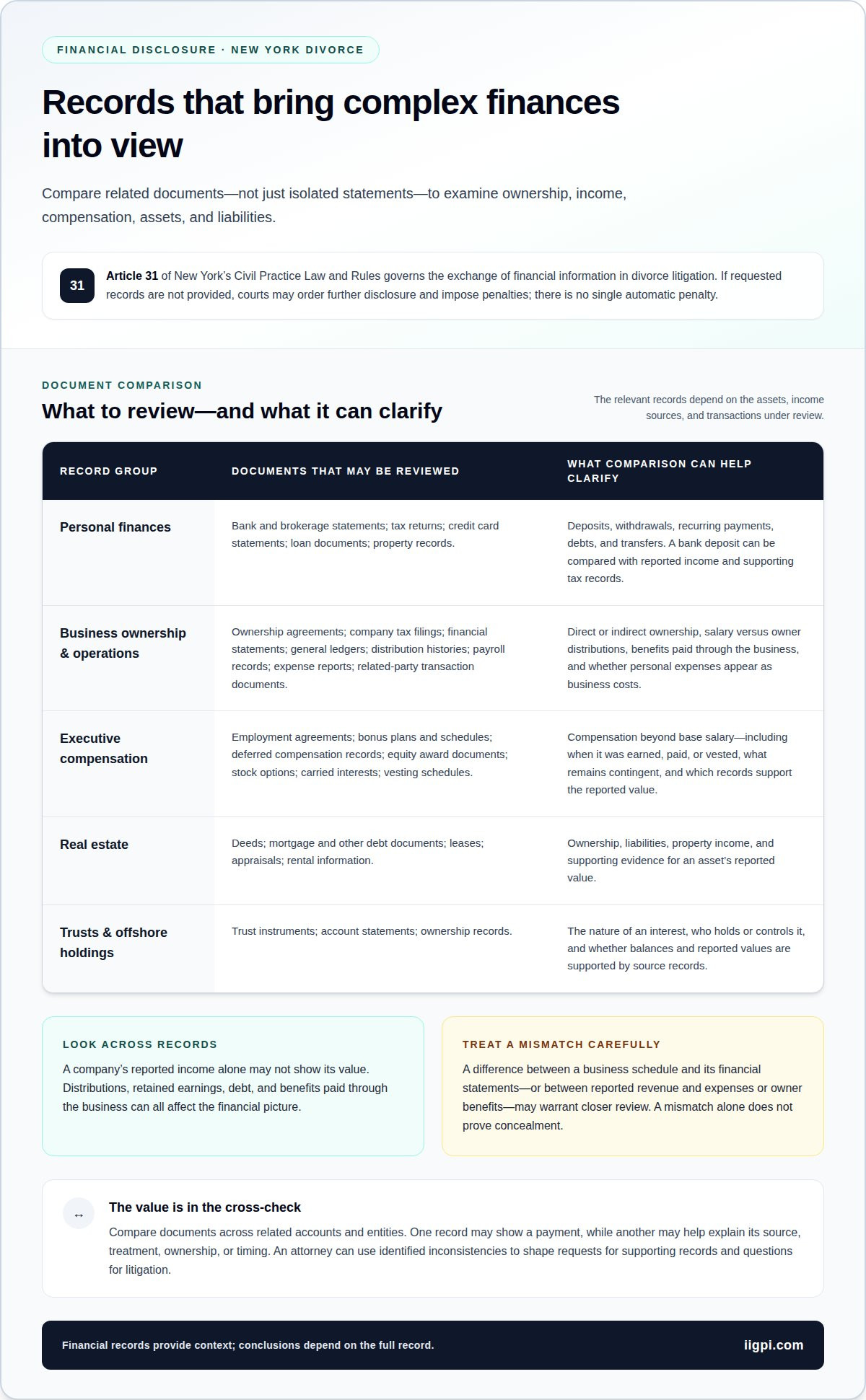
For a privately held company, useful records may include ownership agreements, tax returns, financial statements, ledgers, distribution histories, and documents describing related-party transactions. Together, these can distinguish salary from owner distributions and identify benefits paid through the business. If reported revenue falls while company expenses or owner benefits rise, the discrepancy may warrant closer review. The records can also clarify whether a spouse holds a direct interest or benefits through another entity.
Executive compensation requires a broader view than base salary alone. A review may include bonus plans, deferred compensation, equity awards, stock options, carried interests, and employment agreements. A bonus earned in one period but paid later, for example, can raise questions about timing and treatment. Award schedules and vesting terms help clarify what has been granted, what remains contingent, and which records support the reported value. An attorney can use these details to determine what further documentation is relevant.
Valuation also depends on how an asset is structured. Trust instruments and account statements can clarify who holds an interest, while property records, appraisals, debt documents, and rental information can help assess real estate. For offshore holdings, account statements and ownership records may help trace balances and control. The review connects each asset to its source documents and compares reported values with supporting evidence. A mismatch between a business schedule and its financial statements, for example, can prompt follow-up questions without proving concealment.
Documents requested in high-net-worth divorces
Document requests turn broad financial claims into records that can be compared. In a New York divorce, the relevant materials depend on the assets, income sources, and transactions under review. A request concerning a privately held company, for example, may differ from one examining investment accounts or property. Comparing documents across related accounts can reveal inconsistencies that a single statement would not show.
For personal finances, relevant records may include bank and brokerage statements, tax returns, credit card statements, loan documents, and property records. These can help trace deposits, withdrawals, recurring payments, debts, and transfers. A bank deposit, for example, can be compared with reported income and supporting tax records. For real estate, deeds, mortgage statements, leases, and appraisals can help clarify ownership, liabilities, and property income.
Business records may include company tax filings, financial statements, general ledgers, ownership agreements, payroll records, and expense reports. Comparing an owner’s compensation with company payments can help identify personal expenses recorded as business costs. For executive compensation, employment agreements, bonus schedules, deferred compensation records, and equity award documents can clarify when compensation was earned, paid, or vested. Trust instruments and account statements may also help establish the nature of an interest and who controls it.
- Income: Compare tax returns, payroll records, and bank deposits to trace reported earnings.
- Ownership: Match company agreements and entity records with financial statements and distributions.
- Property: Review deeds, mortgages, leases, and appraisals together.
- Transfers: Trace payment records to identify recipients, purpose, and supporting documentation.
A licensed investigative professional can organize findings by source, date, and transaction, giving an attorney a clearer record for follow-up. The value lies in documented connections, such as a transfer appearing in a ledger and a corresponding account statement, rather than speculation about an isolated entry.
Financial casework
Financial casework connects documented transactions with the broader pattern of income, spending, and ownership. A lifestyle analysis, for example, can compare known spending with reported income across several years. One illustrative analysis compared $2.1 million in spending over three years with $1.2 million in reported income, producing a $900,000 gap. The difference identifies a question for investigation, not proof of concealment.
Investigators and forensic accountants have distinct roles. Investigators develop evidence about activities, relationships, and financial leads. Forensic accountants analyze records, reconstruct financial flows, and assess values. Their work can complement one another: an investigative lead may focus attention on specific transactions, while accounting analysis tests those transactions against the financial records.
For example, a review may trace cash withdrawals through bank statements, establish their timing, and compare them with reported income and spending. If a business records payments to related parties, investigators can examine the surrounding circumstances while accounting analysis evaluates how the entries affect reported earnings. Each conclusion should be tied to identifiable records, dates, and transactions, not assumptions about motive.
Digital records can help clarify how financial decisions were documented. Computer forensics can examine relevant electronic information, such as files or communications, to establish context and preserve evidence for further review. This differs from accounting analysis: it focuses on digital evidence, not calculating a business’s value or reconstructing its books. In a New York County Supreme Court matter, an attorney can use organized findings to develop focused questions and present relevant material in litigation.
For financial disputes involving electronic records, request a computer forensics review to examine relevant digital evidence and its connection to the case.
International Investigative Group
International Investigative Group can support divorce-related inquiries when financial records leave questions about a spouse’s activities or business connections unanswered. Its investigative work can help develop and organize relevant information for an attorney’s consideration, including findings from surveillance or matrimonial investigations. This work complements legal and financial analysis; it does not replace an attorney’s judgment about using evidence in litigation.
Investigative support may be useful when documented inconsistencies raise specific questions, such as whether reported business activity aligns with observed conduct or whether additional factual context could clarify a financial issue. The investigation should stay focused on relevant information and the questions at hand, not assumptions of wrongdoing.
Contact International Investigative Group to discuss investigative support for your divorce-related concerns.
Take the Next Step With a Clear Investigative Focus
Before pursuing a financial concern, identify the specific unanswered question and the records or conduct that could help address it. A focused scope keeps investigative work relevant to the divorce and gives counsel factual material to assess. Lance Ribacoff and Dan Ribacoff’s guidance on verifying financial disclosures in a high-net-worth divorce in NYC supports a deliberate approach: separate documented inconsistencies from assumptions, then determine what information could clarify them.
International Investigative Group’s work includes Corporate Investigations, which can address questions involving business activity, as well as Insurance Investigations and Security and Armed Guards for other client needs. The appropriate investigative focus depends on the issue being examined. For support in defining an inquiry related to your circumstances, contact International Investigative Group. A well-framed next step can help bring greater clarity to a complex financial matter.
Frequently Asked Questions
What Happens if a Spouse Refuses to Provide Financial Records During Discovery?
New York courts may order further disclosure and impose penalties when requested financial records aren’t provided. Missing documents can leave specific questions unresolved, such as whether a reported business payment reached another account. An attorney can use the refusal to frame focused discovery requests and seek the court’s intervention. The response depends on the case record and the court’s determination.
Who are Lance Ribacoff and Dan Ribacoff, and what are their roles in divorce investigations?
Daniel D. Ribacoff is identified as International Investigative Group’s founder and CEO, and Lance Ribacoff is part of the firm’s leadership. Their investigative work can support verification of financial disclosures in a high-net-worth divorce in NYC by developing relevant information for attorney review. The firm does not provide legal advice or determine a spouse’s legal rights; an attorney assesses how investigative findings relate to the divorce case.
What financial disclosures are required in a New York high-net-worth divorce?
Financial disclosure in a New York divorce involves exchanging information relevant to income, assets, liabilities, and ownership. Article 31 of the Civil Practice Law and Rules governs information exchange during litigation. In a complex matter, the financial picture may include business interests, deferred compensation, real estate, or trust interests. The relevance of particular records turns on the financial issues raised in the case.
How can a forensic investigator verify income and assets in a NYC divorce?
When verifying financial disclosures in a high-net-worth divorce in NYC, an investigator can compare disclosed information with independent records and documented investigative findings. For example, a lead about business ownership can be checked against company records and related financial documents, while a discrepancy in reported activity can prompt focused follow-up. Digital evidence may provide additional context. Organize findings by source and date for attorney review.
What records and documents help uncover hidden assets in a divorce?
Records that can clarify asset ownership include account statements, tax filings, company ownership documents, loan records, property records, and transaction histories. A canceled check or wire confirmation, for example, may identify a recipient that a general ledger entry alone does not explain. Trust distribution records can also help trace where funds went. Comparing related documents can surface inconsistencies that warrant further inquiry.
What investigative methods are lawful for tracing assets in New York?
Asset tracing should rely on authorized records, lawful investigative activity, and materials properly provided for review. Investigative work must respect privacy and legal boundaries: accessing private accounts without authorization, trespassing, or intercepting communications is not appropriate. Surveillance and public-record research can help develop leads, while an attorney evaluates the relevance and use of resulting evidence in court.