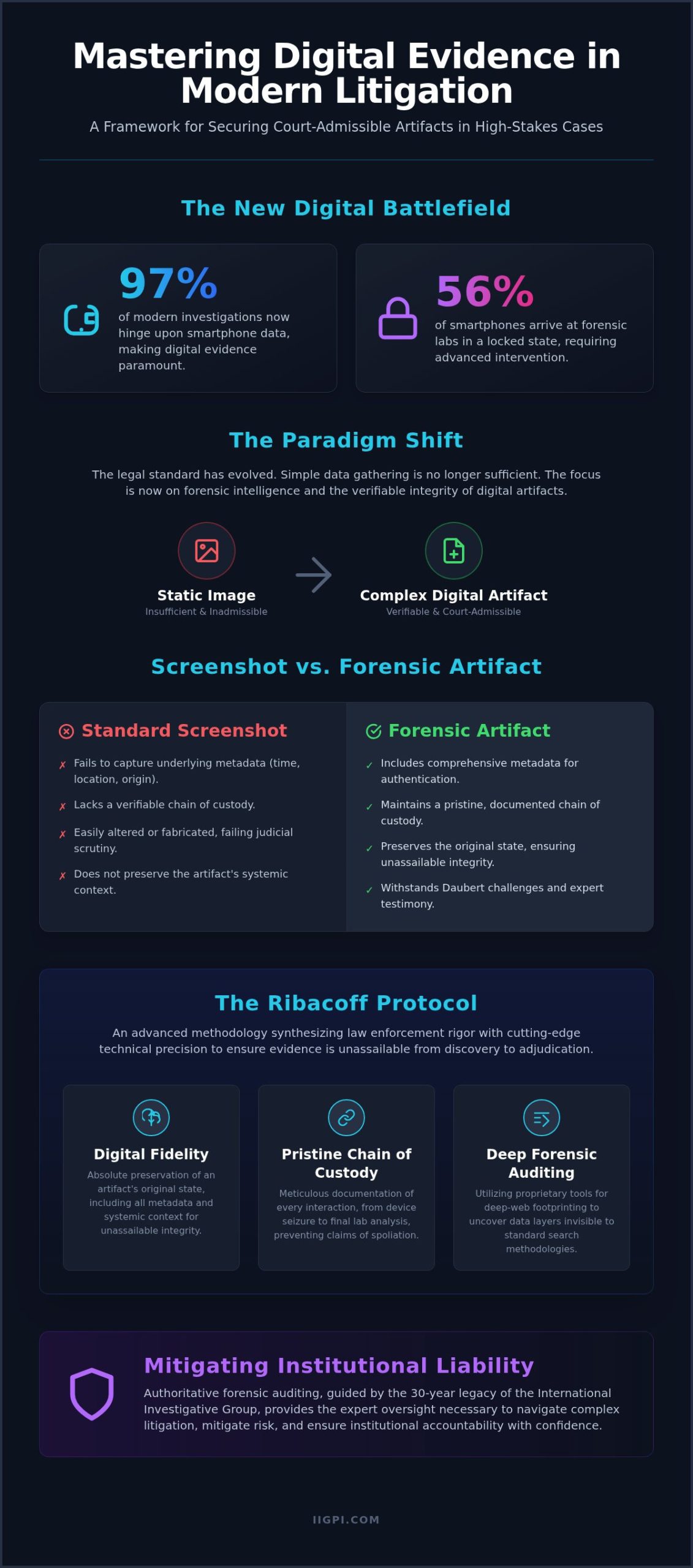
The contemporary judicial landscape dictates that a simple digital image is no longer a sufficient surrogate for authentic evidence, especially when 97% of modern investigations now hinge upon smartphone data. Legal practitioners often struggle with the inherent complexity of recovering data from encrypted or ephemeral platforms, fearing that a single procedural lapse might render a pivotal discovery inadmissible.
This authoritative examination synthesizes the expert methodologies of Lance Ribacoff, social media evidence collection for court cases in high-stakes litigation, and the International Investigative Group to establish a definitive framework for digital discovery. You’ll gain a comprehensive understanding of the protocols required to secure court-admissible artifacts while maintaining a pristine chain of custody. This guide explores the transition from mere data gathering to rigorous forensic auditing, providing the strategic insights necessary to verify artifact integrity and ensure successful expert testimony in the most demanding legal forums. By adhering to these sophisticated protocols, institutions can effectively mitigate liability and navigate the evolving standards of 2026 jurisprudence with intellectual rigor and absolute confidence.
Key Takeaways
- Recognize social media evidence as a complex digital artifact rather than static data to address the systemic challenges of information fragmentation in high-stakes litigation.
- Adopt the specialized methodologies of Lance Ribacoff, social media evidence collection for court cases in complex environments, which synthesize law enforcement rigor with advanced technical precision.
- Analyze the procedural requirements for securing court-admissible digital evidence to ensure that forensic findings meet the evolving standards of modern jurisprudence.
- Implement a resilient framework for the chain of custody that meticulously documents every interaction from device seizure to final laboratory analysis.
- Leverage the thirty year legacy and global network of the International Investigative Group to mitigate institutional liability through authoritative forensic auditing.
The Evolutionary Mandate of Social Media Evidence in Global Litigation
The contemporary legal paradigm has shifted the perception of digital data from static information to complex digital artifacts. Within high-stakes corporate litigation, the systemic risks associated with information fragmentation are profound, as disparate data points across multiple platforms can obscure the factual narrative and lead to institutional liability. The utilization of social media in investigations has evolved into a sophisticated discipline that demands more than simple observation; it requires a deep understanding of how digital traces are stored and retrieved. The 2026 legal landscape identifies a clear transition from traditional ‘discovery’ to ‘forensic intelligence,’ where the focus is on the deep-seated integrity of the evidence rather than its mere existence. Standard IT data recovery is often insufficient for judicial admissibility because it lacks the specialized protocols required to document the forensic origin and history of an artifact, which is essential for surviving a Daubert challenge.
The Landscape of Digital Liabilities in 2026
Ephemeral messaging and encrypted social platforms have introduced unprecedented challenges to case integrity, as these technologies are specifically designed to minimize digital footprints. This transient nature of data necessitates a proactive approach to preservation to prevent the permanent loss of critical evidence. The ‘locked state’ barrier serves as a primary obstacle, with research indicating that over 56% of smartphones arrive at forensic laboratories in a locked state, necessitating advanced cryptographic and forensic intervention. These complexities emphasize the indispensable role of computer forensics in maintaining robust corporate governance and institutional accountability. Without such expertise, the risk of evidence being deemed inadmissible due to a compromised chain of custody remains a persistent threat to legal success.
Defining the Scope of Forensic Intelligence
A fundamental distinction exists between surface-level screenshots and the comprehensive extraction of forensic metadata. While a screenshot provides a visual representation, it fails to capture the underlying systemic data that authenticates the time, location, and origin of a post. Digital Fidelity is defined as the absolute preservation of a digital artifact’s original state, including its metadata and systemic context, to ensure its unassailable integrity for judicial review. The methodologies established by Lance Ribacoff, social media evidence collection for court cases in high-stakes environments, emphasize this fidelity as the cornerstone of admissible evidence. Expert oversight is required to navigate the intricacies of data volumes, ensuring that the extraction process doesn’t inadvertently alter the original evidence, thereby preventing claims of spoliation during judicial scrutiny.
The Ribacoff Protocol: Advanced Methodologies for Evidence Collection
The Ribacoff Paradigm represents a methodological synthesis that bridges the gap between traditional investigative tradecraft and cutting-edge digital forensics. This protocol demands that every digital artifact is treated with the same evidentiary rigor as physical contraband, ensuring that the transition from initial discovery to final adjudication remains unassailable. By utilizing proprietary tools for deep-web social media footprinting, the process uncovers data layers that remain invisible to standard search methodologies. The expertise of Lance Ribacoff, social media evidence collection for court cases in high-stakes litigation requires a nuanced understanding of both technical vulnerabilities and the legal frameworks governing data seizure.
Synthesis of Law Enforcement Rigor and Technical Protocols
The operational framework established by Lance Ribacoff draws upon decades of law enforcement experience to inform modern digital forensic workflows. This institutional knowledge ensures that the collection process adheres strictly to the Organization of Scientific Area Committees (OSAC) standards, which provide the foundational reliability required for judicial acceptance. When acquiring cloud-native social artifacts, maintaining data integrity is paramount, as any deviation from established protocols can lead to claims of evidence tampering. Proper execution involves a meticulous approach to Presenting Digital Evidence, where the focus remains on the defensibility of the collection method itself. It’s this level of precision that’s essential for navigating the most difficult investigative problems where standard digital discovery often isn’t sufficient to produce results.
Advanced Data Fidelity and Recovery Techniques
Recovering data from encrypted volumes and hidden social profiles requires more than just software; it necessitates a sophisticated understanding of mobile-first application architecture. The ‘Forensic Image’ represents the only valid representation of digital evidence, serving as a bit-for-bit duplicate that preserves the original state of the device and its resident metadata. By bypassing sophisticated encryption through advanced cryptographic bypass techniques, investigators can access ephemeral data that was previously deemed unrecoverable. Proactive forensic auditing further mitigates institutional liability by identifying potential evidentiary gaps before they’re exploited by opposing counsel. For organizations facing multi-jurisdictional challenges, leveraging the International Investigative Group’s global agent network facilitates localized data seizure and ensures that digital artifacts are secured according to both regional laws and international standards.
Jurisprudential Scrutiny: Ensuring Court Admissibility of Digital Artifacts
Securing court-admissible artifacts within the jurisdiction of Manhattan and across global legal theaters requires a profound adherence to evolving regulatory frameworks. The enforcement of the Digital Operational Resilience Act (DORA), which became fully applicable on January 17, 2025, has fundamentally altered the expectations for institutional data integrity and forensic readiness. By 2026, the initial period of supervisory tolerance has concluded, and National Competent Authorities are conducting active enforcement actions that demand absolute transparency in digital provenance. The intersection of advanced technological protocols and judicial standards necessitates a shift away from anecdotal evidence toward scientifically validated data sets. The expertise provided by Lance Ribacoff, social media evidence collection for court cases in metropolitan and international centers, is predicated on navigating these stringent requirements to ensure that digital artifacts survive the most rigorous judicial challenges.
Legal Standards and Authentication Requirements
To withstand the rigors of modern judicial review, every digital artifact must be authenticated through unique HASH values and comprehensive metadata. This technical foundation serves as an immutable digital fingerprint, ensuring that the evidence hasn’t been altered since the moment of seizure. Navigating the 2026 regulatory environment also involves compliance with the CISA Logging Reference Architecture, published on August 20, 2026, which sets the benchmark for defensible data logging. Legal practitioners should consult this definitive guide to corporate investigations to understand the broader contextual framing of these requirements. Proving authenticity requires a meticulous accounting of the data’s lifecycle, from its encrypted residence on a social platform to its final presentation in a courtroom.
The Role of Expert Testimony in Forensic Excellence
A forensic report, regardless of its technical depth, remains an incomplete instrument without the authoritative validation provided by a qualified expert witness. Lance Ribacoff provides the intellectual bridge between complex forensic findings and the evidentiary needs of the court, offering testimony that withstands the scrutiny of elite opposing counsel. Preparation for cross-examination involves a transparent accounting of the technical collection methodologies used to secure the data, including the bypass of sophisticated encryption. Beyond technical validation, the analysis of social media footprints in 2026 often involves interpreting behavioral patterns and psychological markers that provide deeper context to the digital traces. Maintaining institutional integrity through transparent reporting and expert oversight is the only viable path to mitigating liability in high-stakes litigation.
Institutional liability in the 2026 legal environment often stems from the mismanagement of digital artifacts during the early stages of discovery. To withstand elite judicial scrutiny, organizations must implement a resilient framework for the chain of custody that meticulously documents every touchpoint, from the initial device seizure to final laboratory analysis. This process ensures that recovered digital artifacts are secured within encrypted storage environments, preventing unauthorized access or accidental spoliation. The expertise of Lance Ribacoff, social media evidence collection for court cases in complex jurisdictions, emphasizes that the integrity of an investigation is only as strong as its weakest logistical link. Assessing the cost-benefit ratio reveals that proactive forensic oversight is a strategic necessity; the financial and reputational risks of reactive incident response often far outweigh the investment in rigorous, pre-emptive auditing.
Rigorous Documentation Protocols
The essential elements of a forensic chain of custody log in 2026 include precise timestamps, verified HASH values at every transfer point, and a detailed accounting of all personnel with access to the evidence. Chain of Custody is the chronological documentation of evidence handling. This meticulous record-keeping is vital when linking physical observations from professional surveillance services to the digital artifacts recovered from social platforms. By maintaining this level of transparency, institutions provide a defensible narrative that satisfies the heightened evidentiary standards of modern courts, specifically adhering to the logging benchmarks set by the CISA Logging Reference Architecture.
Fortifying Institutional Integrity
Mitigating the risk of information fragmentation requires the strategic integration of forensics into broader corporate risk mitigation frameworks. The International Investigative Group provides a ‘Gold Standard’ of private intelligence, ensuring that every investigation is conducted with the intellectual rigor expected by global leaders and high-level decision-makers. This approach moves beyond simple data collection, positioning forensic intelligence as a core component of institutional defense. For those seeking to secure their legal position, it’s essential to partner with a premier investigative institution that understands the nuances of digital provenance and judicial admissibility. This level of institutional integrity is the primary safeguard against the systemic challenges of digital discovery in an increasingly complex global landscape.
Partnering with International Investigative Group for Forensic Excellence
The International Investigative Group (IIG) stands as the premier institution for the resolution of complex digital discovery challenges, offering a level of intellectual rigor that is required for the most demanding legal environments. With a thirty year legacy and a record of solving over 10,000 cases globally, the firm provides an authoritative presence in the field of forensic intelligence. The unique capabilities of the firm in NYC and Nassau County allow for localized expertise while maintaining a global perspective on data provenance. The methodologies pioneered by Lance Ribacoff, social media evidence collection for court cases in high-stakes litigation, ensure that every digital artifact is secured with the technical precision necessary for judicial acceptance. Legal professionals requiring definitive results often find that the firm’s ability to navigate the most difficult problems where others fail is the primary differentiator in securing a favorable adjudication.
The IIG Advantage: Elite Forensic Intelligence
By leveraging a sophisticated global network of agents, IIG facilitates multi-jurisdictional social media investigations that transcend geographic boundaries and technical barriers. This expansive reach is particularly critical when addressing the nuances of insurance fraud investigation services, where the verification of digital activities is essential for risk mitigation. The firm’s operational protocols are designed to integrate seamlessly into existing legal workflows, providing a resilient framework for the preservation of ephemeral data. For immediate investigative support, legal practitioners may initiate a consultation via wew.iigpi.com to secure the forensic oversight required for institutional defense.
Empowering Legal Strategy with Expert Guidance
The involvement of IIG in the strategic development of digital discovery requests ensures that legal teams can articulate precisely what is required to uncover hidden or encrypted artifacts. This expert guidance assists in the formulation of queries that are technically sound and legally defensible, reducing the likelihood of procedural objections from opposing counsel. The firm’s commitment to finding solutions for the most difficult digital problems is reflected in its rigorous approach to forensic auditing and expert testimony. As the standards for digital evidence continue to evolve through 2026, partnering with a research driven institution remains the only viable path for maintaining institutional integrity. Legal professionals seeking elite forensic services are encouraged to engage with IIG to ensure that their digital evidence collection satisfies the highest benchmarks of modern jurisprudence.
Advancing Judicial Integrity through Forensic Excellence
The landscape of digital litigation in 2026 demands an unprecedented level of forensic precision, where the successful adjudication of complex cases depends on the unassailable integrity of digital artifacts. By transitioning from traditional discovery to a framework of forensic intelligence, legal practitioners can ensure that evidence recovered from encrypted or ephemeral platforms withstands the most rigorous judicial scrutiny. The specialized methodologies of Lance Ribacoff, social media evidence collection for court cases in high-stakes environments, provide the necessary synthesis of technical precision and law enforcement rigor required to navigate modern regulatory mandates. This commitment to digital fidelity, supported by a resilient chain of custody, effectively mitigates institutional liability and secures the path to successful expert testimony. With over 30 years of investigative excellence and a global network of forensic experts, the International Investigative Group continues to redefine the gold standard of private intelligence. Secure your digital evidence with the expertise of Lance Ribacoff and the International Investigative Group today. Your pursuit of justice is supported by an institution dedicated to solving the most difficult digital problems with intellectual depth and unwavering professional standards.
Frequently Asked Questions
How does Lance Ribacoff ensure the admissibility of social media evidence?
Lance Ribacoff ensures the admissibility of evidence by adhering to the Digital Fidelity Protocol, which prioritizes the preservation of original metadata and systemic context through the creation of a forensic image. This bit-for-bit duplicate serves as the only valid representation of digital artifacts in high-stakes litigation. By maintaining a rigorous chain of custody and utilizing scientifically validated methodologies, the evidence satisfies the Daubert standard and other stringent judicial requirements. This authoritative approach prevents claims of spoliation and ensures the evidence remains unassailable.
What distinguishes forensic social media collection from a standard screenshot?
A forensic collection captures the underlying metadata and systemic data layers that a standard screenshot inherently lacks. While a screenshot is merely a visual surrogate, forensic extraction identifies the origin, timestamp, and location of the post through unique HASH values. This technical depth is essential for authenticating the artifact in court, as it proves the content hasn’t been altered since its creation. Forensic intelligence provides the intellectual bridge between raw digital data and court-admissible evidence, ensuring institutional integrity throughout the process.
Can International Investigative Group recover deleted social media messages?
The International Investigative Group utilizes advanced computer forensics to recover deleted messages from encrypted volumes and hidden profiles. By bypassing sophisticated encryption through proprietary cryptographic bypass techniques, investigators can often access ephemeral data that was previously deemed unrecoverable by standard IT methods. This capability is vital in high-stakes corporate litigation where 97% of modern investigations rely on smartphone data as a primary source. The firm’s global network of agents ensures that localized data seizure protocols are followed for maximum recovery potential.
What are the legal boundaries of social media surveillance in New York?
Social media surveillance in New York is governed by strict privacy laws and judicial standards that prohibit unauthorized access to private digital spaces. Investigations must focus on publicly available data or artifacts obtained through legal discovery requests and forensic seizure. The methodologies employed by Lance Ribacoff, social media evidence collection for court cases in New York, emphasize ethical compliance to prevent the compromise of the judicial process. Adhering to these boundaries ensures that the surveillance remains a defensible component of a broader legal strategy.
How long does a typical digital forensic investigation take for court cases?
The duration of a digital forensic investigation varies based on the complexity of the encryption and the volume of data being analyzed. While initial device seizure and imaging can occur rapidly, the deep-web footprinting and metadata analysis required for court readiness often take several weeks. This deliberate rhythm ensures that every digital artifact is meticulously documented and verified. The International Investigative Group prioritizes accuracy and thoroughness over speed to maintain the intellectual rigor necessary for successful expert testimony in elite legal forums.
What is the role of metadata in authenticating social media evidence?
Metadata serves as the immutable digital fingerprint of a social media post, providing the foundational reliability required for judicial acceptance. It documents the technical history of the artifact, including creation dates, author identity, and geolocation data. Without this metadata, evidence is often deemed inadmissible due to a lack of provenance. By securing these systemic data layers, forensic experts can provide a transparent narrative that survives the scrutiny of cross-examination and satisfies the heightened evidentiary standards of 2026 jurisprudence.
How does the Digital Operational Resilience Act (DORA) affect evidence collection in 2026?
As of 2026, the enforcement of the Digital Operational Resilience Act (DORA) mandates that institutions maintain absolute transparency and forensic readiness in their data management practices. This regulation requires National Competent Authorities to conduct active supervisory reviews of how digital artifacts are preserved and reported. Evidence collection must now align with these stringent standards to mitigate institutional liability. This shift necessitates the integration of advanced forensic protocols into corporate risk mitigation frameworks to ensure that all digital evidence remains compliant and defensible.
Why is a private investigator necessary for social media evidence collection?
A private investigator specializing in computer forensics provides the expert oversight required to maintain a pristine chain of custody. Standard IT recovery often lacks the procedural rigor needed to survive judicial scrutiny and prevent claims of evidence tampering. By partnering with an elite firm, legal professionals gain access to advanced tools and a global network of forensic experts who understand the nuances of digital provenance. This professional intervention ensures that the collection process is scientifically validated and capable of supporting a complex legal strategy.