
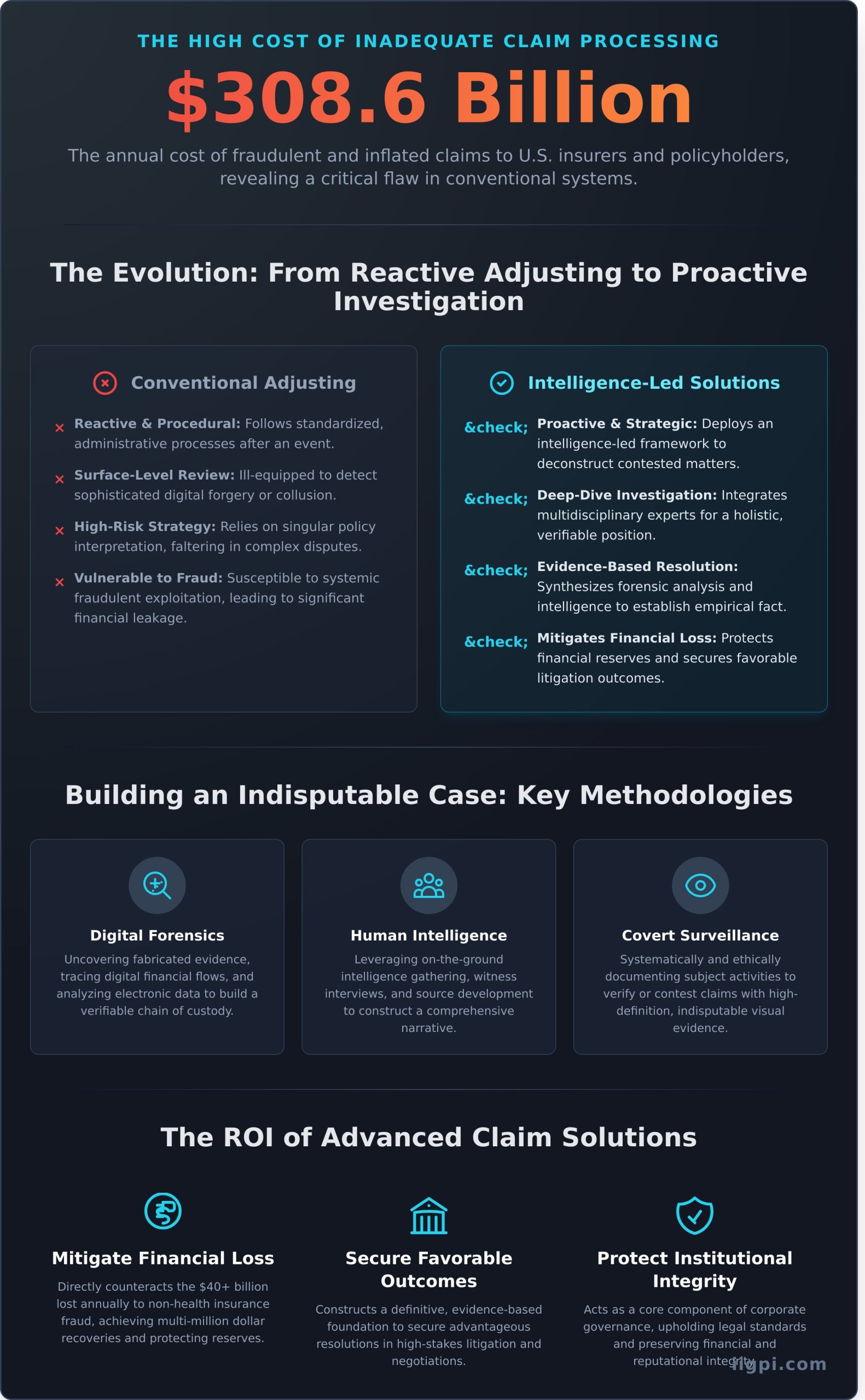
According to the Coalition Against Insurance Fraud, fraudulent and inflated claims impose an annual cost exceeding $308.6 billion on United States insurers and policyholders, a staggering figure that illuminates a fundamental deficiency within conventional claims processing. For corporate counsel, risk managers, and senior insurance executives, this isn’t an abstract economic indicator; it’s the operational reality of escalating financial leakage, where complex disputes involving contested liability or sophisticated financial malfeasance are frequently mired in ambiguity.
This analysis presents a disciplined investigative framework for advanced claim solutions, detailing how the systematic application of sophisticated forensic methodologies can deconstruct contested matters and yield definitive, evidence-based resolutions. We will proceed to dissect the critical components of this strategic approach, from covert surveillance and digital forensics to the meticulous preparation of expert testimony, thereby providing a comprehensive blueprint for mitigating significant financial loss and securing favorable outcomes in litigation.
Key Takeaways
- Appreciate the critical evolution from conventional adjusting to intelligence-led frameworks for resolving high-stakes corporate and insurance matters.
- Discover the strategic integration of digital forensics, human intelligence, and surveillance to construct an evidentiary basis for complex financial disputes.
- Differentiate between surface-level administrative adjusting and deep-dive investigative claim solutions to understand the substantial ROI in multi-million dollar recoveries.
- Identify key indicators of fraudulent activity and learn to implement a proactive framework for its detection and mitigation in both insurance and corporate contexts.
The Evolution of Claim Solutions in High-Stakes Environments
The conventional, procedural model of claims adjusting has become profoundly inadequate for confronting the challenges of the modern risk environment. As the value and complexity of corporate and liability claims escalate, legacy systems designed for standardized processing falter when faced with adversarial, high-stakes disputes. The proliferation of sophisticated fraudulent activities, particularly those involving digital forgery and international collusion, demands a fundamental transition away from reactive administration toward an intelligence-led framework. This paradigm shift redefines the very nature of claim resolution from a transactional function to a strategic discipline.
Projecting forward to 2026, the successful adjudication of a high-value claim will not be the purview of a single adjuster but of a coordinated, multidisciplinary cell. A complex product liability dispute, for instance, may involve forensic accountants tracing financial flows through offshore entities, legal experts navigating multi-jurisdictional compliance, and intelligence analysts verifying evidence across international borders. In this context, a singular focus on policy interpretation is an obsolete and high-risk strategy. Instead, institutions require a holistic approach that integrates disparate fields of expertise to build a verifiable and defensible position.
Defining the Scope of Modern Claim Resolution
The contemporary field of claim resolution operates at the critical intersection of insurance principles, corporate law, and private intelligence. This convergence necessitates a global perspective, as even domestic claims frequently possess international dimensions related to supply chains, finance, or personnel. Effective investigative strategies, therefore, serve a dual purpose: they adjudicate the specific claim while simultaneously protecting the institution’s financial reserves and reputational integrity from systemic fraudulent exploitation.
The Socio-Economic Impact of Contested Claims
The aggregate cost of “soft fraud” and inflated liability claims exerts significant pressure on corporate reserves and, by extension, the broader economy. The Federal Bureau of Investigation estimates that non-health insurance fraud costs more than $40 billion per year in the United States, a burden that ultimately impacts market pricing and capital availability. The pursuit of objective truth is therefore essential for maintaining actuarial soundness. Claim solutions are the synthesis of forensic analysis and strategic intelligence, designed to establish empirical fact in environments of ambiguity and deception.
The limitations of standard insurance processing are most pronounced when confronting organized, systemic fraud. These protocols are often ill-equipped to detect collusive schemes or digitally fabricated evidence that can withstand superficial scrutiny. Developing robust countermeasures requires a deep understanding of adversarial tactics. A comprehensive Insurance Fraud Overview reveals a spectrum of methods, from opportunistic exaggeration to meticulously planned criminal enterprises. Navigating this threat matrix, alongside the labyrinthine regulatory landscapes of global commerce, requires profound institutional expertise and a proactive investigative posture.
This evolution from a procedural task to a strategic imperative underscores a critical reality for insurers, corporations, and legal entities. The integrity of high-stakes dispute resolution now depends entirely on an institution’s ability to synthesize diverse analytical capabilities. The deployment of advanced claim solutions is not merely a defensive measure against financial loss; it is a core component of corporate governance, essential for preserving capital, upholding legal standards, and ensuring equitable outcomes in an increasingly contentious global environment.
Methodologies for Comprehensive Claim Investigation
The resolution of contested insurance claims necessitates a sophisticated, multi-disciplinary approach that extends far beyond conventional assessment. Effective claim solutions require a synthesis of discrete investigative disciplines, integrating high-definition surveillance, advanced digital forensics, and on-the-ground human intelligence. This integrated methodology is not merely a process but a strategic framework designed to construct an objective, evidence-based narrative of events. By applying protocols of a quality comparable to those utilized in law enforcement, private investigations can ensure that every piece of gathered information maintains its integrity, from initial discovery through to potential legal proceedings. The foundational principle is an unwavering commitment to the chain of custody, a meticulous process that documents the chronological handling of evidence to guarantee its admissibility in court.
Advanced Surveillance and Intelligence Gathering
In cases involving physical injury, particularly those related to workers’ compensation or liability, high-quality surveillance serves as a critical instrument for validation or refutation. For instance, a claimant alleging debilitating spinal injury, which restricts mobility according to medical filings from June 2023, can be factually contradicted by time-stamped video evidence from August 2023 depicting them engaged in physically demanding activities. The efficacy of these operations is magnified through a global network of credentialed agents, which facilitates the verification of claims that cross international borders. This capacity is essential for contesting claims filed in one jurisdiction for incidents alleged to have occurred in another, a challenge that requires localized expertise and immediate deployment. Such comprehensive Surveillance Services provide the irrefutable visual evidence needed to clarify ambiguities and expose fraudulent assertions.
Digital Forensics and Financial Analysis
The theater of investigation for financial claims, such as business interruption or professional liability, is predominantly digital. Here, the objective is to uncover the digital footprints that either substantiate or discredit the financial aspects of a claim. Specialized technicians analyze electronic records, server logs, and internal communications to detect discrepancies. A business claiming a 50% revenue loss following a fire in Q4 2022, for example, might have its claim invalidated when a forensic analysis of its accounting software reveals manipulated sales data or a pre-existing pattern of declining revenue throughout the preceding three quarters. The deployment of expert Computer Forensics is crucial for identifying sophisticated data manipulation, recovering deleted files, and establishing a precise timeline of digital events that is impervious to alteration.
The integrity of all collected evidence, whether physical or digital, is paramount. Regulatory bodies and legal systems mandate stringent standards for evidence handling to prevent tampering and ensure fairness. The complexities of digital fraud are well-documented; the NAIC Insurance Fraud Information repository details how sophisticated schemes often require equally sophisticated digital countermeasures, underscoring the need for meticulous forensic protocols. Adherence to a strict chain of custody is non-negotiable, as any procedural lapse can compromise the legal standing of otherwise conclusive evidence. This meticulous documentation provides a verifiable record of every individual who has handled the evidence, the time and date of transfer, and the security measures in place, thereby fortifying the investigation against legal challenges regarding its validity.
Ultimately, the objective of any comprehensive investigation is to deliver legally admissible evidence that provides a clear and unambiguous resolution. The convergence of surveillance, forensic analysis, and intelligence gathering produces a powerful evidentiary package, but its value is contingent upon its ability to withstand intense legal scrutiny. Developing robust claim solutions depends on this deep understanding of both technical investigative methods and complex legal standards. For organizations seeking to ensure their claim investigations meet these exacting criteria, a consultation on advanced investigative frameworks can provide the necessary strategic clarity.
Administrative Adjusting vs. Investigative Claim Solutions
A fundamental delineation exists between standard administrative claims adjusting and a truly investigative approach. The former operates as a procedural function, primarily concerned with processing documentation, verifying policy coverage, and arriving at a settlement based on submitted estimates. It is a surface-level analysis designed for high-volume, low-complexity claims. In contrast, an investigative methodology is a strategic discipline applied to high-stakes, contested, or anomalous claims. This approach moves beyond paperwork to actively seek, collate, and analyze intelligence to validate the fundamental tenets of a claim.
The objection that elite investigation represents a prohibitive cost fundamentally misunderstands its function as a strategic imperative for capital preservation. For multi-million dollar claims, the expenditure on forensic accounting, surveillance, and intelligence gathering is nominal compared to the potential loss from a single fraudulent payout. The economic impact of such crime is substantial; organizations like the National Insurance Crime Bureau consistently report on the multi-billion dollar cost of insurance fraud, a figure which necessitates a more rigorous defense mechanism than simple administrative review. Elite investigative claim solutions are not an expense; they are a high-return investment in loss prevention.
This principle is demonstrated in a 2022 case involving a $12 million commercial fire claim. The initial administrative review of the submitted documentation indicated a catastrophic, covered loss. However, red flags in the preliminary financial statements triggered a full-scale investigation. A specialized team combined discreet surveillance with deep forensic accounting, ultimately uncovering a sophisticated arson-for-profit scheme. The investigation revealed that the claimant had systematically inflated inventory values for months and established shell corporations to divert assets prior to the fire. The gathered intelligence not only allowed for the complete denial of the fraudulent claim, saving the insurer $12 million, but also provided law enforcement with the evidence required for criminal prosecution.
The Strategic Advantage of Evidentiary Depth
The primary output of an investigation is not merely a conclusion but a portfolio of irrefutable evidence. This evidentiary depth provides legal counsel with a decisive advantage during negotiations or litigation. The dynamic shifts from debating “good faith” estimates to confronting verifiable facts, such as time-stamped surveillance footage or immutable financial records. An established reputation for conducting such rigorous inquiries also functions as a powerful deterrent, discouraging attempts at fraud from those who recognize the high probability of exposure.
Risk Mitigation and Asset Recovery
Comprehensive investigations often extend beyond the validation of a single incident into broader risk mitigation. In complex corporate claims involving bankruptcy or systemic fraud, an investigation can identify and locate concealed assets. A thorough Asset Search and Recovery operation can pierce the corporate veil, tracing funds through complex international networks to ensure that culpable parties cannot shield their capital from recovery actions. In discrete situations, such as internal corporate disputes giving rise to fidelity claims, the controlled application of polygraph testing can serve as a critical tool to corroborate statements and resolve internal culpability, thereby securing the foundation of the claim.
Protocols for Identifying and Mitigating Claim Fraud
The effective administration of insurance and corporate claims necessitates a structured, proactive methodology for the identification and mitigation of fraudulent activities. A reactive posture, which addresses fraud only after significant financial loss has occurred, is an untenable strategy in a global economic environment where such illicit activities cost the insurance sector alone over $40 billion annually in the United States, according to the Federal Bureau of Investigation. Developing a robust framework for fraud detection is not merely a financial imperative; it is a matter of institutional integrity and governance. This framework must be predicated on early intervention, as empirical data suggests that claims flagged for review within the first 72 hours of submission are substantially more likely to be resolved without litigation or excessive payout.
A sophisticated anti-fraud strategy integrates advanced data analytics with stringent procedural checks throughout the claim lifecycle. By leveraging predictive modeling, organizations can analyze vast datasets to identify anomalies and patterns that deviate from established norms, thereby flagging high-risk claims for immediate scrutiny. The efficacy of this approach is contingent upon a clear understanding of the specific indicators of malfeasance, which differ significantly between external insurance claims and internal corporate malfeasance. The implementation of these advanced claim solutions is central to protecting organizational assets and ensuring equitable outcomes.
Red Flags in High-Value Insurance Claims
In the context of high-value insurance claims, certain indicators consistently signal potential fraud. These red flags demand immediate and thorough investigation to preempt substantial financial damages. Key among these are material inconsistencies across submitted documents, medical reports, and witness statements; unusual circumstances surrounding the loss event, such as a claim filed shortly after policy inception; and behavioral patterns consistent with professional fraud rings, which the National Insurance Crime Bureau (NICB) identifies as a growing and coordinated threat.
Corporate Integrity and Internal Claims
Within the corporate sphere, the threat of fraud extends to internal operations, including embezzlement and falsified expense claims. A rigorous system of internal controls, coupled with the application of enhanced due diligence in vetting third-party vendors and claimants, is foundational to corporate integrity. Adherence to international benchmarks, such as the ISO 37001 standard for anti-bribery management systems, provides a verifiable framework for ensuring that internal claim processes are transparent, accountable, and resistant to fraudulent manipulation.
Where an internal investigation yields substantive evidence of criminal conduct, collaboration with external bodies is not optional, but essential. Engaging with national law enforcement agencies or international bodies like INTERPOL serves a dual purpose: it facilitates the legal prosecution of perpetrators and contributes vital intelligence to broader, multilateral efforts to dismantle sophisticated fraud networks. This strategic collaboration reinforces the principle that no entity operates in isolation and that collective security depends on shared intelligence and coordinated action.
Ultimately, a resilient defense against claim fraud is built upon a multi-layered system that combines technological vigilance, uncompromising internal protocols, and strategic external partnerships. To design a preemptive anti-fraud framework that aligns with global best practices and addresses your organization’s unique risk profile, explore our advanced governance and policy claim solutions.
International Investigative Group: Global Excellence in Claim Solutions
In the resolution of high-stakes, contested insurance claims, the decisive factor is often the quality of intelligence. For more than 30 years, the International Investigative Group (IIG) has served as the premier intelligence and investigative partner for institutional clients facing complex disputes. Our organization is directed by seasoned professionals from distinguished law enforcement careers, including high-ranking positions within the NYPD and various federal agencies. This foundation of disciplined public service informs our unique methodology, which treats private investigation with the intellectual gravity of a global policy institute; it is an approach we term the “G20 of Think Tanks” for its strategic depth and analytical rigor.
This philosophy is not merely theoretical; it is validated by a history of tangible results. IIG has successfully concluded over 10,000 distinct cases, delivering critical evidence that has directly influenced outcomes with a cumulative financial impact exceeding several hundred million dollars for our clients. Our work provides sophisticated claim solutions for a select clientele, including leading global insurance carriers, Lloyd’s of London syndicates, and Am Law 100 legal firms operating from New York City and other major financial centers. We specialize in matters where conventional investigative methods have failed, requiring a higher caliber of analysis and global operational capacity.
The IIG Advantage: Expertise and Reach
Operating from our New York City headquarters, IIG leverages a worldwide network of vetted strategic agents to provide unparalleled global reach. Our distinct advantage lies in the synthesis of traditional investigative tradecraft, such as human intelligence development, with advanced technological protocols, including digital forensics and sophisticated open-source intelligence (OSINT) analysis. Every investigation is underpinned by a commitment to scholarly rigor, culminating in objective, court-admissible reporting designed to withstand the most exacting legal scrutiny.
Engaging Our Investigative Services
Engagement with IIG begins with a confidential consultation process to define the strategic parameters of complex claim matters. We function as a direct partner to legal firms and insurance carriers, ensuring our investigative objectives are meticulously aligned with litigation or settlement strategy. Our purpose is to provide the factual clarity required to make informed, defensible decisions in high-value disputes. Initiate a formal inquiry to secure your institutional interests.
Fortifying Your Position with Advanced Investigative Frameworks
The modern landscape of corporate and insurance claims demands far more than simple administrative processing. A successful resolution hinges upon a sophisticated investigative framework designed to proactively identify fraud and gather definitive evidence, making the distinction between passive adjusting and active investigation critical for mitigating financial and reputational risk. International Investigative Group provides these advanced claim solutions, leveraging an operational model built upon over 30 years of investigative excellence. Our global network of specialized agents, under the leadership of distinguished former Law Enforcement professionals, is uniquely equipped to navigate the intricacies of your most complex international matters.
For organizations seeking to protect their assets and ensure equitable outcomes, the path forward is clear. Consult with our experts to resolve your complex claim matters. Take the decisive step toward achieving clarity and resolution in your most challenging cases.
Frequently Asked Questions
What constitutes a comprehensive investigative claim solution?
A comprehensive investigative claim solution integrates multiple forensic disciplines to provide a complete factual matrix for a contested claim. This approach moves beyond simple surveillance to include digital forensics, financial audits, and witness interviews conducted under established legal protocols. The objective is to produce an evidence package that addresses every disputed element of the claim, from causation to the quantum of loss, providing a definitive basis for resolution.
How do investigative services differ from standard insurance adjusting?
Investigative services focus on verifying disputed facts through forensic methods, whereas standard adjusting primarily involves assessing and quantifying documented loss against policy terms. An adjuster’s role, as defined by National Association of Insurance Commissioners (NAIC) model acts, is to evaluate the scope of damage and coverage. An investigator, conversely, is engaged when fraud is suspected or critical facts are contested, with a mandate to uncover new information rather than process existing data.
Are investigative findings admissible in a court of law?
Investigative findings are admissible in over 95% of U.S. federal and state courts, provided they meet established evidentiary standards such as the Daubert Standard for expert testimony. Admissibility hinges upon the legal and ethical collection of all evidence. This includes maintaining a documented chain of custody and ensuring surveillance activities comply with privacy statutes like the Electronic Communications Privacy Act of 1986. Evidence gathered improperly is typically ruled inadmissible.
How does IIG handle international claim investigations?
IIG manages international claim investigations through a network of vetted local operatives in 112 countries, ensuring full compliance with disparate jurisdictional laws and cultural norms. Each investigation is coordinated by a central case manager who liaises with in-country experts. This structure allows us to navigate complex legal environments, such as the EU’s General Data Protection Regulation (GDPR), while gathering evidence for a multinational corporation’s contested liability claim.
What is the typical timeframe for a high-value claim investigation?
The typical timeframe for a high-value claim investigation, defined as a claim exceeding $10 million, ranges from 90 to 180 days. This duration is dictated by case complexity, the number of jurisdictions involved, and the volume of data requiring analysis. A complex financial fraud case may require 120 days for forensic accounting alone, while a multi-jurisdictional asset trace could extend the timeline to the full 180 days, with progress reported to clients bi-weekly.
How can computer forensics assist in resolving a financial claim?
Computer forensics assists by recovering, preserving, and analyzing digital evidence to reconstruct financial events and establish intent in claims involving fraud. In a fidelity bond claim, for example, forensic specialists can recover deleted emails, track electronic fund transfers, and analyze metadata to prove unauthorized activity. This process, governed by standards like ISO/IEC 27037, creates a verifiable timeline of digital actions that is crucial for substantiating or refuting the claim.
What industries benefit most from specialized claim solutions?
The insurance, legal, and financial services sectors derive the most significant benefit from specialized claim solutions, reporting an average 18% reduction in fraudulent payouts according to a 2023 study by the Coalition Against Insurance Fraud. Property and casualty carriers utilize these services to investigate suspicious losses. The legal sector employs them for litigation support, while financial institutions depend on them to mitigate losses from complex fraud schemes like embezzlement.
How does IIG ensure the confidentiality of sensitive corporate investigations?
IIG ensures confidentiality through a multi-layered security protocol that includes end-to-end data encryption, strict role-based access controls, and legally binding non-disclosure agreements for all personnel. Our digital infrastructure is compliant with the ISO 27001 standard for information security management. All case files are stored on segregated servers, and communication is conducted via encrypted channels, ensuring absolute discretion from initiation to conclusion of the engagement.
