
A cargo theft investigation in the JFK Airport area can help establish how freight moved, where access may have occurred, and how records, people, and recovered goods connect.
For a shipper, insurer, or business, a missing load creates pressure to determine what happened and preserve evidence that may be harder to assemble later. An investigation distinguishes confirmed facts from allegations while tracing the shipment’s handling and possible resale.
This article explains how investigators approach cargo theft, which records and information can support an inquiry, and how they assess evidence as a case develops. It also outlines when a private investigation can help clarify a loss and inform a business’s or insurer’s next steps.
Key Takeaways
- A cargo theft inquiry examines the shipment’s movement and handling to identify where the loss may have occurred.
- Shipping, access, and inventory records can help investigators build a coherent account of events and assess the evidence.
- Following suspected resale activity may help connect missing goods with people or locations involved in a case.
- Professional theft investigations can help businesses and insurers organize evidence and clarify what happened after a cargo loss.
Cargo theft investigation jfk airport area
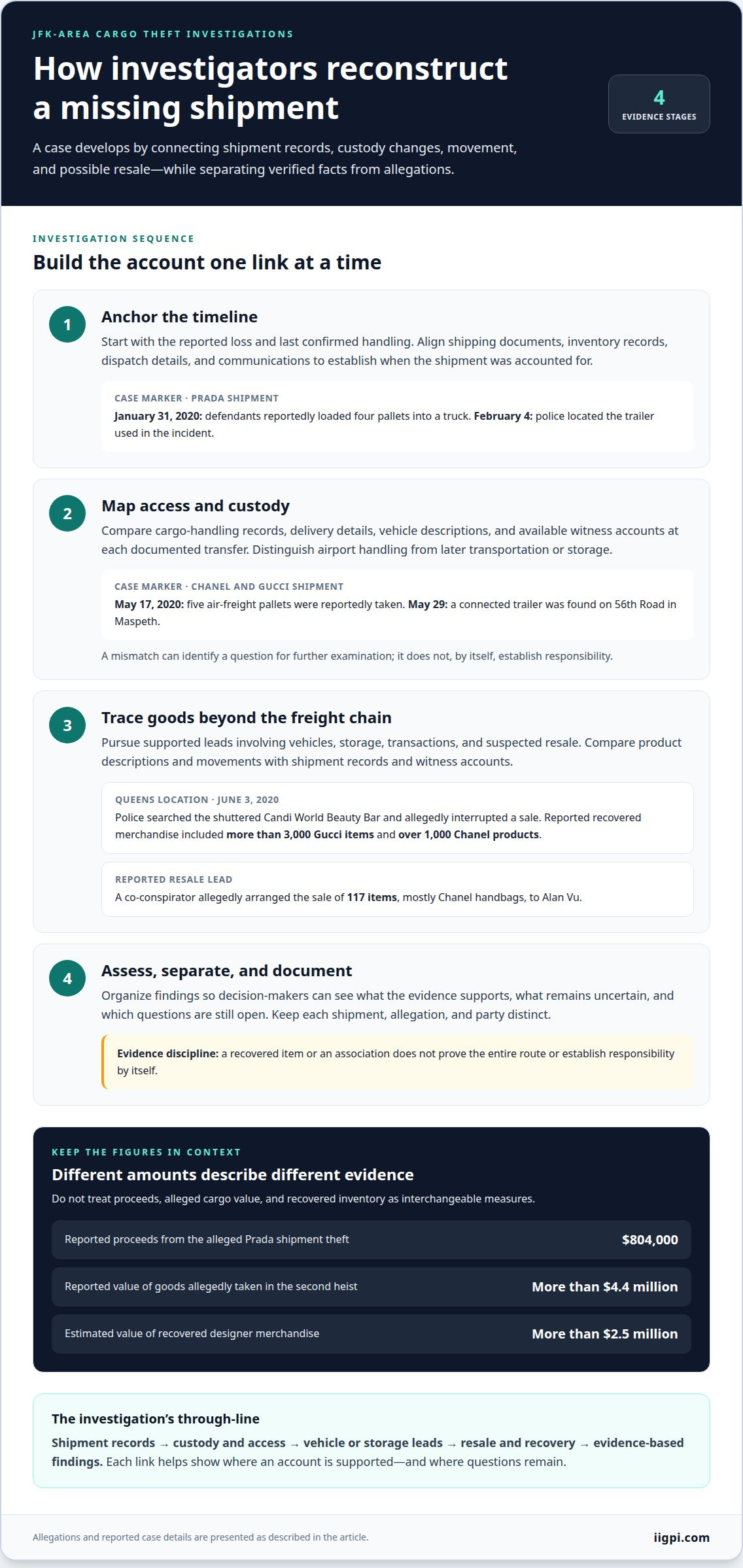
A cargo theft investigation in the JFK Airport area reconstructs the shipment’s route, access points, and custody changes. The alleged 2020 designer-goods cases illustrate why investigators examine events beyond the airport itself. Loads reportedly moved from freight pallets to trucks, then to locations in Queens. A useful inquiry therefore connects shipment records with people, vehicles, storage sites, and resale activity. Each link helps explain where an account is supported and where questions remain.
The first task is to establish a clear timeline. Investigators organize shipping documents, inventory records, dispatch details, and communications around the last confirmed handling event. In the alleged January 31, 2020, Prada theft, defendants reportedly loaded four pallets into a truck. Police located the trailer used in that incident on February 4. These dates create investigative points for comparing recorded movement with the reported loss, rather than treating the missing goods as an isolated event.
Investigators assess who could access the shipment at each documented transfer. They compare cargo-handling records, delivery details, vehicle descriptions, and available witness accounts. A mismatch may point to an issue for further examination, but it does not by itself establish responsibility. In a JFK-area case, investigators may need to distinguish airport handling from later transportation or storage. Each stage involves different records, people, and possible explanations.
The second alleged heist provides another example of timeline reconstruction. On May 17, 2020, five air-freight pallets of Chanel and Gucci goods were reportedly taken. Police found a trailer connected to the incident on May 29, on 56th Road in Maspeth. Investigators can compare the trailer’s reported connection with shipment timing, vehicle movements, and other case evidence. The purpose is to test a sequence, not to assume that one recovered item proves the entire route.
Investigators also follow goods after they leave the freight chain. In June 2020, authorities traced several defendants and an unapprehended co-conspirator to a shuttered Queens beauty salon. Police searched Candi World Beauty Bar on June 3 and allegedly interrupted a sale of stolen designer goods. The reported recovery included more than 3,000 Gucci items and over 1,000 Chanel products. Such a location can generate leads about storage, transactions, and possible connections among people.
Resale evidence can help connect a missing shipment to later activity. In the JFK cases, a co-conspirator allegedly arranged the sale of 117 items, mostly Chanel handbags, to Alan Vu. Investigators examine how sales, product descriptions, movements, and witness accounts relate to the shipment. They distinguish documented observations from allegations and avoid treating an association as proof by itself.
For a business or insurer, an investigation typically follows a sequence of analytical steps. Investigators establish the reported loss and shipment identifiers, then align cargo, transport, and inventory records into a timeline. They assess access, identify inconsistencies, and pursue supported leads involving vehicles, storage, or resale. Finally, they organize the findings so decision-makers can understand the evidence, its limits, and the questions that remain. A clear timeline helps prevent separate records from obscuring the sequence of events.
The wider JFK record shows why case details must remain distinct. A separate cargo-mail matter involved five handlers accused of stealing international mail over four years. Another investigation resulted in federal and state authorities arresting 61 people over alleged thefts valued at $13 million. Those matters are not the same as the designer-goods cases. Accurate analysis identifies which shipment, allegation, evidence, and parties belong to each investigation, then presents conclusions in that context.
The alleged Prada shipment theft generated $804,000 for the defendants, a reported proceeds figure distinct from the value of missing cargo. The second alleged heist took place on May 17, 2020, and the Chanel and Gucci goods allegedly taken were valued at more than $4.4 million. Defendants allegedly hauled away 5 air freight pallets of that merchandise, making pallet-level inventory and subsequent distribution records relevant to checking what was removed and where it may have gone.
The recovered designer merchandise was estimated to be worth more than $2.5 million, offering another benchmark for comparing alleged losses with recovered inventory. A federal sting at JFK closed a “supermarket” for thieves. That development can inform inquiries into how stolen goods were allegedly gathered and moved into resale channels, while investigators still need to verify links among shipments, individuals, storage, and transactions. Recovery value, alleged proceeds, and claimed shipment value describe different parts of the evidence; treating them separately avoids assuming that the figures establish the same transaction or prove responsibility.
International Investigative Group: Theft Investigations
International Investigative Group conducts Theft Investigations for businesses seeking to establish how cargo went missing and organize relevant evidence. The investigation can clarify shipment timelines, examine available records, and assess leads involving handling, transportation, or suspected resale. If a loss also raises questions about business operations or an insurance claim, Corporate Investigations or Insurance Investigations can address those related concerns.
Consider an investigation when records conflict, the shipment’s custody is unclear, or the business needs a documented account to support decision-making. If the concern is instead how to protect people or property, Security and Armed Guard Services address that separate need. A theft investigation focuses on the facts and evidence related to the reported loss.
Contact International Investigative Group to discuss a cargo theft investigation.
Set a Clear Direction for the Investigation
A cargo theft investigation in the JFK Airport area can help decision-makers develop an evidence-based understanding of a loss. Start by defining what needs clarification: the shipment’s movement, its sequence of custody, or a possible connection between missing goods and later activity. A focused objective keeps the inquiry relevant to the business decision at hand.
International Investigative Group’s Corporate Investigations and Insurance Investigations address related business and claim questions, while Security and Armed Guard Services meet distinct protection needs. The appropriate investigative focus depends on the circumstances and the questions that remain. Clear priorities help direct attention to the information that matters.
When you’re ready to discuss the matter, start a conversation with International Investigative Group. A considered next step can help bring greater clarity to a difficult loss.